
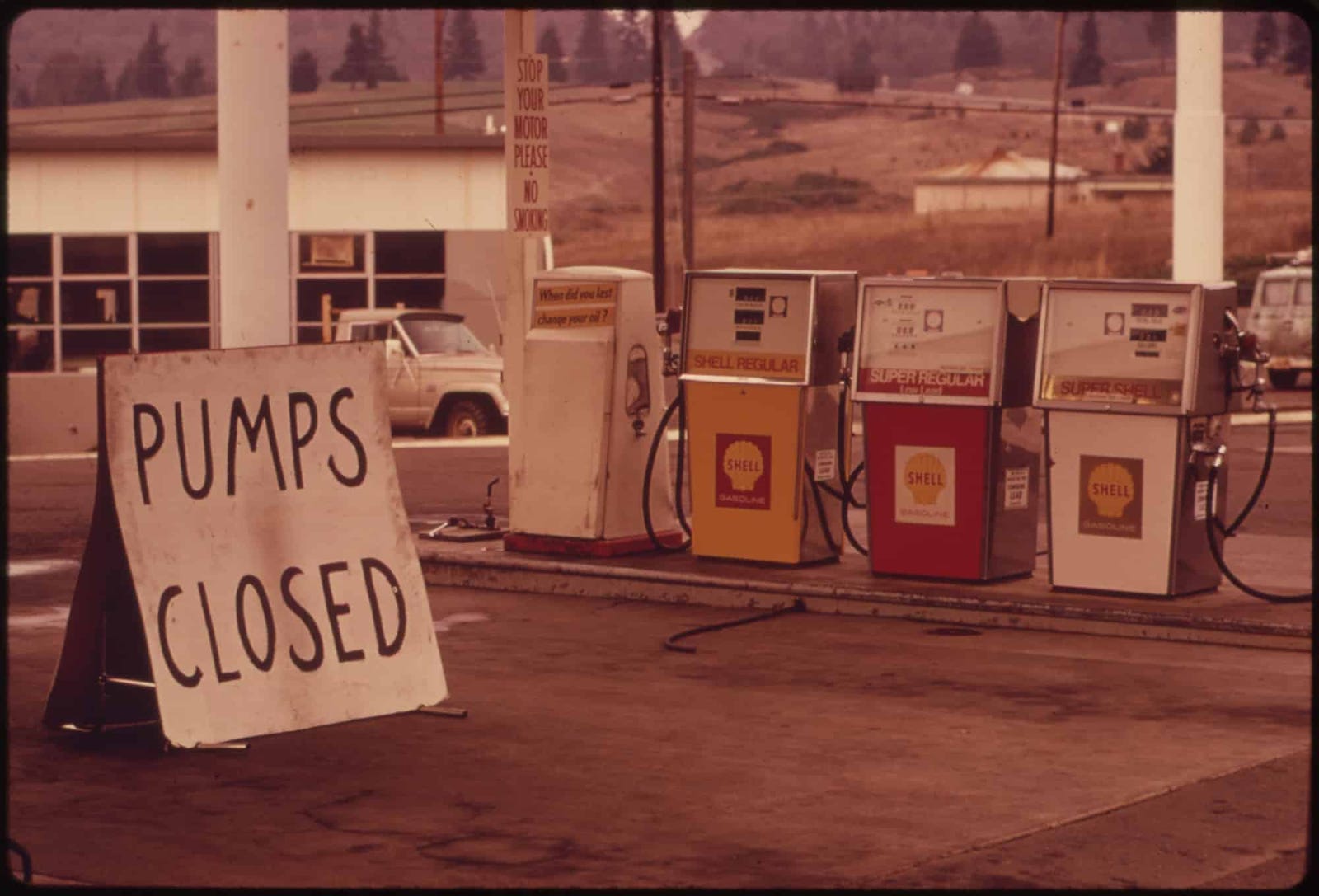
The uni-polar world has become multi-polar. American hegemony, as with the end of the Vietnam War, has been shown to have its limits in the conflict with Iran. The world’s greatest military has failed to vanquish a much weaker enemy. Instead it has committed violence against its own political integrity along with causing another oil shock.
Our common-sense imagining of the way “the world works” often lingers in nostalgia and ignorance long after reality has moved on.
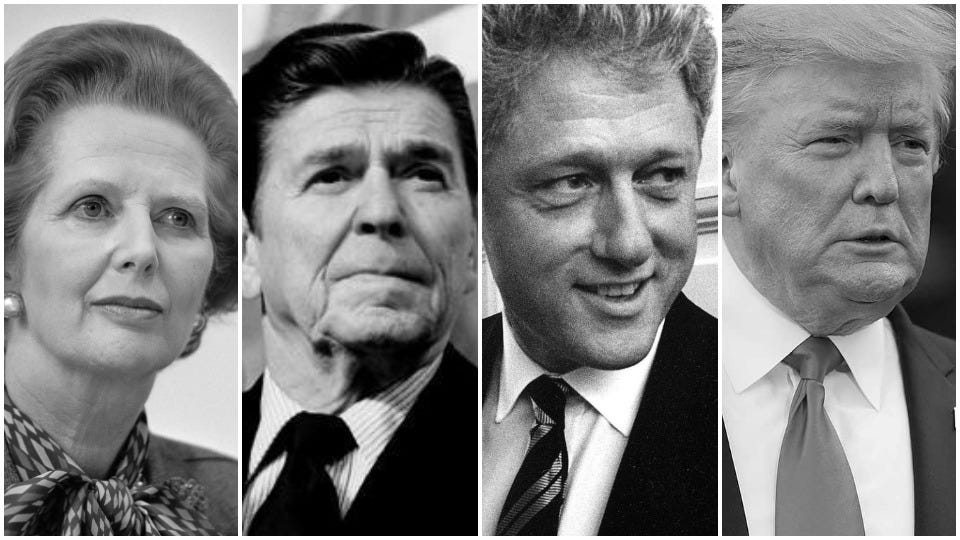
The neoliberal economic project to reform the global economy through free markets, privatisation, and deregulation started 40 years ago off the back of the first and second oil shocks.
Over the course of half a century a “common sense” of free markets, global trade & finance, self-authored individuals, unlimited economic growth, and the obligations of Government and businesses towards workers has been codified through the lens of neoliberalism.
It has fundamentally altered the economic structure of the world.
Evidence of stability and the continuation of institutions and political processes is comforting on a psychological level. But even these things are already several decades beyond their expiry date. Tariffs, COVID, inflation, Bitcoin, China decoupling, and the new Iranian oil shocks all push us to look closer at the project of neoliberalism and what it really is.
Importantly, we can take this chance to review one of neoliberalism’s main outcomes: the wealth gap that has emerged between global elites and everybody else, and in particular the ability of elites to move their wealth beyond the reach of the State.
Despite the relentless consolidation of capital ownership under Neoliberalism, the open-source monetary technology of Bitcoin has opened up the ability for normal people to also move capital beyond the reach of the State – a privilege previously only available to neoliberal elites.
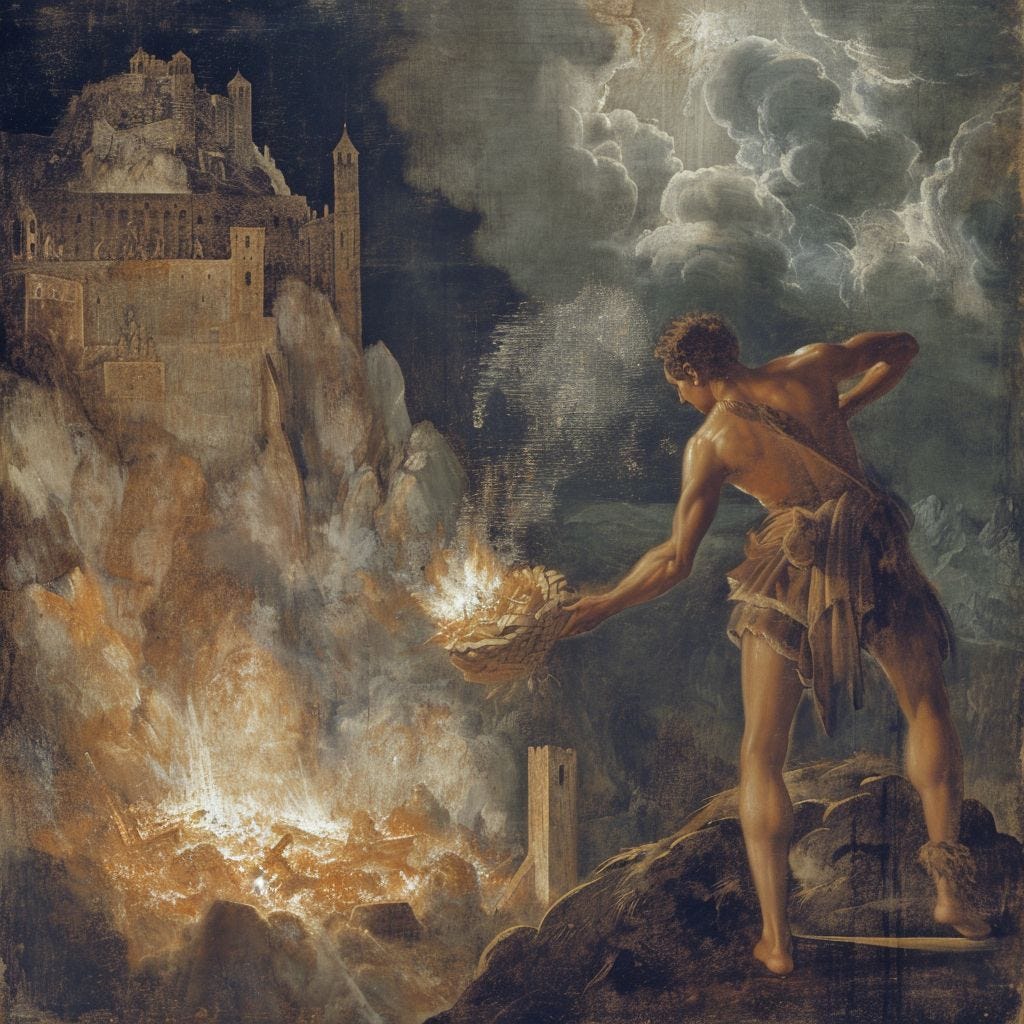
Just as Prometheus stole fire from the gods, this special monetary privilege is now also available for non-elites to possess.
Neoliberalism is a complex topic with many contradictions and definitions. For the sake of argument, let’s use the term Neoliberalism as a bucket to broadly capture several themes that have emerged since the 1980s. Some of these are actual structural economic and policy changes, while others are attitudes that have become “common-sense” including:
The Government should not be involved in certain industries, and is incapable of doing so efficiently.
Capital accounts and markets should be opened up to foreign direct investment.
The weakening of labour power, unions, and worker’s rights is essential to growth.
Supra-national entities like the IMF, WTO, and World Bank are essential to co-ordinate the world.
The “flattening” of the world through globalisation of production and free markets is optimal.
The financialisation of everything is natural and correct.
The fundamental unit of society is the self-authored individual.
These themes stand in contrast to the embedded liberalism and social democracy that characterised much of the developed world after WW2.
The implementation of neoliberal policies came off the back of the oil shocks and the inflation of the 1970s and 1980s, and the response of Governments and the public at the time. Its exact formulation in different countries is rarely the same. It’s easier to imagine neoliberalism as an interlocking global system of various countries trading in a shared political economy (with the major exclusion being the Soviet Bloc). To participate in this system, nations were compelled to adopt some or all of the above themes.
By the early 1980s my own country of New Zealand seemed frozen in time. In “Fortress New Zealand” it was extremely difficult to get foreign currency or import overseas goods. Everything was regulated and there was limited consumer choice. The Government was heavily protectionist and directly involved in the economy.
But with the oil shocks and facing high inflation, the country was on the brink of a currency crisis. After the 1984 election the new government implemented ambitious market reforms – so-called Rogernomics.
In doing so, New Zealand became the first country in the world to go from being a welfare state into a post-welfare neoliberal state. It is hard to overstate how rapid and transformative these changes were. Within a few years the New Zealand dollar was floated (and devalued by 20%), capital controls were removed and the Bank of New Zealand was sold to Australia (never to come back). The railway and many state entities were privatised, farming subsidies were slashed, and other state assets were sold off.
One of the pillars of the embedded liberal era was full employment, driven by leaders who had been through the Great Depression and WW2 and who deeply understood the social danger of unemployment, and in particular men without jobs.
The social contract was that you would have a job, a place to live, and the means to support a family.
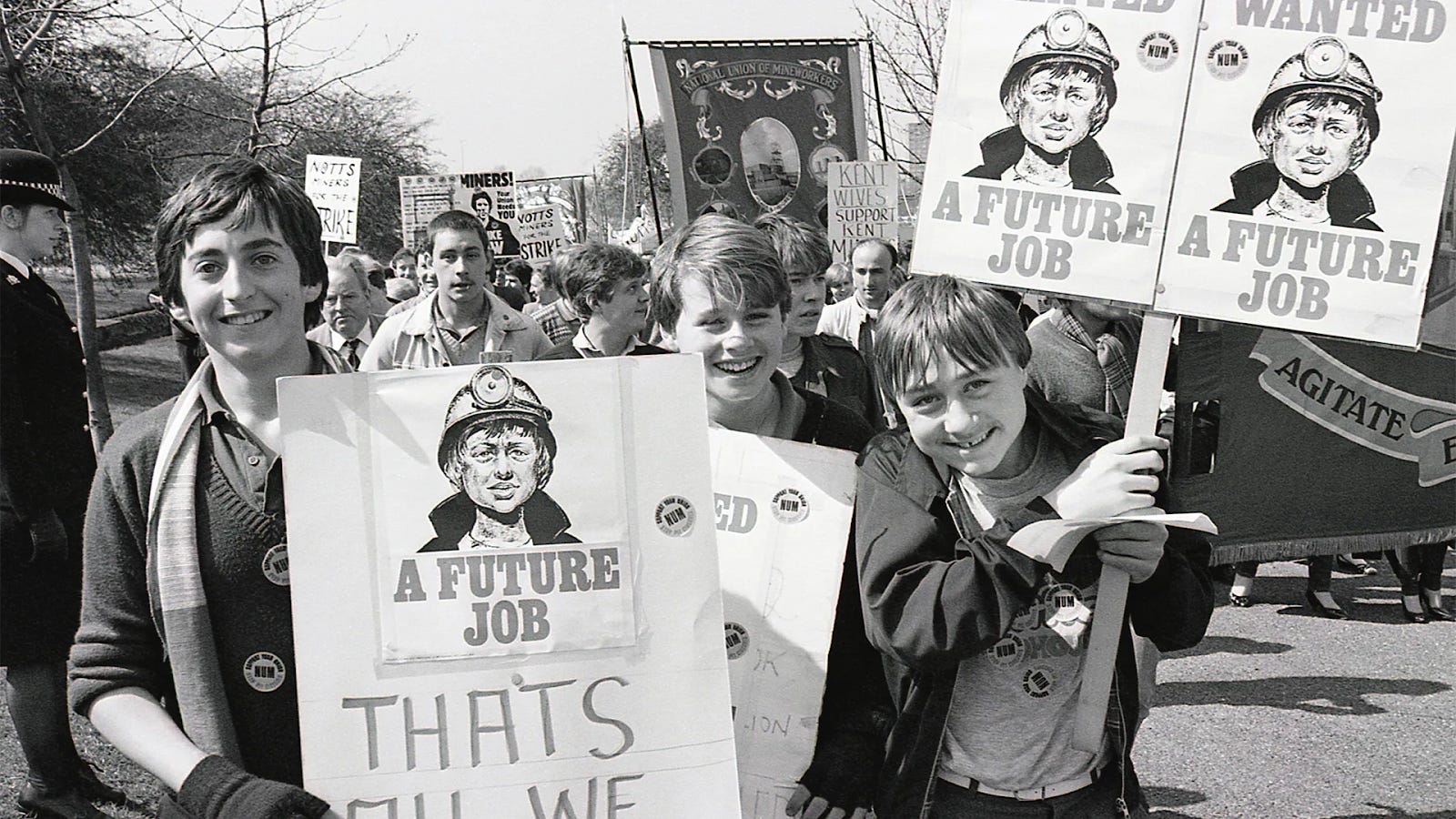
In Britain, the unions held a lot of power. During the 1970s, direct action (in particular of the coal workers) was a major political force. The working class were able to organise and have a political voice by striking and stopping production. In this hegemonic “push-and-pull” the threat of labour power meant that the Government and capital were forced to negotiate wages and working conditions, even if it was not efficient.
In the UK in particular, through a series of legal changes, the ability of organised labour to disrupt the State and business was cut. The unions were transformed from a political force into merely participants operating within the legal and market constraints of the broader economy.
This tension between labour and capital is key. The intellectuals behind neoliberalism at the Mont Pelerin Society were ardent anti-Marxists and anti-communists. For good reason they looked at the failures of the Soviet system, and saw thuggish unions holding a nation’s productive capital hostage (as in Britain and elsewhere) as anathema to prosperity.
On the other hand, under embedded liberalism the working class found its political power through democratic majorities backed up by the ability to undertake industrial action.
In the 1997 treatise The Sovereign Individual: Mastering the Transition to the Information Age , the authors Rees-Mogg & Davidson write about how this would change:
“Market forces, not political majorities, will compel societies to reconfigure themselves in ways that public opinion will neither comprehend nor welcome. As they do, the naive view that history is what people wish it to be will prove wildly misleading.”
Today gig work and part-time contracts have been normalised, and flexible employment (with its upshot of career change potential and labour mobility) are standard. It is not that labour rights have been crushed, paradoxically the labour laws in somewhere like New Zealand are quite protective and have high minimum wages, but this means hiring employees is more of a risky proposition for businesses.
The promise to labour under neoliberalism was the chance to be free, to self-author their lives and to “own shares” in the nation as retail investors in the newly privatised industries. But various financial crises over the decades have continued to separate everyday investors from significant ownership of capital.
At the same time, tribalism and confusion have divided what would otherwise be the broad base of salaried and wage workers in society.
With higher costs of labour, and without social obligation from capital, the common-sense path is to simply outsource, automate, and reduce the role of labour even further.
The main thing is that the collective political power of labour, that is – non-owners of capital, has been significantly reduced. There is no longer the same kind of counter-balance to elite power as there once was.
The relationship between neoliberal capital and labour is explored by David Harvey in A Brief History of Neoliberalism, who frames it as a hidden return of elite power that had been temporarily reduced after the destruction of World War Two.
Harvey argues that for decades neoliberalism has been a systematic project of consolidating capital and wealth in what he calls “accumulation by dispossession”. BlackRock is a well-known example of this – a global entity born from the froth of the 1980s that is able to swoop in and acquire distressed assets from people and countries.
The State implicitly possesses the ability to tax, redistribute, and regulate all that is within its realm. This is supposed to reflect the will of the people. But neoliberalism brought about a new logic, of free market fundamentalism, privatisation and deregulation. The dogma of free markets argued that there should be no state intervention in business or capital allocation, and certainly not the kind of welfare state seen under the previous era of embedded liberalism.
Over time the power, wealth, and majesty of the State and the public sector has slowly migrated into the elite private sector in a great upwards movement. This is shown in the wealth inequality that has been working away beneath the waves since the 1980s.
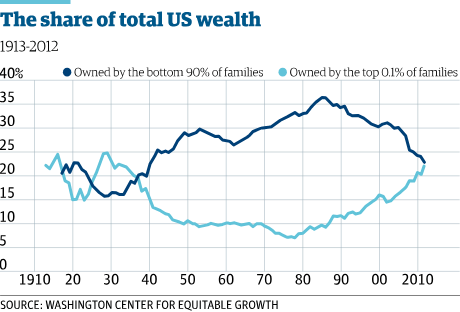
More than this, to be elite in the neoliberal scheme is to have wealth beyond the reach of the State completely. Naive chants of “Tax the rich” fail to recognise that the accretion of elite wealth and power is in zones often beyond the confiscatory reach of the democratic political system - there is nothing to tax.
These entities and private-sector power brokers have found various “escape hatches” to get their wealth out. Neoliberalism and its financialisation of everything ushered in the development of tax havens, free ports, creative accounting for multinational corporations, and other structures for the “exit” of wealth from domestic national economies.
This is a complex and multi-layered system that we cannot hope to explore in detail here, but in short – global elite capital does not play by the same rules as everyday people.
It is partly a knowledge gap, but much of it is relationships. The elite have access to a range of escape mechanisms, from the banking and business systems of Hong Kong and Ireland to the Caymans and British Virgin Islands. There are various sophisticated family offices and other professional services that have the skills and connections to navigate through the cracks of global banking and finance.
The Enron scandal and the 2008 Global Financial Crisis both disproved the core mantras of neoliberalism: that capital markets are always efficient, and that unregulated free markets always lead to prosperity. But more than that, they unveiled the “magic” of creative accounting and the incestuous relationships between State, big finance, and the private elite.
These players were able to manipulate markets and cause massive collateral damage to the global economy while also moving “their money” beyond the reach of the State in a way that normal people would not be able to.

Where did the money go? Cristal, Maybach, diamonds on your time piece. Jet planes, islands, tigers on a gold leash.
Or as George Carlin said: “It’s a big club, and you ain’t in it.”
Bitcoin is a profound one-time technology that introduced the concept of hard money, of permissionless transactions, and the disintermediation of trusted third parties. Anyone could be their own bank and operate infrastructure for sending and receiving digital payments beyond the reach of the State.
Bitcoiners sometimes call themselves Plebs. We have to be careful that we don’t forget who we are.
I know people who have met or worked with the Zuck or Bezos or who are involved with big money. I’ve also met my fair share of power brokers. But as Frank Underwood says, “Proximity to power deludes some into thinking they wield it.”
We also must not forget that Bitcoin came out of the 2008 Global Financial Crisis, the exact moment when elite Neoliberalism revealed its true hand – when the banks were bailed out and the financial elites were able to move their wealth beyond democratic reach, with everyday people ultimately bearing the cost.
The Occupy movement tried to make a stand on this but in the end was ineffectual.
So where are we today? The world seems a lot more abundant than before, New Zealand in particular is quite a different place.
But on the other hand, who can afford to own a home, have a family, and settle down?
There is an increasing frequency of financial crises, uncertainty, and instability. With no social obligation to labour anymore, and an increasingly fragmented world, is there enough bread and circuses to keep people distracted?
On the left and the right there is political agitation towards changing something. The recent Iran oil price shocks have an uncanny resemblance to the same shocks that prompted the original neoliberal revolution 40 years ago.
If things are tough enough, the State will be forced to do something. When a permanent underclass is created, when economic growth and the promise of “a way out” stop being viable, then political unrest ensues.
In the coming years will we see a return to the ideas promised in embedded liberalism for full and steady employment, if only to keep people from rioting on the street?
Maybe classical employment will never come back, but instead there will be a push for something like a Universal Basic Income as jobs are displaced and automated? UBI is a social welfare proposal in which all members of a given population regularly receive a minimum income directly into their account. It is one of the levers that the government can effectively pull – we all know that they can just print money.
But even if UBI monopoly money circulates in the world of consumer goods and immediate desires, the trend will be that you own nothing and you will be happy.
Wealth and capital will continue to consolidate under the unrelenting logic of neoliberalism. I think this will lead to the emergence of different economic orders.
One will be the world of everyday labour: of food, rent, and entertainment, of shopping and small purchases.
The other will be the world of elite capital: investment in businesses, hard assets, and the so-called means of production.
But if the government can just print those UBI tokens, what are they really worth?
What if the UBI Central Bank Digital Currency tokens have an expiry date? Neoliberalism removed capital controls, but will whatever happens next bring them back to keep “money” from flowing out?
In this world, Bitcoin is increasingly one of the only ways that working-class plebs can get access to this second kind of money: real wealth and real capital.
With Bitcoin, and a little bit of knowledge, normal people have access to this same level of “exit” that previously only neoliberal elites possessed.
Bitcoin fundamentally is censorship-resistant, unregulated, and beyond the reach of the State. There is a profound realisation that we now have access to the same kind of “magic” for hiding wealth beyond the purview of the State as they do.
There is an argument that no such escape should exist, but I think this only hurts normal people who do not have access to the relationships and complex arrangements required to preserve their wealth in a rapidly changing world.
If you can’t beat them, join them.
Neoliberalism flattened the world. Is the “common-sense” of free markets and the individual starting to fall away as the world fragments and deglobalises?
New Zealand is seeing that play out. We have outsourced much of the sovereignty of everything from energy to banking, and we are beginning to pay the price for it.
I think there is a strong case that the invention of Bitcoin is a daring move to steal the fire of financial sovereignty from the false gods of the neoliberal elite.
Bitcoin was born from neoliberalism in spite of neoliberalism.
Bitcoin is the same kind of escape hatch (or if you like, lifeboat) that the elites have used for 40 years.
We have to ask ourselves: do we sit in the dark as the ship sinks, or do we climb through the escape hatch?
– Cody Ellingham
No posts
Comments
Nothing yet. Say the first thing.
Sign in to join the conversation.