
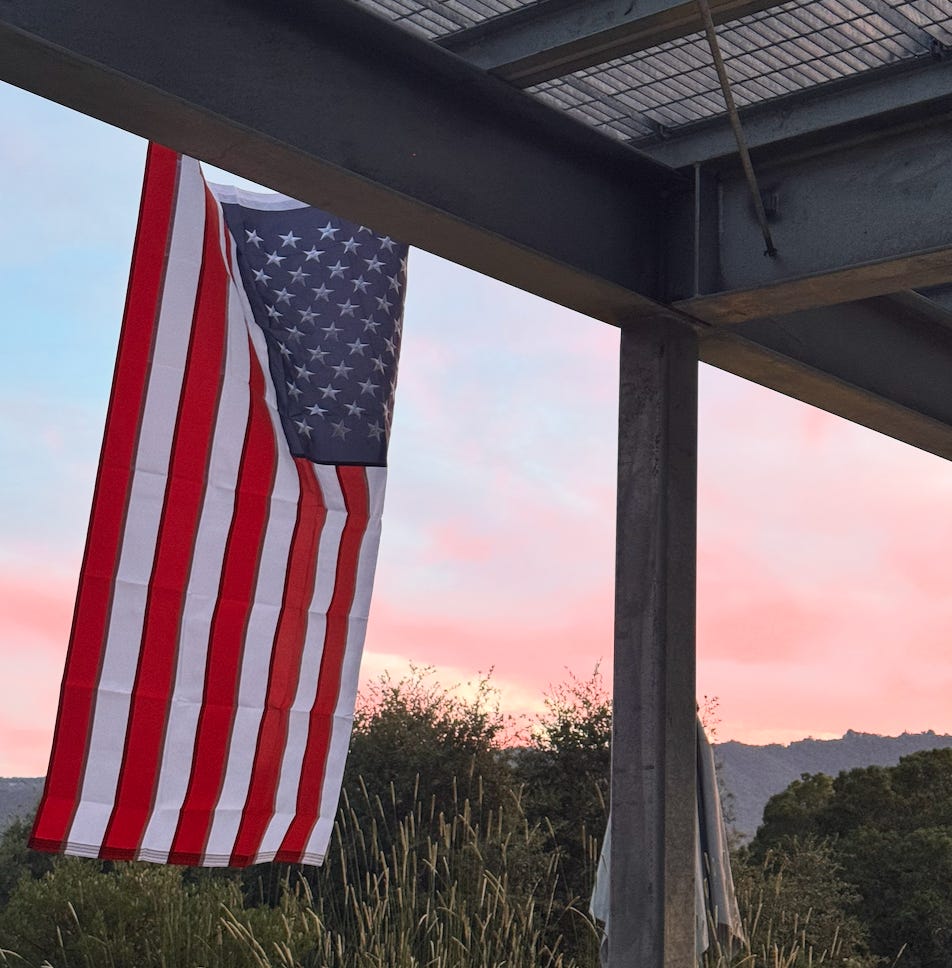
The truth is, even after everything, after the genocides and the overthrowing of democratically elected leaders, and the PATRIOT Act, the rush and heady high of neoliberalism, the unquestioning imposition of the global world order, ICBMs, the atomic bomb, and biological warfare, even after the obesity epidemic, the agricultural subsidies of Big Corn, the co-opting of the UN, the massacre at My Lai, Twinkie’s and the Ford automobile, the spewing of poison gas into the atmosphere, Foxconn, the New York Stock Exchange, the bull market, the extinction of the grizzly bear, the fall of the Lehman Brothers, a Hot or Not list that became a digital panopticon, after the dereliction of Detroit, the Reconstruction, Purdue Pharma, stagnating wages, rising cost of living, the bulldozing of the national parks, the new and old Jim Crows—yes, even after all of it, my heart still keens for America.
In The Reluctant Fundamentalist, Mohsin Hamid writes about a Pakistani immigrant named Changez who comes to Princeton at eighteen and finds himself slowly radicalized against the great behemoth that is American capitalism, spawned in no small part by the 9/11 attacks and his own growing conviction that his work for a major financial services company (McKinsey) is propagating evil the world over. The boy becomes a man. He learns to question, and in questioning, to reject the easy answers that the American Dream otherwise artfully perpetrates. He recognizes the insidious nightmare at the core of anything too saccharine. In his final project before he’s fired, he calls out and spends the day at Pablo Neruda’s house holding love to account rather than continuing his work on headcount reduction. After he returns from South America, a series of things occur—a suicide, an ignoble resignation—and the book comes full circle, to Lahore. Changez has returned to his hometown, and he is sitting across from an unnamed American operative. He is now a fully-committed fundamentalist who longs to splay America open and put her guts on display for the world.
You can understand his radicalization. You can appreciate his anger. I too have felt it, waking inside me slowly, long dormant and satiated by the glut of good things I spent my life feeding on: the latest technology, the seductive spell of literature, the fruits of all the world’s unwilling labor. Where 9/11 was Changez’s catalyst, October 7th was mine: what happened after in Palestine nailed my eyelids to my forehead with a vehemence I hardly thought possible. Before, I had the sheeplike innocence to believe that our military was fighting for the good, for the lofty ideals of the American forefathers—liberty, dignity, equality. It only took the livestreamed murders of a few thousand children to realize that these so-called universal ideals only applied to a subset America deemed worthy. The blast radius of the American Dream did not catch everyone in the selfsame manner. Some it uplifted. Some it tore the breath from their lungs and left to die on enervated, emaciated streets.
My questioning did not only arise from the livestreamed genocide. Just as Changez’s questioning had begun at the Firm, so too had mine: so unfulfilled was I by McKinsey that like generations of shaky youth before me I had purchased the Communist Manifesto and found myself within its pages, although it is unlikely Karl Marx would have sympathized with the laborer in me. There is nothing quite like feeling unfulfilled by the zenith of capitalism to question its priors. If profit’s apex cannot chip away at the meaning a life yearns for, something else must exist that can—something older, deeper, more profound.
In the first hundred and fifty pages of The Reluctant Fundamentalist, I felt Changez and I walking together, as if on a rocky, single-lane path carving the Santa Cruz mountains out to the sea. I trailed behind him, late to his realizations but treading the same ground, until our footsteps blurred into one, and it wasn’t clear which one of us had stepped first. It was not an untrodden path, this sudden gleam of recognition that America is better as an ideal than a country. But Changez makes a final move when he returns to his native Lahore. His last understanding is that his life lies in opposing this ideal, that he loves his country more than he loves the voluptuous American Dream, with her glassy eyes, her bared fangs, her t-shirt flailing behind her. It is here our paths diverge. He steps off the cliff. I cannot. Darkly in the distance I see the trail winding. I know it ends, but inside me I can only find the latent wish that the trail might go on forever, that somewhere the path widens to allow all of us onto it, that the ideal crystallizes into gravel beneath our feet.
Claude McKay, one of the greatest American poets and the progenitor of the African-American sonnet, once wrote this remarkable first stanza in his poem America, “Although she feeds me bread of bitterness / And sinks into my throat her tiger’s tooth / Stealing my breath of life, I must confess / I love this cultured hell that tests my youth.” It is only through this dichotomy that one can understand the grievance and the adoration experienced, in opposing yet equal measure, that I think so many of us feel towards our country. This duality is exemplified in the depth of the anger we often feel towards it. Love and anger; love and hatred; they are not each other’s opposites, but rather two sides of the same coin, two experiences of the same underlying passion. It is only apathy that counters love, that can be love’s unwilling replacement.
What forces this continued passion for America? Why do we not become apathetic? For me, it lies in none other than the fact America is an ideal. In part, this ideal is only experienced through indoctrination. It’s why Hamid, I believe, could write a book so convincingly about leaving America. This is because he had somewhere to return to, somewhere else to love and dream of and hope for. What America does instead to its citizens is assimilate them. So completely does this transformation take place that the second-generation Americans often speak nothing other than English; they celebrate a commoditized Christmas; they can recite the Pledge of Allegiance in their sleep; all of them can draw the American flag from memory; there is no homeland but the American homeland, its founding myths. The nation of immigrants, whatever the current Administration is trying to do, is the most welcoming country in the world to immigrants. In exchange for your own homeland, your customs, your traditions, you can gain the identity of the American; the languid accent with its too-open vowels, the lack of refinement, but above all, the audacity.
But assimilation only works when there is something to assimilate to. This is where I believe America’s enduring fascination comes in: the founding mythology of America is, I argue, the greatest self-conception of a country extant today. A bunch of twenty-year-olds with probably ten teeth between them and a couple very bad wigs got together in New England a few hundred years ago and began a movement that started with the words— “We hold these truths to be self-evident; that all men are created equal—”
In practice, of course this was not true. They did not count Black or Native men as men, and they certainly did not count women. This is why America has always been better experienced as an ideal. But it is the ideal itself that is so powerful. Think of every other country that professes to be the substitute for America. None were founded on this mythology. None can say that every man and woman on the earth is as much an heir to the mythos as any other.
You can move to England, or France, or the Netherlands. You can expatriate to China, or India, or the Seychelles. You can learn the language, you can acquire the passport, you can live along their dreams. But none of the countries would understand you as an heir to their mythologies; you would have no pride in the kings of Normandy, no Tudor rose would be etched into your skin; the words of the Ramayana will never save your immortal soul. But you still can define the American epic. Her story is not yet finished. Her greatest achievements have happened in living memory, and they will happen still. So too her greatest horrors lie ahead. But in her own words, all men are created equal to propagate both greatness and evil. She holds the same belief in everyone.
And what is this belief? It is American audacity. The arrogance to believe that you can shape the world. It is, I believe, what attracted Hannah Arendt to the shores and bid her stay. When she wrote her great treatise The Human Condition, she wrote at length about how the well-lived life attempts to begin something new through speech or action. It is this that differentiates us from the animals: the ability to begin something new. This audacity required the American context. In Europe—Asia—Africa, so paralyzed as you are by history, so understanding that the glory years are behind you: you lack the audacity to skip rocks and make waves on the surface of the world.
It is this misguided belief that forces me to admit my enduring addiction to America. For all the evils she perpetrates and will perpetrate forever, she is also capable of great good. She represents power, in all its neutrality: she wrests control over it and then asks you to wield it. You can wisely decline the offer. But you cannot ignore the outstretched hand.
No posts
Comments
Nothing yet. Say the first thing.
Sign in to join the conversation.