
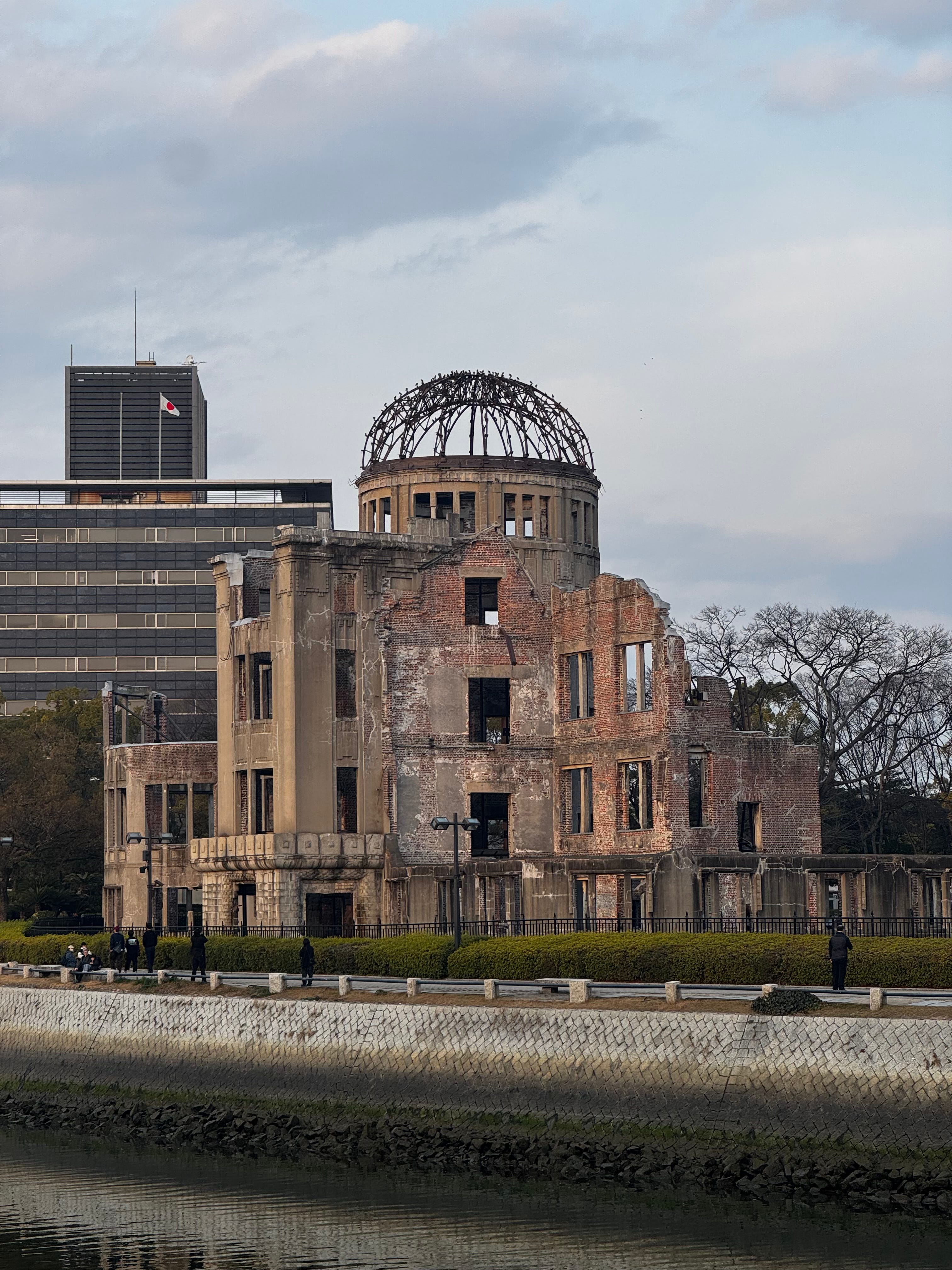
A week and a half ago, I was standing in the center of what used to be one of the main squares in Hiroshima, Japan. About an hour’s train ride from Osaka, where we were staying for work, Hiroshima is now a bustling Japanese city, famous for its oysters and for a small island off its shore known as Miyajima Island, which houses a 12th century shrine and a floating Torii gate, which in traditional Shintoism marks the transition between the mundane and the divine.
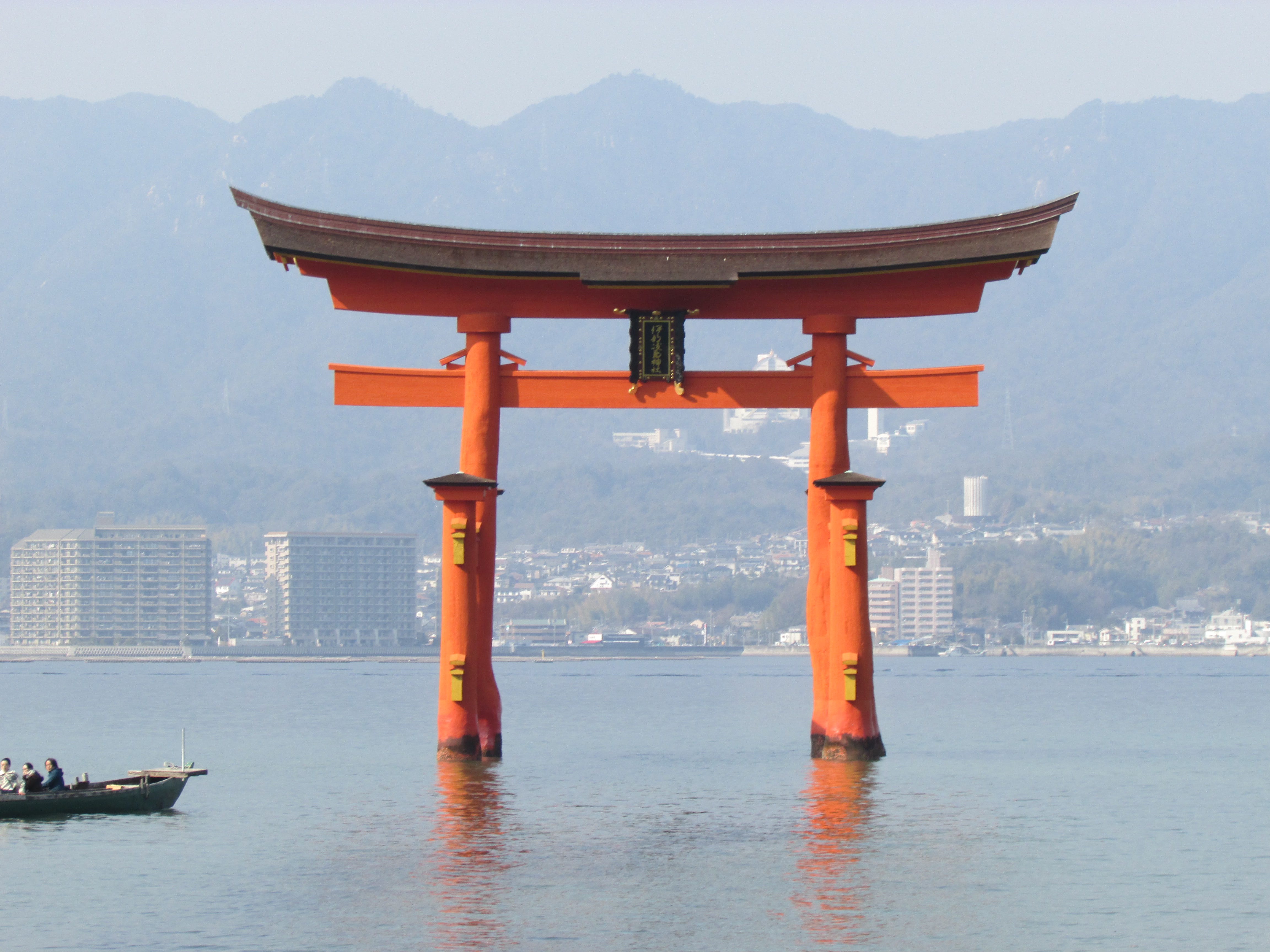
In the old times, apparently, Miyajima’s mountains echoed with the voices of the spirits, giving rise to its nickname: the island of the gods. Still today, deer on Miyajima roam freely, protected by law, as they are thought to be envoys of the divine.

Of course, worldwide, Hiroshima is (in)famous for something else—the unnamable destruction wrought by the first-ever use of the weapon man developed to rend himself from nature. In this light, Miyajima’s presence so close to Hiroshima is no coincidence. When deciding the “strategic” target, the psychological impact of the nuclear site was a key consideration for United States generals. In fact, most of them wanted to bomb Kyoto, Japan’s historic imperial capital, as it was believed this would fully crush the Japanese spirit and remaining will to fight. Kyoto was saved only because the Secretary of War Stimson made a personal appeal to Truman. Stimson had visited Kyoto in the 1920s and knew it to be one of the world’s great cities, and he also believed that a post wartime alliance with Japan was more likely if they showed “restraint” by not razing Japan’s cultural center. Truman, otherwise mostly uninvolved with the atomic bomb, was moved by these arguments, and agreed to support Stimson’s plea for Kyoto to be removed. With the primary target eliminated, the US generals turned to the name that would, in my opinion, seal their final conversion to inhumanity. Hiroshima.
I don’t know if anyone has written about the connection before—a cursory Google search turned up little—but there is such an awful symmetry when you realize the mountains of Miyajima look out over Hiroshima Bay onto the city. In some sense, the Japanese gods were forced to watch as a power that should have never been granted to man was unleashed on civilians. You don’t have to be spiritual—and I certainly don’t profess to speak at all for Shintoism—to recognize that the sacred & the divine were exactly what was at stake the minute America decided to begin the Manhattan Project.
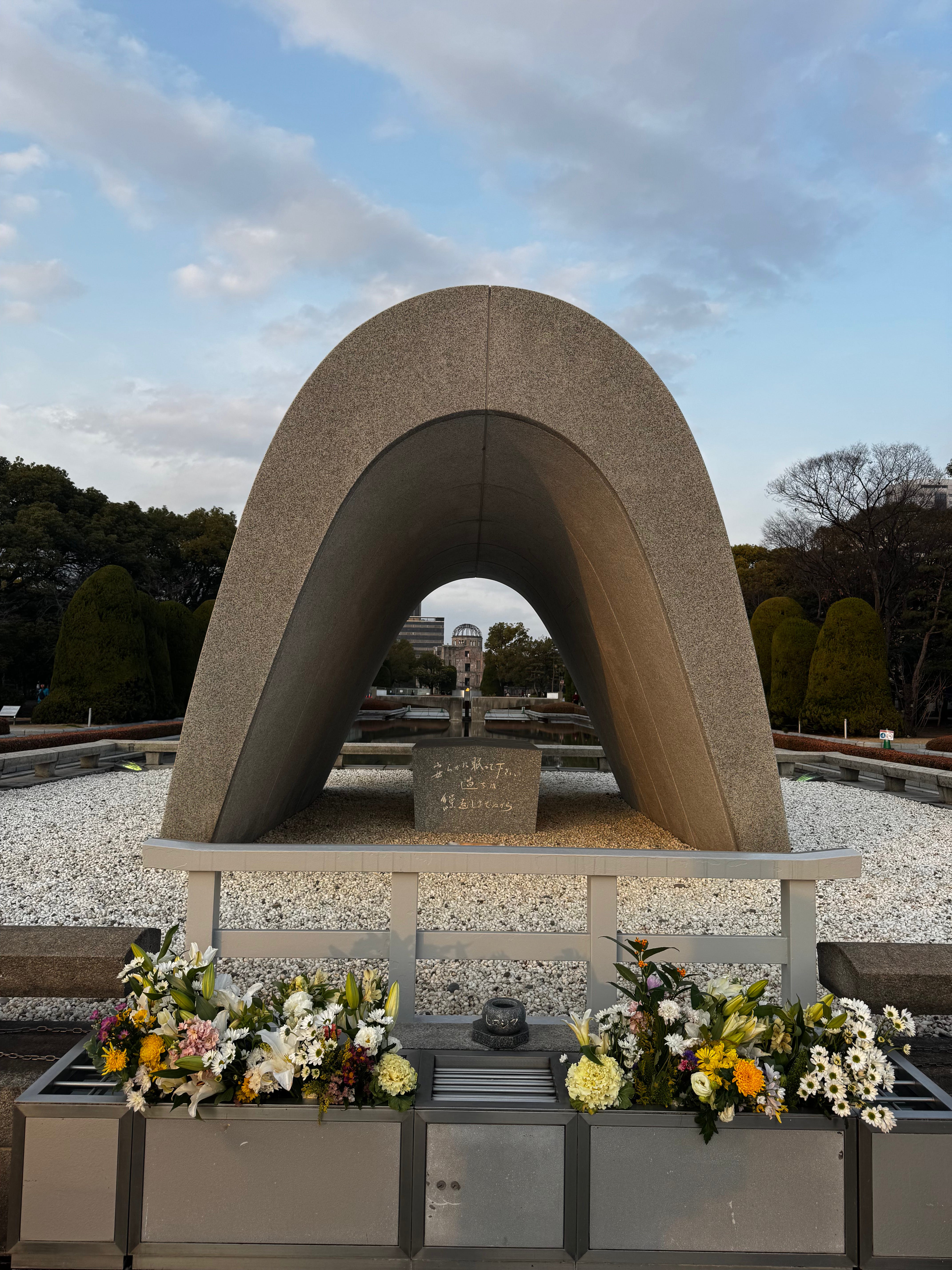
It is pretty much impossible to describe how it feels to stand in the hypocenter, where the bomb was detonated about 600m above sea level. The only word that keeps coming to mind is “enormity.” Of the legacy, of the creation, of the decision to use such a weapon. What was the hypocenter now houses the atomic dome, the remains of a building that was left half-standing after the nuclear strike, the Hiroshima Peace Park, and the Hiroshima Museum. In the Peace Park, the Children’s Memorial looks out over the eternal flame of peace. Hiroshima’s message to the world is simple: No more Hiroshimas.
In the museum, the artifacts and remnants of the victims and the survivors create a montage of the singular. From the specific, the universal: you follow the death of each child, forced into a war effort they were too young to even remember the start of, killed by forces so much larger than them, forces that had begun eons ago and light years away in the stomach of some indifferent star.
Hannah Arendt, who spent much of her career writing on how technology allows for moral displacement—something she also termed the banality of evil—writes this sentence in the beginning of her masterpiece The Human Condition: “This event [the launch of Sputnik], second in importance to no other, not even to the splitting of the atom” (THC, p. 1). It is one of the only times I have disagreed with Arendt. The splitting of the atom is more important to me still. It is the first, and therefore also the final, movement of humans from the natural age to the technological age, the final divorce of ourselves from what we had for so long accepted as moral law.
I am well aware that humans were evil long before Hiroshima. But somehow the technological character of the evils of the Second World War—the Nazi genocide included—feels to be a different character of evil. Maybe it is the fact we tried (and did) harness a power that was never intended for human control, that we played at becoming gods ourselves without possessing the essential spirit of divinity. We tore ourselves from nature in the pursuit of killing each other. And I don’t think nature has ever really forgiven us.
Maybe this is a parallel that keeps coming to me because of what I study, and I don’t mean to minimize any of the suffering of the victims at Hiroshima. But when there, I was struck by something else—the strange and disturbing parallels between the atomic bomb and the race for AGI.
Both of these technologies were fundamental answers to the question of “can we?” rather than “should we?” Both have been legitimized and accelerated in the context of an arms race—the Americans raced to develop the atomic bomb because of information that the Germans were working on it, and the Americans are now racing again to AGI because of the fear China might create it first. Both technologies had their ends greatly occluded—nobody knew what the bomb would be used for until it was, and nobody knows what AGI will become—but both have the literal potential to destroy the world and eradicate all of humanity. Both technologies are sanctified by the same American political apparatus and logic that states “if this is going to exist, it might as well be under the control of a ~Western liberal democracy~.”
What strikes me most is that both are technologies that attempt to abstract away our humanity. The atomic bomb abstracted killing to a button pressed ten thousand miles away, something that evolved into unmanned drone strikes and genocide carried out by robots. AGI tries to abstract away thinking itself, outsourcing what is the most fundamental human activity to a machine with no thought processes at all.
Oppenheimer’s famous quote after detonating the first atomic test was Now I am become death, destroyer of worlds, which he said was taken from the Bhagavad Gita, a Hindu religious text. (Another example of how in times of great technological innovation, the feeling of separation from humanity causes even the most scientific to fall back onto religion).
Many likely don’t know, however, that Oppenheimer mistranslated. The original line is closer to I am Time, the mighty destroyer of worlds. It is a reminder that all forces, no matter their cosmic weight, their strength, and their power, cannot threaten Lord Krishna’s control over time, which vanquishes all living beings. The AGI race, with its roots in transhumanism, is only another manifestation of our fight against mortality. But it is a fight we are destined to lose: all of us—and our machines too—return to dust eventually, and in time.
No posts
Comments
Nothing yet. Say the first thing.
Sign in to join the conversation.