
You explain how you like a job done. Then you explain it again next week. A skill is the folder that remembers, and it costs you one line until the moment you actually use it.
In the last one we looked at hooks, and when to use them. A hook is how you stop asking your AI for something and start enforcing it.
This one is the friendlier half of the same problem. Not the rule you need enforced, but the job you keep explaining.
You ask your AI to do something you have asked for before. Write the weekly update. Clean up the notes from a meeting. Draft the reply.
And before it can do it well, you explain how you like it done. The tone. The length. The three things you always want and the one thing you never want. You type all of that out, it does a good job, and the session ends.
Next week you open a new one and it knows none of it.
Most people solve this by writing it down in one big instructions file. That works, for a while.
Then it grows. The rules for your emails are in there. So are the rules for your notes, your invoices, the way you like a summary formatted. Now every session carries all of it, including the parts about invoices when you are writing an email.
That is the trap. One file, everything in it, always loaded. It gets long, and long means the thing you needed today is competing with fifty things you did not.
A skill is a folder that teaches your AI how to do one job.
That is the whole idea. One job, one folder. The rules for your emails live in the email folder and nowhere else. And the folder stays shut until the moment that job comes up.
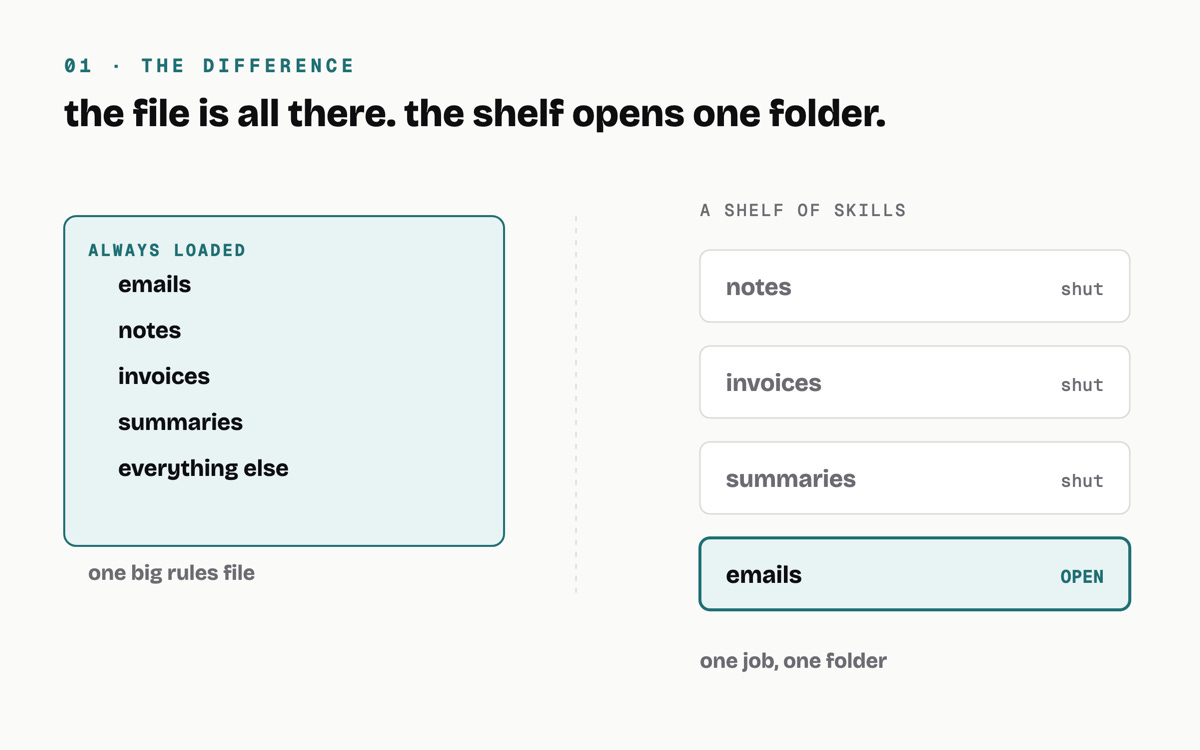
One big rules file carries every job at once. A shelf of skills keeps them apart and opens the one you need.
Four parts, and only two of them matter on day one.
A name. What the job is called.
title-generator,cold-email,memory-manager. Short, and it says the job.A description. One or two lines saying what it does and when to use it. This is the part people rush, and it is the part that decides whether the skill ever runs. More on it in a second, because it is the whole trick.
The instructions. Everything you would have typed out: how you like the job done, the steps, the words you never want used, an example of a good one. As long as it needs to be.
Extra files, if it needs them. A template, a checklist, a script. Most skills never need any.
That is it. A folder, a name, a description, and the instructions.
Here is the part worth understanding, because it explains why a skill does not slow you down.
Only the name and the description are in the room. They sit in your AI’s memory for the whole session, always visible. The instructions are not. They get opened only when the job comes up.
I can put a real number on that. One of my skills holds the rules for writing this newsletter. Its description is 595 characters. The instructions behind it are 27,807. So the thing that sits there all day is about one forty-sixth of the thing it can open.
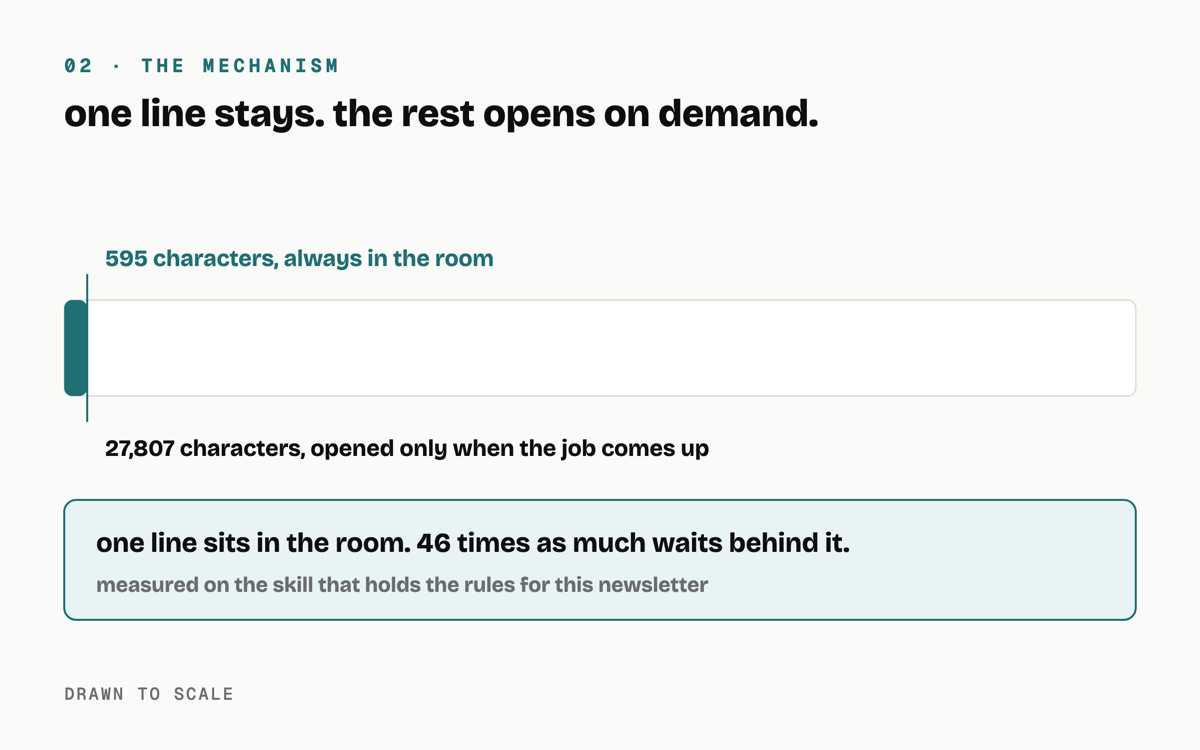
The description sits in the room all day. The instructions behind it are 46 times bigger and only open when the job comes up.
That ratio is why a shelf of skills behaves differently from one long rules file. The file is all there, all the time. The shelf is a row of one-line labels, and only the one you need gets opened.
Now the part that catches everyone.
You do not call a skill by name. You just say what you want, in your own words, and your AI decides which folder to open. It decides by reading the descriptions.
So the description is not a note to yourself. It is the trigger, and you are writing it for the AI.
Which means: put the words you would actually say in it. My title skill says to use it for “titles for X”, “headline for the loop article”, “give me Medium titles”. Those are not a summary of what it does. They are the sentences I catch myself typing.
A description that says “helps with headlines” is true and useless. It never fires, because nothing you type looks like it.
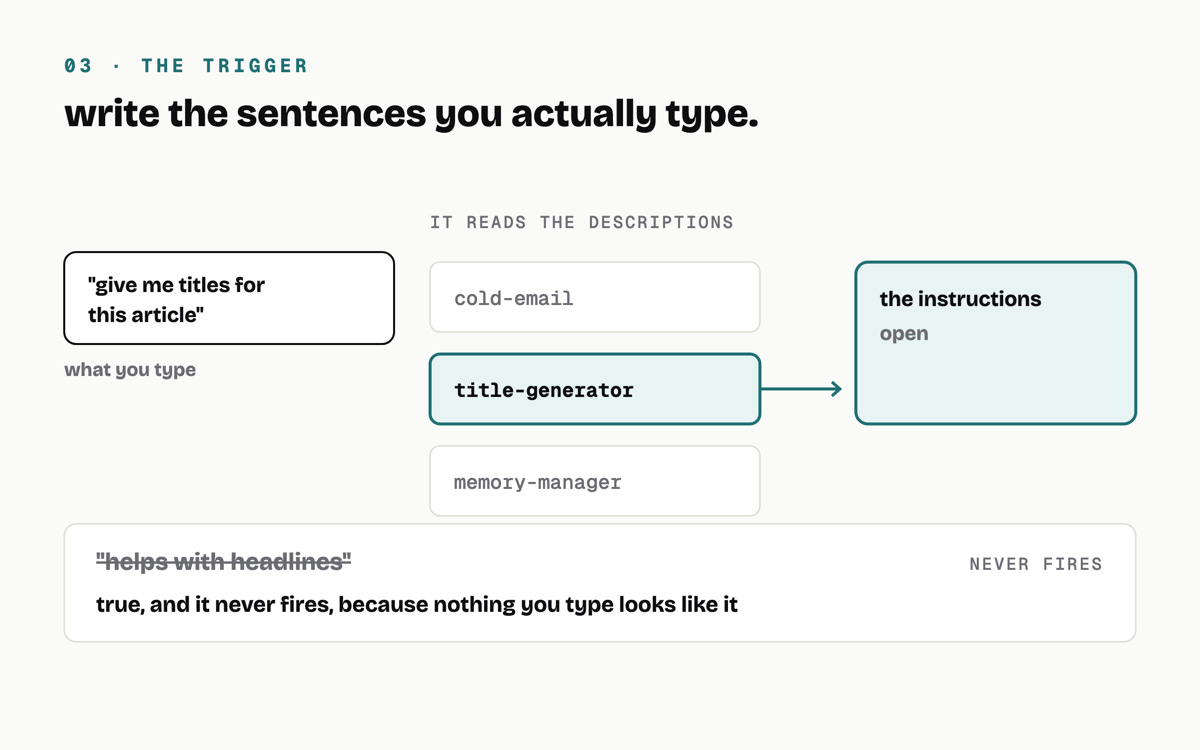
You type a normal sentence. Your AI reads the descriptions and opens the one that matches, which is why a vague description never fires.
The clearest one I have is the skill that holds the rules for this newsletter.
Before it existed, every article started the same way: I would explain the column width, the reading level, that headings go in lowercase, that I do not want em dashes, that the piece opens on a real story and never an invented one. Every time. And some weeks I forgot one, and the draft came back wrong in exactly the way I had spent a paragraph preventing the week before.
Now that is a folder. I say “write the newsletter version of this” and the rules arrive with the job. The article you are reading went through it.
The honest part: it did not get everything right the first time. The rules in it today are the corrections I gave it over about six weeks, written down as they happened. That is what a skill really is once you have lived with it. Not a clever setup. A place to put a correction so you only have to give it once.
A skill is for a job you will do again.
If you need something once, just ask for it. If you have explained the same thing three times, that is your signal. Three is a good rule, and it keeps you from building a shelf of folders you never open.
Start with one. Pick the job you are most tired of explaining, write down what you keep saying, and put your own typed sentences in the description.
Follow for more. Next one is subagents, which is what you reach for when one job turns into four.
Comments
Nothing yet. Say the first thing.
Sign in to join the conversation.