
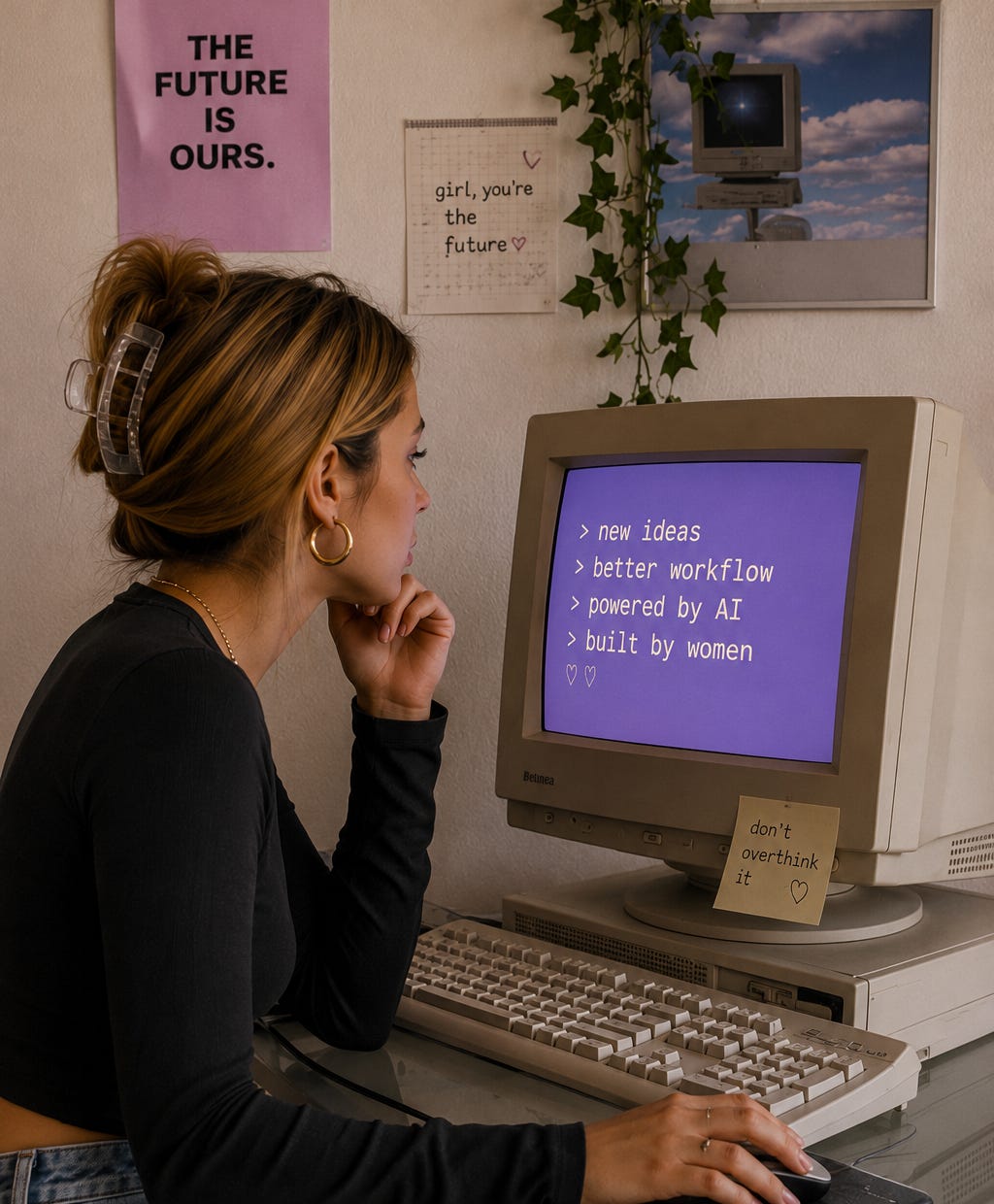
There is a story being told about women and AI, and it goes something like this:
Women are behind. Women are hesitant. Women need to be encouraged, onboarded, reassured. Women are the cautious adopters who will come around eventually, once the technology is proven and the path is clear.
It is a condescending story. It is also, for a specific generation of women, almost comically wrong.
I want to talk about the women who were online in 1997.
Not the ones who had it set up for them. The ones who listened to a modem scream for forty-five seconds and waited, with genuine patience, for a webpage to load one horizontal line at a time. The ones who figured out dial-up internet before broadband existed, before Wi-Fi existed, before anyone had made it easy or obvious or intuitive.
Those women are in their late thirties and forties now. They are accountants and analysts and CFOs and controllers. They are the people running the numbers, managing the close, advising the clients, and keeping the financial infrastructure of this country functioning.
And they are being told, with a straight face, that AI might be a little too complicated for them.
I want to offer a different frame.

Welcome to Code Like a Girl, the community where women in tech come to be seen, heard, and championed as they walk this path together.
If you have spent decades figuring out every new tool without anyone calling you a tech person, this is where you find the women who already know you are one.
The women who grew up with the internet arriving in real time did not have a tutorial for any of it.
They learned AIM by using it. They built MySpace profiles by copying HTML from forums, breaking it, fixing it, and eventually making something that looked exactly the way they wanted. They navigated the first iPhone with no manual. They figured out Facebook, then Twitter, then Instagram, then Snapchat, then TikTok — each one a new interface, a new logic, a new set of unwritten rules that had to be decoded through experimentation.
They did all of this without being called early adopters. Without getting the LinkedIn post. Without anyone noting, in a profile or a performance review, that they had demonstrated exceptional technology adaptability across three decades of digital transformation.
They just did it. Because that’s what you do when something new arrives, and you’re curious, and you want to participate.
That is the biography of a generation of women in professional services. And it is the exact skill set that the AI moment rewards.
Here is something worth sitting with: the methodology for learning AI tools is identical to the methodology a fifteen-year-old girl used to customize her MySpace page in 2004.
Find something you want to do. Look for how someone else did it. Try it yourself. Break it. Figure out why. Fix it. Try something slightly more ambitious. Repeat.
That’s it. That’s the whole curriculum.
The women who taught themselves HTML from a forum post — not because anyone encouraged them, not because it was a career strategy, but because they wanted their profile to look different from everyone else’s — already know how to learn technology this way. It is in their bones.
What’s different now is that the stakes are higher. Not higher in terms of difficulty — AI tools are, in many ways, more intuitive than early web development. Higher in terms of opportunity. The thing you figure out this time isn’t a prettier MySpace page. It’s a competitive advantage in a profession that is changing faster than at any point in its history.
There’s another piece of this generation’s technology biography that doesn’t get enough credit: they already lived through a moment when a transformative new tool arrived and broke all the existing rules simultaneously.
Napster didn’t ask permission. It just showed up and made every existing music industry assumption obsolete overnight. And everyone who used it — which was essentially everyone — had to figure out in real time where they stood. Was this okay? Was it theft? Was the industry’s outrage legitimate or self-serving? What did it mean that something was technically possible but legally and ethically contested?
Those were not easy questions. And a generation of people navigated them without a framework, relying on instinct and values and a gradually developing sense of how new technology intersects with existing systems of ownership and fairness.
That is exactly the conversation happening around AI right now.
The people who have thought the longest about what it means when technology disrupts incumbent industries, when the rules haven’t caught up with the tools, when something feels powerful and slightly uncomfortable at the same time — are not the 24-year-olds who grew up with smartphones. They are the people who were online when the internet was still figuring out what it was.
Here is where I want to be direct, because this is ultimately what Carry Forward is about.
Women in this generation — the dial-up generation, the MySpace HTML generation, the figured-it-out-themselves generation — are facing a retirement wealth gap that is real, documented, and not going to fix itself.
They earned less, in most cases, than their male counterparts. They took time out of the workforce for caregiving at higher rates. They were passed over for promotions at higher rates. They negotiated less aggressively, in part because the penalties for negotiating as a woman are documented and real. And all of those individual inequities compounded, year over year, into a wealth gap that is significantly wider than the wage gap that gets all the attention.
AI is not going to fix systemic inequality. I want to be honest about that.
But it is creating an income opportunity that is specifically well-suited to people with deep domain expertise, strong analytical instincts, and three decades of proof that they can figure out a new tool without anyone holding their hand.
That is a description of a lot of women in accounting and finance right now.
The template shop, the productized service, the newsletter, the consulting practice built on an AI-augmented workflow — these are not fantasies. They are things women in this profession are building right now, quietly, in the margins of their existing careers. They are assets, not just income. Things that compound, not just things that pay out once.
The window is open in a way it may not be in five years. The tools are accessible. The expertise is already there.
And the women who taught themselves to build something online before anyone told them they could — they have done this before.
Every platform. Every interface. Every tool that arrived without instructions and required patience and curiosity and a willingness to break things and figure out why.
You navigated all of it. You didn’t wait for the tutorial. You didn’t wait for permission. You didn’t wait for someone to tell you that you were a tech person before you started behaving like one.
AI is the next chapter in a story that started with a modem screech and a blinking cursor.
You already know how it ends.
You figure it out.

We're grateful to Kelsey Helstrom for sharing this here. If you want the case for why your own track record is the qualification you keep waiting for someone else to grant you, this is a voice worth following. This was originally posted on The Carry Forward here.
Kelsey calls out that this generation of women has already navigated a transformative tool that broke every rule at once, and did it without a manual. Code Like a Girl is the community for women in tech who are done being told they are behind on something they have been doing their whole lives.
Subscribe for free and join our Rise Together Thursday chat. It’s a community where women in tech share their latest work, spotlight another woman’s post, and support one another through thoughtful comments and restacks.
You’ll come in with work that deserves more attention and leave feeling seen, supported, and connected.
Comments
Nothing yet. Say the first thing.
Sign in to join the conversation.