
I did everything they told me to do. I studied computer science. I got into AI before most people around me even knew what a large language model was. I built the projects. I moved countries for it. Everyone kept saying the same thing: You’ll be fine. Just keep going. So I kept going.
I’m technically an early Zoomer. We grew up with the internet, but it wasn’t our whole childhood. I spent most of mine outside. I still have the scars to prove it. I’d disappear for hours, climbing things, making up games, coming home covered in dust.
And when I wasn’t outside, I was reading. I have photos of myself sitting in the grass with a book, completely entertained by my own imagination. There wasn’t a phone to rescue you every time you got bored. You either sat with it or found something to do.
Maybe that’s why I believed adults when they told us that if we worked hard, things would work out.
School felt like a straight line: study hard, get the degree, get the job. For computer science students, that job came with a number attached to it. New grads with a co-op or two were walking into salaries close to six figures. Whether anyone said it out loud or not, that’s what many of us were working towards.
CS felt like the safest bet.
Then I graduated into a job market that no longer needed beginners.

Welcome to Code Like a Girl, the community where women in tech come to be seen, heard, and championed as they walk this path together.
If you are a woman in tech navigating a market nobody prepared you for, this is where you find the people who will help you through it.
I’d been targeting roles across EMEA before I even thought about grad school, just to gain more skills and stand out. I had my eye on an associate role at Lenovo, and the moment it opened, I applied. They got back to me. I was ecstatic. It was such a happy moment. I kept rereading the email. Next steps, it said.
I went through the first round, then the second. I’d already imagined my life in the UAE the apartment, the whole picture.
Then nothing.
No rejection email, no response, nothing to even push back against.
I tried reaching out anyway. For weeks I kept refreshing my inbox, convincing myself they were probably just busy.
My parents only knew one way to get a job: print your CV, walk in, ask if they’re hiring.
That’s how it worked for them. So I tried it.
Every day I picked companies, showed up, dropped off my resume, and got told an online application would do.
Old advice, new rules, neither one working.
Then the grad school applications. US, Canada, Germany, all at once. The US was the one I wanted. Me, in Seattle. I had everything laid out. The only thing left was the visa.
Denied. September 12th, 2023.
I still remember the date, because I’d already built a new life around a letter that turned out not to mean anything. Germany came next, a program I knew I was strong for. Rejected anyway.
Then my uncle called with a new option: Canada. So at 3 am, more nights than I can count, I went down the rabbit hole. Programs, deadlines, requirements, applying to anything that looked possible. Fanshawe said yes.
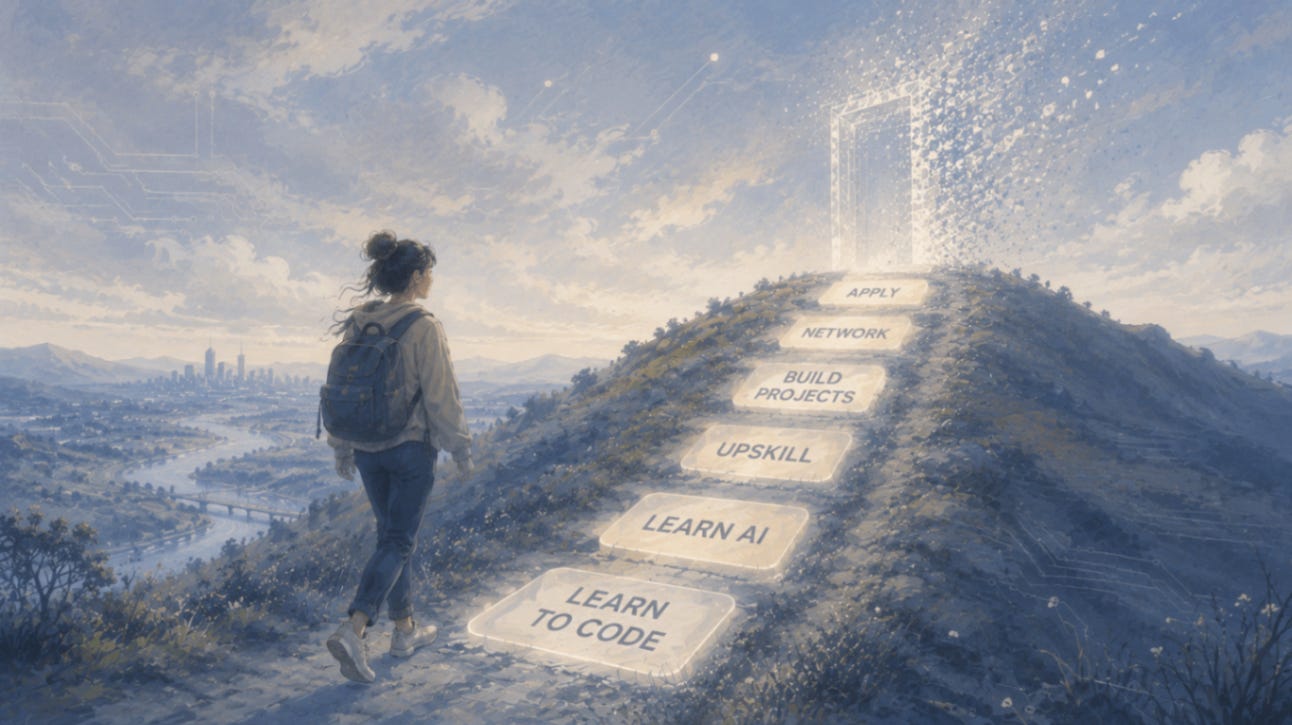
Every piece of advice sounded simple enough. Learn to code. Learn AI. Build projects. Network. Apply to jobs.
So I did. I did all of it. Across four countries, over several years. And still, getting that first “yes” felt almost impossible. By the time I’d ticked every box, the goalpost had moved.
I spent a long time assuming I just wasn’t good enough.
Every rejection felt personal, because that’s what job hunting trains you to believe. Enough silence, enough “we’ve decided to move forward with other candidates,” and eventually you stop questioning the market and start questioning yourself.
Then I read the Stanford study.
Turns out it wasn’t just me, which took longer to believe than it should have.
A Stanford Digital Economy Lab study pulled actual payroll data on millions of workers and found early-career workers aged 22-25 in AI-exposed jobs saw a 16% relative decline in employment since late 2022.
But for Software developers, it was worse. There were 20% fewer developers age 22-25 getting hired in 2025 vs 2022, while employment held steady or grew for more experienced workers in the same roles.
Same title, same job description.
The only real difference was how many years you’d been alive.
One of the study’s authors, Erik Brynjolfsson, said something in an interview with Derek Thompson that’s stuck with me:
“It appears what younger workers know overlaps with what LLMs can replace.”
We weren’t underqualified. We were qualified in exactly the thing that stopped being rare.

If you’ve been sending applications into silence and wondering what’s wrong with you, here’s what the numbers actually say: it isn’t you.
Employers aren’t hiding it either. NACE’s 2026 outlook, pulled straight from employer surveys, projects a 1.6% increase in hiring for this year’s graduating class. Forty-five percent of employers rated the market “fair,” the same rating employers gave in 2021, the last time hiring was actually flat.
The signal shows up in the postings themselves. 13.3% of U.S. job postings now require AI skills, 10.5% of entry-level ones specifically. Recent-grad unemployment in the U.S. sits around 5.6–5.7%, against a national rate closer to 4.2–4.3%.
So if it feels like the ground shifted under you, it did. The rung’s still there.
What changed is what sits at the bottom of it.
The entry-level work, the tasks juniors used to prove themselves on, is exactly the work these tools now do fastest.
And the cruel part is that we saw AI coming. We adopted it faster than anyone. We weren’t dragged into it. We were the ones showing our managers how to prompt it.
Being early didn’t protect us, because the skill wasn’t the problem. The overlap was.
Gallup’s been tracking Gen Z sentiment long enough to show what that turned into:
excitement about AI down 14 points to 22%
hopefulness down 9 points to 18%, anger up 9 points to 31%
anxiety stuck at 42%
Almost 9 in 10 graduates this year are worried AI will take the job they’re chasing, up from 64% last year.
I don’t think AI is the villain here. The work companies need from entry-level people changed faster than the advice we were given about how to become one of them.
This is the part I wish someone had told me straight, instead of “just keep grinding.”
Your work introduces you before your resume does now.
57% of employers say they’re less likely to even interview someone they can’t find online, and 54% have ruled a candidate out entirely based on what they found.
So build something visible while you wait: a project, a write-up, a small tool, anything that shows the work instead of just claiming it.
This is also a good time to get specific instead of general.
AI-exposed roles are getting impacted the most. But roles that need judgment, physical presence, or trust. Health care, skilled trades, education, anything hands-on are holding up better right now. That doesn’t mean abandon your field. It means know which parts of it are still scarce, and lean into those.
Stop treating the side hustle as a backup plan. Somewhere between 57% and 77% of Gen Z already has one going, depending on which 2026 survey you check. It’s a generation building its own proof because the old proof stopped being enough.
Talk to actual people, not networking-event people. But one door did open because of She Writes AI and Code Like a Girl itself. People read my work, reached out, and treated it like it mattered before any company did. It wasn’t a job offer, but it reminded me that opportunities still start with people. Algorithms might surface your application, but people are the ones who remember your name.
I’m writing this while I’m still looking. I don’t have a hiring story to point to yet, no tidy ending where it all worked out. What I have is the thing I wish someone had handed me two years ago:
The market I spent all that effort preparing for was already disappearing while I prepared for it.
That’s a hard thing to sit with. It’s also the most freeing thing I’ve figured out, because it means the silence was never a verdict on me or you. I was preparing for the right job in the wrong year, and maybe you have been too.
So here’s what I’d carry forward, and what I’m carrying myself.
Stop auditioning for a rung that changed and start building something visible while you wait.
Get specific about the parts of your field the tools can’t do yet.
Treat the side project as proof, not a backup.
And talk to actual people, because the one door that has opened for me opened because someone read my work and remembered my name before any company did.
The game changed mid-play.
That’s not on us.
What’s on us is learning to see it, and deciding what to build next.

We're grateful to Lipgloss and LLMs for sharing her work here. If you're drawn to honest writing backed by real data her publication is worth following.
Lipgloss and LLMs followed every piece of advice she was given and got silence back. The data says that silence was never a verdict on her.
Code Like a Girl is a community of women in tech who show up for each other, share what they’ve learned, and cheer each other on.
Subscribe for free and join our Rise Together Thursday chat. It’s a community where women in tech share their latest work, spotlight another woman’s post, and support one another through thoughtful comments and restacks.
You’ll come in with work that deserves more attention and leave feeling seen, supported, and connected.
Comments
Nothing yet. Say the first thing.
Sign in to join the conversation.