
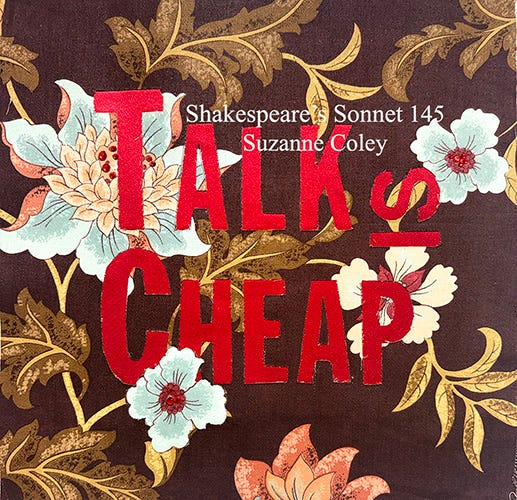
For me, Shakespeare’s sonnets are like people. They come in 154 types: Some are bodacious. Some are introspective. Some are fantastical. Some are complicated. Some make me uncomfortable. And, like people, they leave me feeling slightly different. Whether good or bad, each interaction has some impact on my being.
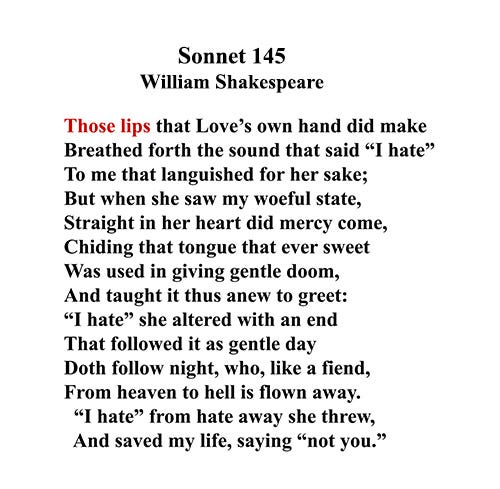
Shakespeare’s Sonnet 145 caught my attention with its opening “Those lips that love’s own hand did make.” And, surprisingly, by the end of the poem’s emotional roller coaster of mainly hearing how “hate” filled the speaker with a “woeful state,” I was not convinced of the Bard’s final line when the speaker declared all was well with, “and saved my life, saying ‘not you.’”
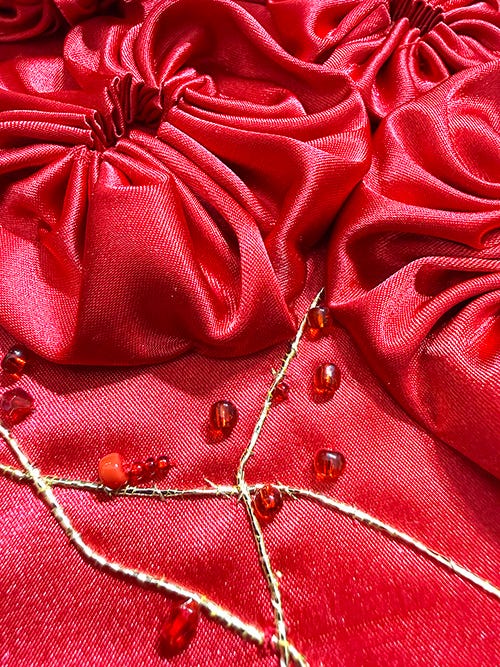
The sonnet’s first line, “Those lips that love’s own hand did make,” drew me in and inspired the creation of numerous small round fabric puffs that simulated kisses. This fabric manipulation technique is called Suffolk Puffs, also known as Yo-Yos, and they have a long history in the United Kingdom (since the18th century) and the United States (since the 19th century). Like words in a poem, when Suffolk Puffs are joined together with sturdy thread at their edges, they create dynamic embellishments and structures. The way fabric is meticulously gathered at the ends reminds me of kisses, more specifically, puckered lips about to blow a kiss. To further the idea of the sultry heat of the moment, I used the brightest red fabric in my stash, signaling “love’s hand did make.”
Breathed forth the sound
These words offered a powerful visual for me. They signaled how words travel through space and take on meaning to the hearer. I visualized the movement of “Breathed forth the sound,” with gold embroidered string darting quickly around the red rosettes. The poem’s next words, “I hate” disrupts this movement and introduces us to an uneven gathering of fabric that forces the eye to stop. These two words are heavy. To further show how heavy “I hate” is, I gathered the red satin fabric in a chaotic manner and stuffed it with dozens of tiny balls of cotton. The juxtaposition of the controlled technique of making Suffolk Puffs next to the erratic impulsive-like creation of a mountain of puff balls does not offer a bridge. Once fabric has been pinned, tucked, stuffed, and manipulated, it is impossible to return it to its earlier state.
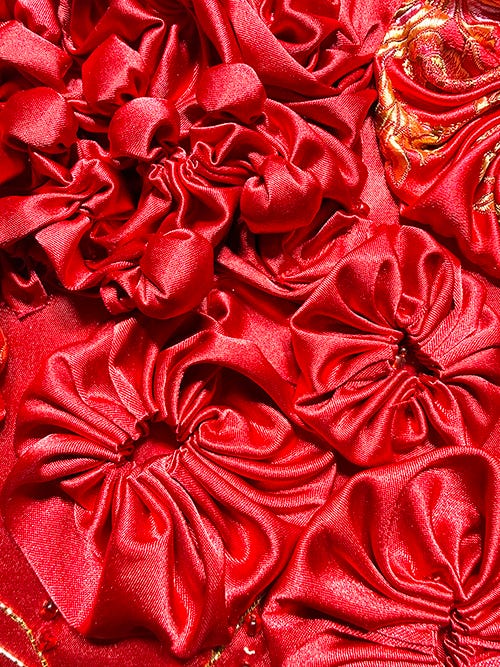
Fabric remembers what happened to it, just like we remember what happens to us. Words do have power and the speaker tells us this with “to me that languished for her sake.” The speaker tells us that he is heartbroken. Talk is not cheap at this moment. They can crush and he describes his state as “woeful” and “gentle doom.”
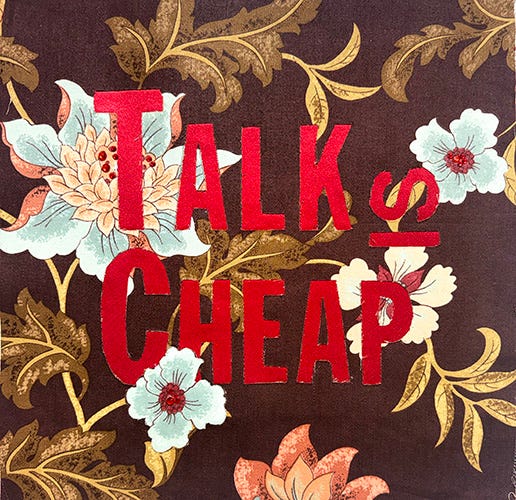
At the end of the poem the speaker says that when he hears the words “Not you,” (after the beloved realizes how distraught her words made him feel) all is forgiven. All the pain inflicted by the original words are now erased, and these new words have “saved” his life. For me, this ending is unbelievable, and makes words empty and “talk cheap”. If words are powerful and can inflict wounds, can the same speaker then say words that miraculously heal those wounds? The poem did not suggest that the beloved changed her original words of “I hate.” It says that when she realized that they hurt the speaker, she added two additional words, “not you,” and that served as magical sutures for his deep wounds.
The second image I created, Talk Is Cheap, is in response to this quick two word ending. The majority of the poem is about the consequences of saying hateful words, with “hate” appearing six times throughout the poem. I have a difficult time seeing how two words, “not you” could honestly undo the pain that was inflicted to the speaker. You cannot unhear what you just heard. Perhaps, the speaker doesn’t believe it too.
What do you think? I would love to hear your take on this poem in the comments.
Thank you for joining me this week. See you next sonnet.
Suzanne ♥
52 Weeks of Shakespeare’s Sonnets is a year-long exploration of how I come to understand Shakespeare through artist’s books. Each week begins with a close reading and then develops through sustained visual inquiry, material testing, and revision. Through printmaking, historical textiles, and the structure of the book itself, I test one sonnet in material form and document what the process reveals.
No posts
Comments
Nothing yet. Say the first thing.
Sign in to join the conversation.