
When classical academies and Catholic schools proclaim with much confidence that their program of formation builds virtue, what exactly do they mean? Which virtues? There are intellectual virtues like science, but the virtue of which Aristotle speaks is distinct from what we typically mean by science today. There are moral virtues, too, like temperance, but schools typically focus on academics and it is not obvious that learning about temperance makes a person temperate. Perhaps in the case of Catholic schools, they mean that their religion classes promote the theological virtue of faith; what of the other classes? How are virtues formed in the humanities, mathematics, or science?
In Plato’s Meno, Socrates hosts a similar discussion of virtue—what it is and whether it can be taught— but concludes in a state of aporia: the controlling questions have not been satisfactorily answered. Socrates has revealed a previously hidden ignorance within his interlocutors’ interior life. He has even convinced Meno of the value of unveiling such ignorance. Classical education takes the Socratic discussion as its foundational pedagogy for one of two purposes. Students might take the place of Meno’s attendant and learn a discipline like geometry or literary analysis by answering a series of questions from the teacher. Alternatively, they may take the place of Meno himself and end a class period in a state of aporia, which their teacher hopes results in humble wonder and not skepticism.
The relationship between Catholic education and classical education can be elusive. On the one hand, the reality to which many refer as classical education—liberal arts, Socratic discussions, integrated humanities, and the telos of virtuous students—developed within and because of the Catholic Church, especially in medieval Europe. On the other hand, there are major advocates for Catholic liberal education who intentionally avoid calling it “classical,” even when the distinction is not quite clear. In other contexts, the distinction between liberal education and the classics of ancient Greece and Rome is an important one that is too often obscured.
What is distinctly not classical in the latter sense—but more medieval—is the integration of the Christian gospel into this educational vision. The incarnation and paschal mystery bring with them profound ramifications for what it is to train up young people and “transmit manhood to men,” as C.S. Lewis put it. The Catholic faith has integrated classical wisdom into its vision for human nature, but has also elevated merely human wisdom by a hypostatic union with divine mysteries. Succinctly, the incarnation of the logos changes everything. Like Socrates, the Word made flesh had true wisdom that confounded his contemporaries, resulting in his own death. Like Socrates, Christ’s questions make him a great teacher.
While Catholic teachers might ask Socratic questions and inspire wonder with humble aporia, they might also use what we might call a Christic approach to asking questions in the seminar classroom; questions modeled after the example of the greatest teacher. The Easter episode of John’s Gospel contains an often overlooked question from our Lord. St. Thomas Aquinas’ commentary is illustrative of Jesus’ pedagogy.
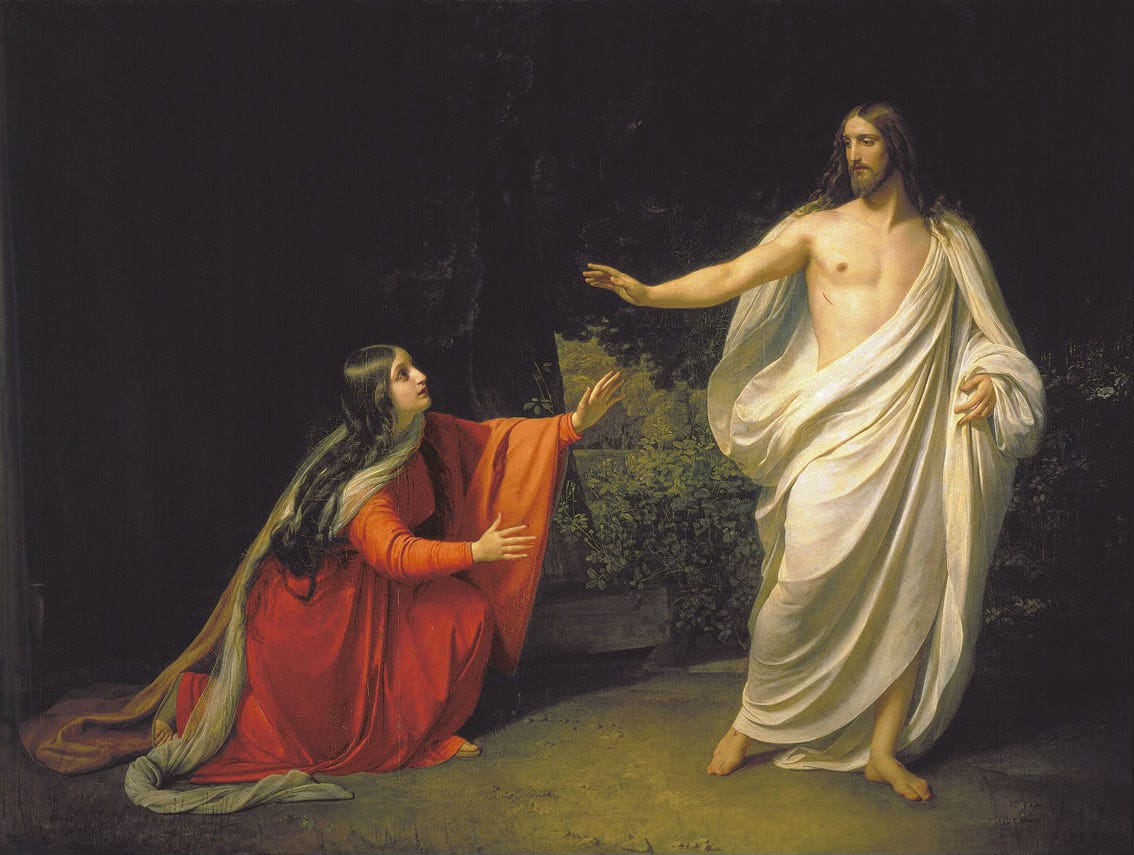
In John 20, Mary Magdalene’s visit to the Holy Sepulcher begins in an unexpected sorrow. The empty tomb is not an immediate cause for joy, but a cause for weeping. Thomas’s commentary on this episode returns again and again to Mary’s admirable love for our Lord: “Because of Mary’s exceeding love she could not delay telling… the disciples.” She “was more ardent and more devoted to Christ…” It was “the desire of love” that caused Mary to weep “abundant tears of devotion.” Even the fact that “she stooped and looked” into the tomb is because in the absence of the beloved Lord, she wanted at least to hold the memory of him in her heart. As the risen Jesus approaches, Mary turns to face him. St. Thomas imagines her physical turn as a sort of conversion: “if anyone desires to see Christ, they must turn round to him.”
Despite Mary’s impressive love, she does not recognize him. So, Jesus begins his pedagogical inquiry: “Woman, why do you weep? Whom do you seek?” Jesus asks questions to which he knows the answer with the purpose of producing something within the disciple. In this case, Mary is already weeping; already suffering the painful loss of her beloved. “Christ asked her whom she was looking for in order to increase this desire, for when she spoke of the one she was seeking, her love burned more intensely and so she would continue to seek him.” The fulfillment of her desire came when Jesus called her by name; immediately she recognized him and exclaimed, “Rabboni!” which St. John explains means teacher.
Jesus’ questioning here is not wholly dissimilar from Socrates’ characteristic interrogation, but the subtle differences are important. Socrates examines the knowledge of his interlocutors with a multitude of questions in extended dialectic. He truly does not know what Meno, Gorgias, or Thrasymachus will say. He suspects that their confidence in areas of virtue, rhetoric, or justice is misplaced, and merely points out ignorance of which they were previously unaware. There is an affective dimension, since wonder is a passionate response, but the line between knowledge and passion is clear.
In contrast, Jesus’ question is keyed to the integration of Mary’s interior life with the personal reality that is Truth himself. “Whom do you seek” is implicit praise for Mary’s sorrow; as if to say, “it is right to sorrow over my absence because that sorrow motivates the search for me.” As a rhetorical question, the goal is to produce (in this case, intensify) the answer within the student. Mary does not need to answer exteriorly, because the deepened desire in her heart is itself the right answer. Jesus’ question has contributed to the ordering of Mary’s passions that she might ever more closely conform to the reality of Jesus’ lovability. He is infinitely lovable, and so she should continue to desire him deeper and deeper still. Mary recognizes Jesus for what he is to her in this moment: Rabboni—even more, a teacher of virtue.
Jesus’ question becomes the answer to Plato’s Meno. At the end of the dialogue, Socrates and his companions have not explicitly articulated either a precise definition of virtue or whether it can be taught. Jesus’ questioning of Mary Magdalene has effected virtue within her. Sorrow at the absence of Christ motivating the search for him is itself a species of charity. For charity, as Aquinas teaches, is friendship with God, an orientation of the will toward him as final end. Jesus has assisted Mary in cultivating this important virtue by asking specific questions; he sees her interior life, diagnoses her specific need in that moment, and becomes in that moment her Rabboni, teaching her virtue.
Can fallen man imitate Jesus in this sort of questioning? Perhaps the obvious answer is in the negative. Certainly I cannot see into the hearts of my students in the way that Jesus can. On the other hand, as a Catholic educator I purport to seek the cultivation of virtue in my manner of educating. It is virtue that makes a man free, so Catholic liberal education liberates students by assisting them in the conformity of their passions to reason. C.S. Lewis summarized education in The Abolition of Man by including Augustine’s conception of ordered love (ordo amoris), Plato’s command to train “the little human animal” to have “the right responses,” and Aristotle’s aim of “making the pupil like and dislike what he ought.”
An essential foundation for teachers to ask Christic questions is a high quality of the spiritual life. Catholic school leaders must do all they can to empower and enable their teachers to develop a rich spiritual life. Teachers must be the branches to Jesus’ vine. Nemo dat quod non habet should be carved into every classroom podium and every teacher’s desk. Faculty culture must be animated by the Catholic identity of the school and should reciprocally intensify the school’s Catholic identity. Catholic schools should be making saints, but that means we hire saints and host holy professional development. Of course, the knowledge and love of God required for perfect holiness is a tall order; but the point is that without Christ we can do nothing.
Further, teachers can only be Christ to their students if they see Christ in their students. Pupils are “the least of these” that merit elevated dignity in our eyes, special affection, and loving attention. Teachers must have high expectations, hold their students accountable, play, laugh, and sing with their students, and cultivate a true friendship with them. This friendship should be the friendship of virtue of which Aristotle speaks in his Nicomachean Ethics. Such a friendship does not necessitate blurring the lines of school hierarchy, but it does mean acting in loco parentis with full transparency for the primary educators.
Only then can teachers ask questions that integrate the passions with the intellect. If we can ask Socratic questions to lead students to truth, then we can take one further step to ask Christic questions that lead them to love the Truth. These can be in the form of stated questions. I told my students in a lecture recently that moral theology is all about living an answer to the question, who or what do you love? Christic questions can also be part of a seminar discussion, how should the reader feel toward these characters? or does a Catholic have an obligation to patriotism? What kind of patriotism and why? Before they are even answered, these questions contribute to the reordering of the passions.
Man fails in the pursuit of wisdom when he is unaware of his lack of knowledge. Socratic questioning seeks aporia and results in wonder, the beginning of wisdom. Yet, man not only lacks knowledge, he also lacks the proper passionate responses; he lacks the union of intellect and affections that comes with the moral virtues. He lacks charity. The Word was made flesh to justify human nature, to train and infuse us with the virtues, and by his stripes to make us whole. The great Rabbi taught as one with authority, led by example, and modeled good teaching in his lectures, story-telling, and Christic questioning. As the Catechism of the Catholic Church says, “it is Christ alone who teaches—anyone else teaches to the extent that he is Christ’s spokesman, enabling Christ to teach with his lips.” Those who teach in Catholic schools are not even supposed to teach, they are supposed to allow Christ to move in and through them.
If this piece made you think of someone — a teacher, a principal, a parent wrestling with these questions — would you forward it to them? One attentive reader is worth a hundred passive followers, and you probably know exactly who I’m describing.
Comments
Nothing yet. Say the first thing.
Sign in to join the conversation.