
Advocates of school choice, classical education, and other alternatives to the day’s status quo have a keen sense that the typical primary and secondary school is doing more harm than good. National discourse centers around falling test scores, grade inflation, the necessity of remedial college math courses, vanishing literacy, political indoctrination, and similar problems. Popular media figures and policy makers almost never talk about the sources of any of these. Why and when did modern education go so wrong?
All these critiques of modern education are—of course—legitimate and important. Yet, if we start new schools, divert public funds, and fail to properly diagnose the source of our problems, then we’ll end up with the same failures in a few years.
Jeremy Tate of CLT is right when he says that at the national scale, there are essentially four strategic targets for educational reform:
Control of public educational funds
Accreditation
Teacher Certification and Licensure
Standardized Testing
All four of these must be considered deeply as Americans and Catholics reform both public and private education. There are classical Charters as well as school choice legislation doing great work in diverting public funds to support good curriculum and pedagogy. While there is much to do in the accreditation space, several organizations are doing important work, including Lumen Accreditation, NAPC*IS, ACCS, the Classical Latin School Association, and others. I discussed solutions to teacher licensure last week. CLT is doing great work in standardized testing for grades 3-12. At the ground level, new schools are coming up everywhere. There is at least one Catholic Bishop that is working on the intentional renewal of Catholic education in every school in his diocese.
If these various endeavors, organizations, and individuals are to be successful, they must consider the root causes of the present crisis. While contemporary Americans often don’t want to consider underlying philosophies, we would be silly to think we have the cure to an illness we don’t understand. One such underlying cause is the philosophical basis of modern, progressive education itself, and its founder: John Dewey.
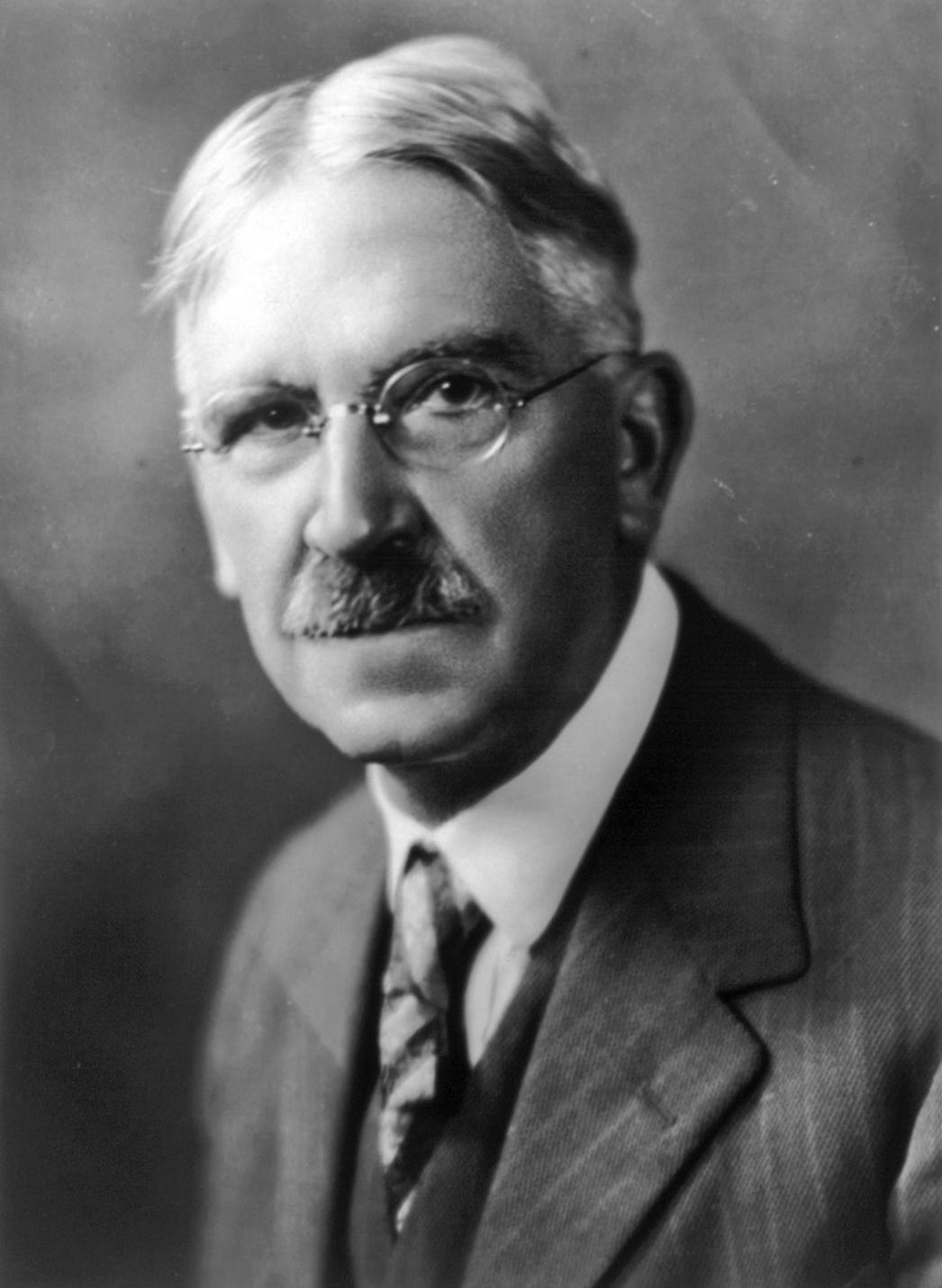
John Dewey (1859-1952) was an American philosopher and educational reformer. If you’ve heard of him, it was probably in reference to the Dewey Decimal system in libraries. His greatest influence, however, was in his 26 years as a professor in the Teacher’s College at Columbia University. He taught the nation’s future leading teachers, principals, and superintendents their educational philosophy. As a result, his impact on American education was a great deal more influential than most people might think.
Dewey sharply opposed what education had been up to his day. He rejected traditional education’s tendency to “impose” knowledge “from above;” his own educational philosophy prioritized “expression and cultivation of individuality.”1 Dewey preferred the “free activity” of students over external discipline. He replaced learning from texts and teachers to learning by “experience.” These and other hallmarks of Dewey’s philosophy birthed what is now referred to as “child-centered” education.
Inspired by Jean Jaçques Rousseau (1712-1778) and Johann Heinrich Pestalozzi (1746-1827), Dewey’s approach to education drove a wedge between the received tradition and a narcissistic individualism. R. Jared Staudt rightly points out:
a child-centered approach to education has undermined the passing on of tradition. The claim that children learn incrementally only in set stages has translated into the dumbing down of the curriculum, putting off complex thoughts into the future (or not at all). That children should be active rather than passive in the classroom has itself resulted in a different form of passivity in not aspiring to knowledge. That education should relate to the child’s direct experience and environment has cut students off from consideration of the transcendent. That education should provide useful preparation has sidetracked the need to enrich the human person with noble thoughts and aspirations.2
Modern education has traded the tradition of initiating the young into our shared humanity and into Christian discipleship for asking the young what they want to be, and forming them for that. It is no wonder that this has been a disaster.
Staudt rightly points out the neglect of the transcendent. Catholic education is meant to be inspired by a supernatural vision and Christian anthropology. As I’ve noted before:
Every time someone suggests something about education they are simultaneously making a statement about what they think the human person is.
Dewey’s understanding of the human person cuts the student off from the transcendent. Catholic education, on the other hand, is inspired by a supernatural vision. Catholics study the world and its creator because that contact between our minds and reality is something worthwhile in itself. We don’t ask about the practical utility of reading Shakespeare or studying biology, because we know that Shakespeare reveals human nature to us and biology reveals living creatures to us. When our minds grasp the complexities of our nature or the world, we find truth. Truth is transcendent of any particular fact or use. Ultimately, all contact with truth is contact the Truth which Jesus reveals himself to be.
This sort of knowledge (of Truth) enables us to grasp our own nature, and what it’s for. Beyond a navel gazing exercise of self-discovery, true knowledge of human nature puts on display what it means to be good as a human. Like truth, goodness transcends this life and it transcends the created world (Mark 10:18).
Truth and goodness, when seen and appreciated by the well-formed soul is delightful. This delight is a result of beauty. Truth, Goodness, and Beauty—those three words that grace the mission statements of classical schools everywhere—are three of the transcendentals. They are shared in by everything that exists because they are the mark of the creator.
It is man’s purpose to know the truth, do the good, and love the beautiful. Dewey and modern education have cut us off from these transcendental properties of the world. Without them, we fail to achieve our ends as human beings. Without their pursuit, we see other failures as evidence: failing academic progress, evil political indoctrination, and ultimately a diminished participation in our shared humanity.
John Dewey, Experience and Education (Great Books of the Western World, Vol. 55, ed. by Mortimer J. Adler and Philip W. Goetz; Chicago: Encyclopedia Britannica, 1990), 100.
R. Jared Staudt, Words Made Flesh: The Sacramental Mission of Catholic Education (The Adeodatus Series on Catholic Education and Culture, ed. by Alex Lessard and R. Jared Staudt; Washington D.C.: CUA Press, 2024), 108.
Comments
Nothing yet. Say the first thing.
Sign in to join the conversation.