
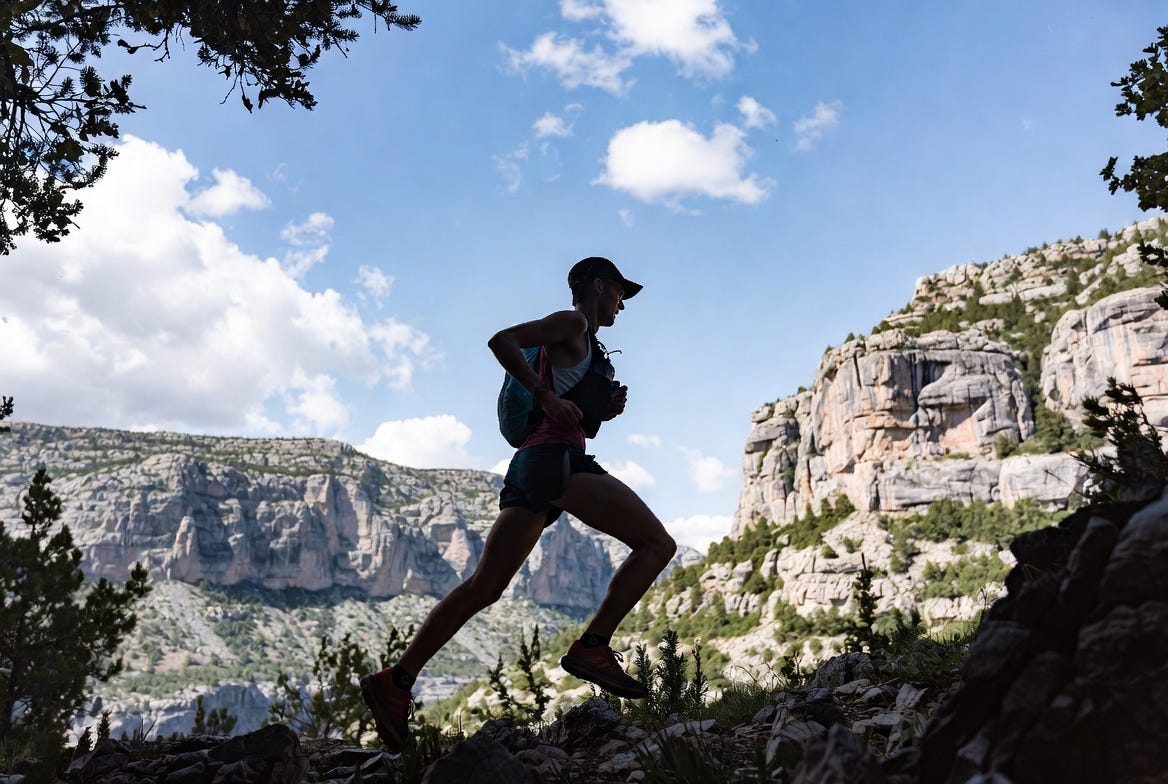
In September of 2022, I attempted my first (and subsequently only) 100-mile footrace in the KZN Midlands. It was the fourth race out of five that I was trying to run in 12 months. My previous three races (all 100 km races in mountains and the desert) had gone relatively well, and this “miler” I was hoping would be my first buckle. (Completing a running race earns you a medal, but when you finish a 100-mile race, you traditionally get a belt buckle.) It was a big ask considering the amount of training required to attempt this race, and even with all the required training, my normal life commitments didn’t stop.
I started the race probably a little overcooked, and at 121 km my body finally enforced what it had been threatening to do since kilometre 107. I had run the last 80 km by myself with a malfunctioning watch, making navigating tough in the dark. I had been awake for 41 hours, and I wasn’t sure if the eyes watching me run in the forest were actually there or not. Access to decent nutrition was impossible, and I had a dire case of the wobbles. I was so dizzy and nauseous that if I didn’t look where I was planting my feet, I’d want to fall over. I could hear liquid sloshing around in my stomach, which meant I wasn’t hydrating properly.
All races have challenges, but these had all compounded into what felt like a final stand with my ego, and as I arrived at the aid station, I knew this was the end of my race. Exhaustion had made itself at home in my body as my mind screamed to escape the sensations it was trying to process. I sat down, with feet and hands swollen, beaten and emotional, knowing this would be my first DNF. I reached to take off my tracker, officially withdrawing from the race, but before I could, a lady at the aid station stopped me. “Wait,” she said. “Before you quit, let me get your wife.” She was hoping that perhaps chatting to Candice (who was seconding me) would give me a boost to continue the race as she had done at the previous aid stations. She ran off and after a few minutes returned. I had closed my eyes, desperately wanting to sleep where I was sitting, but Candice’s voice was speaking light through the Midland mist in my mind.
“He would rather die than quit, so if he says he’s done, he’s done,” she said. I felt the tension leave my body. I felt like I had got that elusive buckle. I had been seen, and that was enough. I was done. I couldn’t possibly go any further, and although I had fallen short of my race objective, the lessons and growth of the previous 41 hours was why I was there anyway.
Candice drove me to our accommodation. She stopped the car twice so I could vomit and helped me into the shower and then bed. In sickness and in health, they say. I woke up the next morning to post that I had not completed the race and to thank everyone who had supported and followed my progress. A fellow runner (who went on to complete a 200-mile race in the desert) and brand ambassador for the same hydration drink that I represented commented on my post: “The biggest challenge is getting to the start line; anything can happen on the day. The experience you get with a DNF is invaluable for the next one.”
That comment is the inspiration for this piece of writing. So much of life is about chasing the finishing line so fiercely that we forget that the race is the whole point. We’ve inverted the human experience by placing emphasis on the outcomes and ignoring the process of becoming. Perhaps our focus should be on the learning, building, trying and failing rather than trophies, bank balances, followers and titles. If we prioritised process over outcome, we wouldn’t abandon ambition; we would deepen our relationship with it.
It’s a natural law that if you sustain effort, then growth becomes inevitable. The growth is in the process, though, not the results. When results are the only measure of success, the anxiety it creates causes us to judge every step of our progress by proximity to the goal. Results can be falsely seductive because they are simple and measurable. The process isn’t linear and so often is messy, slow and delayed. It’s about who we become in the attempt, because life isn’t a test; it’s a practice.
To prioritise process means to treat every step or action in a journey as an end in itself. The Japanese have a concept of shokunin, which is the relentless pursuit of mastery for its own sake. A sushi chef will spend years just learning how to cook rice perfectly, not for recognition but because rice is the soul of sushi. The glory is in 10,000 bowls of rice no one will ever taste. The process is the offering, and when we treat the process as sacred, then failure loses its sting. The true virtue of achievement is victory over oneself—who we become on the journey. Those who know this victory can never know defeat. Process over results.
When I could reframe my DNF in my race, the failure simply became data and lessons. These invisible harvests forced me to make some changes in my diet, attitude and an inner acceptance of who I had become in my running attempts. The glory ends the moment you finish a race, and eventually dust overwhelms the shine of medals on a shelf. The finish line photo doesn’t tell your full story. The resiliency and discipline you develop in process through focused, repetitive effort lasts a lifetime. These gifts of process compound over time and bleed into each other. Development in one area of your life leads to development in others as these unseen forces become neural scaffolding on which results are built.
Prioritising process is realising that life is the growth between our first and final breaths. Life should be lived from the perspective of “What did this situation teach me?” rather than “Why wasn’t I enough?” This mindset is liberating, allowing us to attempt without fear of existential threat. It doesn’t mean abandoning goals or striving for achievements but simply to hold them lightly. The goal or result gives direction; the process gives meaning, and paradoxically, focusing on the detachment of outcomes increases the likelihood of achieving them.
So one day, before you set yourself free from this life, I hope you look back at who you are at the end of your journey and are happy with your attempt. It is the only thing you can control and the only thing that is truly yours. So attempt. Attempt fiercely, imperfectly, daily. Attempt when no one is watching or because everyone is watching. Attempt especially when the odds are laughable, because the universe doesn’t keep score the way we think it does. It keeps track of how fully you lived your attempt in life. The glory is in the attempt. The rest is just noise.
Travel well.
Coalition of the Willing is free.
I would however like to continue to share ideas with you and that means time out of clinic. If you have found valuable ideas or thoughts in what I’ve shared with you, please come and grab a coffee, and discuss them with me in person at Blackout Brew Coffeehouse. www.blackoutbrew.co.za
I’m here most Wednesday mornings from 11:00am to 12:00pm. I hate small talk, so we are going to get straight to the deeper, meaningful stuff. Straight in. No kissing.
If you aren’t in Joburg, South Africa, or can’t treat yourself to phenomenal coffee, please consider supporting me by buying a virtual coffee on the link below.
I would also appreciate you subscribing to Coalition of the Willing and sharing this story with people who you think might benefit from it.
Share Coalition of the Willing
Diverse voices in meaningful conversation. over coffee, breeds powerful collective action.
No posts
Comments
Nothing yet. Say the first thing.
Sign in to join the conversation.