
“The kumite is cancelled,” he shouted from the kitchen door. “I don’t want to fight you anymore.” Rosco slammed the door shut.
“Why not?” I screamed back.
Silence. I stood for a while and then jumped down off our boundary wall rather indignantly. There would be no showdown, no final test of good versus evil. There would be no ultimate battle that day between myself and my older neighbour. A petty squabble the previous day had escalated into an official fight at 08:00 the following morning. I was confident of victory. I had, after all, built a ninja training school in my backyard and had watched every martial arts movie ever made, most of them twice, and Bloodsport’s final fight scene between Frank Dux and Chong Li at least 100 times.
I’m often encouraged by family (Candice especially) to retell the story above, but also to divulge how I arrived for battle that morning in 1988. I’m pretty sure Rosco thought he would easily finish me without using any blinding powder (if you’re a Bloodsport fan, you’ll know what I mean), but perhaps how I arrived to fight forced him to reconsider what he thought would be an easy victory. As an eight-year-old I was round (a genetic trait I carry to this day; you can see I like to train but also don’t say no to cake). So to see this round guy wearing a shorty wetsuit, high-top sneakers, his dad’s army balaclava, and a backpack full of knives, ninja stars, and nunchucks must have caused some reconsidering on his part. A victory without throwing a punch or a spinning back kick. As Sun Tzu said, “Every battle is won or lost before it is ever fought.”
Thomas Hobbes was a 17th-century English philosopher, and he proposed that man’s natural inclination was “war of every man against every man,” a perpetual state of conflict driven by competition, timidity, and the quest for glory. Long before Hobbes, the Ancient Greeks understood the concept of polemos (war) not simply as armed conflict between city-states but as the fundamental principle of becoming. Heraclitus wrote, “War is father of all and king of all,” meaning that battle, struggle, and opposition are the driving force of all change, growth, and accomplishment. In this deeper sense, war isn’t an abnormality of human nature; it is human nature itself. Our minds are battlefields where fear wrestles with courage, laziness confronts discipline, and ego battles humility. To be human is to be constantly at war.
This fundamental truth often causes quite a bit of societal throat-clearing and uneasiness. We are told that inner and outer peace is the natural and more desirable state, that violence is pathology, and that the highest human goal is comfort and the absence of conflict. This is, however, a very dangerous illusion playing out within society today. When we deny our warlike nature, we don’t abolish war; we drive it deeper into our subconscious, where it festers into resentment, passive aggression, addiction, self-sabotage, and eventual explosion. Men and women who do not fight and confront their demons are bound to be prisoners and slaves to those demons. Any society that forbids its young men from competing in an arena of moral struggle produces cowards or directionless thugs who turn their unchanneled aggression on the weak or on women in society. If you saw the response to GBV Day last week in South Africa, you’ll know we have a problem in our country.
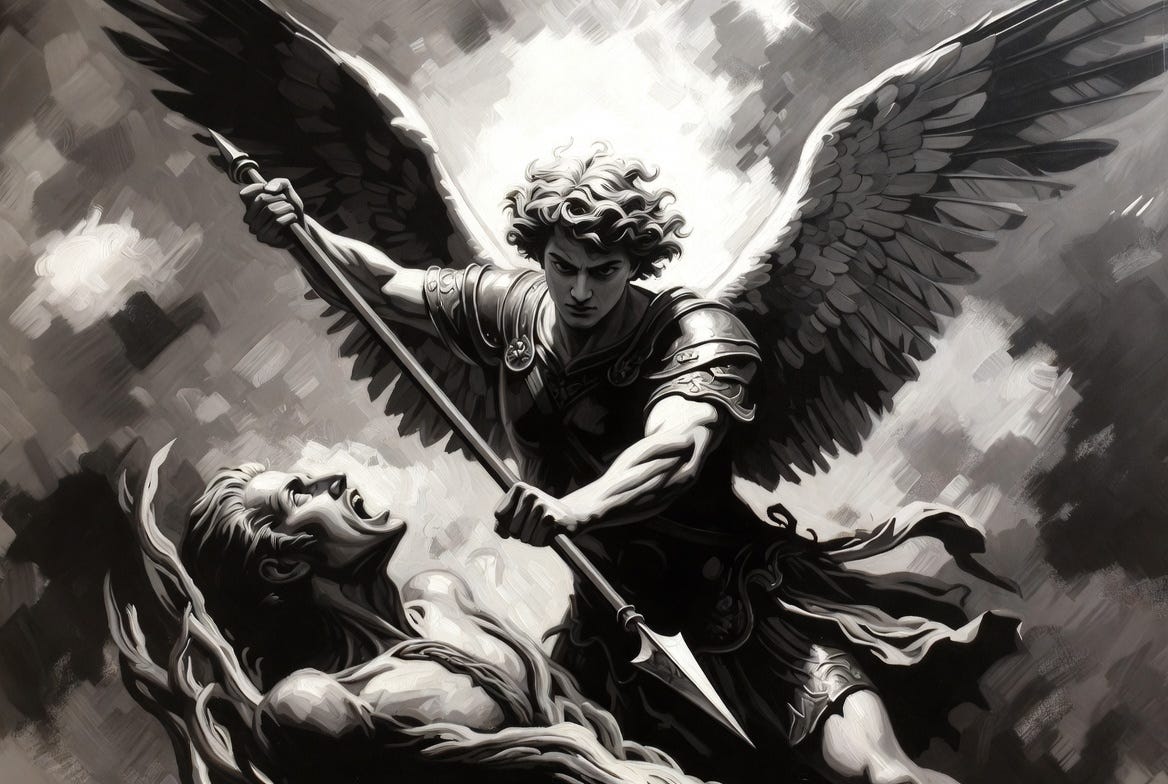
All holy and religious texts often describe wars on earth, in Heaven, and in Hell. In the Bhagavad Gita, Krishna commands Arjuna not to lay down his weapons in pacifism but to fight with detachment as an act of duty rather than hatred. My arm has an unfinished tattoo sleeve with a focal point of Archangel Michael defeating Lucifer and casting him into Hell. A Latin inscription on his shield says, “If it is peace you seek, then you must prepare for war.” A reminder, metaphorically, to constantly engage in battle to overcome the dark parts of myself. The warrior’s path is simultaneously the yogi’s path and converges on the same insight: the external war is only as valuable as it reveals the quality of the internal war. The real enemy is not the opponent opposite us; it is the chaos, cowardice, and mediocrity within.
Because we are born for conflict, we are also born for transcendence. This is the redemption inherent within our warlike nature. Every vice has embedded within it the seed of its opposite virtue that is germinated through struggle. Fear isn’t eradicated by recklessness; it is refined into awe before true greatness and into courage that chooses to act despite trembling because the victory is worth the risk. Anger isn’t eradicated; it is forged into righteous indignation and bridled force. Pride does not disappear; it is humbled and then reborn as self-respect earned through trial. What doesn’t kill us makes us stronger, but only if we choose to fight rather than cower from the battle.
Character is only built where the darker parts of our nature meet disciplined opposition, and so the warlike nature of man is not a curse to be socialised away; it is raw material waiting for the sculptor’s chisel. The same fire that burns the village can forge the sword. The same aggression that harms can also protect the innocent. The same ambition that tramples others can, when turned inward, drive a person to heights of excellence that benefit everyone. Peace is not the absence of war; true peace is war that still kneels, war against the chaos inside us, war in service of something greater than the self.
Humanity will probably never be rid of conflict because, as I’ve said above, it is so deeply ingrained in our DNA. The task is not to abolish the fight but to choose the right enemies and the right weapons. The war is inevitable. The only question is whether we will be its victims or its victors, whether we will let it destroy us or let it refine us into something nobler than we were. That choice is the one battlefield on which you can never surrender.
Travel Well
Coalition of the Willing is free.
I would however like to continue to share ideas with you and that means time out of clinic. If you have found valuable ideas or thoughts in what I’ve shared with you, please come and grab a coffee, and discuss them with me in person at Blackout Brew Coffeehouse. www.blackoutbrew.co.za
I’m here most Wednesday mornings from 11:00am to 12:00pm. I hate small talk, so we are going to get straight to the deeper, meaningful stuff. Straight in. No kissing.
If you aren’t in Joburg, South Africa, or can’t treat yourself to phenomenal coffee, please consider supporting me by buying a virtual coffee on the link below.
I would also appreciate you subscribing to Coalition of the Willing and sharing this story with people who you think might benefit from it.
Share Coalition of the Willing
Diverse voices in meaningful conversation. over coffee, breeds powerful collective action.
No posts
Comments
Nothing yet. Say the first thing.
Sign in to join the conversation.