
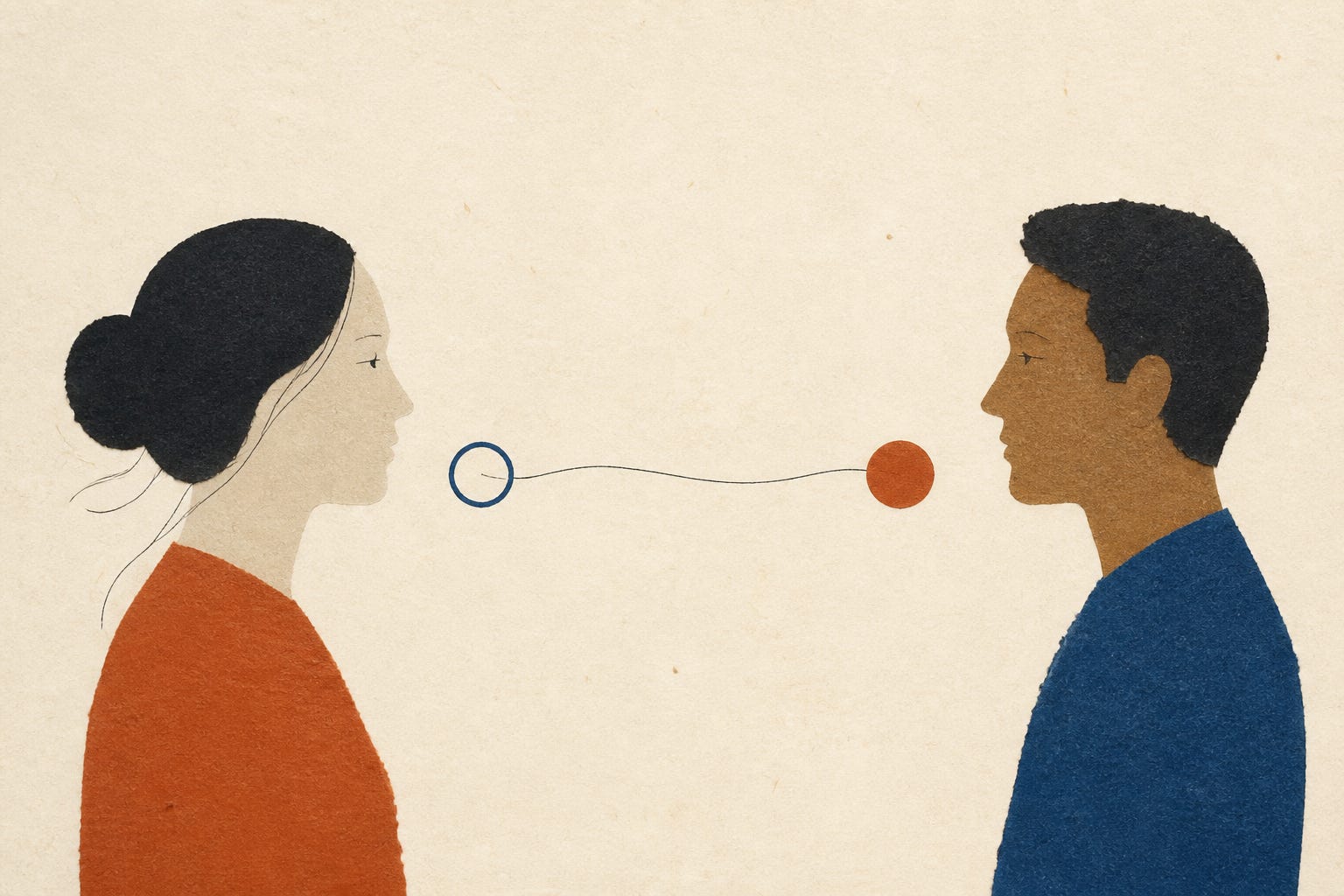
Two people. One of them makes a request. The other one gives an answer.
That’s all that’s required. Everything else is context.
The board deck. The four meetings before the real meeting. The eleven months of relationship you’ve been carefully building with someone you still haven’t asked for anything.
Context.
You haven’t made a request. You know which one. You’ve known for months, and you’ve got very good reasons.
You didn’t decide against making it. You did something more sophisticated than that.
You turned it into a statement.
You told your co-founder you’d been thinking about the split, and watched his face. You told the investor where the round was, and waited. You told your wife you’d been traveling a lot lately.
A statement can’t be refused.
That’s why you picked it, and it worked exactly as designed.
The man who wouldn’t answer
I told a man I’ve known for years to come spend a day with me.
He said he’d love that. I told him I was going to charge him for it, so he'd know. He said of course.
I sent him my offer.
He wrote back: “Want to know something I’m afraid of?”
Then: “That if I say no, you won’t want to talk to me anymore.”
I told him that was powerful, and thanked him for sharing it.
The next morning there was still no answer.
So I texted him. “Good morning. Are you going to reply?”
He told me he’d been with someone all day yesterday. Then: “but yeah, man, that’s where I’m at.”
I pointed out that he hadn’t told me where he was at.
He repeated himself. “I’m worried that if I say no, you won’t want to talk to me.”
I told him I’d understood that the first time. My question was a different one.
“Are you going to make a decision, or avoid making one because of what it might mean?”
He said, “Oh. Good point. I’ll let you know later today.”
He wasn’t afraid of losing me.
That was the sentence he had available, and it was a good one. It was warm, it was honest, and it bought him another day of not answering.
He was afraid a no would prove something about himself he’s been outrunning for a long time.
So he did what you do. He turned it into a statement.
Notice he’d already told me the truth. Twice, in plain English, and it still wasn’t an answer.
Later that day, he sent me his no. Nothing bad happened to either of us.
Why the good version doesn’t help
Now put yourself on the other side of it.
You’re the one waiting on the answer, and you’re decent, and you can see he’s struggling.
So you do the generous thing. You go first. You name your own fear, you promise the relationship survives either way, and then, because you’re perceptive, you tell him what he’s afraid of.
That will fail.
The moment you narrate his half, you’ve written his lines. He has to either read them or defend himself against a diagnosis he never asked for.
You didn’t open anything. You did his flinching for him and called it empathy.
His half isn’t yours to solve. You don’t get to know it. You only get to ask for it and be quiet.
All that preparation reaches exactly half of the problem. Yours.
He still can’t answer. He doesn’t know anything is running him.
He thinks he’s deciding.
What we’re actually protecting
We do this everywhere, and we don’t do it because we’re cowards.
We do it because we decided the answer was going to prove something.
We ask questions without using a question mark.
“I love you.”
Said a certain way, with a pause after it, that isn’t a declaration. It’s a request that can’t be turned down.
A question can be refused. A statement can’t.
A statement also can’t be answered.
So you’re protected, and you’re alone, and you’ll stay in the eleven-month relationship for another eleven months.
What the world would look like
If every person asked the question they actually wanted to ask, and every other person answered exactly as they wanted to answer, everything would sort itself out.
Everyone would be in the right company, with the right partners, married to the right person.
Not because everyone got the answer they wanted. Almost nobody would.
Because everyone would find out, and then be free to go and do something about it.
Including the answers you’re certain you couldn’t survive.
“Dad, do you actually love me?”
“No, son. Never have.”
Okay. Cool. Now I know.
I’ll go and find a family that loves me. Good luck to you.
I know how that reads. It reads like I’m making light of the worst thing a person could hear.
I’m not. I’m telling you what it costs to not hear it.
The alternative isn’t safety. The alternative is sixty years of managing a question, which we’ve agreed to call having a complicated relationship with our father.
Sixty years isn’t cheaper. It’s only quieter.
The answer isn’t the verdict
Here’s the part that makes it possible, and it’s the opposite of what you’re braced for.
The no isn’t proof of anything. The yes isn’t proof of anything either.
They’re not verdicts. They’re information about what the other person wants, which you didn’t have this morning.
That’s the whole return on investment. Not the yes. The knowing.
Every hour you spend arranging the conditions so the answer comes back right is an hour spent making sure you never get the information.
Now, someone reading this is thinking: some requests genuinely shouldn’t be made yet.
Sometimes that’s true. Mostly it’s the statement talking. The test is simple, and it isn’t comfortable: if you already know what they’d say, you’re not waiting for a better moment. You’re avoiding the answer you’ve already written for them.
You don’t need him to say yes.
You need him to say something.
Ok, now it’s your turn.
Find the request you’ve turned into a statement. Start with the business one, since it’s the easiest to see. Then find the other one, the one you thought of first and skipped past.
What am I afraid the answer would prove about me?
Have I already decided what they’ll say, and am I calling that being realistic?
If I got the worst possible answer on Tuesday, what would my life actually look like on Friday?
What have I been hinting at for months because a hint can’t be turned down?
Then go and ask it. Plainly, once, and stop talking.
Most people won’t. That’s okay. Everyone’s doing the best they can with what they can see.
You’re not owed a particular answer.
You’re owed an answer.
Loving you,
Townsend
No posts
Comments
Nothing yet. Say the first thing.
Sign in to join the conversation.