
Hey Coach,
Do you have a System?
This week was a first for me.
After 30 years of coaching, I spent my first week ever as a classroom teacher.
And let’s just say I learned a lot.
I was creating lesson plans.
Teaching classes.
Grading papers.
Trying to figure out what worked, what didn’t, and what I needed to change for the next day.
At the same time, I coached three flag football games during the week.
Basketball is starting back up.
I’m working with our players.
I’m continuing to run System Basketball and build everything we’re doing inside the System Basketball Community.
And somewhere in there, I’m still trying to be a husband and dad.
By the end of the week, one thought kept coming back to me:
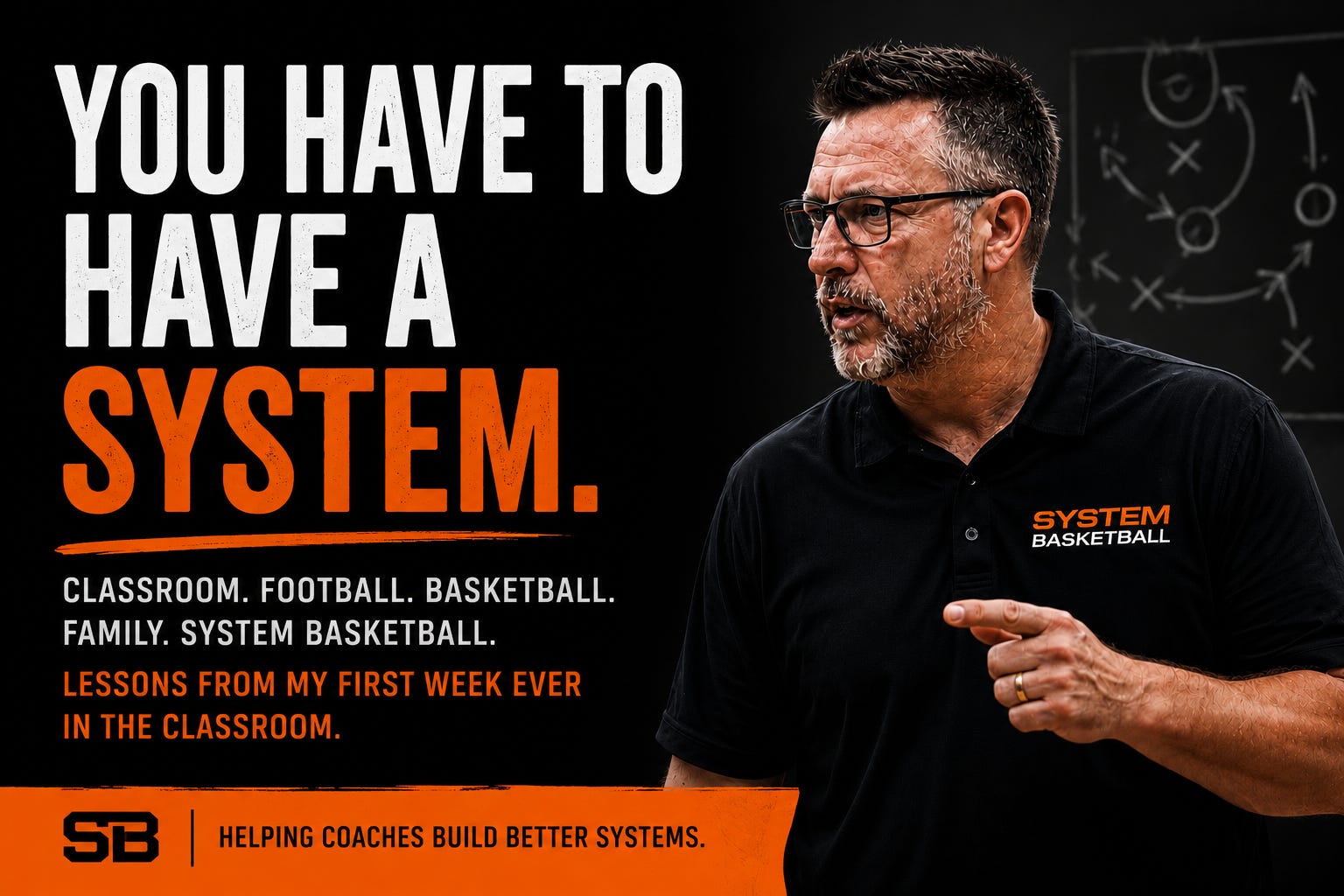
You have to have a system.
And I’m not just talking about basketball.
I’ve coached for 30 years.
I’ve planned thousands of practices, prepared for games, broken down film, organized teams and dealt with just about everything that comes with a basketball season.
But teaching in a classroom?
This was new.
I’m learning how to organize multiple classes.
How far ahead do I need to have my lesson plans ready?
What’s the best way to grade everything?
What worked with one class that didn’t work with another?
What needs to change tomorrow?
Then the school day ends and coaching starts.
This week, that meant three flag football games.
Then there’s basketball.
Then there’s System Basketball.
Then there’s family.
Maybe your schedule looks different from mine, but I know a lot of coaches reading this understand exactly what I’m talking about.
Most of us aren’t just coaches.
We’re teachers.
We work other jobs.
We’re parents.
We’re husbands and wives.
We’re watching film.
We’re answering messages.
We’re planning practices.
We’re preparing for games.
There aren’t more than 24 hours available just because our schedule gets busier.
So one of the biggest lessons from my first week in the classroom has been this:
Being organized isn’t about having more time. It’s about getting more out of the time you already have.
Think about how much time we can spend during a season making the same decisions over and over.
What are we doing at practice tomorrow?
What drill should I use?
How do I teach this?
What are we going to run?
What happens if they take away our first action?
What do we need against this defense?
What’s our plan for the next opponent?
Where did I save that drill?
Where was that video I wanted to show my staff?
Those decisions don’t seem like much individually.
But they add up.
And when you’re already balancing everything else in life, they take away your most valuable resource:
Time.
That’s why I’ve become even more convinced that coaches need a system.
I’ve spent a big part of my coaching career studying basketball systems.
Dribble Drive.
5-Out.
Grinnell.
Pressure defense.
Different ways to create advantages and teach players how to play.
But the longer I coach, the more I realize that a basketball system isn’t simply the offense you choose.
It’s how everything connects.
Your player development should connect to your offense.
Your shooting philosophy should connect to the shots you’re trying to create.
Your spacing should create the driving opportunities you’re teaching players to recognize.
Your drills should reinforce the decisions players are going to make in games.
Your terminology should stay consistent.
Your defense should reflect how you want to play.
Your practice structure should prepare players for the situations they’re actually going to see.
And when the defense takes something away, your players shouldn’t always need another play call from the bench.
They should understand what comes next.
That’s a system.
That’s probably my biggest takeaway from this week.
A good system eliminates unnecessary decisions.
If I develop a system for my lesson plans, I’m not starting from scratch every night.
If I develop a system for grading, I’m not reinventing how I’m going to handle every assignment.
If we have a system in flag football, we’re not teaching something completely different every game.
If I have a system for running System Basketball, I know what needs my attention and what can wait.
Basketball is no different.
A good system gives the coach fewer things to figure out every single day.
But here’s the interesting part.
While we’re trying to eliminate unnecessary decisions for the coach...
we’re trying to create better decision-makers on the court.
That’s really where so much of what I’m building with System Basketball is headed.
There are already 200+ videos, clinics and resources inside the System Basketball Community.
I could easily make the goal to get to 300.
Then 400.
Then 500.
But coaches don’t need another giant folder filled with stuff.
We need organization.
We need to know how things connect.
We need resources we can actually use.
That’s what I want SBC to provide.
Need a drill for practice? Find it.
Need an idea for creating better spacing? Find it.
Need help teaching decision-making? Find it.
Need something against pressure? Find it.
Need ideas for your offense or defense? Find them.
Need something you can watch today and take directly to practice tomorrow?
That’s what I want the community to become.
Not simply more basketball information.
A system for actually using it.
Over 30 years of coaching, I’ve accumulated a lot of basketball.
I’ve run different offenses.
I’ve studied different coaches.
I’ve taught different systems.
I’ve coached different levels of talent.
And I’ve changed a lot along the way.
What I’m trying to do now with the System Basketball Framework is organize those experiences into something coaches can actually use.
Instead of starting with:
What play should we run?
Start with:
What are we trying to teach?
Why are we teaching it?
How does it connect to the way we want to play?
That’s why you’ll continue seeing me talk about spacing, creating advantages, shooting, decision-making, pressure, pace and player development.
They’re not separate topics.
They’re pieces of the same system.
And our next clinic is a perfect example.
On August 23, our next System Basketball clinic will focus on:
We spend a lot of time developing shooters.
Footwork.
Balance.
Mechanics.
Reps.
Getting shots up.
Those things matter.
But there’s another part of shooting we have to train:
The decision to shoot.
When should I shoot it?
When should I drive it?
When should I move it?
What is a good shot?
What is a great shot?
What’s a great shot for me?
What’s a great shot for our team?
Can our players recognize those situations without looking toward the bench every possession?
That’s part of player development too.
One of the simple ideas inside our framework is:
Shoot it. Drive it. Move it.
Three decisions.
But those decisions have to be trained.
That’s what we’ll get into on August 23.
We’ll talk about shot selection.
We’ll talk about creating a shooting culture.
We’ll talk about how I teach players to recognize their shots.
We’ll talk about decision-making.
And I’ll show some of what I’m doing with my own players.
Because shooting shouldn’t be separate from your system.
It should be part of your system.
Your shooting development should connect to your offense.
Your offense should create the shots you value.
Your players should understand which shots you value and why.
And your practices should give them opportunities to make those decisions.
That’s the difference between simply teaching players how to shoot and teaching players how to play.
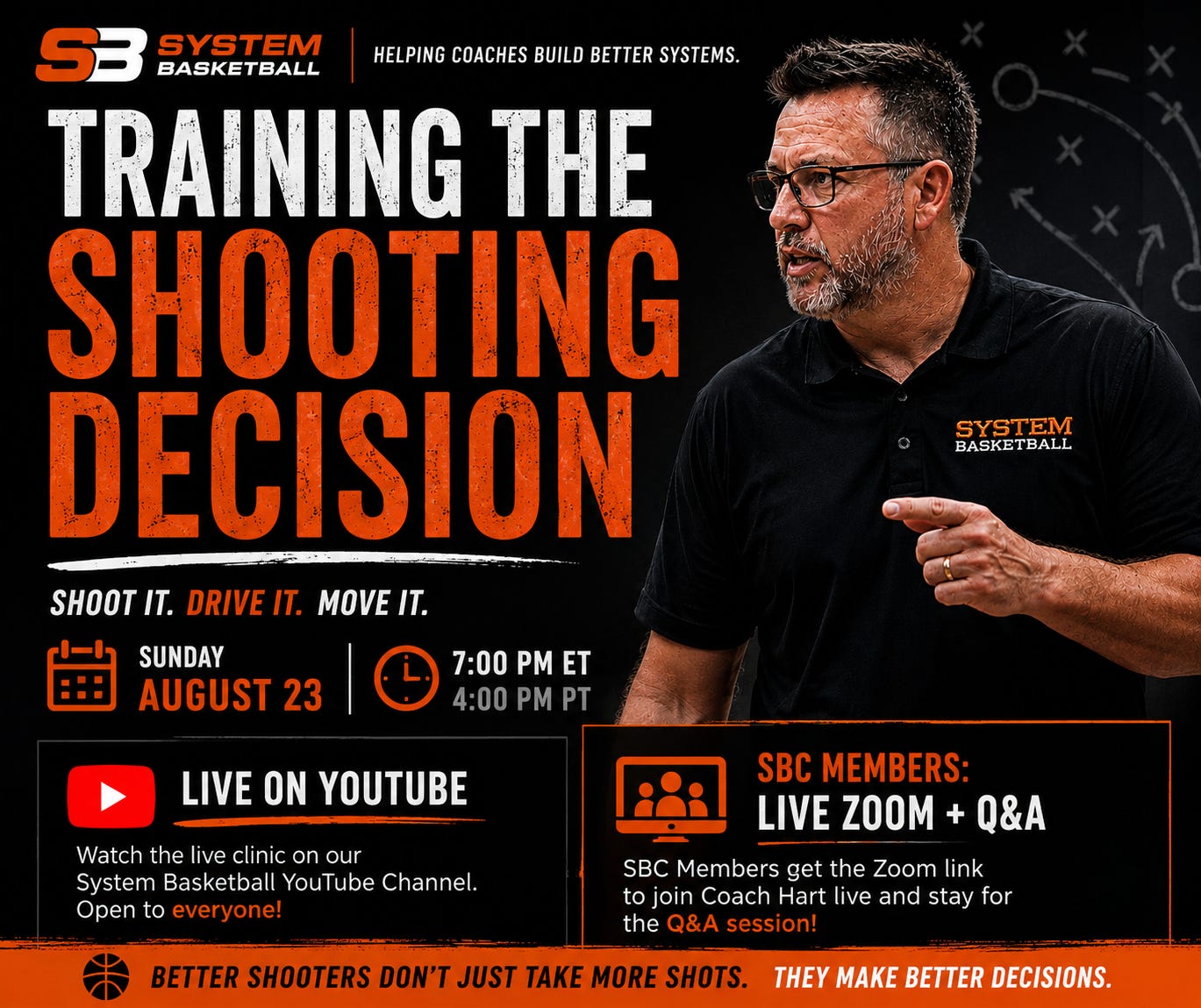
SBC Membership Memberships get the full clinic, pdf’s, video clips, and Q and A portion of this clinic.
So that’s been my first week ever in the classroom.
Lesson plans.
Teaching.
Grading.
Three flag football games.
Basketball.
System Basketball.
Family.
Daughter’s 16th B-day party.
And probably a few things I’m forgetting.
It’s been busy.
It’s been a learning experience.
But it’s also given me a different perspective on something I’ve been talking about for years.
You have to have a system.
In the classroom.
In your schedule.
In your basketball program.
And sometimes just to make it through a really busy week.
I’m living many of the same challenges as the coaches reading this.
I’m trying to figure out how to fit coaching into everything else that matters in life too.
That’s why the mission behind System Basketball continues to become clearer to me:
Helping Coaches Build Better Systems.
Because a better system doesn’t just help your players.
It helps you.
It creates clarity.
It creates organization.
It helps eliminate wasted time.
And hopefully it allows us to spend a little less time searching for what to do...
and a little more time actually coaching.
Have a great week, Coach.
Join the System Basketball Community (SBC) and get access to 200+ coaching resources, clinics, playbooks, drills, and the evolving System Basketball Framework.
Built for coaches who don’t need more random basketball content—they need ideas they can organize, teach, and take to the court.
→ JOIN THE SYSTEM BASKETBALL COMMUNITY
Monthly and yearly options available.
Marc Hart -System Basketball
Helping Coaches Build Better Systems.
Helping Players Make Better Decisions
Comments
Nothing yet. Say the first thing.
Sign in to join the conversation.