
In Collaboration with Coach Andrew Nevit
When developing a game plan,there are many situations a coordinator on either side of the ball must prepare for in order to be successful on game day. One situation that every defense must be able to execute on is passing downs, whether those come in PAR situations or on third down.
More often than not, when it is 3rd-and-medium (4–6 yards to go) or 3rd-and-long (8+ yards to go), the offense is preparing to throw the football. Even in the NFL, 3rd-and-2 or 3rd-and-3 is often considered a passing down depending on the offense, situation, and tendencies.
These situations present an opportunity for the defense.
Having a plan to manipulate the structure of the pass protection an offense is using and isolating areas to exploit within the rules of that protection can be the difference between generating pressure, sacks, pass breakups, and takeaways versus giving up explosive touchdowns and extended scramble drills.
The question should not be simply, “What pressure are we going to call?”
A better way to look at it is:
“How can we manipulate the protection into giving us the matchup we want?”
Offenses have developed countless ways to identify and handle pressure. The amount of options is a writing topic on its own. Whether it be Half-slide, full-slide, BOB (Big on Big), empty dual read protections, running back scan to checkdowns, or even quarterback audibles all are designed to account for potential rushers and keep a clean pocket.
Because of this, simply finding a pressure or blitz you like is not enough.
The best defenses understand that pass protection is a numbers game. The offense is constantly trying to determine how many potential rushers exist on a given play, where those rushers could come from, and which players are actually responsible for blocking them within the protection.
Through a variety of tools like front presentation, late movement, simulated pressures, and line stunts / games, we can manipulate where the offense allocates resources to solve the perceived threats. We can show the offense one problem, force it to commit pieces toward that problem, and then attack somewhere else.
The objective is not necessarily to create a true numerical advantage.
The goal is to create a perceived numerical advantage, manipulate the protection through presentation, and then attack the space this deception creates.
In today’s article, we will review and examine several examples of how we can accomplish this objective. This is by no means a comprehensive examination of every way to manipulate pass protection or generate pressure, but rather a collection of concepts and ideas that can serve as a foundation for developing your plan of attack on game day.
Our first example looks at a team using their front four to get the advantage, starting with Indiana from this past season against Michigan State. The Hoosiers run a three-man game out of their Mint Front. Using the heavy presence of their defensive line into the boundary gets the offensive line to slide that way. The zero nose and boundary 4i attack upfield before converting to a wide path to get the slide to chase, while ultimately working to pick the adjacent blocker with the boundary edge looping back into the open window. While the backside guard sees the looper late and gets hands on the pressure, the stunt forces the quarterback to climb and try to escape, running right into the fieldside 4i, who is rocking out to keep contain before redirecting upfield for the sack.
We will stay with Indy here in the same game. MSU runs a condensed set versus the Hoosiers’ Bear Front, with the overhang walked up as a pseudo wide 9 technique. The overhang bails to the curl-flat, matching the WR out. The stunt to the field goes into the slide, isolating the boundary defensive tackle and end. Both players win their matchups and generate pressure on the quarterback, leading to an incomplete pass.
Another team we can look to is Ohio State, who in 2024 loved using the BOSS Front (Bigs On the Same Side) to achieve similar results. Against the Oregon Ducks here in the all-time classic during the regular season, on 3rd-and-long, the Buckeyes put their 1, 3, and 5 techniques to the fieldside of the center, with a wide 5 technique and the boundary linebacker mugged (walked up in an open gap over a lineman) on the guard to buy his attention.
On the snap, the backer bails, and the 1 technique works back across the center, creating 1-on-1 matchups versus Oregon’s 5-man protection. The Mike backer is hug rushing as insurance for the QB scramble. The defensive line gets pressure, forcing the quarterback to throw the out route short of the goal and ultimately making Oregon settle for a field goal attempt.
Sometimes you don’t need to get fancy: just get your dudes 1-on-1 versus their weak links.
Another great way to dictate protections and create matchup problems or daylight is to walk up second-level defenders into open gaps or onto uncovered offensive linemen. Clemson utilized this tool well in their contest against LSU by getting into a Jet Front (wide 3 and 5 techniques over the guards and tackles) while walking up their Mike to mug the center.
The slide to the field picks up the 3-man game to the field, but Clemson has a weak safety pressure to the man side of the protection, along with a TEX stunt (DL twist in which the tackle attacks the B-gap and works to contain while the end loops around to find daylight) to the boundary.
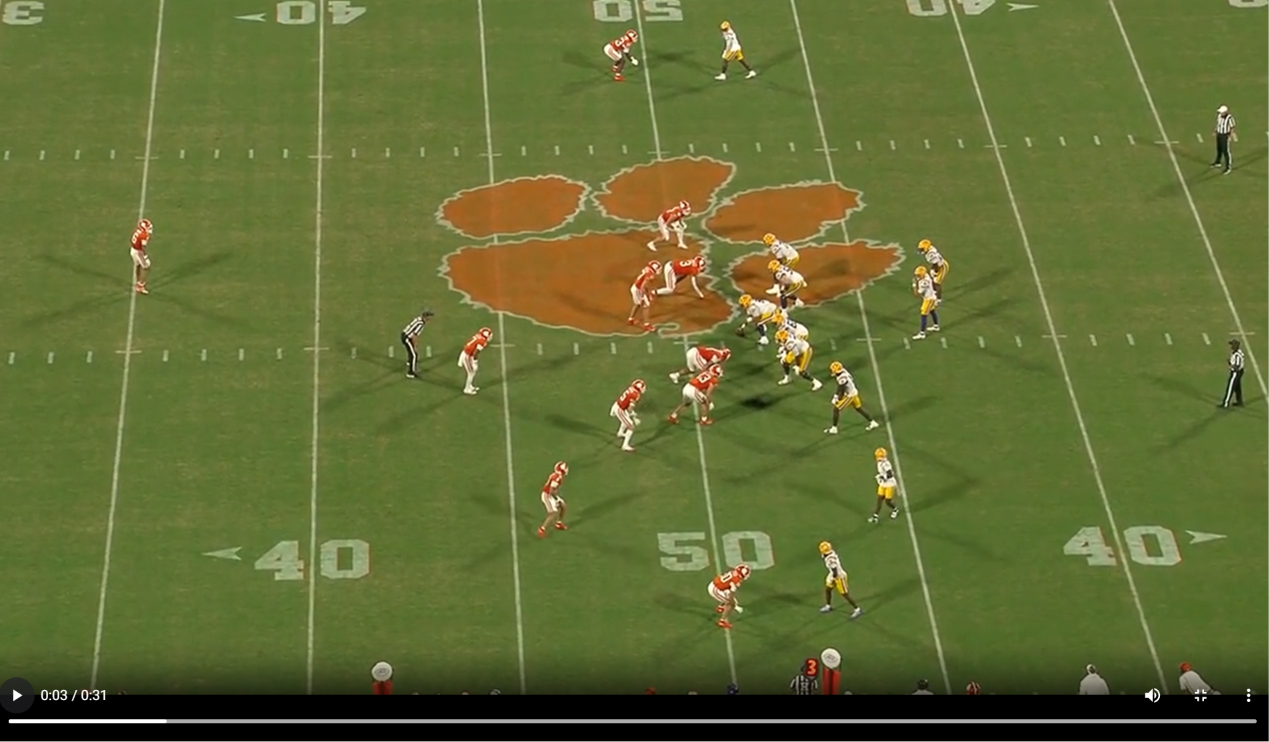
The offensive line picks up the TEX, but the boundary safety is free off the edge. The pressure moves the quarterback off his spot and ultimately results in an incomplete pass into tight coverage.
Finally, we will review an example from the Michigan Wolverines under former Defensive Coordinator and OG pressure guru Wink Martindale, running a simulated pressure out of another mug or MOB (multiple backers walked up) presentation against Washington.
The wide alignments by the defensive front buy the manside of the protection, allowing the backer blitzing through the B-gap on a run-through. Even if they weren’t running a screen, which takes senior linebacker Jaishawn Barham (the “Nose” in a four-down picture) to the play, his path would have occupied the center to the slide side, giving the pressure a free shot on the QB.
This is another great example of how the presentation itself can manipulate the protection. Barham doesn’t necessarily need to win the matchup; his alignment and path force the center to account for him, creating the space for the actual pressure to attack the opening in the protection.
At the end of the day, manipulating pass protection is about understanding that you don’t always have to beat the protection, you can use the rules of the protection to beat itself. There are many different ways to achieve a desirable result (covered in future topics) but by utilizing some of the methods discussed by using different presentations upfront, we can dictate where the offense allocates its protection and ultimately create the matchup or daylight we want to attack. Whether it is getting our best rusher 1-on-1, creating a free runner off the edge, or simply forcing the QB to make a rushed throw, the goal is to make the offense solve a problem that we created.The ability to manipulate protections rather than simply attack them head-on will increase your odds of success on gameday. Show them one thing, make them protect it, and attack somewhere else. Change the math, create conflict, and let your dudes make plays.
I hope you enjoyed this article and found a few ideas that you can take back with you. Thank you for reading, and I look forward to seeing you again next time!
Comments
Nothing yet. Say the first thing.
Sign in to join the conversation.