
Hey coaches, hey.
Next week, our very own Mayank Thanawala will be leading a conversation about integrating the Enneagram into his coaching.
I’ve only dipped my toe into the world of the Enneagram, so if you have no idea what that word is or why I’m capitalizing it, you’re in good company. The tl;dr is that it’s a highly dynamic personality matrix with nine types, which include:
Ones,
Twos,
Threes,
Fours,
Fives,
Sixes,
Sevens,
Eights, and
INFJs
Very good, Erica, just making sure you were paying attention.
I figured y’all should hear about it from a better authority than me, so I exchanged some voice memos with Mayank and edited it for length and clarity:

MJ: How would you describe the Enneagram generally?
Mayank: What we do in coaching is we try to help clients identify patterns that are getting in their own way and to move past those patterns. The Enneagram is a way of mapping these patterns - like “I avoid conflict” – using nine personality “types”. When you know your type, you can say, “Oh, I’m avoiding this conflict out of a fear of this or that, and that’s based in my inner self’s desire for validation.” You notice that you’re behaving in a way that doesn’t really serve your actual goals.
The map points to inner motivations. Knowing those gives us the ability to select a growth path. For me, it’s a way of seeing myself, and – through that – a way of seeing everyone else. When somebody’s behaving a certain way, the Enneagram is a way of seeing patterns that are shortcuts to deeper understanding.
MJ: How much Enneagram familiarity do you think is necessary for accessing its growth potential?
Mayank: I love this question, because the Enneagram kinda masquerades as a fun little personality party trick, which it just definitely is not.
If somebody wants to grow, they’ve got to start by seeing themselves. At that level, any of these frameworks - MBTI, StrengthsFinder, astrology - are actually useful because they act as ways we can see ourselves and start to be more honest with ourselves. You don’t need to know much Enneagram to get that little bit of growth potential.
Where deeper knowledge comes in handy is that pretty quickly we can get to a point where we’re just validating our behaviors and making excuses rather than actually going after the patterns. You know, “I’m a type Four, so you just got to deal with it.” That’s where other frameworks sort of stop - they put you in a category and you’re forever resigned to acting a certain way.
Growth comes not just from maximizing our strengths, but from finding the things that we’re less good at, finding the motivations for those and using those to bolster ourselves. A little bit of growth with the surface level of Enneagram is just as available as with any other framework, but the potential to go deeper is mind blowing in comparison.
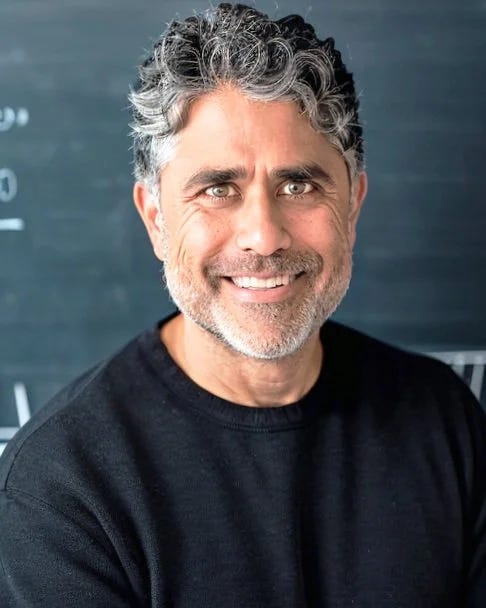
MJ: What’s your Enneagram type? How does your type impact how you experience the world?
Mayank: So before I answer about my type, I do want to say that the important thing about Enneagram is that there are a number of categorizations, including wings and instincts and–
MJ: Answer the question, Mayank.
Mayank: I’m a type Four, the individualist. But almost all of the interesting stuff comes out of not what bucket you’re in, but of the dynamism in the system. I can look very different from other Fours depending on level of consciousness, wings, instincts, and more.
The type Four’s holy idea is holy origin - the idea of a deeper central source of something that’s deeply true. We go around believing at some visceral level that all of the stuff we’re operating in is fake, so there’s this quest for authenticity. We’ve got this idea that there’s this greater meaning; the real world can only be a letdown. So we spend a lot of time in fantasy - that’s our fixation. As we look around and see artificiality, we experience a lot of envy for people who end up being more successful than us in this fake world.
MJ: Can you say more about what makes Enneagram distinctly useful? What makes it a growth framework?
Mayank: The Enneagram is really a multi-dimensional chart of energies. Before you can make a map useful, you have to know where you are. These nine types indicate energies we all have - Type Three is “the achiever”, but all of us can achieve. Type Seven loves new experiences, but a lot of us love new experiences. No type has a monopoly on these behaviors.
Where other personality tests are categorizing you and giving you validation to make excuses, Enneagram is about exploring the source of our emotions. Once we recognize our patterns, what other energies do we have access to? How do we get there?
The arrows you always see drawn between types are each type’s readily available energies. When we have higher consciousness, we can more easily access other energies and exercise more agency. When we are stressed and less conscious, we have less agency and our ego becomes more controlling and destructive.
MJ: On a personal note, my roommate and I are both Sixes. In what ways might that be a good or bad thing?
Mayank: The first thing I’ll say is that there are definitely no bad types…
MJ: Uh oh.
Mayank: Trust can be a really interesting thing for type Six. A lot of things are kind of anxiety-driven. It can lead to a sense of adventure – to conquer the fear -- or to withdrawing. Dynamics can exist between two Sixes where you trust each other with your lives but, at the same time, you constantly test each other a little bit to make sure that the connection is still there and trustworthy.
I wonder what it’s like when there’s a problem the two of you need to solve together. Sixes often look for an expert opinion, but then there’s a lot of questioning what is considered a viable expert opinion.
MJ: I won’t get into details about the heart-to-hearts or the discussion of where to plant the tomatoes, but… suffice it to say that a lot of this resonates.
Want to learn more about the Enneagram and how you can use it to chart a clearer course towards pattern recognition, behavior change, and, perhaps, vegetable gardening? Join Mayank at The Enneagram in Coaching and Growth on Thursday, April 23rd at 9am PT.
9️⃣ The Enneagram in Coaching and Growth | Thursday, April 23 | Hosted by Mayank Thanawala
🗣️ Real Talk: Practice the Art of Revealing | Friday, April 24 | Hosted by Kelly Liu
Subscribe to our calendar here to stay up-to-date on all our upcoming events.
No posts
Comments
Nothing yet. Say the first thing.
Sign in to join the conversation.