
Japan is targeting the deployment of 10m AI-powered robots by 2040, partnering with Nvidia to advance physical AI through Fanuc, Kawasaki Heavy and Yaskawa Electric.
All three stocks have pulled back sharply over the past month, but strong order backlogs and record forecasts point to continued underlying demand growth.
China’s ability to manufacture robots at least 20% more cheaply than Japan remains the biggest long-term threat to Japan’s robotics leadership ambitions.
During Japan’s annual New Year’s address in January, Prime Minister Sanae Takaichi stated that the country would harness data from its manufacturing and services industry to “realise physical artificial intelligence (AI)”. This will “enable robots to autonomously support humans or let factories engaged in precision manufacturing operate without humans,” said Takaichi. “Japan will use this to make its mark on the world.”[1]
China currently leads the way when it comes to industrial robots, with 295,000 units installed in 2024, representing 54% of the market, according to the International Federation of Robotics (IFR). Japan was second with 44,500 installs.[2]
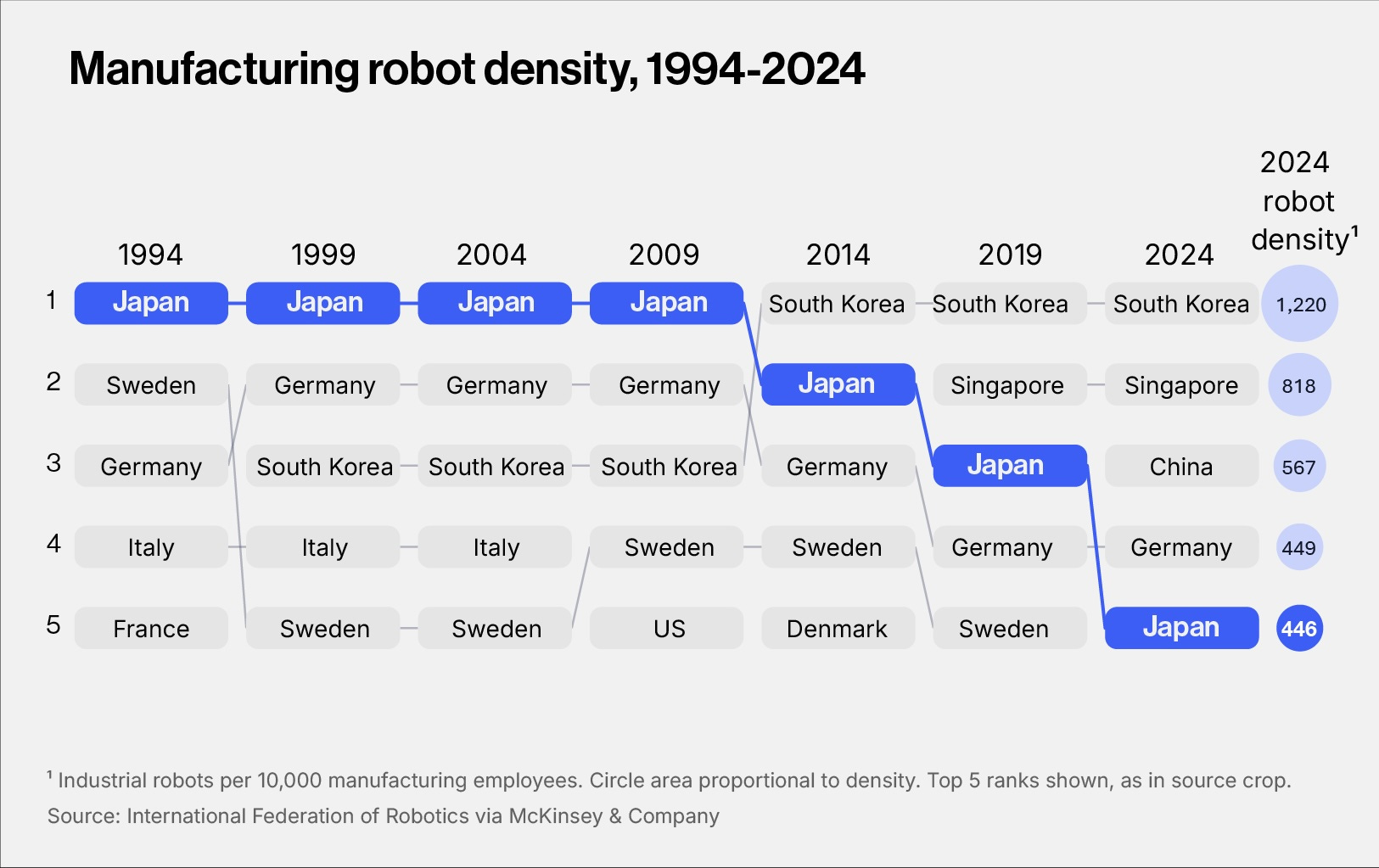
However, IFR data crunched by McKinsey shows that Japan has lost the lead in terms of robot density (the number of installs per 10,000 employees), as shown in the graph below. The researchers point out that, back in the 1990s and early 2000s, Japan prospered thanks to “a strong domestic industrial base consisting of local OEMs that often favoured domestic suppliers”. As domestic demand has fallen, so has robot density.[3]
This analysis looks at three Japanese robotic stocks that should benefit as the country pushes to become the industrial robot leader: Fanuc [FANUY], Kawasaki Heavy Industries [KWHIY] and Yaskawa Electric [YASKY].
In mid-July, Nvidia [NVDA] announced a partnership with Fanuc, Yaskawa Electric and Kawasaki Heavy to help advance physical AI in Japan. Fujitsu [FJTSY] will also be involved in the collaboration. The aim is to improve how physical AI is implemented in manufacturing, logistics and healthcare settings.
“We will strive to create a society in which people and robots coexist and collaborate seamlessly, strengthen industrial competitiveness, create new value and contribute to the realisation of a sustainable society,” Fanuc CEO and President, Kenji Yamaguchi, said in a press release.[4]
Kawasaki Heavy CEO and President Yasuhiko Hashimoto added that the collaboration should improve the quality of healthcare by establishing “a hospital one-stop solution that safely and efficiently connects every stage of the patient journey – from hospital admission and consultation to treatment, surgery and post-operative care”.
Nvidia CEO Jensen Huang declared that the companies will work together to “teach the world’s machines to think, move and work alongside people – across factories, hospitals and cities”.
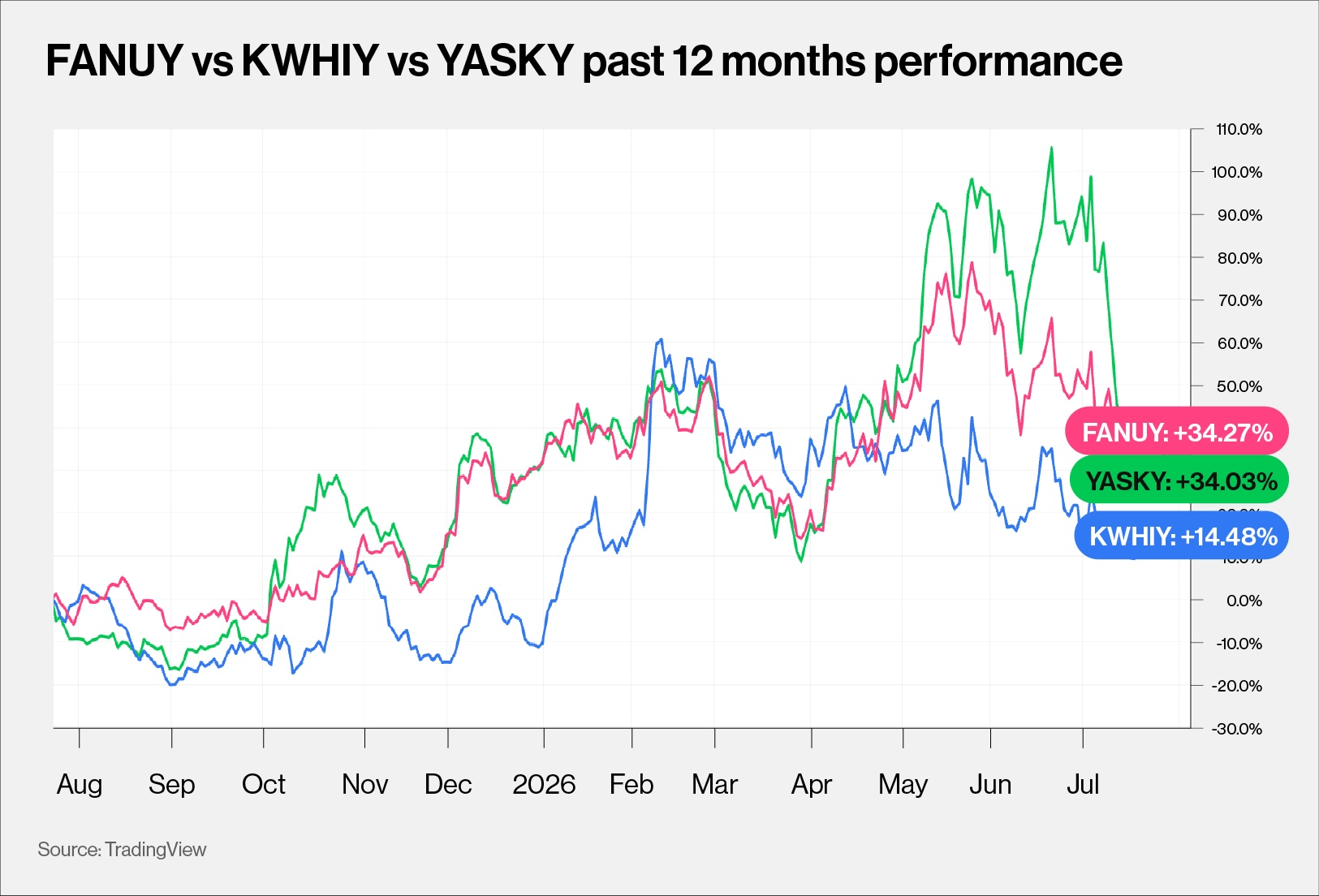
The Fanuc share price is down 16.19% in the past month through 23 July, though it is up 6.06% since 1 January.
The Kawasaki Heavy share price is down 16.15% in the past month, though it has gained 27.84% since the start of the year.
The Yaskawa Electric share price has tumbled 33.36% in the past month, but it is up 5.39% year-to-date.
Fanuc is set to report its fiscal Q1 2026 earnings on 31 July. Steady sales in its robotics division in the Americas and China helped push total annual revenue to a record high in fiscal 2025. The company expects to exceed this in the current year. Net income is forecast to grow 20.3% year-on-year on the back of 19.4% growth in 2025.[5]
Kawasaki Heavy is due to report its fiscal Q1 2026 earnings on 7 August. Revenue and net income hit record highs for the second consecutive year in 2025. Annual profit is expected to surge from ¥108.1bn in 2025 to ¥170bn in 2026.[6]
Yaskawa Electric reported its fiscal Q1 2026 results on 10 July. While operating profit fell in Q1, the company expects to recoup this money over the rest of the year. It also emphasised that “capital investment demand remained strong, particularly in the semiconductor and data center markets driven by AI-related investments”.[7] Orders for semiconductor-related robotics jumped 141% year-on-year and 55% from the prior quarter.[8]
Here is how the current fundamentals of FANUY, KWHIY and YASKY compare.
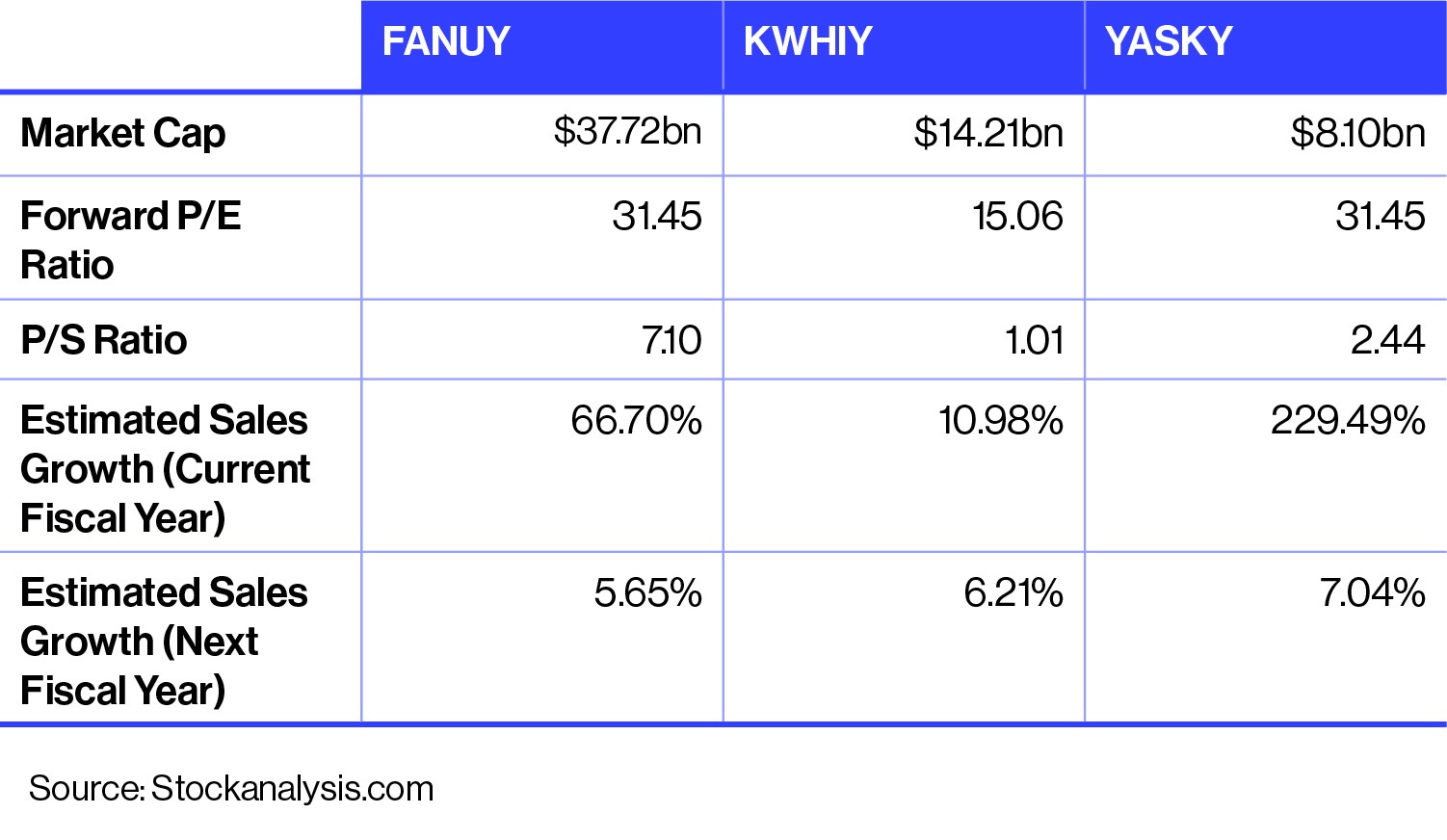
It can be hard to determine the valuation of OTC stocks given the lack of data. The big jump in revenue for FANUY and YASKY is partly due to the impact of US President Trump’s tariffs, which would also explain why next fiscal year’s sales are expected to be incremental in comparison.
While FANUY and YASKY look more expensive based on forward P/E, they could be considered undervalued based on the 40.46 forward P/E of the iShares Automation & Robotics UCITS ETF [RBOT:L], which holds Tokyo-listed shares in both stocks.[9]
Thanks for reading Foresight! This post is public so feel free to share it.
Japan is targeting the deployment of 10m AI-powered robots across the country by 2040.[10] Domestic robot makers are investing aggressively to help achieve its goal.
Earlier in July, Kawasaki Heavy raised ¥92.7bn through a mix of shares and bonds. The funds will go towards developing production technologies, including robots for semiconductor manufacturing.[11]
“Strengthening physical AI technology will give us a competitive edge … We want to produce results as quickly as possible,” Kawasaki Heavy CFO Katsuya Yamamoto had told Nikkei in June.[12]
The biggest threat to Japan’s domestic industrial robot makers, like Fanuc, Kawasaki Heavy and Yaskawa Electric, is, arguably, price competition.
Over the years, Japan has lost ground due to China’s manufacturing boom. The latter’s localised supply chains and ability to manufacture at scale mean the country has been able to produce robots at least 20% more cheaply, according to Morgan Stanley estimates.[13]
There is a risk Japan could fall further behind unless it can convince domestic customers to stop importing robots from China.
Plans are afoot to establish a physical AI ecosystem in Japan. Fanuc, Kawasaki Heavy and Yaskawa Electric are set to be key players, along with Nvidia and Fujitsu.
Whether the country can retake the crown as the robotics market leader, however, is likely going to depend on the speed of innovation and whether its industry can compete with China’s much cheaper robots.
This is for informational purposes only. CMC Markets UK Plc does not recommend any specific securities or investment strategies. Investing involves risk and investments may lose value, including the loss of principal. Past performance does not guarantee future results.
[1] https://japan.kantei.go.jp/104/statement/202601/05kaiken.html
[2] https://ifr.org/ifr-press-releases/news/global-robot-demand-in-factories-doubles-over-10-years
[3] https://www.mckinsey.com/industries/industrials/our-insights/japans-100-billion-opportunity-in-general-purpose-robotics
[4] https://global.fujitsu/en-global/pr/news/2026/07/16-01
[5] https://www.fanuc.co.jp/en/ir/announce/pdf/2026/reference202603_e.pdf
[6] https://global.kawasaki.com/en/corp/ir/library/pdf/qa_260514-1e.pdf
[7] https://www.yaskawa-global.com/wp-content/uploads/2026/07/20260710_en.pdf
[8] https://www.yaskawa-global.com/wp-content/uploads/2026/07/261Q_QA_EN.pdf
[9] https://www.ishares.com/uk/individual/en/products/284219/ishares-automation-robotics-ucits-etf
[10] https://www3.nhk.or.jp/nhkworld/en/news/20260630_21/
[11] https://global.kawasaki.com/news_260702-2e.pdf
[12] https://asia.nikkei.com/business/technology/artificial-intelligence/kawasaki-heavy-to-raise-over-1bn-via-new-shares-bonds-for-ai-investment
[13] https://fortune.com/2026/06/09/china-builds-85-percent-worlds-humanoids-robots-cheap/
No posts
Comments
Nothing yet. Say the first thing.
Sign in to join the conversation.