
MercadoLibre is at the heart of Latin America’s digital transformation, combining a fast-growing e-commerce platform with Mercado Pago’s fintech ecosystem.
Q2 earnings showed continued momentum, with revenue rising 50% to $10.2bn and payment volumes climbing 42% on an FX-neutral basis, but higher investment pushed operating margins lower.
The bull case for MELI stock rests on converting regional scale into lasting profitability, in the face of margin pressure, competition and credit risk.
For some investors, Latin America remains a terra incognita.
It is a vast market, with more than 650 million people, growing digital adoption and significant long-term economic potential. Yet investors outside the region, ignorant of its complexities, can struggle to find the best way to gain exposure.
One company offers a compelling route into this opportunity: MercadoLibre [MELI].
Often described as the combined Amazon [AMZN] and PayPal [PYPL] of Latin America, MercadoLibre has built an ecosystem spanning e-commerce, payments, logistics and financial services.
In particular, MercadoLibre has positioned itself to capture the region’s growing e-commerce market. As the graph below illustrates, e-commerce penetration across Latin America remains relatively low, accounting for only mid-teens percentages of total retail sales, leaving the region almost a decade behind the US in terms of digital adoption.[1]
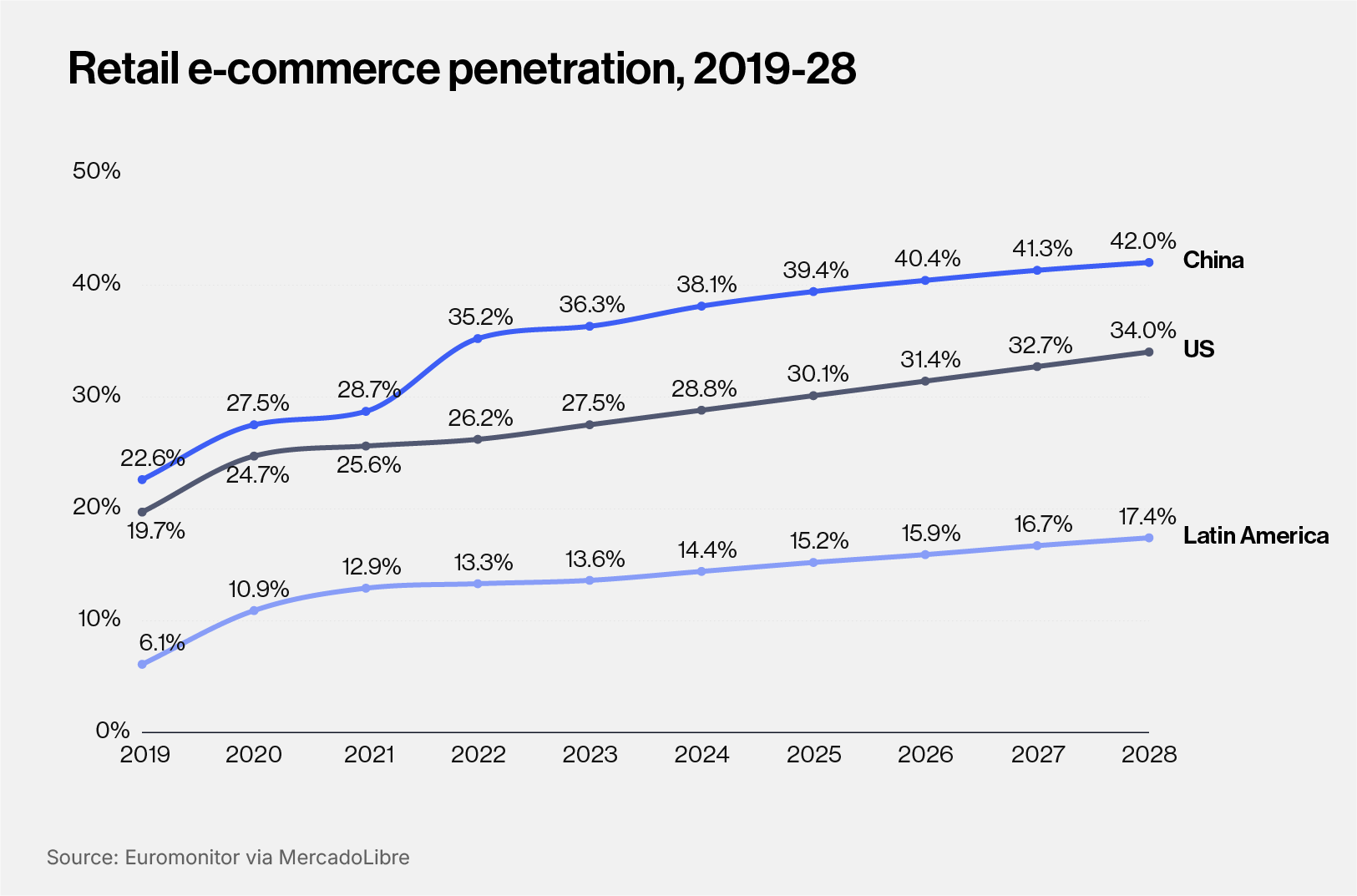
However, the market is expected to close that gap rapidly, with forecasts predicting a 54% expansion from $151bn in 2023 to $232bn by 2028.
Beyond e-commerce, MercadoLibre has built a second growth engine through Mercado Pago, its digital payments and financial services platform. The potential is significant, as Latin America’s financial infrastructure remains ripe for disruption. Indeed, Mercado Pago may ultimately prove to be the more important part of MercadoLibre’s long-term investment case.
What began as a payments solution for marketplace transactions has evolved into a broader fintech ecosystem spanning digital wallets, payments, credit and financial services.
Its growth is rooted in Latin America’s fragmented banking landscape. In Mexico, for instance, only around half the population has a bank account and fewer than one in five people hold a credit card. Even Brazil, the region’s most developed fintech market, remains dominated by traditional institutions, with four major banks controlling 59% of credit operations. Meanwhile, Argentina’s loans-to-GDP ratio remains below 10%, highlighting the scope for financial deepening.
Mercado Pago is already gaining scale, ranking among the leading fintech platforms by monthly active users across Brazil, Mexico, Argentina and Chile. As adoption of digital payments accelerates and more consumers seek alternatives to traditional banking, Mercado Pago has the potential to become a central financial platform for hundreds of millions of Latin Americans.[2]
Released on 5 August, MercadoLibre’s latest earnings furnish an opportunity to assess whether this regional champion can continue turning Latin America’s digital transformation into sustainable shareholder returns. This analysis will crunch the numbers, make some prognostications and compare MELI stock to two other companies which similarly offer a way into LatAm’s vast potential.
The firm delivered another strong quarter of growth, reinforcing its position as one of Latin America’s most important digital platforms.[3] Revenue climbed 50% year-on-year to $10.2bn, driven by continued momentum across both its commerce and fintech operations. Gross merchandise volume increased 36% on an FX-neutral basis, while Mercado Pago’s expanding ecosystem helped drive payment volumes higher and deepen user engagement. The results underline the strength of MercadoLibre’s flywheel: a growing marketplace attracts more users, which fuels greater adoption of financial services, creating additional opportunities for growth across the region.
However, the market’s reaction highlighted the challenge facing MercadoLibre as it enters its next phase of growth. Despite record sales, profitability came under pressure, with higher investments in logistics, financial services and customer acquisition weighing on margins.[4] Net income declined year-on-year, prompting investors to question whether the company’s aggressive expansion strategy will translate into stronger earnings power over time.
The latest results therefore present a familiar platform-company dilemma: sacrifice near-term margins to build a larger ecosystem, or prioritise profitability today.
Overall, the numbers reflect “a deliberate choice to continue prioritising investment ... over near-term profitability”, as CFO Martin de Los Santos framed it on the call.[5]
They show a company still operating at exceptional scale. Quarterly revenue grew at the fastest rate in four years, highlighting the continued strength of its core marketplace and Mercado Pago ecosystem.
Commerce remained a key growth engine. The increase in gross merchandise volume reflected higher transaction activity across the platform. Meanwhile, Mercado Pago continued to broaden its role beyond payments, with total payment volume increasing 42% on an FX-neutral basis as more users adopted MercadoLibre’s financial services.
The trade-off was visible in profitability. Net income fell 11% y/y to $466m, while operating income declined to $683m. Operating margin dropped to 6.7%, compared with 12.2% a year earlier, as the company increased spending on logistics infrastructure, shipping subsidies and credit expansion.
That investment is central to MercadoLibre’s long-term strategy. The company’s credit portfolio has expanded rapidly, helping deepen customer relationships while creating another source of revenue. However, lending growth also brings greater risk, particularly if economic conditions deteriorate across key markets such as Brazil, Mexico and Argentina.
For investors, the numbers illustrate both sides of the MercadoLibre story: a rare growth platform with enormous regional opportunity, but one that must prove its investments can ultimately deliver expanding margins.
While MercadoLibre offers one of the broadest ways to access Latin America’s digital transformation, investors can also gain exposure through more focused fintech players such as Nu Holdings [NU] and StoneCo [STNE].
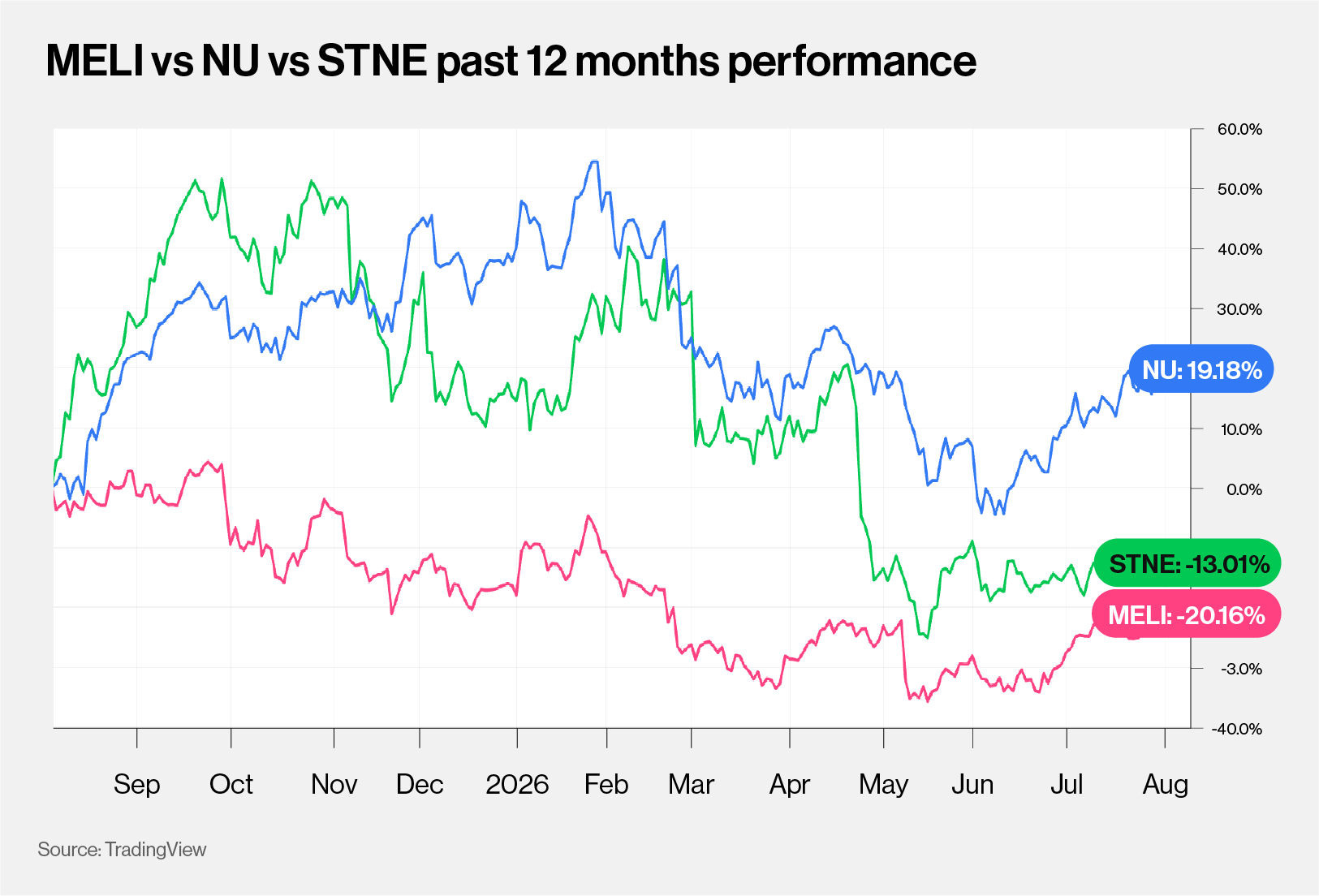
Nu represents the pure-play digital banking opportunity. With a rapidly expanding customer base across Brazil, Mexico and Colombia, Nu is targeting millions of consumers underserved by traditional banks. Its opportunity is tied closely to financial inclusion and the shift from legacy institutions towards lower-cost digital alternatives.
StoneCo, meanwhile, provides exposure to the region’s merchant digitisation trend through payments infrastructure and financial software. Its focus is more closely linked to small businesses adopting digital commerce tools.
Compared with these peers, MercadoLibre offers a broader ecosystem, combining e-commerce, logistics, payments and credit. The trade-off is that investors pay for this diversification with a higher valuation and the challenge of proving that heavy investment can translate into expanding margins.
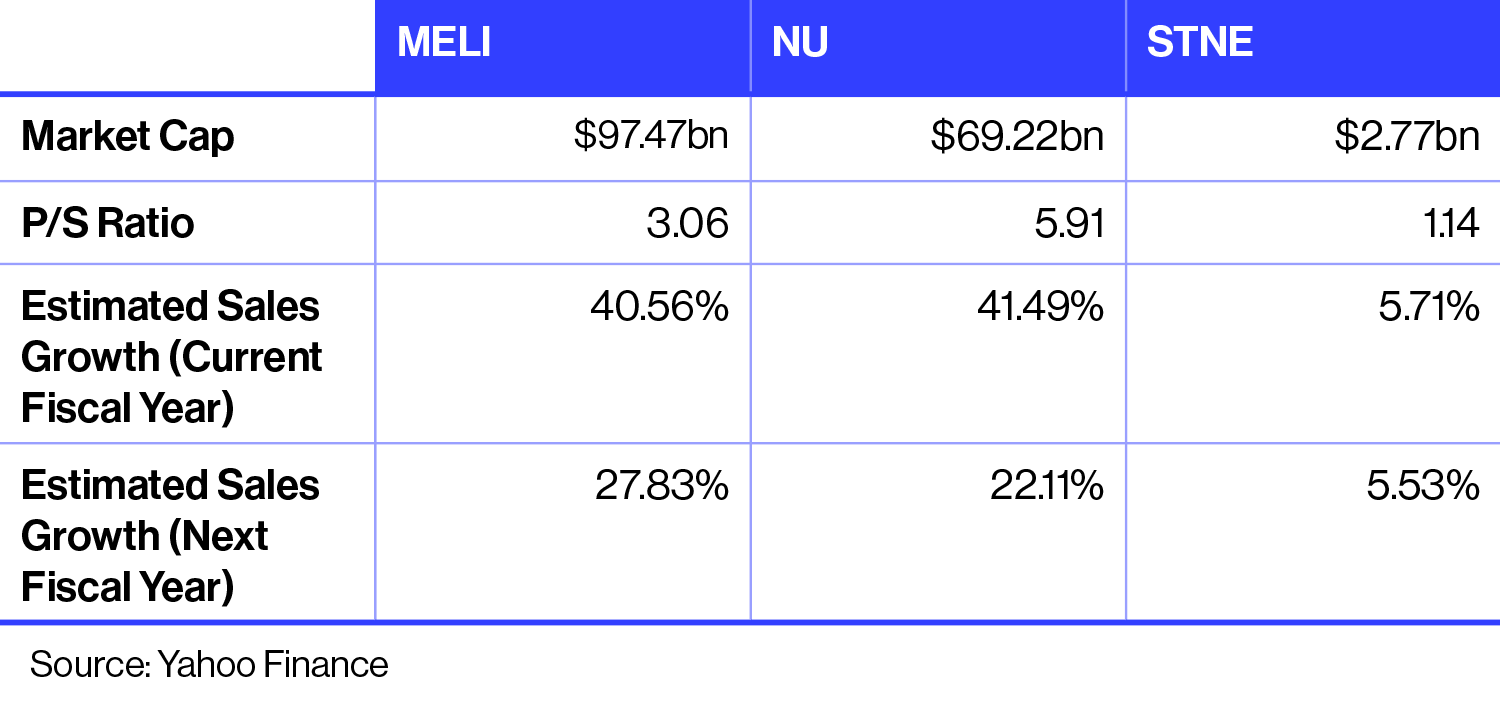
MercadoLibre’s bull case rests on the continued expansion of Latin America’s digital economy and the strength of its ecosystem. The company has built a powerful flywheel, where e-commerce growth drives adoption of Mercado Pago, which in turn increases engagement, data and cross-selling opportunities. With e-commerce penetration still well below US levels and financial inclusion remaining limited across much of the region, the runway for growth remains substantial. MELI bulls argue that near-term margin pressure reflects deliberate investment rather than structural weakness, with spending on logistics, credit and financial services strengthening MercadoLibre’s long-term competitive advantage. If the company can convert its scale into improving profitability, MELI could become one of the defining digital platforms of emerging markets.
The bear case for MercadoLibre centres on valuation, competition and, as ever, execution risk. Investors are already paying a premium for the company’s long-term growth potential, leaving little room for disappointment if margins remain under pressure or returns on investment fail to materialise. Rising spending on logistics, shipping subsidies and credit expansion could weigh on profitability for longer than expected, while fintech competitors and global e-commerce players continue to target the same opportunities. Mercado Pago’s rapid lending growth also introduces credit risk, particularly across volatile Latin American economies. The challenge for MercadoLibre is proving that its ecosystem creates a durable moat, rather than simply requiring ever-greater investment to defend market share.
MercadoLibre offers investors a rare way to navigate Latin America’s terra incognita, providing exposure to two of the region’s biggest structural shifts: digital commerce and financial inclusion. The opportunity is vast, but the latest earnings show that turning untapped potential into sustainable shareholder returns will depend on whether MercadoLibre can transform scale into lasting profitability.
This is for informational purposes only. CMC Markets UK Plc does not recommend any specific securities or investment strategies. Investing involves risk and investments may lose value, including the loss of principal. Past performance does not guarantee future results.
[1] https://investor.mercadolibre.com/
[2] https://investor.mercadolibre.com/
[3] https://www.sec.gov/edgar/browse/?CIK=1099590
[4] https://www.reuters.com/business/mercadolibres-net-profit-beats-estimates-despite-third-straight-decline-2026-08-05/
[5] https://finance.yahoo.com/quote/MELI/earnings/MELI-Q2-2026-earnings_call-662711.html
No posts
Comments
Nothing yet. Say the first thing.
Sign in to join the conversation.