

Another paper praising the modRNA Covid vaccines is making the rounds, this time from and about France:
In this cohort study including 22.7 million vaccinated individuals and 5.9 million unvaccinated individuals, vaccinated individuals had a 74% lower risk of death from severe COVID-19 and no increased risk of all-cause mortality over a median follow-up of 45 months.
Amazing, isn’t it? And look at Table 2 from the paper:
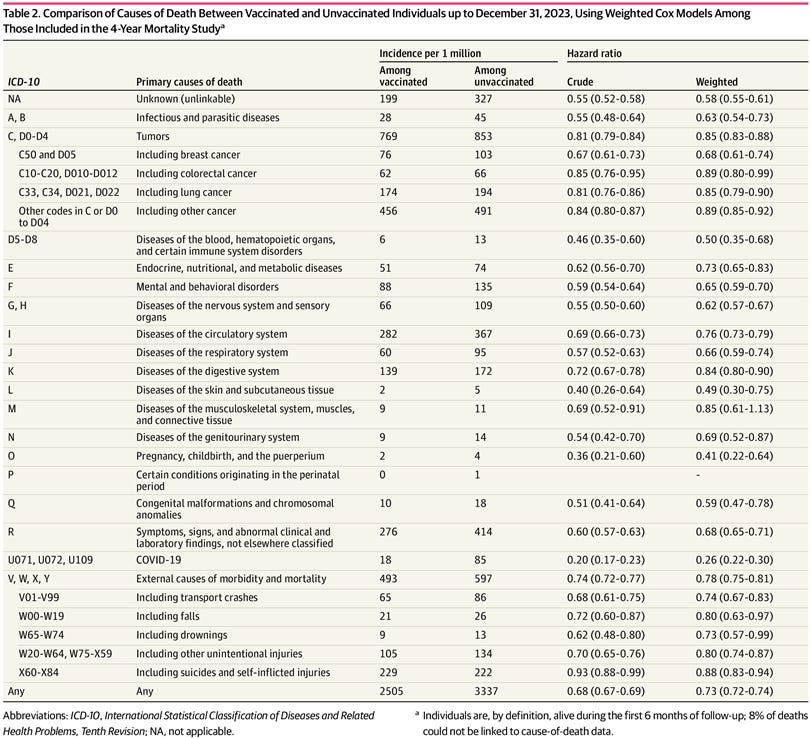
All those Hazard ratios, crude and weighted, are smaller than 1.0 and thus indicate lower risk of death for the vaccinated, even when it comes to transport crashes, falls, and drownings. Looks like a major step on the road to immortality!
How can nonsense like this come about? My guess is that, similar to what Clare Craig and others have written about regarding the UK (I am too busy, or too lazy, to find and provide the link) the problem is that while the paper seems to compare two groups, actually three groups have to be considered.
To see this, take a look at eFigure 2 from the paper’s supplementary material (with my annotations in red, green and yellow):
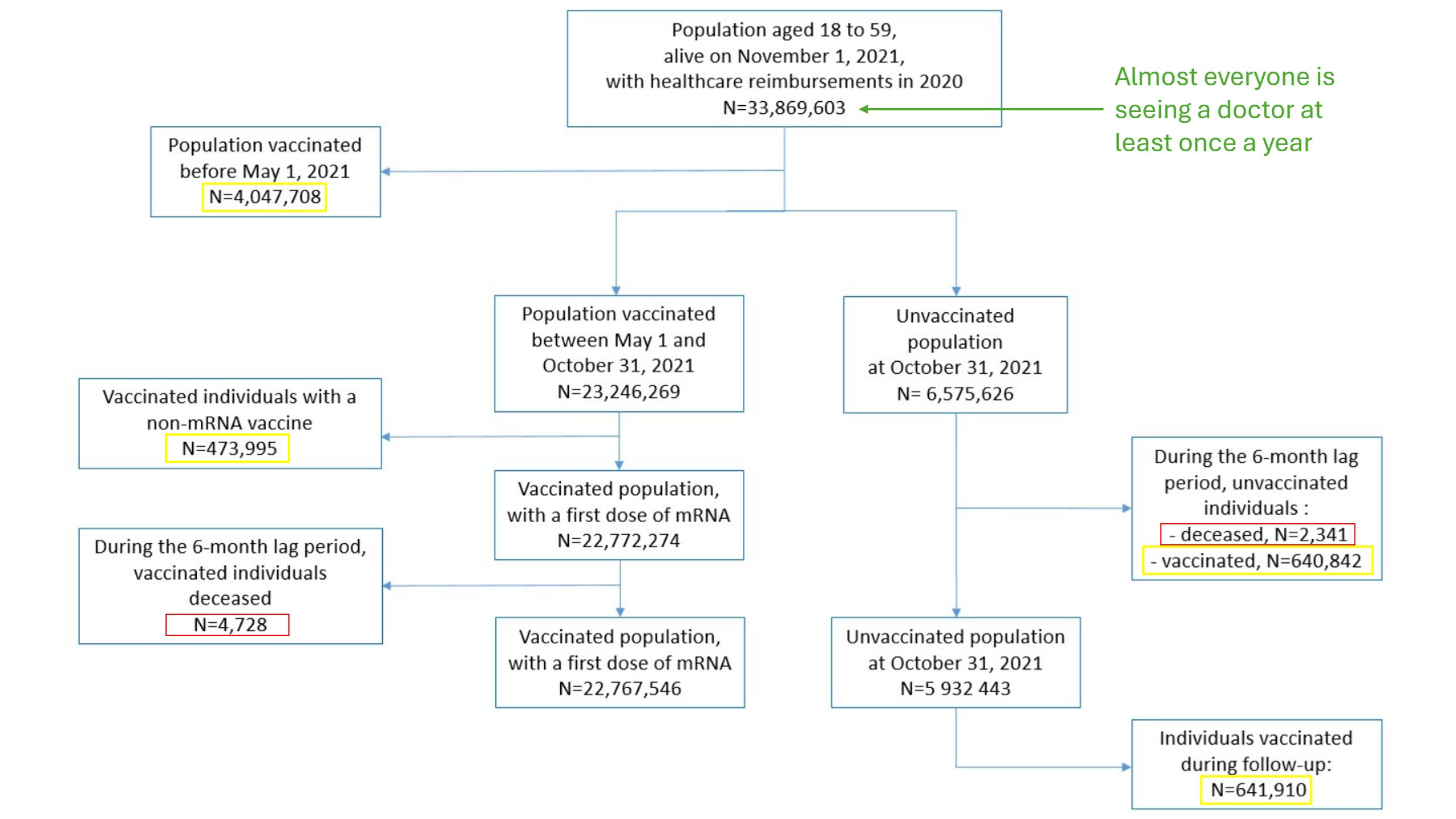
The study starts with a cohort of 33,869,603 French people aged 18-59, having received any health care reimbursement in 2020. Some of them died too early (marked in red), and some were excluded due to “wrong” vaccination of different kinds (marked in yellow). In the end, 22,767,546 vaccinated and 5,290,533 (= 5,932,443 - 641,910) unvaccinated individuals remain. Among the vaccinated, 98,428 deaths are recorded throughout the study period, and 32,662 among the unvaccinated. In terms of raw death rates, this amounts to 0.43% for the vaccinated and 0.62% for the unvaccinated - from which the above Hazard ratios follow.
But is that a complete picture? Data on deaths by age group are difficult to find on official French pages but we can turn to the WHO (of all people). We find that, for the years 2020 to 2022 (most recent data available), the 20-59 population hovered around 32.3 million. Add 1.6 million for the 18-19 year olds, and we recover those around 33.9 million in the paper’s cohort (this makes sense because basically everyone will come into contact with the medical system at least once a year, if only to have their teeth checked).
The curious thing is that the WHO counts around 60,000 annual deaths among those 20-59 year olds. In a study with “median follow-up of around 45 months” we would therefore expect around 225,000 deaths (disregarding a few details, like the difference between a fixed cohort over three years and three different cohorts over one year).
Where else might we find the missing deaths but among the “missing” group (those marked in yellow in the above figure; all of them vaccinated)? Let’s see what happens:

If indeed the “missing” are accounting for all the missing deaths, they are quite a miserable bunch. Taking the vaccinated (v) and the missing (m) together, we get a death rate of 0.67%, very close to the total death rate, and slightly higher than the death rate for the unvaccinated.
Is that the whole story? The paper’s authors can surely tell, but do they want to?
No posts
Comments
Nothing yet. Say the first thing.
Sign in to join the conversation.