
Olympiacos entered this season with Final Four ambitions. The talent was there, the coach was there, and yet, through the first 16 rounds, the Piraeus side looked anything but a contender, posting an underwhelming 8-7 record (excluding the postponed game against Fenerbahçe). Then something shifted. A few lineup adjustments and a couple of mid-season signings later, Olympiacos is now one of the most feared teams in the competition, sitting 2nd in the EuroLeague standings. The season splits almost perfectly in half - a struggling first act and a dominant second - so let's break down exactly what happened.
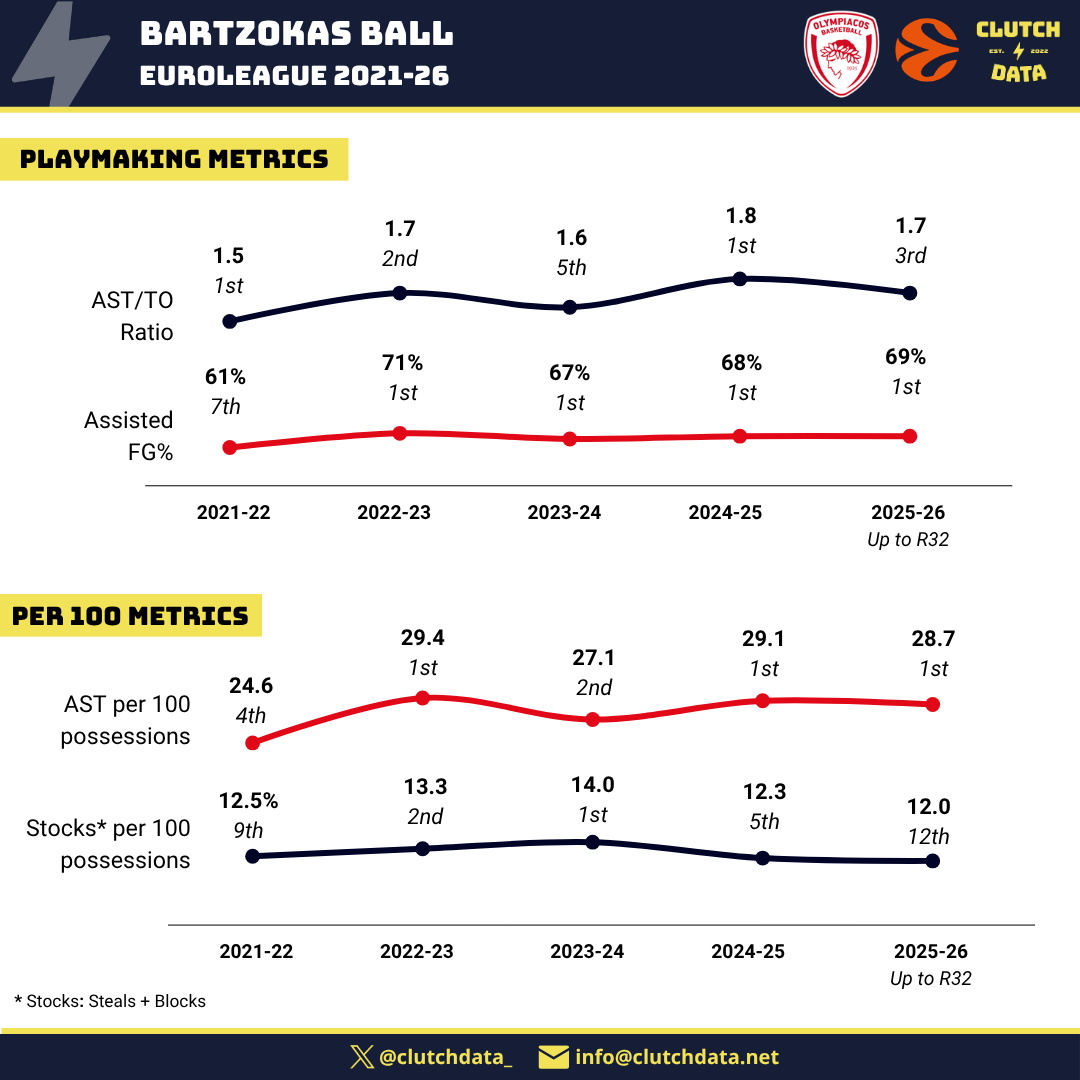
To understand how Olympiacos fixed things, you first need to understand what Head Coach Giorgos Bartzokas is actually trying to build. His brand of basketball is built on movement, off-ball actions, hand-offs, constant ball sharing, and making sure the right player gets the right look. The numbers back this up. Olympiacos has led the EuroLeague in Assisted Field Goal% every single season since 2022-23. They currently rank 4th in the league with a 1.7 Assist-to-Turnover ratio, and they dish out 28.7 Assists per 100 possessions - the best mark in the entire competition.
The one area where Bartzokas Ball has softened? Defensive aggression. Stocks (Steals + Blocks) have dipped to 12.0 per 100 opponent possessions, ranking 12th - a notable decline for a team that dominated that category between 2022 and 2024.
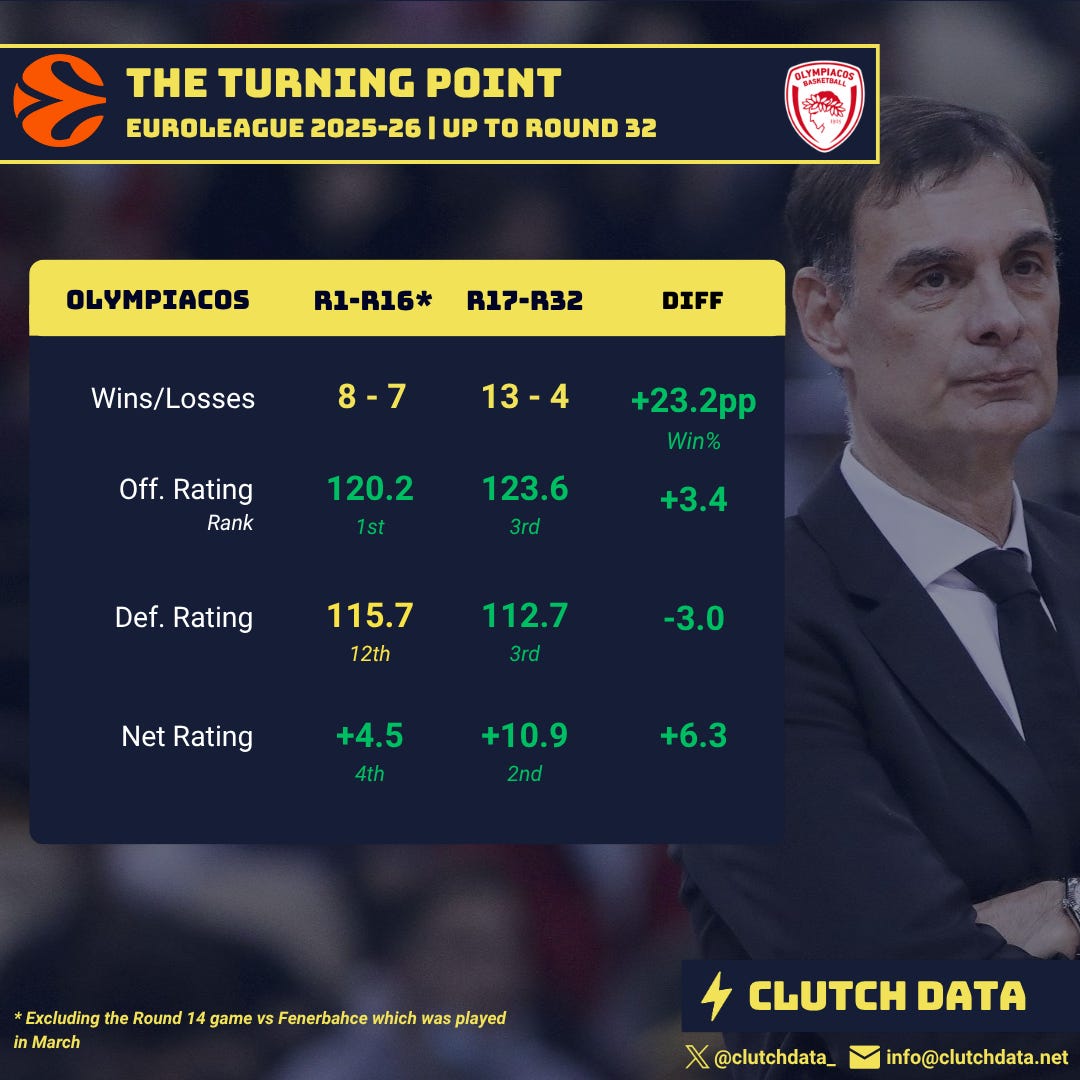
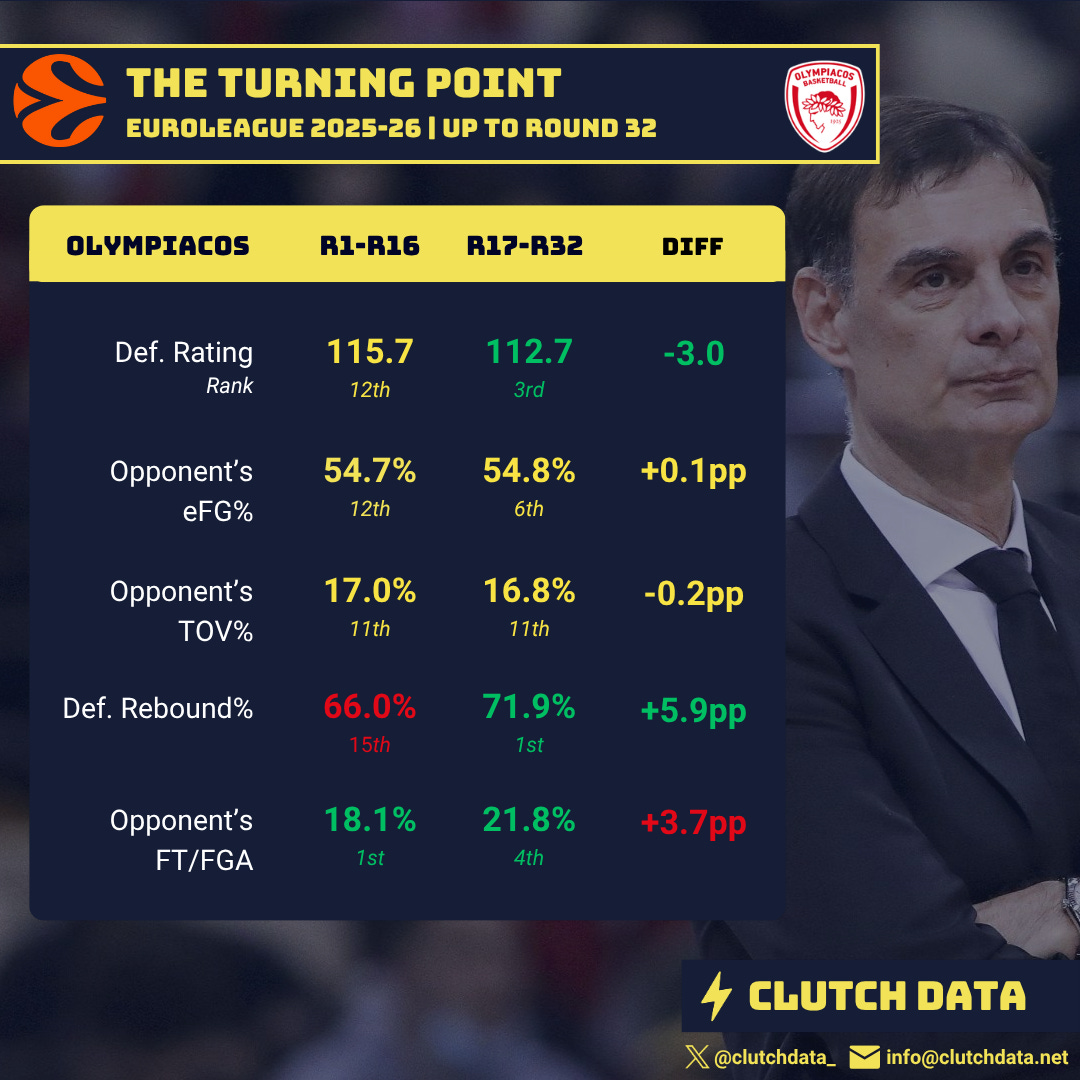
Everything changed after Round 16 and a home loss to Valencia. From that moment on, Olympiacos became a different team. Comparing the two halves of the season side by side, the numbers tell a clear story: the team's winning percentage jumped by 23 percentage points, their Offensive Rating climbed to 123.6 points per 100 possessions (+3.4), and their Defensive Rating tightened to 112.7 points per 100 possessions (-3.0), producing a Net Rating of +10.9. Both sides of the ball improved - and that rarely happens by accident.
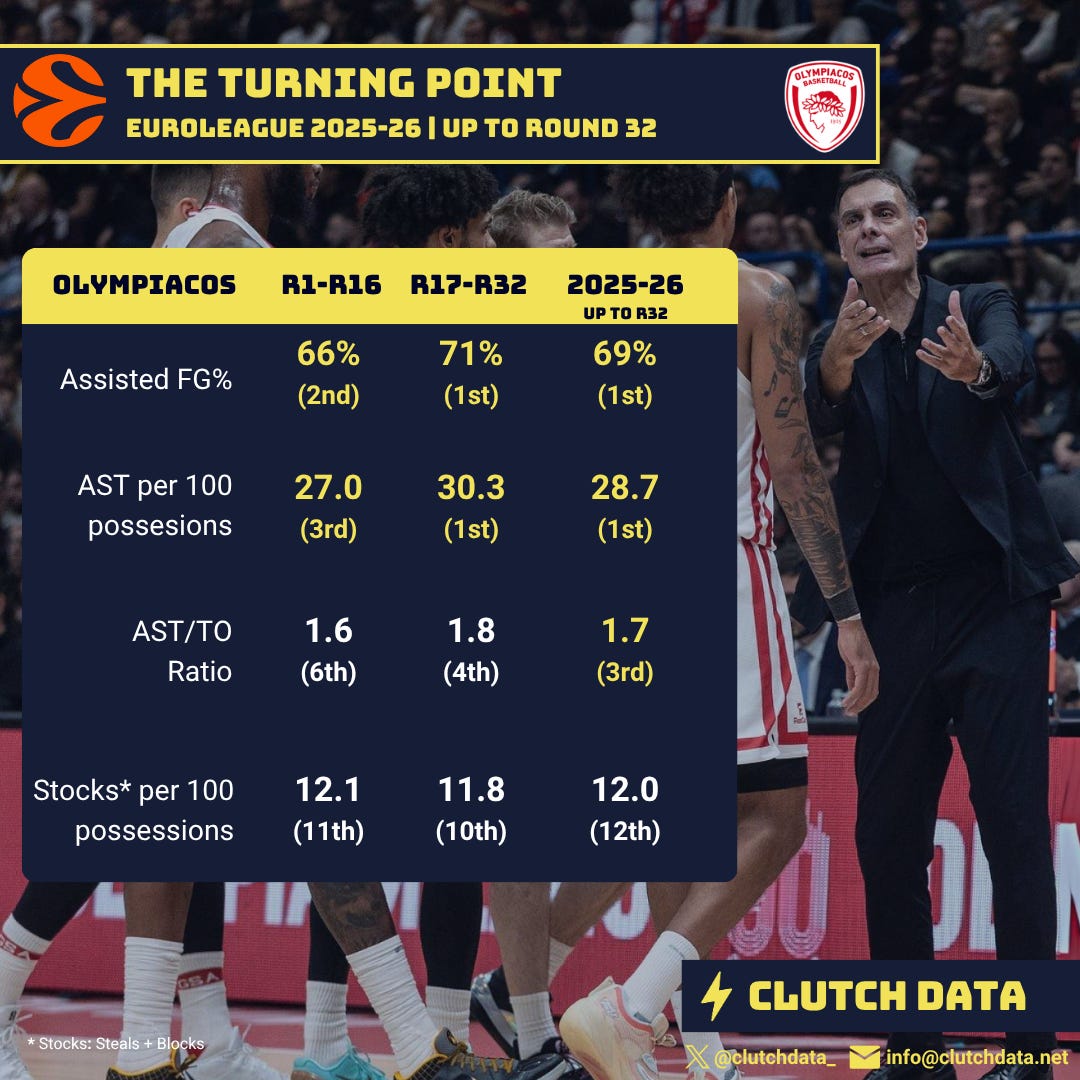
The underlying stylistic metrics improved right along with the results. Assisted FG% climbed from 66% to 71%, Assists per 100 possessions rose to 30.3, and the Assist-to-Turnover ratio nudged up to 1.8. The team didn't abandon its identity - it sharpened it. Defensive stock numbers remained relatively stable, but as we'll see, the defense found other ways to get better.
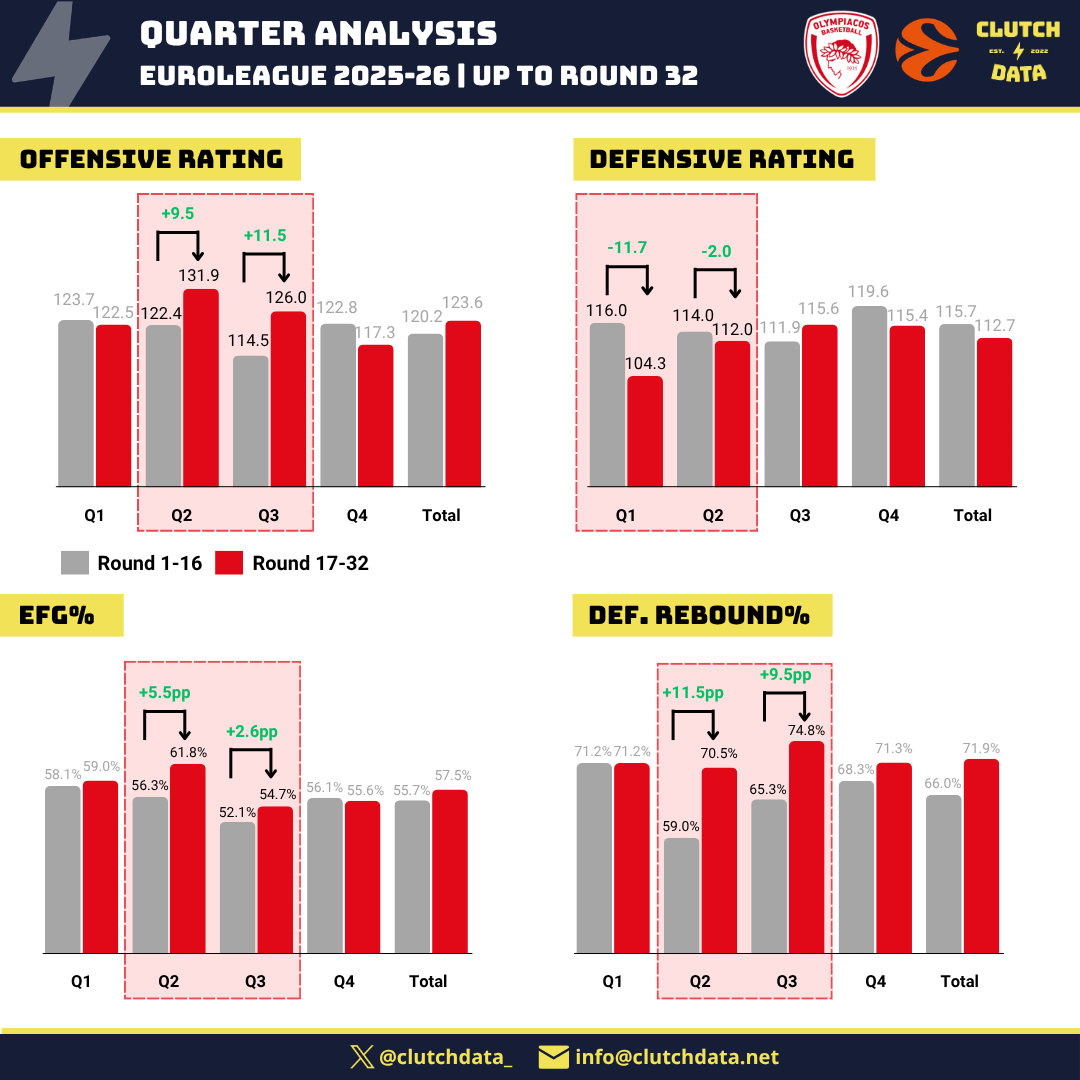
Zoom into the quarter-by-quarter numbers and the improvement becomes even more vivid. Every quarter got better, but the 2nd and 3rd quarters stand out in particular.
On offense, the 2nd quarter saw a +9.5 jump in Offensive Rating, while the 3rd quarter improved by +11.5.
On the defensive end, the 1st quarter was the big story - opponents scored 11.7 points fewer per 100 possessions - with a modest -2.0 improvement also showing up in the 2nd quarter.
Shooting efficiency followed a similar pattern: eFG% jumped by 5.5 percentage points in the 2nd quarter alone, with Olympiacos hitting an eye-popping 61.8%, plus a +2.6pp bump in the 3rd.
And on the glass, Defensive Rebound% exploded - up 11.5 percentage points in the 2nd quarter and 9.5pp in the 3rd. Olympiacos went from leaking defensive rebounds to owning them.
So what actually happened? Several things. But the single most important adjustment was this: Evan Fournier moved from the starting lineup to the bench.
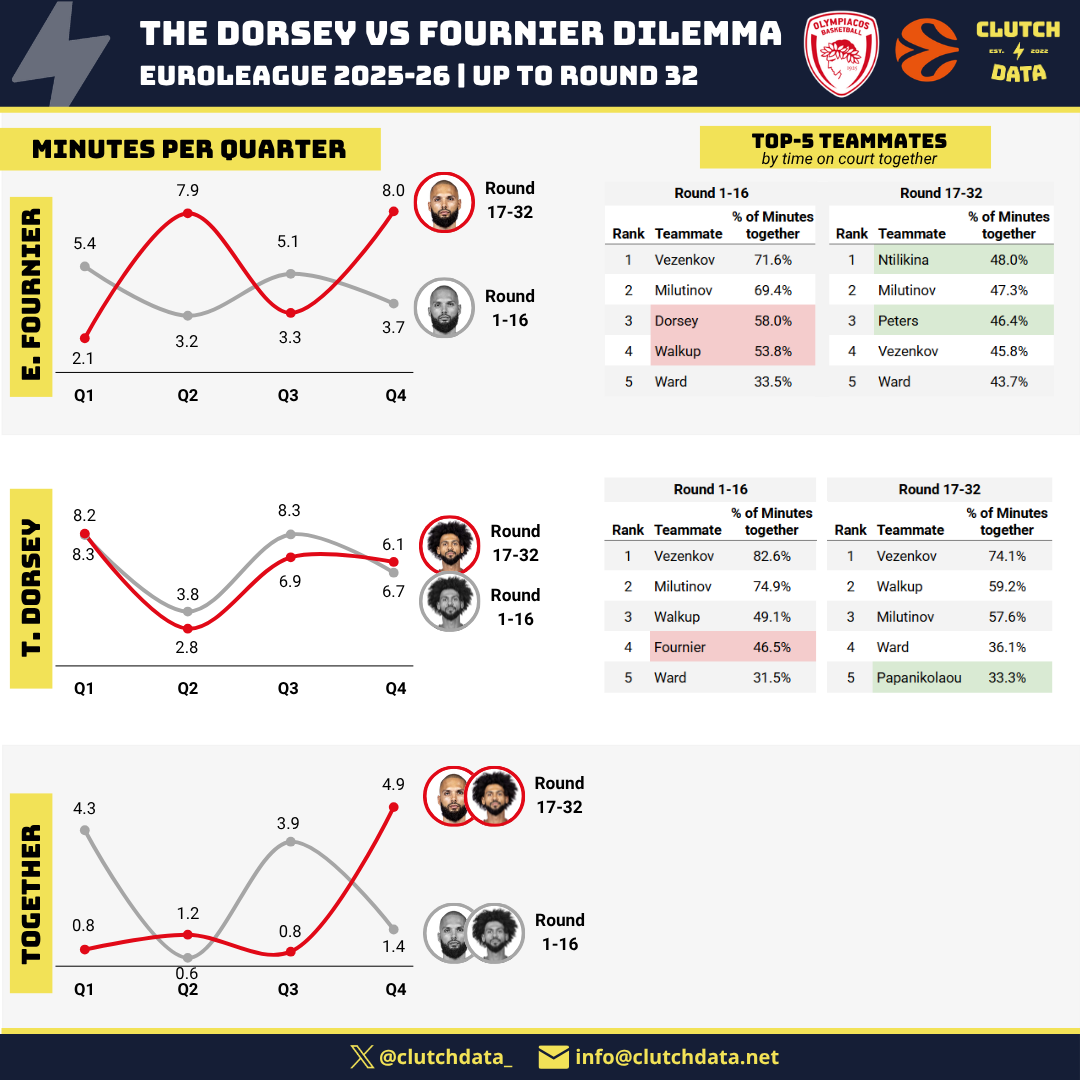
In the first 16 games, Fournier was playing the majority of his minutes in the 1st and 3rd quarters. Now it’s the complete opposite - he anchors the 2nd and 4th quarters. Tyler Dorsey’s minutes, meanwhile, stayed relatively stable. The two share only occasional time together through the first three quarters, and split roughly half of the 4th quarter side by side.
The downstream effects of this shift rippled through the entire roster. Fournier now spends 48% of his minutes alongside Frank Ntilikina and 46% with Alec Peters - two players who weren’t even in his Top 5 minute-sharing partners before. Vezenkov and Milutinov have both seen big drops in their time with Fournier. As for Dorsey, his Fournier minutes have been replaced by time with team captain Kostas Papanikolaou.
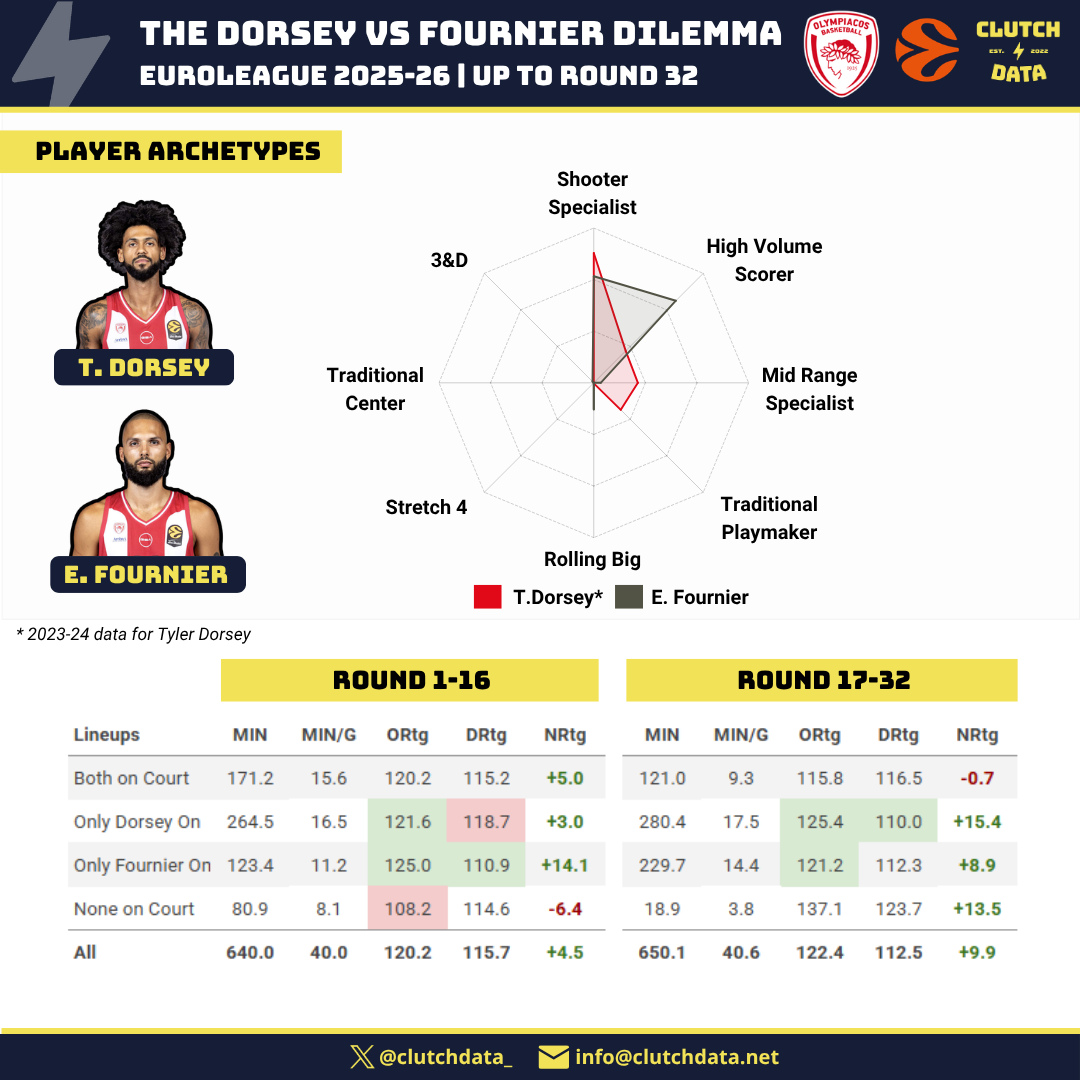
Tyler Dorsey had an explosive start to the season, improving massively from last year’s campaign. He has been on fire ever since and this meteoric rise created a problem. Why did this overlap become a problem in the first place? Look at their player archetypes and the answer becomes obvious. Both Fournier and Dorsey are Shooter Specialists and High Volume Scorers. That means both of them are looking for the ball - and on a team that relies on ball movement to create shots, having two high-usage scorers on the floor at the same time can create friction.
In the first half of the season, the on/off numbers reflected exactly that tension. When Fournier and Dorsey shared the court, Olympiacos had a +5.0 Net Rating - fine, but not special. When Dorsey was alone, likely without the right supporting cast, defense slipped and the Net Rating dropped to +3.0. But when Fournier played alone? Both ends of the floor improved sharply, producing a +14.1 Net Rating. And in the 8 minutes per game where neither was on the floor, the offense went cold entirely: -6.4 Net Rating.
After the change, the results speak loudly. Fournier and Dorsey still share some minutes (mostly in the 4th), and their combined Net Rating is slightly negative - but that’s a small price to pay. The real gains came from giving each player space to breathe: Dorsey’s solo unit now posts a +15.4 Net Rating, Fournier’s unit is nearly 9 points better than their opponents, and the “neither on the floor” minutes have shrunk to just 3.8 per game.
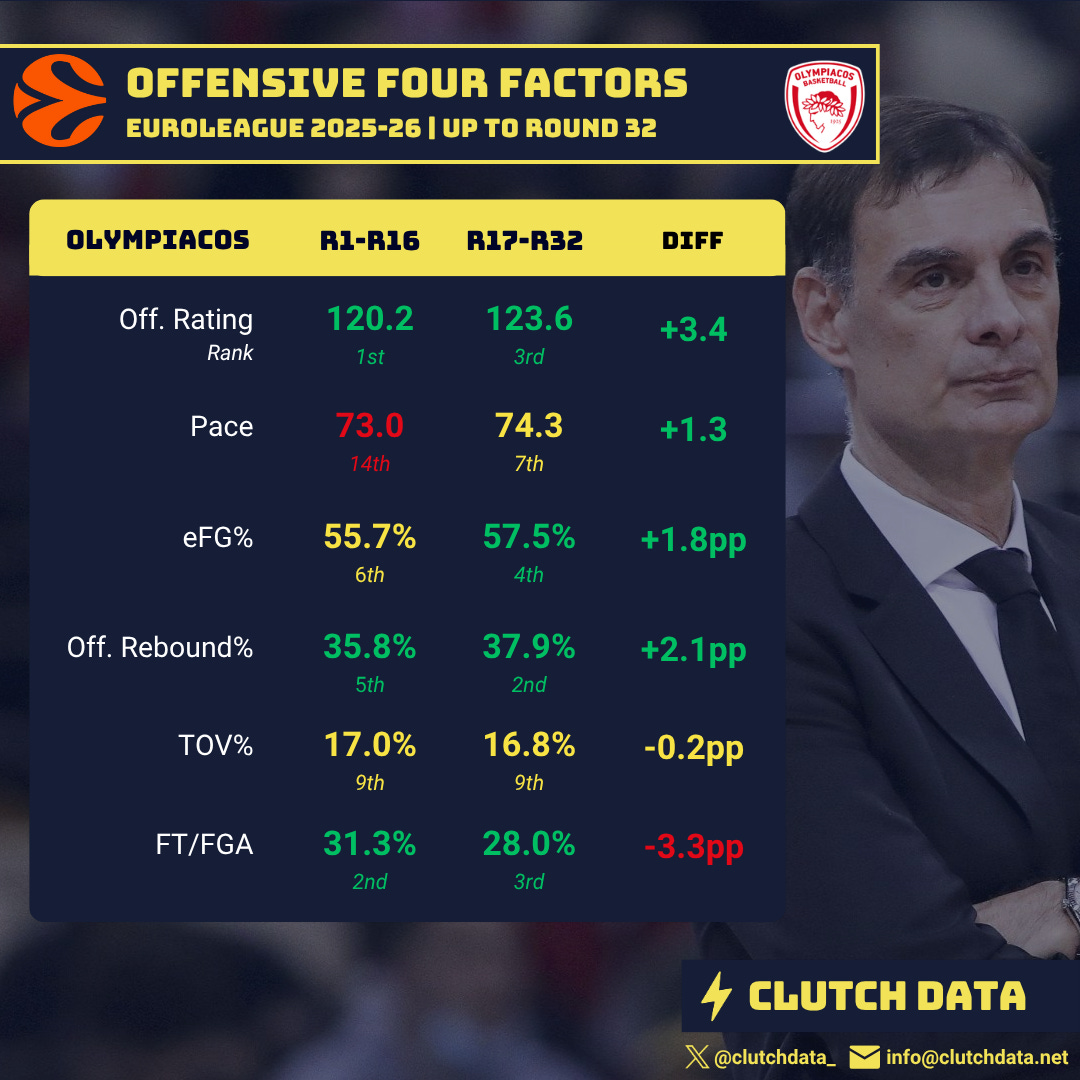
Dig into the offensive numbers and you can see the second half of the season written all over them. The team plays slightly faster (+1.3 possessions per game), shoots 1.8 percentage points better from the field, and has improved their Offensive Rebound% by 2.1 points, ranking 2nd in the league in that category. Turnover rate held steady, though the team is getting to the free throw line less often - a small trade-off for the gains elsewhere.
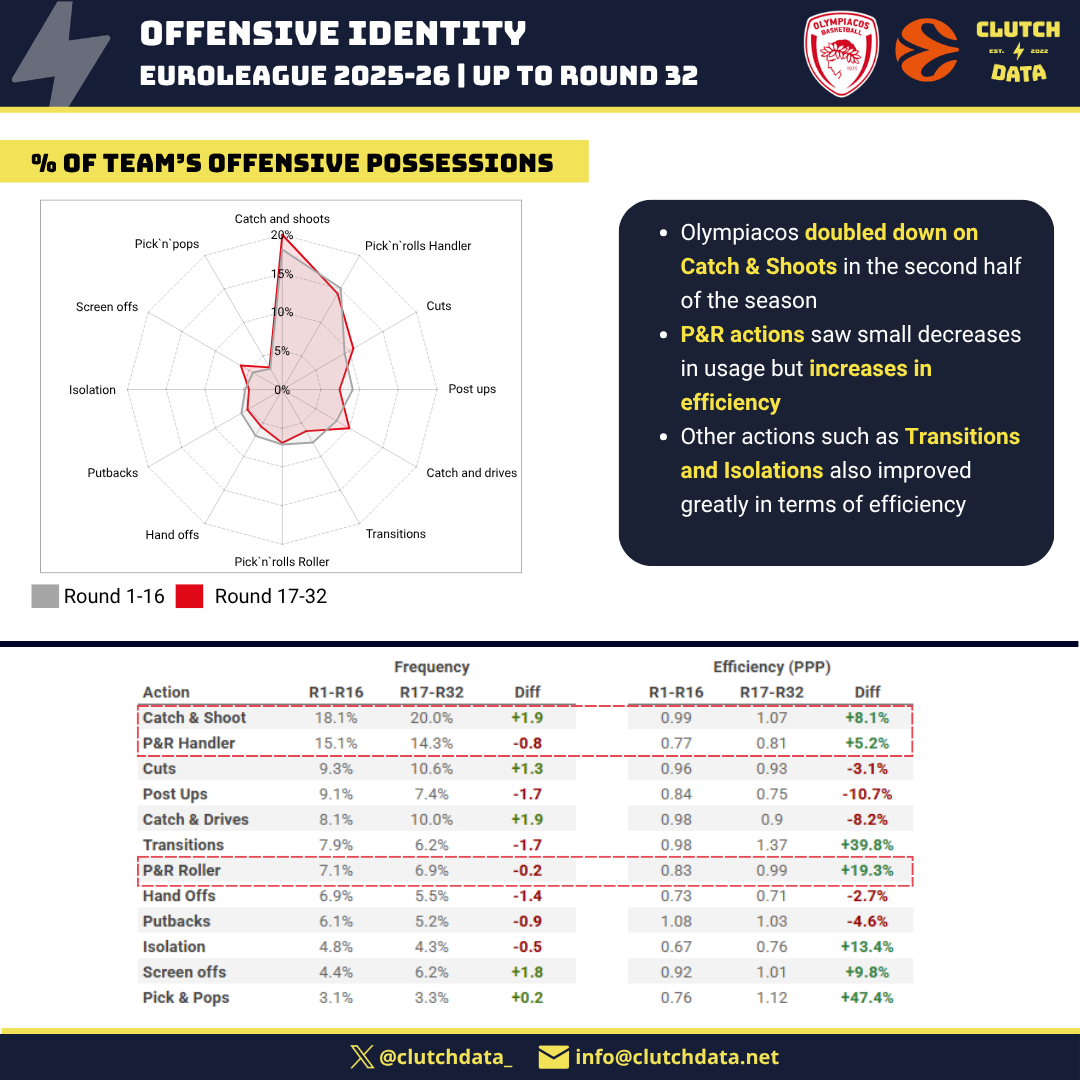
The offensive game plan itself evolved. Catch & Shoots became more frequent (+1.9pp), as did Cuts and Catch & Drives. Meanwhile, Post Ups and Handoffs took a back seat. In terms of efficiency, the improvements were across the board: Catch & Shoot conversions improved by 8.1%, P&R Handler efficiency climbed 5.2%, and P&R Roller possessions jumped a remarkable 19.3%. Transition and Isolation plays also became more dangerous - up 39.8% and 13.4% in efficiency respectively - even if they're used less often. The two pillars driving everything, though, are Catch & Shoots and Pick & Rolls and that’s where we’re going to focus next.
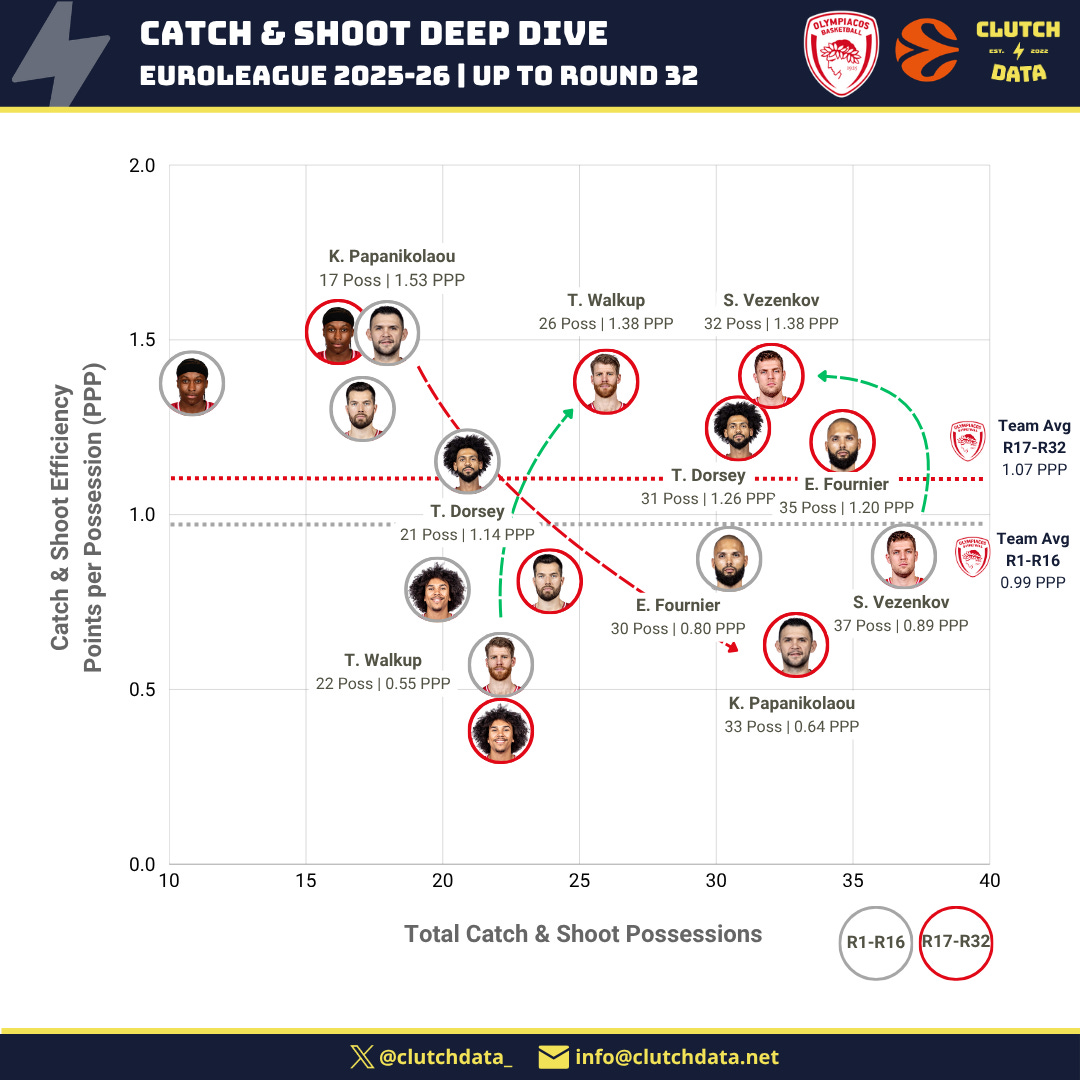
Nearly every primary shooter on the roster improved from the mid-point of the season onward. The two exceptions are Kostas Papanikolaou, who nearly doubled his Catch & Shoot attempts but at a significantly lower efficiency, and Alec Peters, who dipped slightly. Everyone else? Better.
The standout case is Thomas Walkup, who has been excellent this season and whose Catch & Shoot Points Per Possession more than doubled compared to the first half. And then there’s Sasha Vezenkov - operating at an elite level, taking a high volume of attempts and converting at an elite rate. When the shooters are this dialed in, it opens up everything else.
The biggest single transformation in Olympiacos’ offense has been their Pick & Roll efficiency - and it connects directly to the Fournier lineup change.
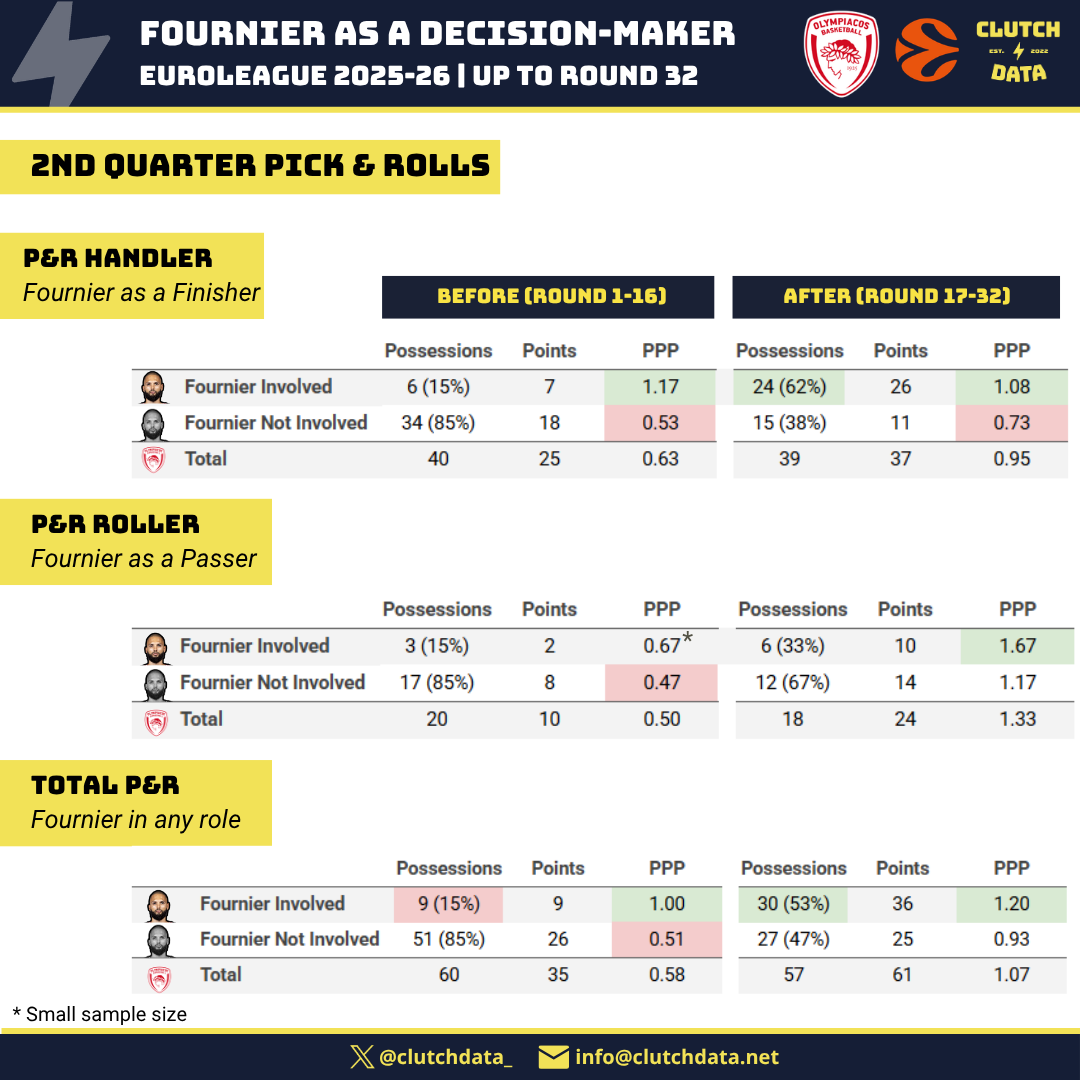
In the first half of the season, the P&R in the 2nd quarter was genuinely broken: 0.63 PPP for P&R Handlers, 0.50 PPP for Rollers, 0.58 PPP total. The warning signs were there, though. When Fournier was involved in P&R actions, efficiency jumped significantly - but since he was playing mainly in the starting lineup, he was resting during the 2nd quarter and involved in only 15% of all Pick & Rolls in that period.
Now? Fournier is involved in more than half of all 2nd quarter P&R actions, either as a passer or a finisher. The results have been transformative: 1.08 PPP for Handlers, a staggering 1.67 PPP for Rollers, and 1.20 PPP total. That’s not an incremental improvement - that’s a completely different offense.
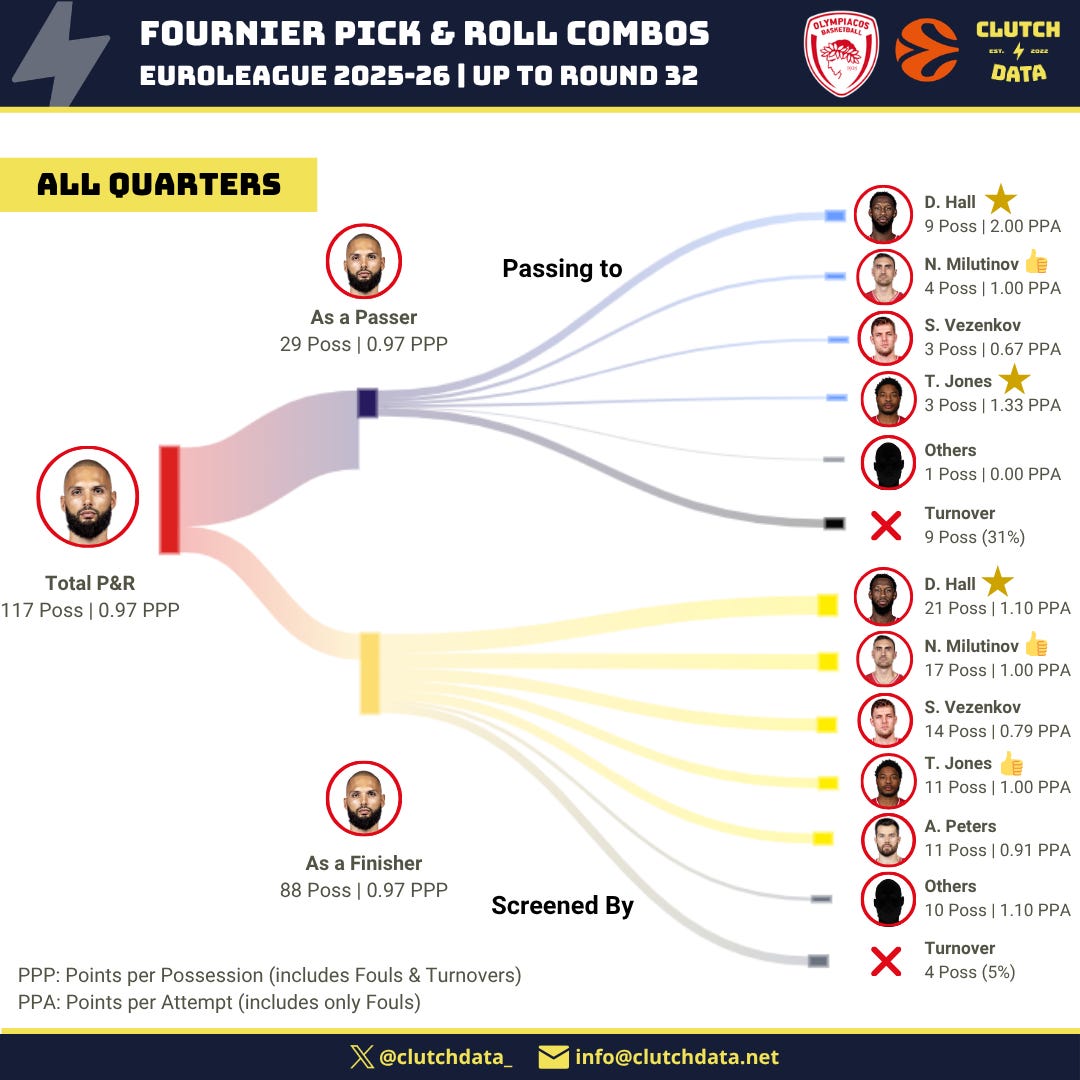
Any Pick & Roll involving Evan Fournier averages 0.97 PPP - whether he’s finishing or passing to the roller. But dig into his individual partnerships and some genuinely fascinating patterns emerge.
His best partnership by far is with Donta Hall. When Fournier passes to Hall off the P&R, the result is 2.00 Points Per Attempt - that’s 100% field goal percentage, for the record. When Hall sets the screen and Fournier finishes, it’s still an excellent 1.10 PPA. Fortunately, Hall is Fournier’s most frequent P&R partner. P&Rs with Nikola Milutinov yield a solid 1.00 PPA, and with new addition Tyrique Jones, things look promising too: 1.00 PPA when Fournier finishes, 1.33 PPA when he passes to Jones (small sample, but encouraging). The one combination that hasn’t clicked yet is with Sasha Vezenkov - 0.79 PPA when Fournier finishes and 0.67 PPA when he passes to Vezenkov. One number worth watching: 31% of Fournier’s passes to rollers result in turnovers, a risk that Olympiacos needs to manage as the season gets more critical.
On defense, the biggest story isn't about limiting shots - it's about controlling the glass. Most opponent-scoring patterns and turnover-generation rates stayed relatively similar, but Defensive Rebound% made a dramatic leap. Olympiacos now grabs 72% of available defensive rebounds, which means they've gone from ranked 15th in the first half of the season to ranked 1st. That's a complete reversal, and it has quietly been one of the most important factors in their second-half surge.
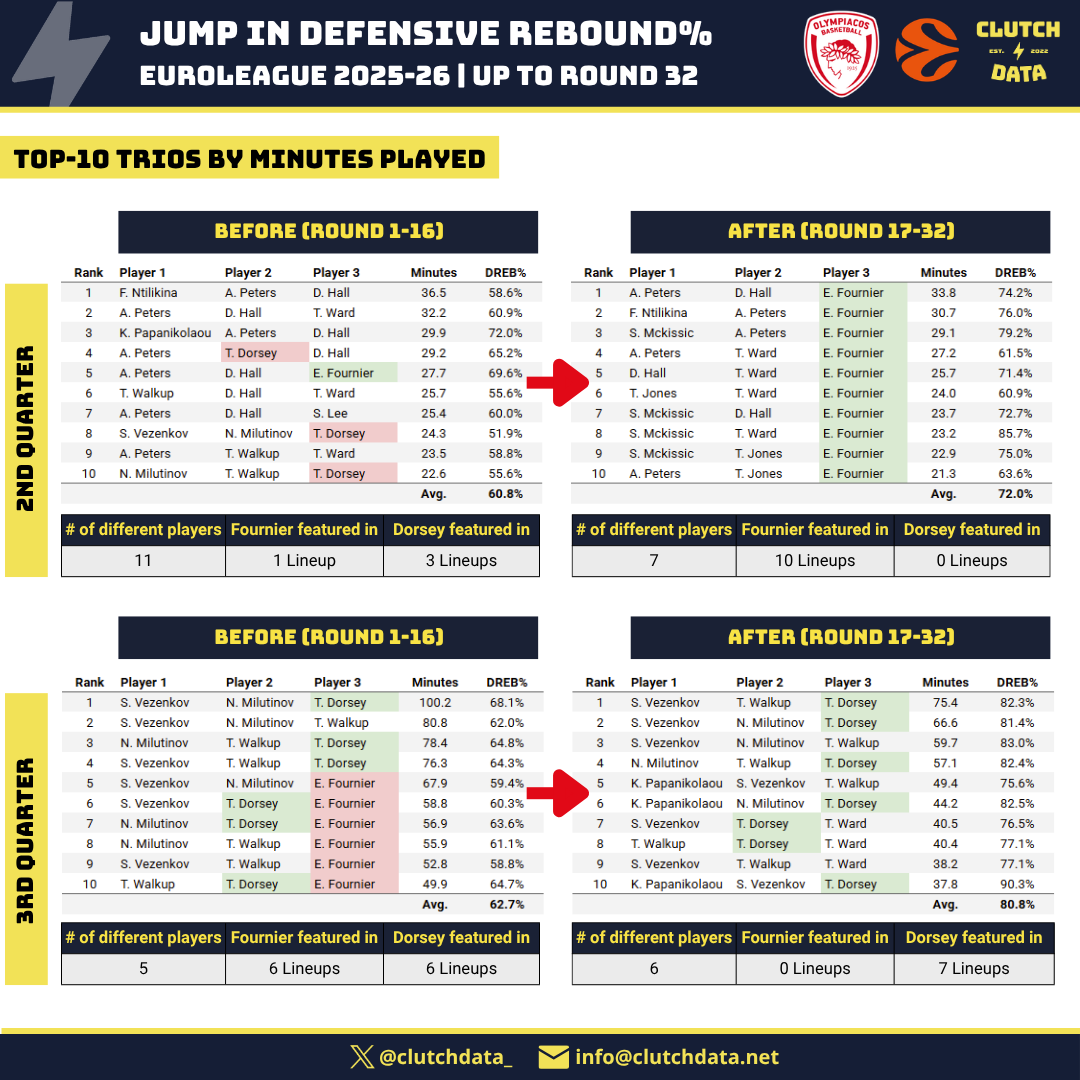
The 2nd and 3rd quarters are where the rebounding gains have been most pronounced, and lineup data offers a revealing clue. In the first half of the season, Fournier appeared in just one of the 10 most-used 3-player combinations in the 2nd quarter, while Dorsey appeared in three. The lineup that did feature Fournier - alongside Alec Peters and Donta Hall - posted a 70% Defensive Rebound%, the second-best in the Top 10, against an average of 61% across those groups.
In the second half? Fournier appears in all 10 of the most-used 2nd quarter trios. Better lineup construction led to a 72% DREB% across the board.
The 3rd quarter tells an equally interesting story. In the first half, both Dorsey and Fournier featured across the Top-10 combinations, averaging 63% DREB% - with Fournier-without-Dorsey lineups dropping below 60%. In the second half, Fournier has been moved out of the 3rd quarter picture entirely, while Dorsey now anchors 7 of the 10 top trios. The result? A jaw-dropping 81% Defensive Rebound% across those lineups. Lineup construction isn’t the only factor here, but it’s hard to argue it isn’t one of the defining ones.
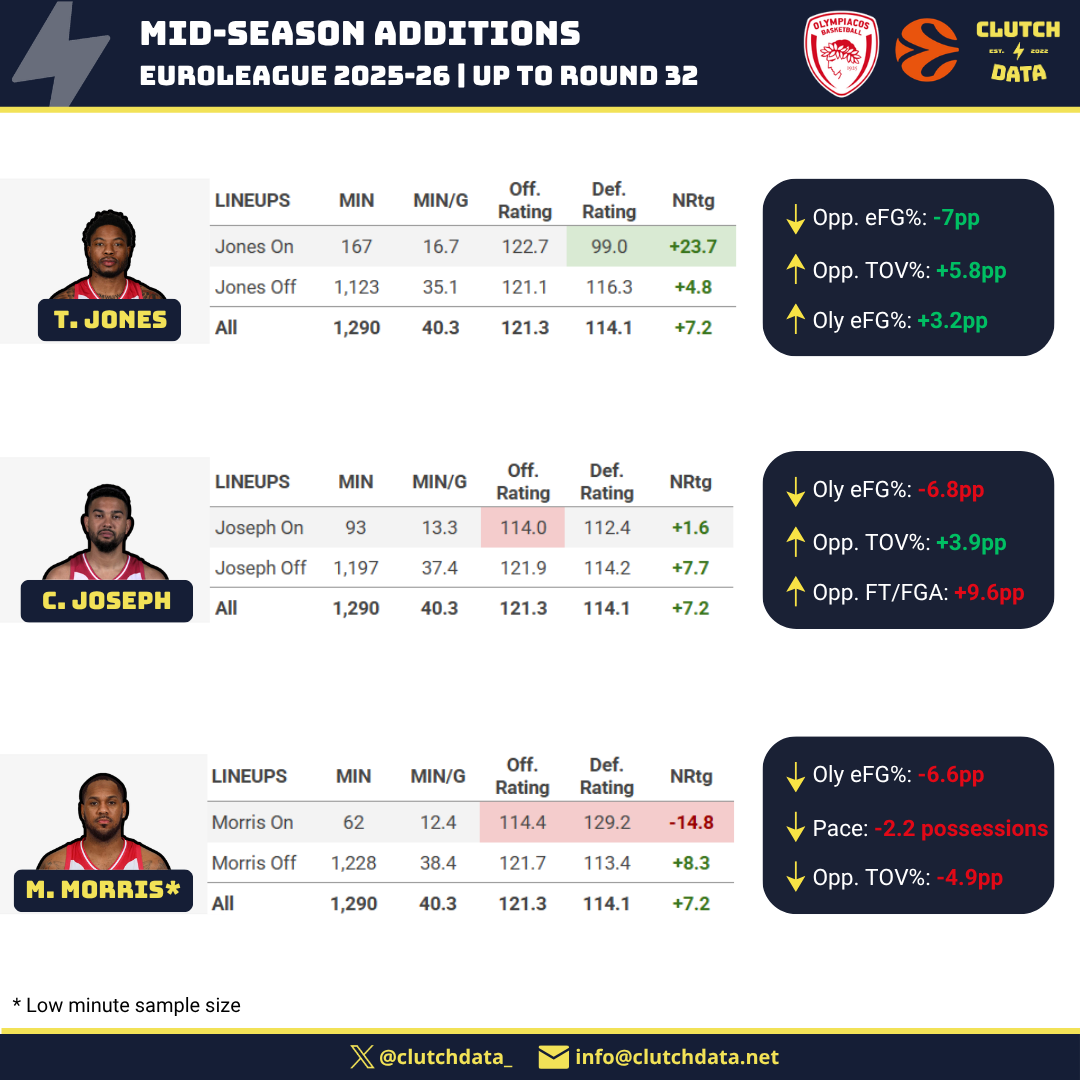
Three players joined Olympiacos mid-season - Tyrique Jones, Cory Joseph, and Monte Morris - and their contributions have varied significantly.
Jones has been the most impactful, and the defensive numbers around him are almost hard to believe. With Jones on the floor, Olympiacos allows 17.3 points fewer per 100 possessions than when he sits, with the Defensive Rating dropping to an absurd 99 points per 100 possessions and a Net Rating of +23.7. He gets there by cutting opponents’ eFG% by 7 percentage points and forcing turnovers at a rate 5.8 percentage points higher, while also boosting Olympiacos’ own eFG% by 3.2pp. He’s been a revelation.
Monte Morris has missed significant time with injury, so any verdict on him is premature. Cory Joseph has had more of a sample to work with, and the picture is mixed. With Joseph on the court, Olympiacos’ Offensive Rating drops by nearly 8 points per 100 possessions, though the defense improves enough to keep the Net Rating at a still-positive +1.6. The drop in shooting is the main culprit on offense, partially offset by better defensive turnover generation.
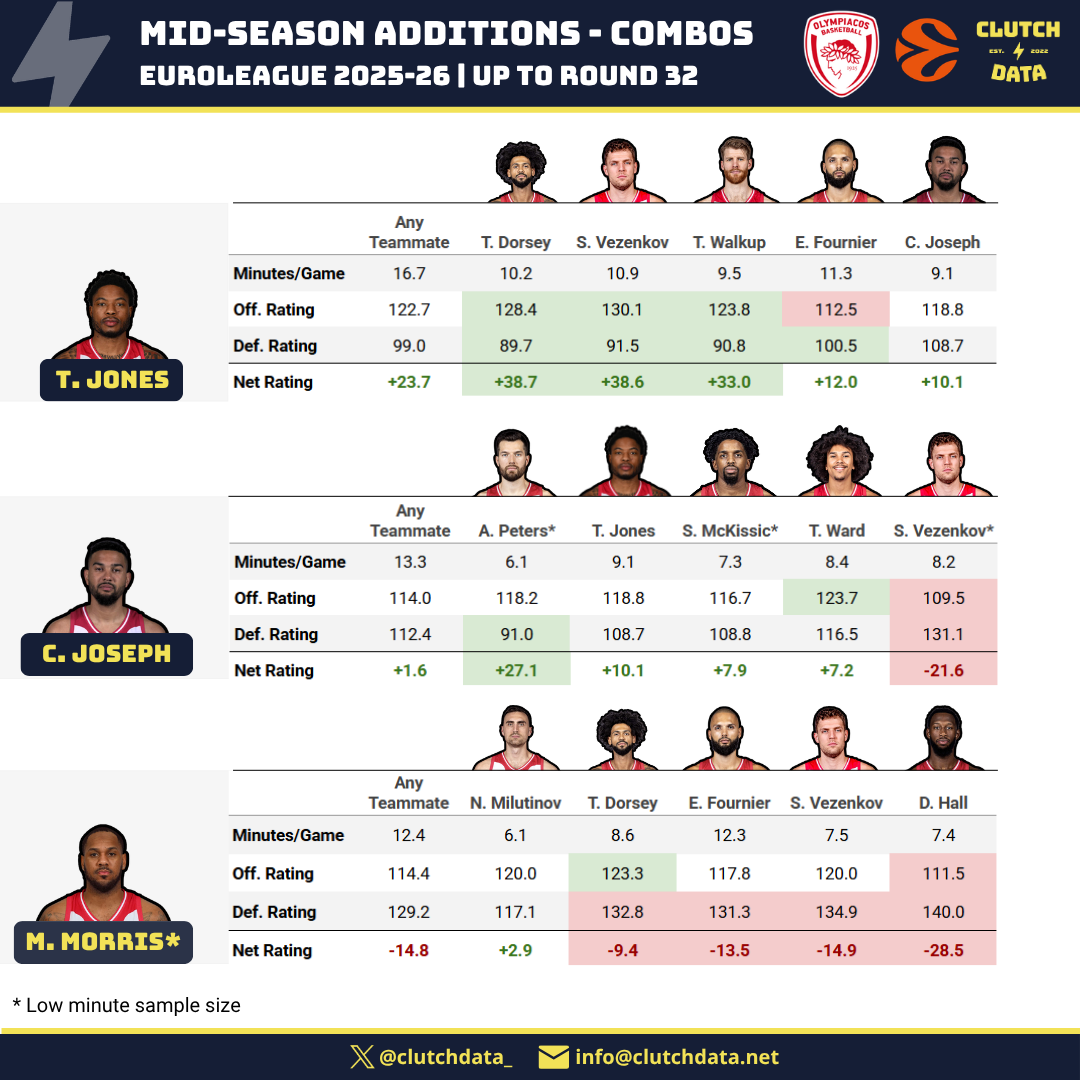
The new additions each come with their ideal partners - and their trouble spots.
Tyrique Jones works well with almost everyone, but his best combinations are with Dorsey, Vezenkov, and Walkup. Together, those lineups push the Defensive Rating to extreme lows and produce Net Ratings above +30 points per 100 possessions.
Cory Joseph has shown promise in limited minutes alongside Alec Peters, and also with Jones, McKissic, and Ward. The combination to avoid? Joseph and Vezenkov together - both offense and defense decline, and the Net Rating crashes to -21.6.
Monte Morris presents the biggest defensive risk, particularly when paired with Dorsey, Fournier, Vezenkov, or Hall. The one pairing that mitigates that risk is with Milutinov - in their limited time together, the team holds a positive +2.9 Net Rating.
What Olympiacos have shown in the second half of this season is that intelligent roster management and tactical flexibility can matter just as much as raw talent. The fix wasn’t a complete overhaul - it was a reordering. Moving Fournier to the bench didn’t diminish him; it elevated both him and Dorsey by giving them the space and the right teammates to operate at their best.
The Pick & Roll transformation in the 2nd quarter - from among the worst in the league to among the very best - is perhaps the clearest symbol of just how much changed. Add in Tyrique Jones’ defensive impact, dramatically improved rebounding across multiple quarters, and a roster of shooters who are firing on all cylinders, and you have a team that looks very different from the one that stumbled through the first 16 rounds.
Final Four dreams are alive - and for good reason.
No posts
Comments
Nothing yet. Say the first thing.
Sign in to join the conversation.