
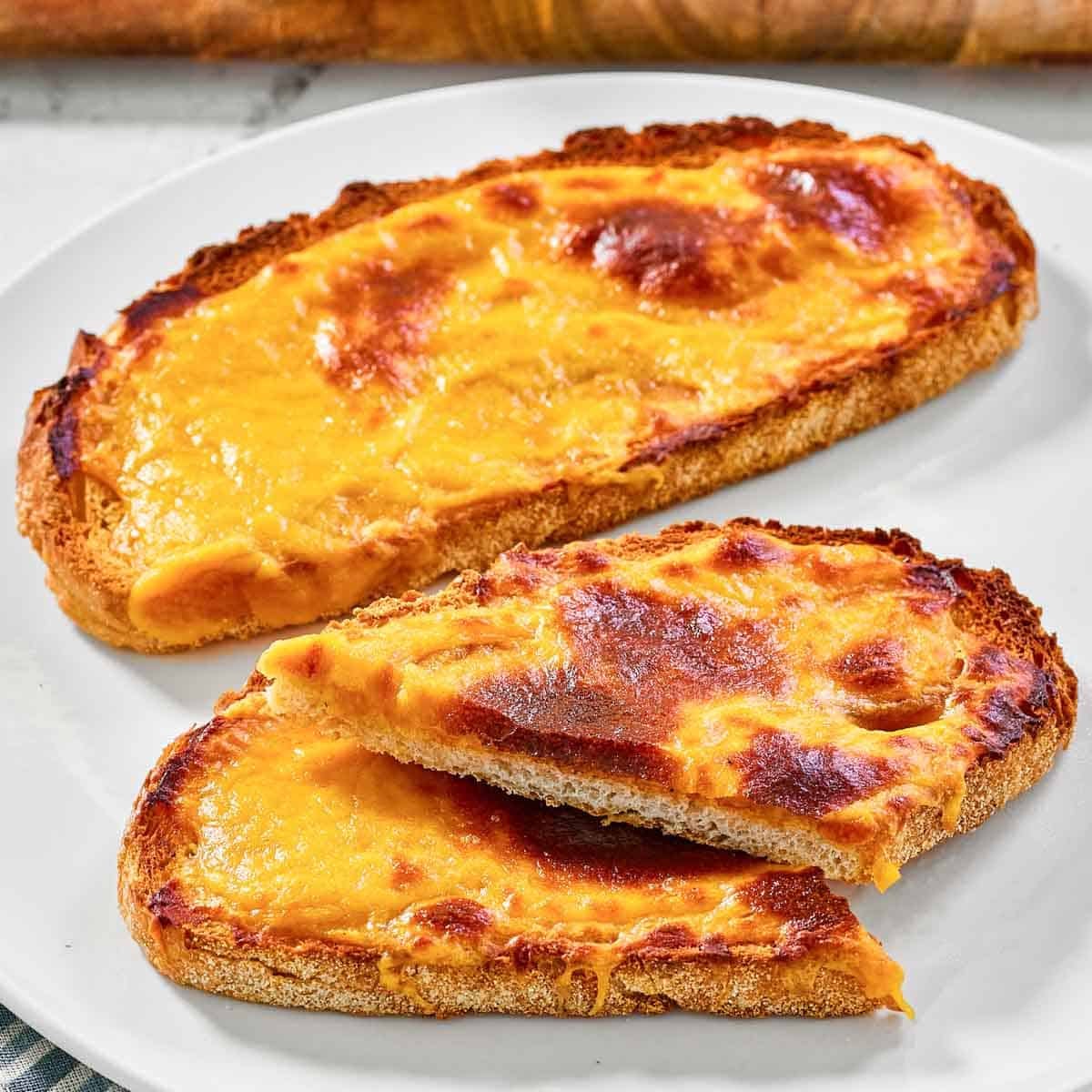
Welsh rarebit. (Photo credit: Vintage Recipes.)
Having recently looked at the now-endangered Patum Peperium, a key ingredient of Scotch Woodcock, I thought it would be worth looking at another Clubland staple savoury: Welsh rarebit, or Welsh rabbit. (Despite its name, no rabbit is involved.)
Often dismissed as “a posh name for cheese on toast”, Welsh rarebit involves rather more than that, blending melted cheese with ale and strong seasoning, and then serving it freshly solidified over the toast.
The name ‘Welsh rarebit’ is a 1780s corruption of its original form, Welsh rabbit, which had emerged by the 1720s, just as the modern idea of a club was evolving. It was a popular standalone snack, fueling round-the-clock gambling in the early clubs of the 18th century. These early clubs often lacked a formal menu, or ‘bill of fare’, instead providing a combination of the cook’s speciality for the day, and attempting to fulfil the members’ requests. And Welsh rarebit was a common request, very much being 18th century comfort food.
Because of its ubiquitousness on modern club menus (alongside such courses as dressed crab or potted shrimp for starters, and - if in season - a main course of fresh game), I find I often order it in clubs, as it offers a benchmark for comparing how different clubs can approach a familiar dish, in their own distinctive style.
As previously noted, between the late Georgian era and the Inter-War era, “Savouries” were regarded as a course in their own right - served either alongside dessert, or as a standalone course after dessert; and they were common across Clubland.
The benefits of a savoury course stretch beyond mere greed. It cleanses the palate between the sweet course and the dessert wines; and the infusion of salt makes diners thirstier, ahead of port being served. It was also long believed - per humoral theory - that it aided digestion in ‘closing up’ the stomach, although today’s doctors will tell you that there is absolutely no medical or scientific basis for this belief.
Ironically, given its Welsh moniker, the dish was never particularly big in Wales: savoury courses were very much an English phenomenon.
The origins of Welsh rarebit (and its predecessor term, Welsh rabbit) are not so much shrouded in mystery, as in mythology - there are several competing versions of its origin.
The most commonly-cited etymology is that it is a derogatory joke, referring to how the Welsh were thought to be so impoverished that they could not afford to eat meat, such as rabbit; and so this dish was presented as a meat substitute, involving inexpensive ingredients. There is, however, limited evidence for this story, or for the popular version that it refers to the banning of Welshmen from hunting on English rural estates. In truth, these different versions should all be considered hearsay.
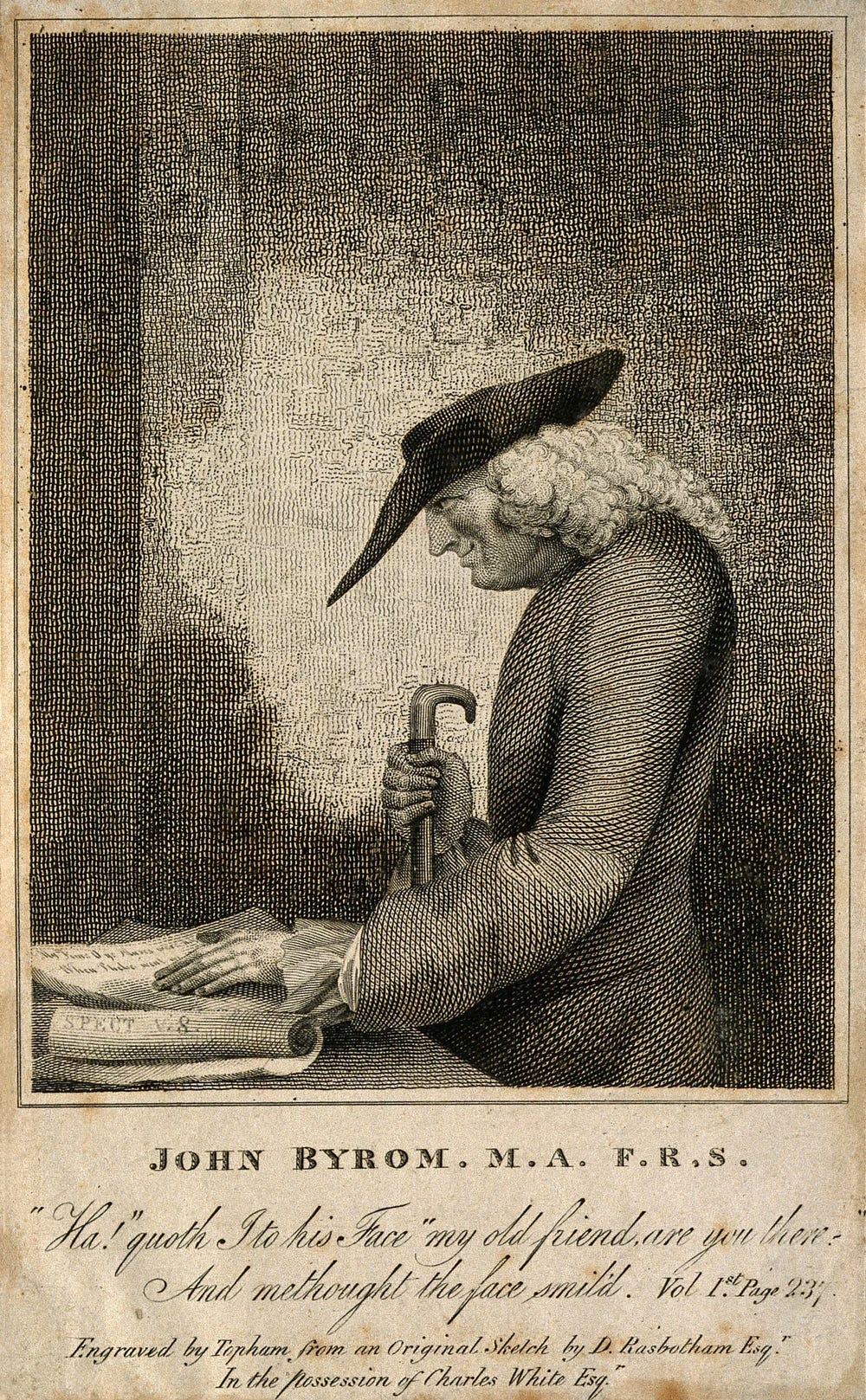
John Byrom, who gave us the first recorded use of Welsh rarebit. (Picture credit: Wikimedia Commons.)
The earliest written reference to it, according to the Oxford English Dictionary, is from The Private Journal and Literary Remains (1725) of John Byrom, in which he wrote, “I did not eat of the cold beef, but of Welsh rabbit and stewed cheese.”
The oldest published version of the recipe is from one of the most influential cookery books of modern times, The Art of Cookery Made Plain and Easy (1747), by Hannah Glasse. It can be found here, on page 146, where it is rendered as “Welch Rabbit”. The book also contains variant recipes for English Rabbit, and Scotch Rabbit. At least a third of Glasse’s recipes were not original, and given Byrom’s reference to it 22 years earlier, it was clearly a pre-existing recipe.
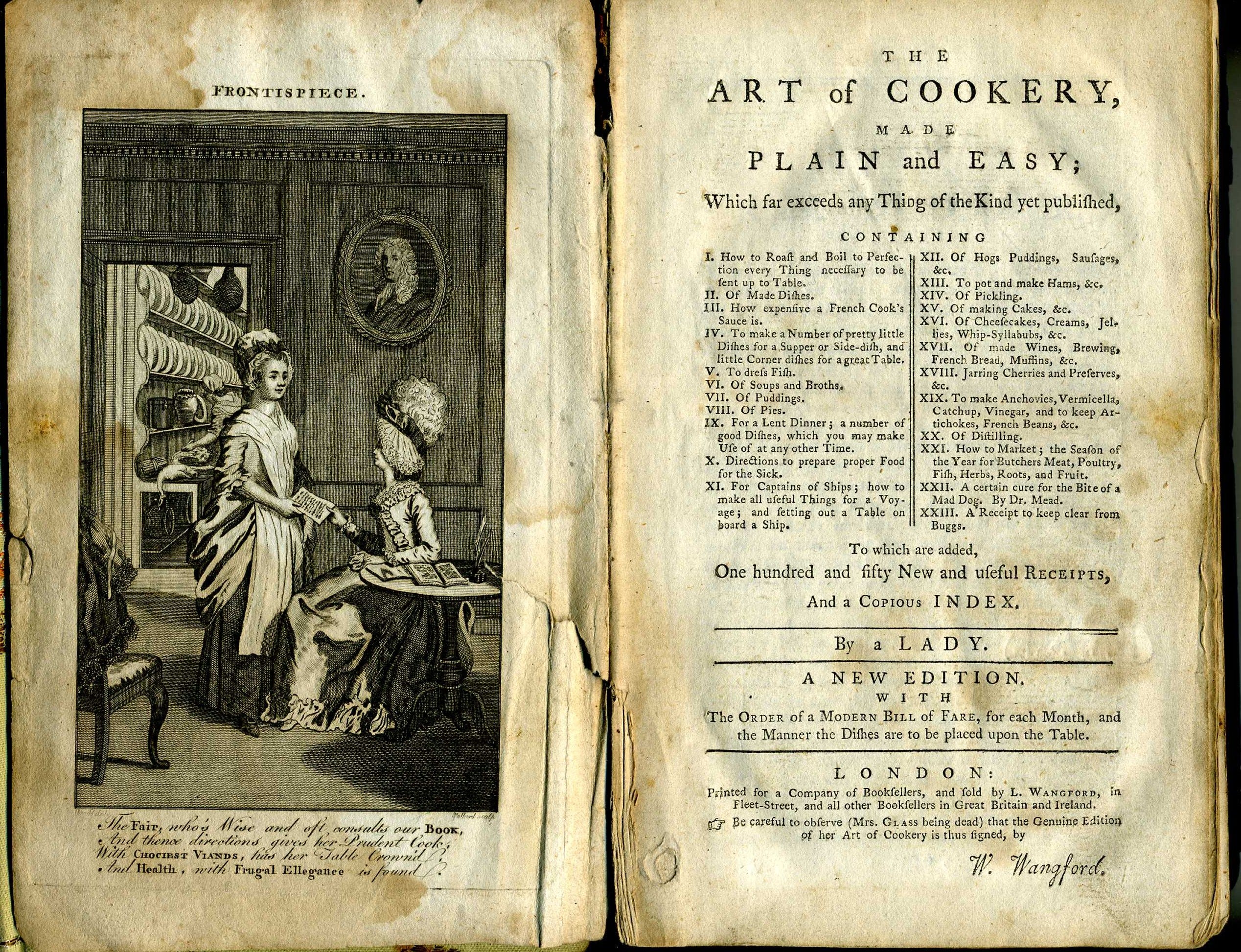
Hannah Glasse’s The Art of Cookery Made Plain and Easy (1747) gave us the first recorded recipe for this dish. (Picture credit: Wikimedia Foundation.)
And savoury variants had existed in earlier centuries: the Restoration-era cookbook The Closet of the Eminently Learned Sir Kenelme Digbie Kt. Opened (1669), attributed to Sir Kenelm Digby, carried a recipe for “Savory Tosted or Melted Cheese’, typically blended with mutton gravy, and served with becon, or onions, or anchovies.
The OED gives the variant spelling of “Welsh Rarebit” as having first been used in 1781. It was ostensibly a way of further distancing the dish from any expectation of meat. In 1892, Professor Brander Matthews of Columbia University was the first of many observers to write that the evolution of “Welsh Rabbit” into “Welsh Rarebit” was a ridiculously pretentious affectation; and that “ignorant and dense” was, “the unknown unfortunate who first tortured the obviously jocular Welsh rabbit into a pedantic and impossible Welsh rarebit.”
Nevertheless, Rarebit remains more common in cookery books and menus today, even if the older Rabbit remains perfectly acceptable for day-to-day usage. Indeed, H. W. Fowler in his A Dictionary of Modern Usage (1926) declared that, “Welsh Rabbit is amusing and right. Welsh Rarebit is stupid and wrong.”
Just about every club (and indeed every restaurant) serving Welsh rarebit has its own slight variation on the recipe. Despite the “posh cheese on toast” moniker, Welsh rarebit recipes have never consisted of just these two ingredients. There are four core parts to most recipes:
Toast
Cheese
Ale
Seasoning
And of course, the presentation may vary, i.e. London’s Walbrook Club chops its toast into little squares, about two inches by two inches.
Hannah Glasse’s own 18th century recipe used unspecified bread and hard cheese, while mustard was used as the seasoning. But the recipe has evolved considerably since then - Glasse did not mix in the mustard with the heated cheese, but simply smeared a little mustard on top.
To look at each of the four key elements in turn:
Toasted bread is the base of the whole recipe, and is not to be overlooked. Sourdough is the clear favourite to use, although something like rustic Rye can be substituted. Avoid bland, overly-processed white bread, and favour more flavoursome, whole seed or multiseeded breads. But if you must use a white bread, Bloomer can work.
While this may seem incredibly obvious, due care is needed not to burn the toast: I recently ordered Welsh rarebit in a very well-known, upper-crust London club, and while the melted concotion was heavenly, the toast underneath had been burned to a crisp.
Cheddar is by far the most common cheese to be used for this recipe; although this is more a reflection of its overall profile (“It’s the single most popular cheese in the world!”, exclaimed John Cleese in The Cheese Shop Sketch) than its necessarily being optimal. If you are going to use Cheddar, then mature Cheddar adds tanginess.
Softer cheeses from the Francosphere such as Camembert or Tomme Vaudoise also work; though if you are keen on a hard cheese, I can recommend using Gruyère. (I’m not just saying that because I’m Swiss!) English cheeses that have long been used for the recipe include Double Gloucester and Lancashire. If you want to be super-traditional, Digby’s 17th century recipe for cheese on toast recommended Brie, Cheshire, or thick cream cheese.
And of course, one can blend more than one type of cheese in this recipe. An equal mix of a crumbly cheese like Caerphilly, with a hard cheese like Cheddar, produces striking results.
The ale is blended in with the the cheese. The most common traditional ales used were an English porter such as Brown Porter, or an Irish stout such as Guinness.
Other alternatives include pale ales such as Samuel Smith’s Organic Pale Ale, and brown ales such as Newcastle Brown Ale.
Sweet beers are to be avoided at all costs - they would defeat the whole point of a savoury course.
Felicity Cloake notes that the Cheese Society has its own version of the recipe that involves substituting ale with cider. While I’m very fond of cider (and actually prefer it to beer), I think it is all wrong for the flavour profile of this recipe, and I would steer well clear of using any.
The cheese and ale are given a further tangy umami flavour with the addition of some strong seasoning. Either English mustard or Worcestershire sauce (but not both!) are the most common examples. Personally, I would favour mustard over Worcestershire sauce, as the latter is often served as a condiment with Welsh rarebit - it seems silly adding more Worcestershire sauce to something partly made of Worcestershire sauce.
Variant recipes include the use of horseradish, smoky paprika, cayenne pepper, balsamic vinegar, ground white pepper, or even Marmite.
On no account is salt to be added: in most variants, the recipe contains quite enough salt as it is.
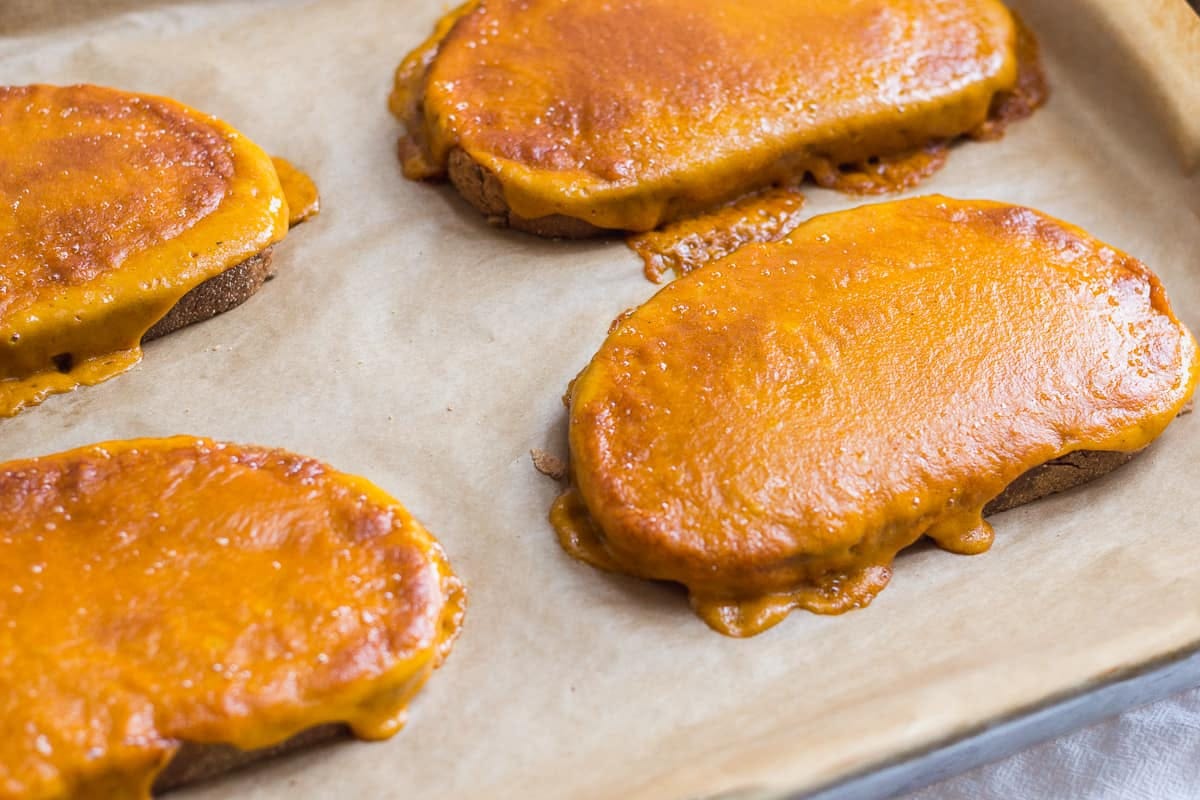
Welsh rarebit, fresh out of the grill. (Photo credit: Food + Table.)
Making Welsh rarebit is relatively simple, even though timing needs to be precise. A typical recipe is below. In addition to the four main ingredients above, it uses milk/cream, butter, flour and pepper.
Finely grate 250g of cheese in advance, and lightly toast two slices of bread - the toast should be underdone at this stage; and preferably only toasted on one side.
In a pan over a medium heat, melt 50g of butter, and thoroughly whisk in 50g of plain flour, until the mixture is smooth and brown. Slowly add in 150ml of ale, and 150ml of either cream or milk, to produce a thick paste.
At this stage, add one or two heaped teaspoons of your seasoning. Feel free to add a dash of pepper to taste. Stir over the heat for 5-10 minutes.
Finally, remove the pan from the heat, and gradually add the grated cheese to the pan, stirring it in thoroughly, to produce an even thicker paste.
Place the toast on a baking tray, with its toasted side down, and its untoasted side up. Pour the paste directly over the toast (onto the untoasted side), and place the baking tray with the toast under the grill, for between 3 and 5 minutes.
Plate, and serve promptly.
Serve alongside Worcestershire Sauce, which can be added to taste.
Some establishments serve it with bacon, ham, pickles, chutney, chives, buttered leeks, and/or even a green salad with a lemon vinaigrette; but these may be viewed as showing off, distracting you from the main event. Welsh rarebit is supposed to be a modest dish, not a major course in its own right.
Similarly, the addition of a poached egg on top makes it a variant dish, a ‘Buck Rabbit.’
However you choose to eat it, whether ordered in a club or restaurant, or made at home: enjoy!
You can view the full and varied backlog of Clubland Substack articles, by clicking on the index below.
Index
March 12, 2025
Articles are centred around several distinct strands, so the below contains links to the main pieces, sorted by theme.
No posts
Comments
Nothing yet. Say the first thing.
Sign in to join the conversation.