
DARPA: Universal Artificial Plasma / Blood Supplier
Part 2: DARPA’s Fieldable Solutions for Hemorrhage with bio-Artificial Resuscitation Products (FSHARP)
As we continue with part 2 of DARPA’s Fieldable Solutions for Hemorrhage with bio-Artificial Resuscitation Products (FSHARP). To refresh: DARPA is developing a shelf-stable, powdered synthetic blood product to sustain injured troops on the battlefield.
As of 2023: DARPA Team Begins Work on Field Deployable Whole Blood Equivalent
DARPA’s Fieldable Solutions for Hemorrhage with bio-Artificial Resuscitation Products (FSHARP) program aims to develop a field-deployable, shelf-stable whole blood equivalent that can be used to resuscitate trauma patients when donated blood products are not available. DARPA has teamed up with several universities, Biotech NGO’s and contracts with governments. The alarming concern – Gov’ts will be manufacturing and have the capacity to provide a universal 100% “synthetic blood” on a global scale.
“Bleeding is the most common cause of potentially survivable death in trauma, in both military and civilian settings. Whole blood is recognized as the resuscitation fluid of choice; however, it has limited viability, requires cold storage, and is not always available due to logistical challenges and donor dependence. Despite the Department of Defense’s (DoD) extensive and highly effective blood program, rapid patient evacuation to a facility that has blood is not always an option. To improve changes for survival, patients should have access to blood in 30 minutes or less1.
“When blood donations decline – as we have seen during the COVID pandemic – that threatens availability everywhere, even in high resource settings. Blood availability also could be at risk in military engagements with large numbers of casualties, with a sudden and significant increase in need,” stated Cmdr. Jean-Paul Chretien, DARPA’s program manager for FSHARP and a U.S. Navy medical officer. “The primary problem FSHARP aims to solve is whole blood’s dependence on cold chain and resupply.”
DARPA selected a team at the University of Maryland, Baltimore (UMB) to lead this effort with support from Case Western Reserve University, Charles River Laboratories, Haima Therapeutics, KaloCyte Inc., Latham Biopharm Group, Ohio State University, Pumas-AI Inc., Southwest Research Institute, Teleflex Incorporated, University of California San Diego, and University of Pittsburgh. Their plan is to integrate multiple bio-artificial and synthetic components to deliver oxygen, stop bleeding, and replace volume—key therapeutic functions of whole blood in resuscitation. They will evaluate efficacy and safety in increasingly complex and realistic trauma models and intend to develop strategies for stabilizing the product for months without cold storage and scalable manufacturing methods.
Other subcontractors have the potential to join the UMB consortium pending the exercise of additional options in the FSHARP award.
“This is truly a ‘DARPA Hard’ problem and an example of DARPA’s ability to facilitate the partnerships needed to achieve technological breakthroughs,” added Chretien. “To address FSHARP’s goals requires multiple universities and companies developing analogues of various blood components, simultaneous evaluation of multiple efficacy and safety features and interactions among components in various model systems, industrial-scale manufacturing capabilities that can adapt the lab-scale methods, and analytics to integrate large volumes of experimental data and guide further optimization. UMB has assembled a consortium with the broad set of capabilities needed to accomplish these tasks.”
Additional information on the FSHARP program can be found in the broad agency announcement at https://sam.gov/opp/36db79ac97b0496399f472d5f2d5dd5a/view.
1 Shackelford, S. et al. (2021 July 16). Joint Trauma System, Defense Committee on Trauma, and Armed Services Blood Program consensus statement on whole blood. Transfusion. https://doi.org/10.1111/trf.16454.
DARPA selected a research consortium led by the University of Maryland, Baltimore (UMB) to develop a shelf-stable, field-deployable whole blood substitute. Awarded a grant of up to $46.4 million, this DARPA program aims to revolutionize trauma and combat casualty care.
Over the past 10 years, Dr. Hu and his colleagues have received $35 million in grant funding to contribute data and aid the development of lifesaving interventions in trauma. He is also working on other research to predict the early need for blood transfusions in mass casualty incidents.
**This is AI advanced technology.
DARPA’s Research Infrastructure for Trauma with Medical Observations (RITMO) effort, which is funding the study, aims to create a single database of de-identified trauma patient data derived from the early post-injury period. The RITMO program is the foundational data component of the DARPA Triage Challenge, a 3.5-year challenge designed to drive the development of physiological ‘signatures’ of injury that will help medical responders quickly assess patient vital signs, make triage decisions and render aid to the critically injured in military and civilian mass casualty incidents. Mass casualty incidents involve multiple injured patients and can include large-scale traffic accidents, natural disasters like hurricanes or wildfires, or violent attacks like mass shootings.
2023: UM School of Medicine Awarded Up to $7.3M from DARPA to Drive Innovation in Trauma Triage Technology, Improve Mass Casualty Response Efforts
In an effort to better optimize the triage of patients during mass casualty events, University of Maryland School of Medicine (UMSOM) researchers are receiving up to $7.3 million in funding from the Defense Advanced Research Project Agency (DARPA) for vital new research. The funding will be used to support a study that will collect data over the next 3.5 years on trauma patients with the aim of identifying and implementing lifesaving advancements in medical triage for large-scale mass casualty incidents.
Findings from this new study will also be used in a separate RITMO initiative called the DARPA Triage Challenge data competition. Teams in the data competition are challenged to develop algorithms that will detect the signatures of injury through non-invasive sensors. This will provide insights that will enable accuracy in triage decision-making such as prioritization for medical evacuation.
As part of the DARPA Triage Challenge, a University of Maryland College Park robotics team is working on building drones with stand-off sensors that will utilize the algorithms to drive the aerial assessment of vitals and injuries in real-time. Sarah Murthi, MD, Professor of Surgery at UMSOM and a critical care surgeon at the Shock Trauma Center, is part of this team and will contribute her expertise on medical sensing and triage procedures.
Haima Therapeutics, LLC is one of the biotech companies that was awarded research with DAPRA.
Combat Readiness-Medical
2023: A Nanotechnology-Enabled Biosynthetic Whole-Blood Surrogate for Hemostatic Resuscitation -
“Uncontrolled hemorrhage (bleeding) is recognized as the leading factor in medically preventable death from traumatic injury, especially on the battlefield. Advances in injury management, such as tourniquet use and damage control resuscitation, have largely reduced fatality rates, but significant challenges persist. Damage control resuscitation is a non-surgical intervention that seeks to limit blood loss and prevent the lethal cascade of physiological events. One facet of this approach is the administration of fluids, whole blood, and/or targeted blood products (red blood cells, platelets, plasma), to reduce morbidity and mortality from traumatic hemorrhage. Fresh or cold-stored whole blood is the ideal choice for blood transfusion, but conditions in the battlefield may limit availability for immediate treatment of casualties. Development of a synthetic whole blood substitute could augment efforts to establish in-theater blood banks, significantly reduce mortality associated with hemorrhage and related trauma-induced coagulopathy, and reduce the logistical burden of storage and administration of blood products, especially in scenarios with a limited natural blood component supply or prolonged/remote care.
Under the fiscal year 2019 (FY19) Combat Readiness-Medical Research Program’s Rapid Development and Translational Research Award, Dr. Michael Bruckman of Haima Therapeutics, LLC, leads a collaborative team that is developing a dried, whole-blood surrogate that can address logistical challenges related to the availability of whole blood in austere battlefield environments. To pursue this approach, Haima Therapeutics has teamed with biotechnology companies to combine, into a single product, blood component surrogates that are already in development. Combination of the nanoparticle-based, red blood cell surrogate, ErythroMer (Kalocyte, Inc.); platelet substitute, SynthoPlate (Haima Therapeutics); and freeze-dried plasma (FDP) are anticipated to serve as a biosynthetic whole-blood surrogate for remote damage control and resuscitation. To create this novel agent, the study team must establish the compatibility of the individual components when mixed with FDP and test the clotting and oxygenation function of the co-formulation. The final product will be evaluated in an in vivo model of acute massive hemorrhage and resuscitation.”
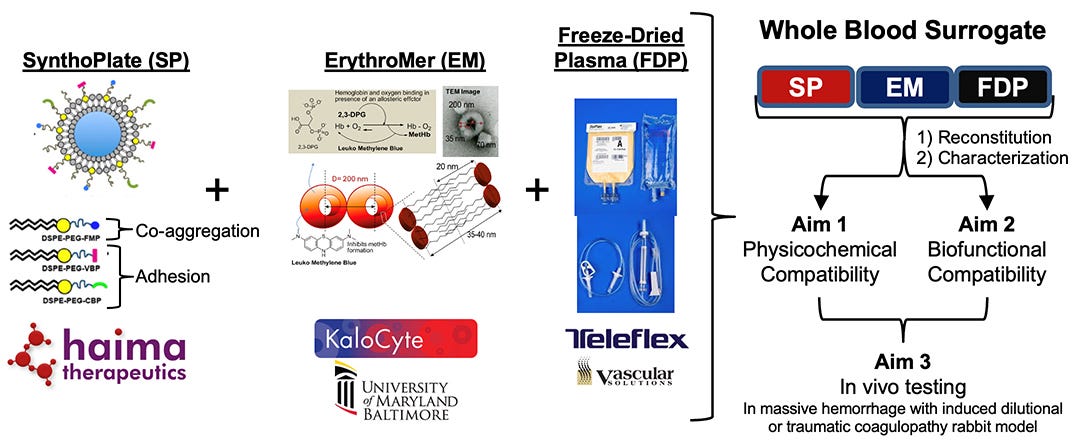
https://cdmrp.health.mil/crrp/research_highlights/23Bruckman_highlight.aspx
No posts
Comments
Nothing yet. Say the first thing.
Sign in to join the conversation.