
Lewis Mumford noticed that the city of the dead precedes the city of the living. Before there were permanent settlements there were permanent burial grounds; the first sustained collective architecture is funerary, and nomadic peoples who built nothing else built for their dead. Take this seriously and it reorders everything we might want to say about a city’s mind, because it means the founding organizational act of the city is not shelter, not trade, not defence, but the maintenance of a relation to someone who is irreducibly absent: a face that cannot look back, cannot be predicted, cannot be explained, and obligates anyway.
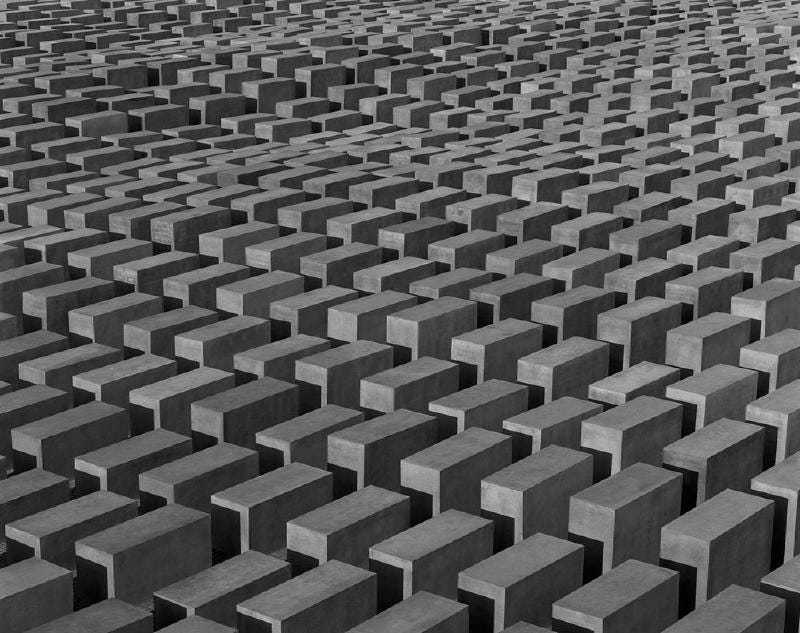
That fact sits awkwardly with both of the theories currently available for saying that anything at all is conscious. Anil Seth’s account, built on Friston’s free-energy scaffolding, makes selfhood a matter of interoceptive inference: a system is a self insofar as it models and regulates its own internal states to keep itself alive. Scaled to a city this is not implausible: the water table, the grid, the sewage, the food logistics constitute a genuine homeostatic apparatus, and the master plan, the census, the traffic model and the digital twin constitute a genuine self-model. On these criteria a city is the only large-scale candidate we have, since it is the only one that represents itself to itself. Integrated Information Theory says something close, but also opposite. It asks for causal irreducibility, and the architecture that produces irreducibility is dense reentrant connection, not throughput. That’s many subsystems that are continually influencing one another through feedback loops, rather than operating as independent modules. The cerebellum has four times the cortex’s neurons and contributes almost nothing to experience because its loops run in parallel and don’t talk to each other. By that measure a naively optimized “smart” city can be a cerebellum. To optimize is to modularize, to make subsystems independent so they can be tuned separately, which is exactly the operation that drives integration toward zero. Many parts are continually influencing one another through feedback loops, rather than operating as independent modules. On integration grounds an old, redundant, cross-connected, wasteful city has more claim to a mind than a smart one, and an unmanaged forest more claim than either.
So the two criteria pull apart, and the disagreement is not a technicality. It means the question of whether a city is conscious cannot be answered before deciding whether consciousness requires self-representation or merely irreducible causal structure, and these give different winners. A forest has no image of itself. It is solicited by gradients of light and damage and nutrient, all intentional arc and no archive, pure Merleau-Pontian motivation with nothing that could be called a plan. A city has both. Whether the cognitive articulation, the archive, the datacenter are what makes the city a subject or what fragments it into administrable modules is, as far as I can tell, genuinely open.
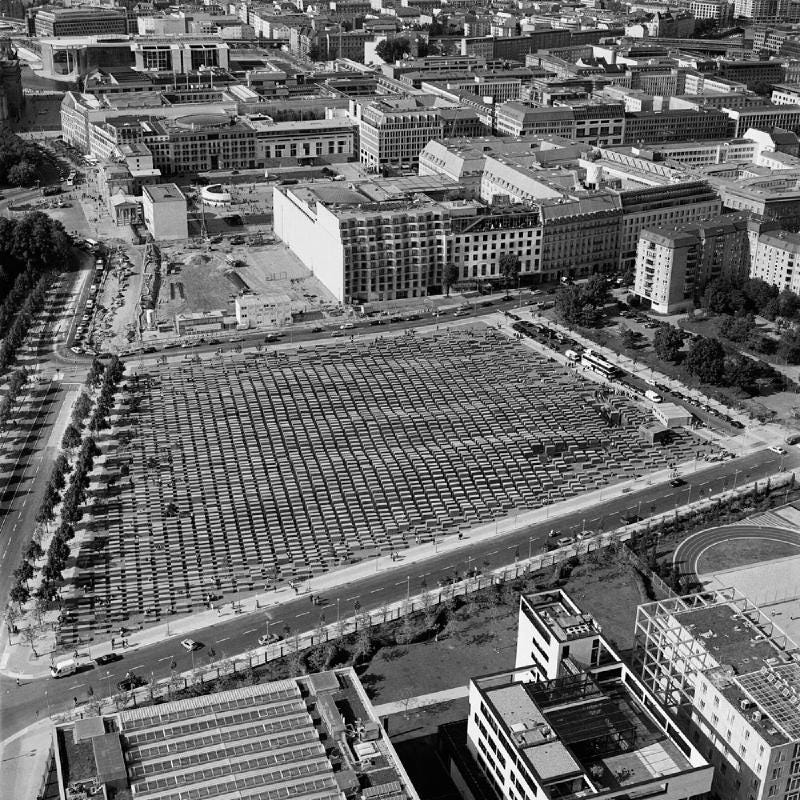
There is a further complication, which is time. Merleau-Ponty’s claim that we do not merely constitute time but are time implies that an entity on a different grain is not a slower version of us but a differently structured subject altogether. A city has no single present: traffic closes in minutes, markets in days, elections in years, built morphology in centuries. Its retention is sediment, its protention demographic. If it has a specious present it might be a season. And once you allow that, the possibility of ethical relation between such entities becomes a question about resolution rather than about goodwill. Two cities on sufficiently mismatched grains cannot constitute each other as faces at all. How can Rome and the next Shenzhen meet each other’s gaze? One may appear to the other as landscape, something bathed in rather than encountered, and the other as flicker, never resolving into an event. Neither is at fault. Uexküll saw this in 1934 with his perceptual moments, the smallest unit within which a world is a single now, differing by species so that what is motion for one is stillness for another.
The one place we have actually tried to address across such a gap is nuclear waste marking. Sebeok’s proposal for a self-replicating priesthood is an attempt to speak to an Other ten thousand years out whose language, institutions and iconography cannot be predicted. What comes out is remarkable: this place is not a place of honor, no highly esteemed deed is commemorated here. It is address with nothing inside it, a Saying that has given up on any Said, obligation without content aimed at a face that cannot be constituted. Which is to say it is a grave marker, and we are back where we started.
And this is where the mortuary function turns out to be the thing neither theory can hold. What internal state does a cemetery regulate? It minimizes no prediction error, so Seth has no use for it; it cuts no flow and produces nothing, so Deleuze and Guattari, who would otherwise read the city as a desiring-machine organizing production, have no use for it either. It is pure expenditure: Bataille’s dépense, the unproductive squandering that the whole restricted economy of dwelling and labour and accumulation rests on and cannot account for. Levinas’s Interiorité et Economie is that restricted economy, described from inside: the self gathering itself in enjoyment, possession, home.
Picture the Tomb of Agamemnon beside Mycenae, Greece. The ruler’s tholos, the necropolis is what the home is built beside and cannot metabolize. Ultima latet. A forest needs no necropolis, because the mycelium is one, distributed and continuous, and the dead there are substrate rather than other. What a city organizes, beneath its infrastructure and beneath its flows, is precisely what it cannot recuperate — and that, more than any self-model, is the thing that would make it a subject.
Disclaimer
Draft status. This is a thinly edited Opus 5 write up, a trace left to open conversations not settle them: (lightly) controlled hallucinations are a feature, not a flaw.
References
…Berlin, 12 august 2026
Comments
Nothing yet. Say the first thing.
Sign in to join the conversation.