
You will design and operate Nexus AI Operations Platform — a single control plane that treats specialized accelerators, edge inference nodes, ML-driven infrastructure decisions, secure delivery tooling, responsible-AI governance, and autonomous remediation as one coherent system rather than a collection of disconnected tools.
The platform is built from scratch as one product: every module shares the same API process, the same console, and the same operational vocabulary. There are no separate mini-projects stitched together at the UI — compute, edge, intelligence, governance, and automation are first-class domains inside one repository.
Agenda
Compute orchestration — GPU multi-instance sharing, placement policies, and spend visibility
Accelerator scheduling — TPU pod queues with preemptible cost optimization
Edge fleet management — device registration, model rollout, heartbeat health, cloud sync
Infrastructure intelligence — forecasting, anomaly detection, predictive scaling, incident response
Delivery intelligence — code security analysis, log anomaly detection, alert correlation, documentation generation
Model governance — bias analysis, fairness monitoring, explainability, approval workflows
Autonomous operations — DAG workflows, self-healing, controlled chaos, AI-assisted scheduling
Unified console — real-time dashboard with cross-domain Run Demo simulation
Platform objective: Deliver the integration pattern production ML platform teams use before opening a shared GPU pool to multiple product lines — one API boundary, explicit promotion gates, observable state, and automation that closes the loop.
In most organizations, GPU scheduling lives in one team’s scripts, edge rollout in another’s Ansible playbooks, bias review in a spreadsheet, and incident correlation in a third-party SaaS. Each layer works in isolation until something breaks at a boundary — a model promoted without review, inference scaled without reading logs, or a TPU job submitted onto full-GPU capacity because nobody exposed MIG slices.
Nexus models the opposite architecture: one FastAPI application registers seven domain routers; one React console polls them; one demo orchestrator proves they cooperate. That shape mirrors how mature internal platforms (not public cloud consoles) are actually operated:
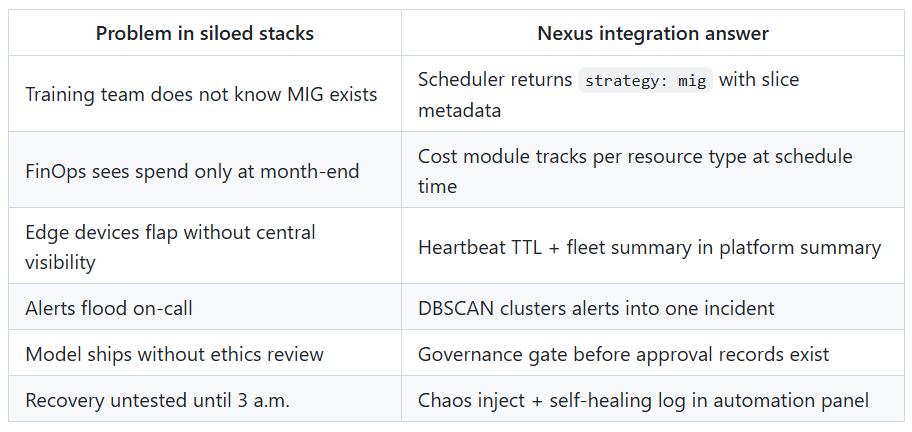
You are not learning seven unrelated APIs — you are learning how platform engineers wire them together.
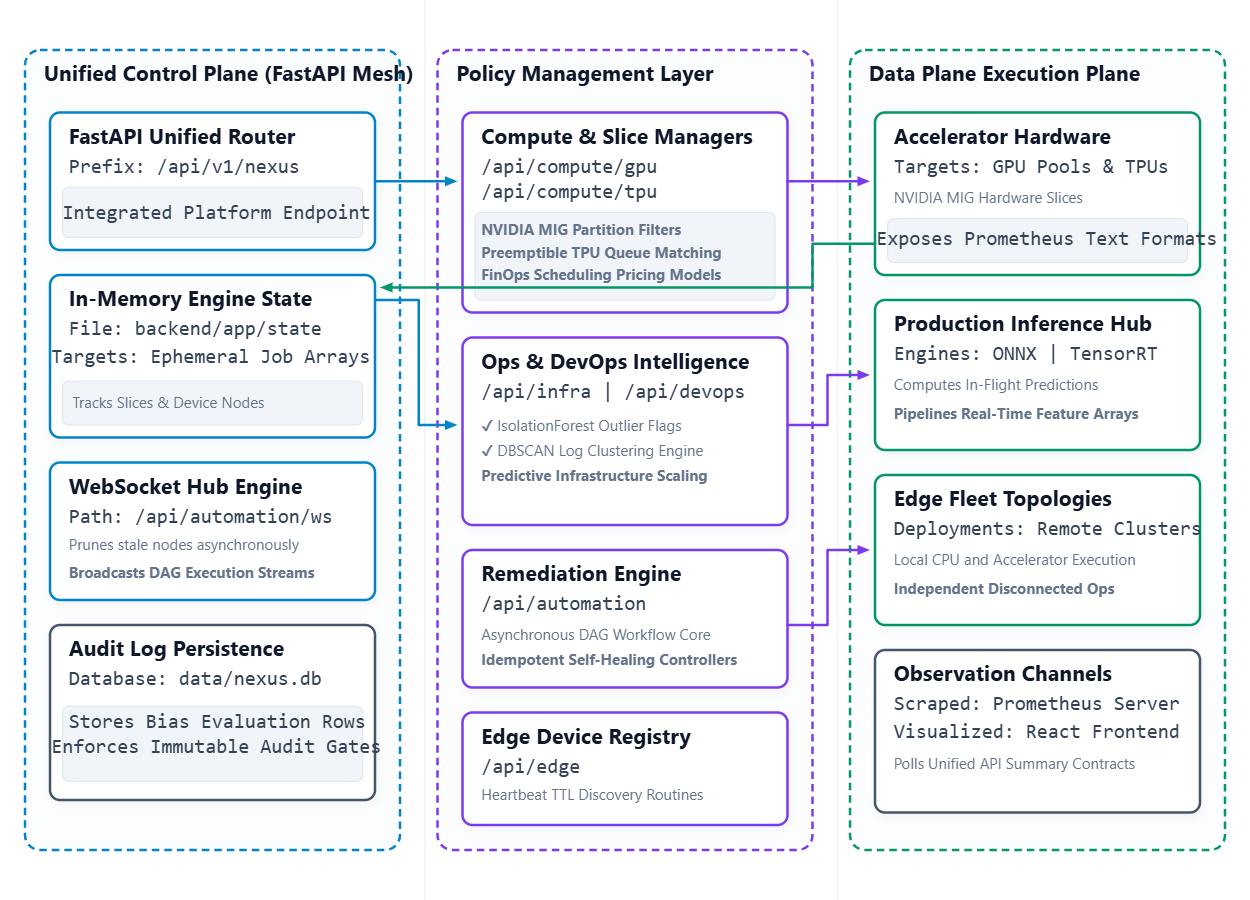
Modern AI infrastructure at scale (recommendation training at Meta, TPU fleets at Google, factory-floor inference at industrial operators) converges on three planes that must cooperate:
Nexus is the coordination layer between product engineers and raw infrastructure. It does not replace Kubernetes, cloud consoles, or observability backends. It exposes a stable internal API so an inference team can submit a job without knowing whether it lands on a MIG slice, a preemptible TPU pod, or an edge CPU node — while SRE and platform teams retain policy control behind that abstraction.
Comments
Nothing yet. Say the first thing.
Sign in to join the conversation.