
G2E is where the global gaming industry comes together to navigate what’s next—delivering an all-in-one experience designed to move business forward. With actionable insights, high-value connections, and real-world solutions, G2E delivers value that extends far beyond the event itself. G2E takes place September 28–October 1, 2026 at The Venetian Expo.
Register today: http://g2e2026.com/ClosingLine

Loyal readers of this newsletter know that I love baseball generally, and the Philadelphia Phillies specifically.
I watched a lot of bad Phillies baseball in person in the 1980s and 1990s. Today, I watch Phillies games almost every night. I watch West Coast games after my daughter goes to bed. I am in four different fantasy baseball leagues.
Unrelated to all of that — but related to this post — most of you know that Major League Baseball has a deal with Polymarket. (Or if you didn’t, you do now.)
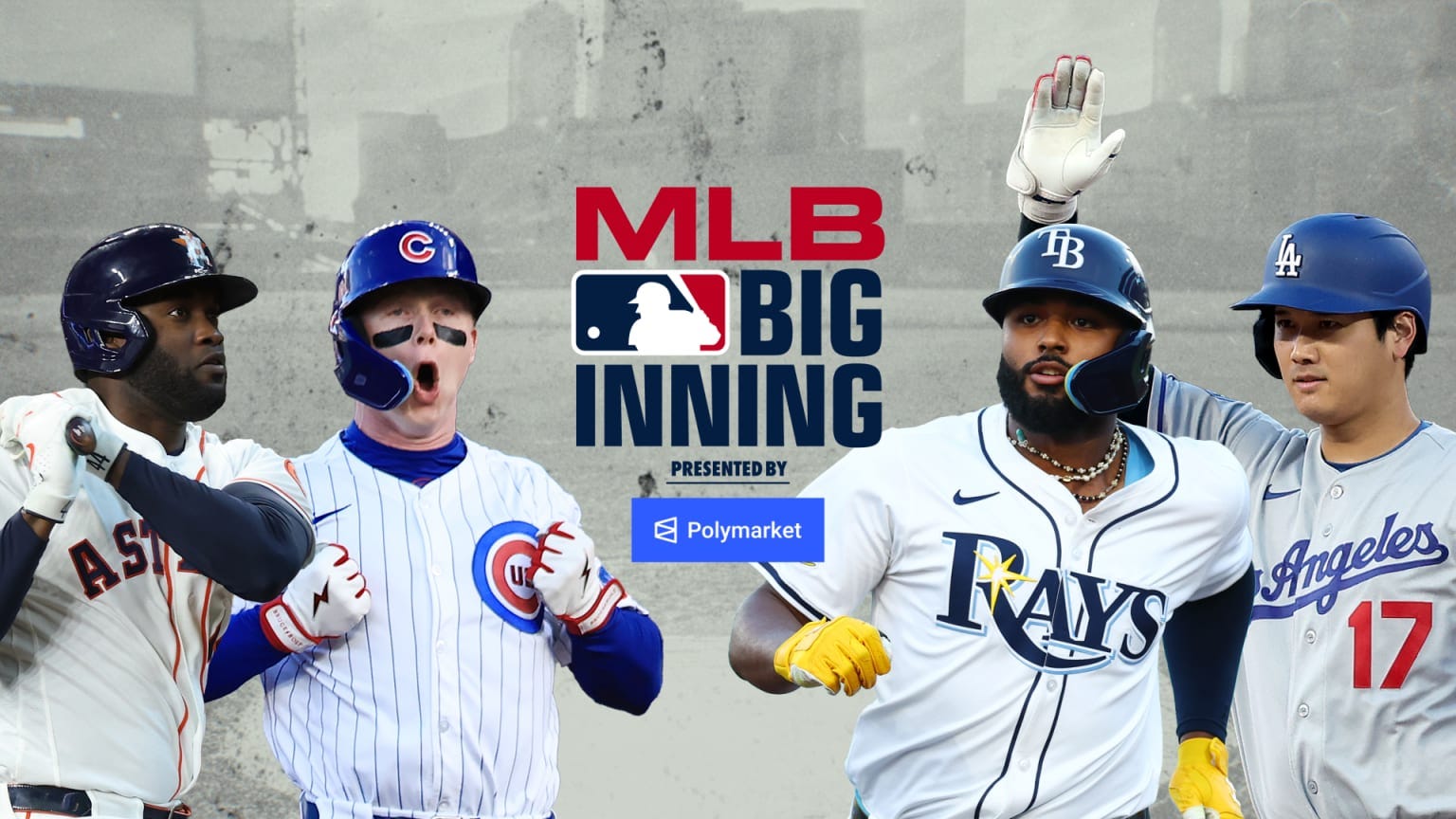
Anyway, on one recent evening I plopped on the couch to work on my newsletter at The Event Horizon. I put on the MLB TV app and I was happy to see “Big Inning,” which lets you watch up to four games at a time.
But no sooner did I turn it on than an announcer told me that Big Inning was presented by Polymarket:

Dustin Gouker@DustinGouker
Turn on MLB TV “Big inning presented by Polymarket”

2:54 AM · Aug 11, 2026 · 2.04K Views
5 Replies · 9 Likes
I just wanted to watch some baseball, and instead I get bombarded with betting (sorry, trading) on Polymarket. During breaks on Big Inning, I would get a full Polymarket ad, as well. If you watch a game on MLB TV, you also see a lot of Polymarket on the digital ads in the background.
Maybe I am just tired after a year and a half of covering the rise of prediction markets. But I am predisposed to support advertising during sports events, and for some reason it felt like the straw that broke the camel’s back. I can’t imagine people who don’t gamble at all like this stuff. But it also probably converts and creates new users, so it’s probably here to stay.
I kind of want to watch baseball without thinking about gambling. I don’t want to watch a Phillies game and get a promoted same-game parlay or the odds for a batter to get a hit in his upcoming plate appearance or how I can “live trade” the game.
The NFL has maybe gotten this right? They allow commercials, but you don’t get it during broadcasts, beyond veiled Al Michaels betting references.
Anyway, the era of prediction markets means even more gambling in our eyeballs. And I am not sure that’s a good thing.

Trusted Voices: Conversations About Betting is designed to equip adults, including parents and coaches, with tools and resources to talk to young people about gambling, including information on warning signs, risks and proxy betting. The program is led by retired professional basketball player Randy Livingston and his wife, basketball agent Anita Smith, who share their personal stories related to problem gambling, with the hope of preventing others from experiencing similar harms. Learn more and join the conversation here.
Congress asks MLB to take action after Bryce Harper betting video (ESPN): “Sen. Richard Blumenthal, D-Conn., and two House representatives want Major League Baseball and its players' union to prohibit promotional deals with betting operators, such as a personalized greeting featuring Philadelphia Phillies star Bryce Harper that was sent to a VIP gambler by a sportsbook.”
"‘We write to demand an end to the MLB and MLBPA policies that enabled this type of predatory promotion,’ Blumenthal and U.S. Reps. Paul Tonko, D-N.Y., and Valerie Foushee, D-N.C., said in a letter sent to the league and the Major League Baseball Players Association.”
The letter also demands that FanDuel end its VIP program, according to The Inquirer: “FanDuel should not be using reckless and unscrupulous loyalty programs to drive bettors into debt and addiction,” [the Senators] wrote to the company’s CEO, Christian Genetski. “As such, we strongly demand FanDuel to end its VIP program for bettors, especially those suffering from a gambling addiction, on its platform.”
“Elected officials in Pennsylvania are separately planning legislation that would restrict or eliminate sportsbook VIP programs, and in-game microbets, an effort that Joe Maloney, the president of the Sports Betting Alliance — a national advocacy organization whose members include FanDuel, DraftKings, BetMGM, bet365, and Fanatics — said the organization will oppose.”
Penn Sits Out Sports Betting Spending War As Analysts Back Strategy (Legal Sports Report): “Penn Entertainment will not be among the sportsbook operators spending heavily on promotions this football season, a strategy Wall Street largely endorsed following the company’s second-quarter earnings.”
“Citizens analyst Jordan Bender said he was encouraged by Penn’s focus on profitability rather than ‘chasing customers during an uncertain period for the online sports betting market.’”

With first-chair trial experience and a record of success in complex disputes across federal and state courts and in arbitrations, Kim Conroy is Ifrah’s cross-firm coach for crafting and executing complex litigation strategies. She teams up with both senior and junior lawyers to strengthen their cases with procedural insights and time-tested tactics. Kim also is called upon to assist with bet-the-company cases involving institutional and individual clients, including iGaming operators facing novel legal onslaughts.
Read More: Conroy on Unleashing Litigation’s Maximum Potential in High-Stakes Cases
In Gambling Industry, No Election Looms Larger This November Than Texas Lieutenant Governor (Casino Reports): “Patrick is now running for a fourth term, and although Texans have access to a form of sports betting (or “trading”) via prediction markets as well as to offshore-operated and sweepstakes-style online casinos, there’s every reason to expect that if Patrick is reelected as lieutenant governor, neither casinos nor state-regulated sports betting will come to Texas before 2031. … According to the poll, Republican Patrick is trailing Democratic nominee Vikki Goodwin, 48% to 46%.”
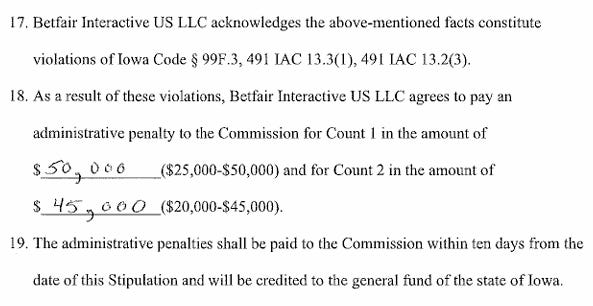
Iowa regulator fines FanDuel for soccer, basketball betting errors (SBC Americas): “According to documents obtained by SBC Americas, the Iowa Racing and Gaming Commission (IRGC) fined FanDuel a total of $95,000 for two separate sports betting violations. The infractions occurred between June 2024 and July 2025, and relate to impermissible betting markets offered by FanDuel tied to basketball and soccer.”
“According to the IRGC, FanDuel self-reported to the regulator that it offered impermissible wagers on the Maharlika Pilipinas Basketball League (MPBL) between June 4, 2024 and April 2, 2025.”
From the stipulated agreement:
Nevada problem gambling group cuts ties with national organization over Kalshi deal (Nevada Current): “The Nevada Council on Problem Gambling confirms it intends to formally sever ties this month with the National Council on Problem Gambling over the latter’s partnership with Kalshi, a prediction market that has been banned from taking sports bets from Nevada gamblers.”
Flutter Sees ‘Good or Great’ Outcomes From Prediction Market Legal Fight (Covers): “The rapidly evolving regulatory environment makes it difficult to predict exactly where prediction markets are headed, CEO Peter Jackson said during an Oppenheimer fireside chat Tuesday. He nevertheless expects the fundamental jurisdictional dispute between federal commodities oversight and state gaming regulation to eventually reach the U.S. Supreme Court.”
“Until that seemingly inevitable ruling, Jackson said Flutter is focused on two opportunities: using FanDuel Predicts to acquire customers in states where online sports betting isn’t yet legal and generating revenue by providing liquidity to other prediction platforms through its market-making business.”
Kalshi rejected in CT court: ‘at bottom, they are sports wagers’ (SBC Americas): “The pendulum in the legal battle over sports prediction markets continues to swing in favor of state-based gambling regulation, as a Connecticut judge denied Kalshi and Coinbase’s respective motions for preliminary injunction in separate rulings on Monday.”
From the order: “Kalshi characterizes its sports-related event contracts in various ways, but at bottom, they are sports wagers. Kalshi itself has touted its platform as offering legal sports betting nationwide. But sports wagering has long been subject to state regulation pursuant to the states’ police powers because of the significant public interests and risks associated with gambling. The Court declines to conclude either that these sports wagers are properly categorized as swaps and fall under the CFTC’s authority, or that Congress clearly displaced Connecticut’s traditional authority to regulate sports wagering and vested that authority in the CFTC, an agency that has not historically regulated sports wagering and has not exercised meaningful oversight over Kalshi’s sports event contracts.”
🔍 There’s a reason gaming/gambling/whatever companies have historically been so careful with the language they use to describe their products. The courts are always paying attention. Kalshi’s use of the term ‘sports betting’ in its early marketing is now coming back to haunt some of its litigation.
Latest newsletter and roundup at The Event Horizon:
Are ‘casino-style’ prediction markets really the next development? (SBC Americas): “Speaking at the National Council of Legislators from Gaming States (NCLGS) Summer Meeting in July, the chairman of Nevada’s gaming regulator was one of multiple industry figures who warned that casino-style contracts are already on their way, and that state legislators cannot afford to sit on their hands and wait for the Supreme Court to settle the issue of sports prediction markets.”
“Last month, the Commodity Futures Trading Commission (CFTC) outlined its proposed rules on prediction markets, seeming to suggest that casino-style contracts should not be allowed, although it used much more vague language than the lawmakers who are concerned by such products.”
WVU research aims to curb risky loss-chasing in online betting (WVU Today): “Because gamblers often up the ante rather than cut their losses when their online bets and parlays are a bust, researchers at the West Virginia University John Chambers College of Business and Economics are studying loss-chasing behavior in West Virginia to help protect Mountain State gamblers and their families from the associated risks. …”
“Arnold Ventures recently awarded WVU a nearly $300,000 grant for research that analyzes real-time data collected from state gaming operators to identify trends in risky betting and the triggers that cause loss-chasing. Experts refer to it as loss-chasing when a person places bets to make up for a previous lost wager.”
On Substack:
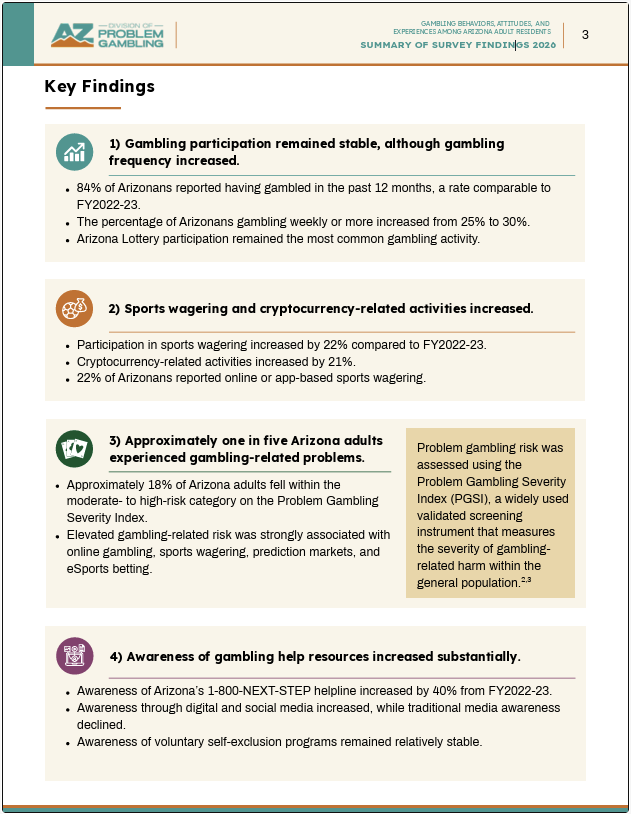
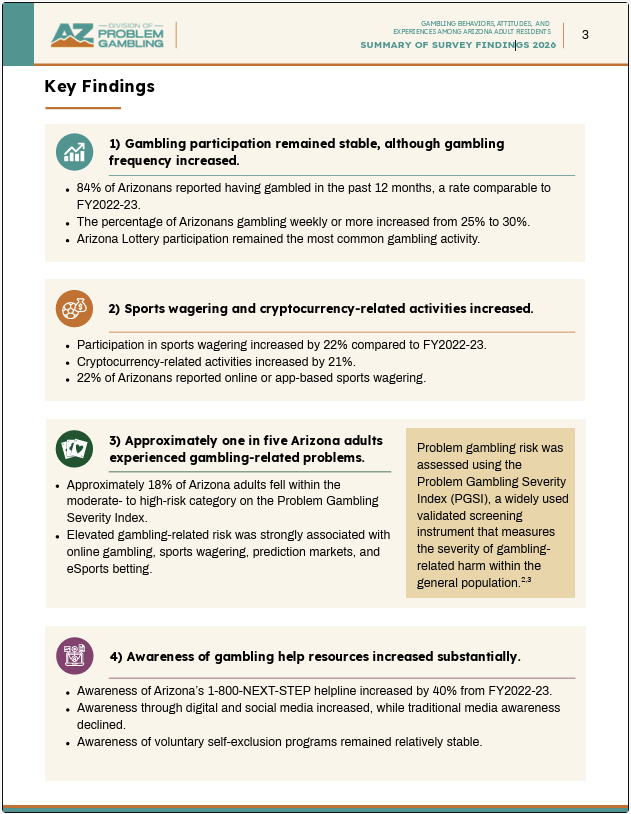
Report shows 84% of Arizonans placed bets, nearly 20% fall into the problem gambling category (KJZZ Phoenix): “The Arizona Division of Problem Gambling says roughly the same number of Arizonans placed bets in the past year, compared to its last report three years ago — that number was 84%. But nearly a fifth of state residents fell within the category of problem gambling.”
Mark Brodie: Did this report take into account people who use prediction markets like Kalshi or Polymarket?
Elise Mikkelsen: We didn’t do thorough research on prediction markets, but we did ask about prediction markets and esports betting and all those different things to see if there was an overall awareness, and I would say yes, that we’re definitely seeing the emergence of these newer forms of gambling activities are taking over the market.
From the summary of survey findings:
UNLV Oral History Project to Capture the Story of Nevada’s Bookmakers (UNLV): “As legal sports betting continues to expand across the United States, the UNLV Oral History Research Center is launching a new project to preserve the firsthand stories of the Nevada bookmakers who helped build the industry.”
“The initiative brings together Richard Schuetz, CEO of American Bettors' Voice, and David G. Schwartz, gaming historian, author, and ombuds at UNLV, to help identify 10 historically significant bookmakers whose stories will be preserved as part of the project.”
Colorado Sports Betting Deposit Limits Take Effect (Community News): “Colorado online sportsbooks must stop accepting credit card deposits and hold each customer to no more than six separate deposits per gaming day from Wednesday, Aug. 12, under a law signed by Gov. Jared Polis on June 2.”
Latest podcast from GNC:
No posts
Comments
Nothing yet. Say the first thing.
Sign in to join the conversation.