

I applauded sports prediction market Novig last week for what was an entirely self-regulatory move to only allow users 21 and over. That — and the totality of their framework for responsible trading — is really good.
However, it took less than a week for something not great to happen. Novig (and a lot of prediction markets) often work with sports accounts on Twitter as affiliates, giving them badges to promote their apps.
A Buffalo Bills account recently showed up with a Novig badge. Not a big deal on its face; happens all the time.
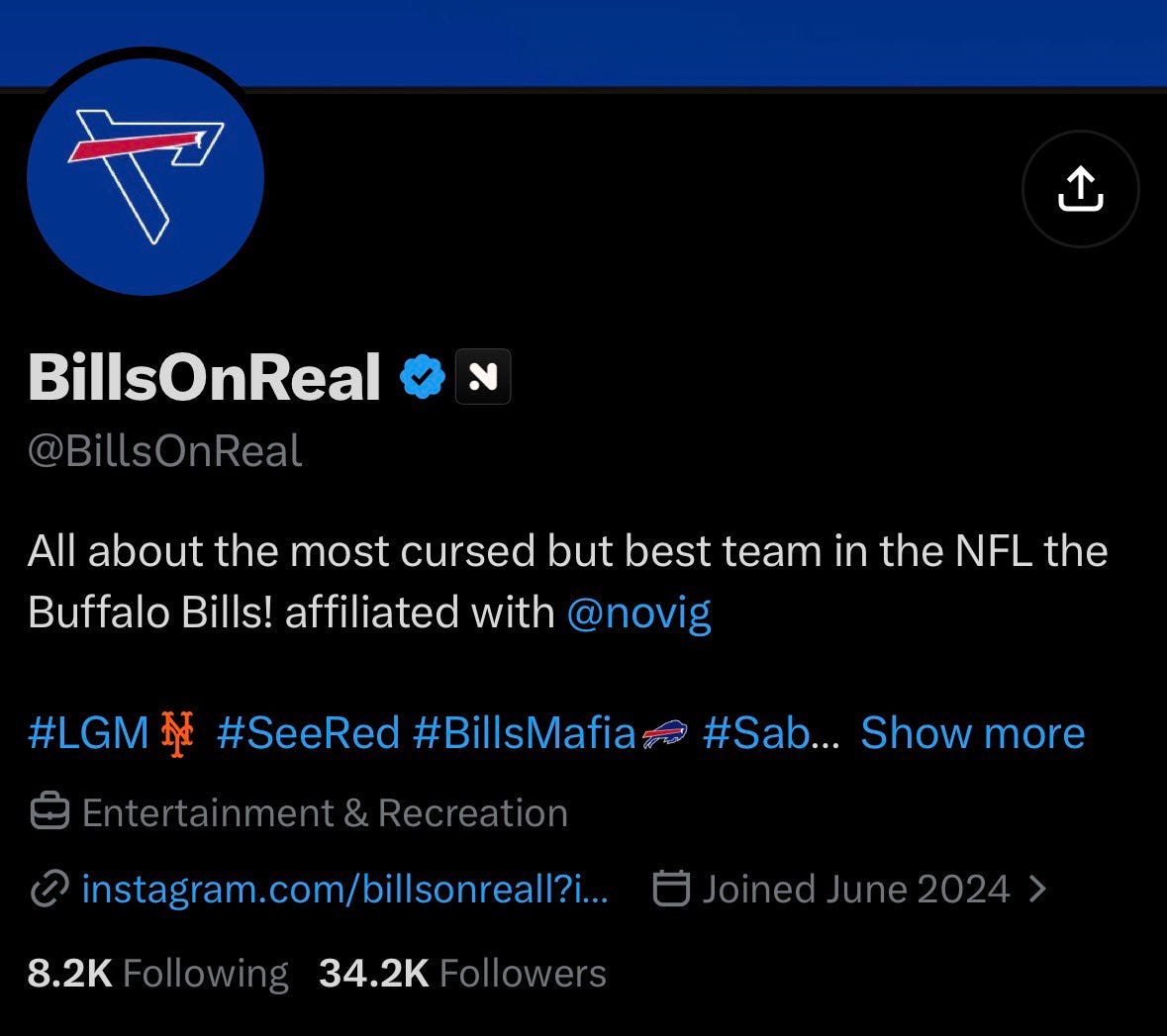
But I discovered that the account appears to be run by someone under 18:

Dustin Gouker@DustinGouker
Well, I was applauding Novig last week, but apparently they gave someone an affiliate badge that looks to be under 18 and is certainly under 21. I’ll again remind you that sportsbooks would get in a shit ton of trouble if they did this.
4:24 PM · Aug 17, 2026 · 65.7K Views
3 Replies · 1 Repost · 188 Likes
The badge was removed pretty quickly after I posted this. That’s great news, of course, and a sign that they are taking the issue seriously. I applaud that as well.
But a few things:
It shouldn’t happen in the first place. Age verifying someone you are working with to market your product should be step one, not something done after the fact. That’s especially true if you are leaning into having a framework you think everyone should emulate.
Novig is working under an entirely self-regulatory model. Will it face any serious repercussions for any of this? They may get a little blowback from my tweet, and that’s likely it. The Commodity Futures Trading Commission has not taken any known actions on how prediction markets advertise themselves.
Also there are a variety of other prediction market operators that do nothing or very little that is public-facing on responsible trading. Novig is at least doing the right thing (eventually) but will others attempt to be good actors in the same position? That’s not as clear.
It’s in the tweet above, but sportsbooks would be in some actual trouble if they did something like this. They would certainly face fines in a number of jurisdictions. Would their licenses be in jeopardy? For a single instance, probably not, but repeated similar offenses could end up bringing that into the conversation.
I spoke at an event at the UNLV International Gaming Institute last week, where I talked about — big shocker — prediction markets. Part of my presentation was about the dichotomy between the repercussions for problematic advertising by sportsbooks vs. prediction markets (very serious vs. not-at-all serious).
The best example I can give you is Ohio dishing out a six-figure fine for something that wouldn’t even move the needly in prediction-markets land.
Matt Schuler, executive director of the state commission that oversees sports gaming, on Wednesday announced at a public meeting that it intends to fine Penn Sports Interactive $250,000 because its affiliate Barstool Sportsbook marketed its services to college students at the University of Toledo, a big no-no under state rules that prohibit sports gaming by anyone under age 21.
FanDuel has caught heat for a VIP host using Cameo to get a video of baseball player Bryce Harper and sent it to a bettor. It will presumably face repercussions from a regulatory body at some point, and deservedly so.
Prediction markets are regulated. But they are not regulated the same way as gambling enterprises. That’s perhaps appropriate in some ways, but not in others. Advertising and responsible trading are two of those ways.
If prediction markets (and sports event contracts) are here to stay, we need more regulation than self-regulation and vibes. There should be actual repercussions for stuff that would be heavily penalized in the world of gambling.
Or that’s what I would like to see happen. But I’m just a guy with a newsletter.
Footnote: No sooner did the Bills account lose its Novig badge than it was affiliated with Onyx Odds, a sweepstakes operator that also has a registration allowing it offer event contracts:
Dustin Gouker@DustinGouker
lol


Dustin Gouker @DustinGouker
Well, I was applauding Novig last week, but apparently they gave someone an affiliate badge that looks to be under 18 and is certainly under 21. I’ll again remind you that sportsbooks would get in a shit ton of trouble if they did this.
5:54 PM · Aug 17, 2026 · 2.1K Views
2 Replies · 8 Likes
That badge is also gone.
Attorney General James Uthmeier Files Lawsuits Against Operators of Illegal Online Casinos (press release): Attorney General James Uthmeier announced the filing of two lawsuits against the operators of major online “sweepstakes” casinos—including Stake and VGW’s Chumba Casino, LuckyLand, and Global Poker—and the payment processors that enable them. The complaints, filed in Hillsborough County Circuit Court today, allege the defendants are operating illegal online gambling enterprises that violate Florida’s gambling laws and the Florida Deceptive and Unfair Trade Practices Act.

Attorney General James Uthmeier@AGJamesUthmeier
If it looks like a casino, takes money like a casino, and pays out like a casino, it is a casino—and it’s illegal in Florida. That’s why we’re suing predatory online gaming sites Stake and VGW to stop illegal gambling and recover money lost by Florida consumers.
1:13 PM · Aug 19, 2026 · 14.7K Views
28 Replies · 114 Reposts · 612 Likes
From the complaints here and here:
“Defendants operate and facilitate illegal online casinos in the State of Florida. They call them “sweepstakes” casinos as if that’s some sort of talismanic cure-all. But if it looks, swims, and quacks like a duck, it’s a duck. The VGW Defendants’ ‘sweepstakes’ casinos violate Florida laws, harm Florida citizens, and deprive the State of licensing, taxation, and other revenues from gambling entities that the State properly regulates.”
“Defendants scam Floridians by, among other things, deceptively advertising ‘free,’ ‘100% safe,’ and ‘100% legal’ casino games, providing easy 24/7 access, accepting credit cards and Apple Pay, and using influencers to deceive consumers into the online casino. These actions threaten vulnerable Floridians, including children and seniors, and cause Floridians to lose substantial amounts of real money—all while Defendants reap enormous, illicit, ill-gotten gains at their expense.”
🔍 The payment processors are a noteworthy inclusion, a lever we’ve seen state and federal prosecutors pull in the past as a means to exert a different kind of pressure on their primary targets (and even adjacent parties).

Sponsor’s message: For iGaming companies, protecting customer privacy is paramount: Nicole Kardell acts as their guardian against federal, state and civil actions that could damage their reputations and profitability. Nicole performs on the leading edge of privacy law, helping to keep Ifrah’s clients in compliance with U.S. and international regulations governing the handling of customers’ confidential information. A certified privacy professional with expertise in European privacy law (CIPP/E), Nicole works with iGaming operators and other industry participants to navigate the complex challenge of keeping players safe.
Read More: Nicole Kardell on Keeping iGaming Clients Nimble Amidst Ever-Evolving Privacy Regulations
Missouri schools not expecting budget boost despite sports betting revenue (ABC17NEWS): “When Missouri voters approved legal sportsbetting in November 2024, Winning for Missouri Education, backed by millions of dollars from DraftKings and FanDuel, touted millions in new revenue for the Department of Elementary and Secondary Education.”
“However, despite $3.213 million being transferred into the Missouri Education Fund during fiscal year 2026 -- the first year of legalized sports betting -- school districts say they do not expect to see an increase in their budgets as a result.”
Cantor Lets Hedge Funds Place Big Bets on Kalshi’s Prediction Markets (Wall Street Journal): “Cantor’s some 3,000 institutional clients, which range from family offices to hedge funds, will have full access to Kalshi’s suite of events-based, yes-or-no contracts such as those tied to weather, commodities and corporate results.”
From the press release: Cantor will act as an Introducing Broker, arranging and facilitating the execution of institutional-size block trades in event contracts for institutional clients, enabling them to negotiate block trades in event contracts at a single price through Kalshi’s block trading framework, away from the central order book. Cantor is also collaborating with Susquehanna Predictions, part of the Susquehanna International Group of Companies, a leading liquidity provider in prediction markets, to provide institutional-scale pricing and liquidity for its prediction markets coverage.
More from CoinDesk: “Still a retail-first trading vehicle, prediction markets are starting to look less like a betting product and more like a market Wall Street firms could use for trading and hedging risk. Firms like Kalshi or competitor Polymarket initially focused much of their trades on elections, sports and smaller retail trades but Kalshi has increasingly been trying to broaden its offerings to expand institutional participation.”
🔍 Paired with other recent developments, it’s becoming clear that Kalshi is assembling the pieces of a serious, institutional exchange. It’s hard to know which maneuvers were already on the roadmap and which are a more-recent product of the increased legal scrutiny surrounding non-financial markets, in particular. But it’s happening quite fast.
Latest newsletter and roundup at The Event Horizon:

Sponsor’s message
Trusted Voices: Conversations About Betting is designed to equip adults, including parents and coaches, with tools and resources to talk to young people about gambling, including information on warning signs, risks and proxy betting. The program is led by retired professional basketball player Randy Livingston and his wife, basketball agent Anita Smith, who share their personal stories related to problem gambling, with the hope of preventing others from experiencing similar harms. Learn more and join the conversation here.
How BetMGM Grew From $30 Million To Nearly $3 Billion (Forbes): “BetMGM’s rise illustrates how quickly the sports betting market has evolved—and why its next phase may depend less on acquiring customers and more on building loyalty around travel, entertainment and live sports.”
“BetMGM may not repeat a 93% annual growth rate as it approaches $3 billion in revenue. Few businesses could. But by connecting betting with Marriott, MGM Resorts and live-event experiences, it is trying to replace the growth of a young category with something potentially more durable: an ecosystem customers have reasons to remain inside.”
Pennsylvania Online Casinos Start New Fiscal Year With $311.9 Million In July Revenue (Crossing Broad): “In July, PA online casinos recorded $311.9 million in revenue, the sixth-highest monthly total in the state’s history.”
“It was a 2.9% jump from June’s $303.1 million, and a 12.3% increase compared to July 2025’s $277.9 million.”
Gaming Companies Prevail in Kentucky Gambling Loss Recovery Suit (Bloomberg Law): “The companies behind Underdog Fantasy and two other gaming platforms convinced a federal district court to dismiss a lawsuit alleging they should be held liable for gambling losses under Kentucky’s Loss Recovery Act.”
From the order: “The Court does not have subject matter jurisdiction to hear this case because KGR fails to show that it has Article III standing. Without standing, the Court lacks subject-matter jurisdiction and cannot proceed at all in any case.”
🔍 As someone who remembers Brown v. (Poker)Stars, the specifics of the dismissal seem important. The judge said that this Delaware-based company had no standing in Kentucky—even under the state’s somewhat unique loss-recovery laws—without deciding the underlying arguments. Don’t be surprised if you hear about the Kentucky Loss Recovery Act again; there are a other relevant cases on file in state court.
Little League responds to offshore betting availability (X/Twitter): “Little League International stands by its statement first issued last year that there is no place for betting on Little League games and players or any youth sports competition. Little League is a trusted place where children are learning the fundamentals of the games and all the important life lessons that come with having fun, celebrating teamwork, and playing with integrity, and no one should be exploiting the success and failures of children playing the game they love for their own personal gain.”

Little League@LittleLeague
Little League International stands by its statement first issued last year that there is no place for betting on Little League games and players or any youth sports competition. Little League is a trusted place where children are learning the fundamentals of the games and all the

6:00 PM · Aug 19, 2026 · 15.8K Views
13 Replies · 35 Reposts · 187 Likes
ICYMI: I wrote about this terrible tradition yesterday:
BetMGM Launches Progressive SideBet Jackpots Across 200+ Casino Games, Featuring a Mega Jackpot Starting at $500,000 and Growing Daily (press release): BetMGM, a leading iGaming and sports betting operator, announced the launch of BetMGM Jackpots in Michigan, a new optional progressive SideBet Jackpot feature that gives online casino players additional opportunities to win while playing eligible casino games. BetMGM expects to expand SideBet Jackpots into additional markets throughout the summer and fall, subject to regulatory approvals.
BetMGM Jackpots is available on more than 200 eligible casino games with additional titles regularly added. Players can opt in and place a fixed $0.10 SideBet on qualifying wagers. Each SideBet provides a chance to win one of four progressive jackpot tiers – Mini, Minor, Major and Mega. The Mega Jackpot currently stands at more than $618,000 and continues to grow as players participate across eligible games.
Half of Americans say they are gambling, but rate is declining (SBC Americas): “Gambling for money online was the only category that posted an increase since the last poll in 2016, up by one single percentage point. Back then, legal and regulated options for gambling online were more scarce than they are today, and the Professional and Amateur Sports Protection Act (PASPA) was still two years away from being repealed.”
“The prediction markets section was limited to wagering on “a future non-athletic event,” meaning that it does not account for the vast majority of trading volume on Kalshi and other sports-focused prediction market platforms.”
Gambling opponents slam online Lottery’s ‘child-like themes’ (22 News WWLP): “Stop Predatory Gambling sent a letter Monday to Treasurer Deborah Goldberg, Gov. Maura Healey, Attorney General Andrea Campbell and legislative leaders urging Goldberg, who oversees the Lottery, ‘to take immediate action against the Massachusetts Lottery for purposefully designing their online casino gambling-style app to target and exploit the vulnerabilities of the state’s young people.’”
“Games that alluded to the common arcade claw game and the folk tale of Aladdin and a magic lamp, and one that featured cartoon chickens were of particular concern for the group.”
FanDuel Addiction Lawsuit Alleges Targeted Advertising Caused Substantial Gambling Losses (AboutLawsuits): “A Pennsylvania man has filed a lawsuit claiming the sportsbook FanDuel’s aggressive, exploitative design and allegedly illegal promotions led to his gambling addiction.”
“Faulk accuses the defendants of designing a sports betting app that tracks users’ every interaction and uses that data to foster addiction and mental health problems. He alleges the platform financially drains users instead of warning them when their gambling habits may be dangerous.”
From the filing: “Since starting to use FanDuel, Plaintiff has wagered over $970,000.00 with net losses of approximately $75,000.00”
Splash Tweaks $21M Survivor Contest, Adds Marketplace (InGame): “The company has changed the pick schedule for its flagship $1,000 contest after hearing from players who thought the original setup — eight weeks where contestants had to pick two winners instead of one — was a little much.”
Opinion: Popularized sports betting generates ethical concerns for Americans (The Southerner): “Watching sports has always been a part of American culture. The picture of a crowded living room couch with the game on the TV is about as American as you can get. Now, the people sitting on that couch are participating in something a little riskier than eating too many hot wings.”
No posts
Comments
Nothing yet. Say the first thing.
Sign in to join the conversation.