
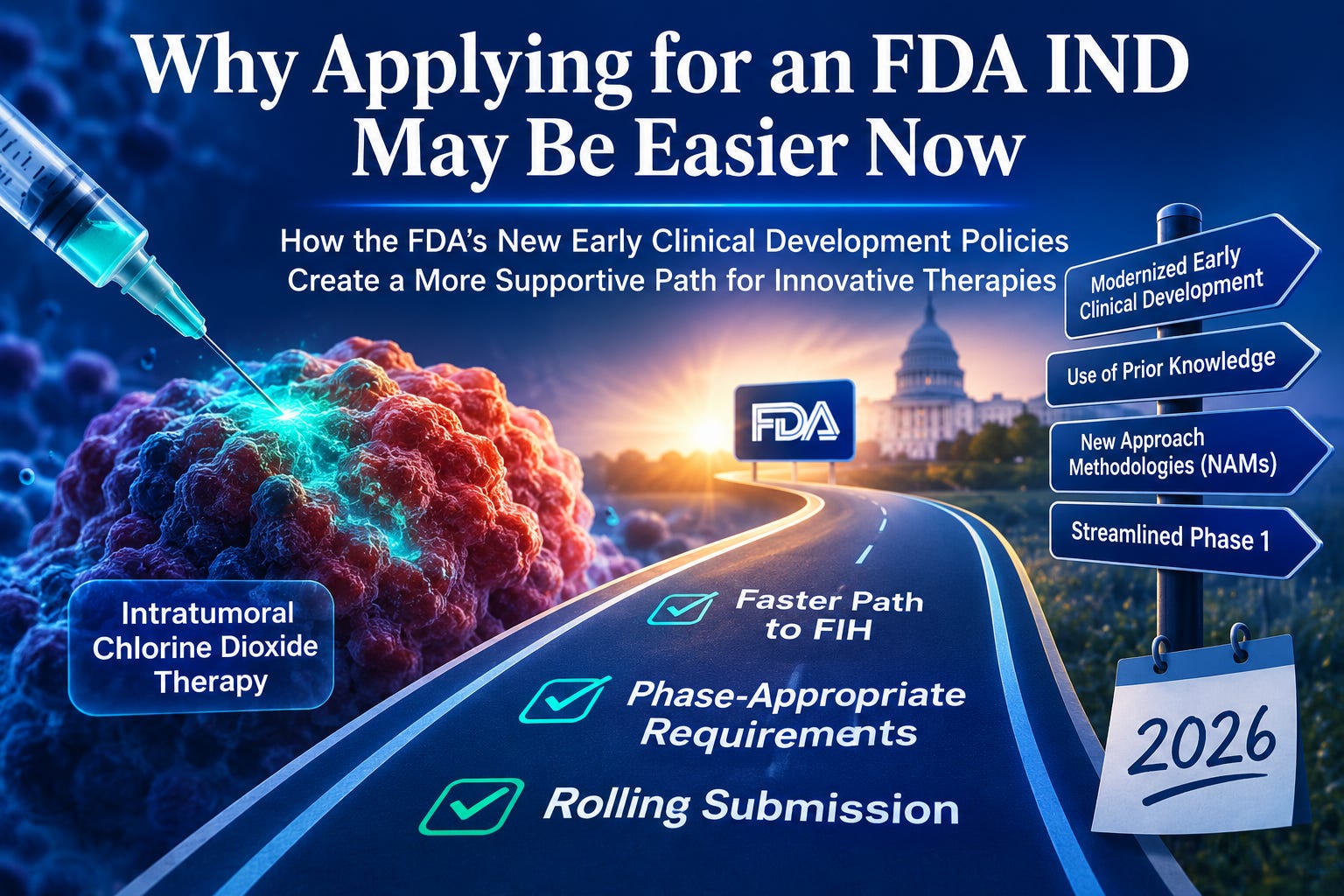
On July 27, 2026, the U.S. Food and Drug Administration published a broad set of actions under Operation TrialBlazer aimed at accelerating and modernizing clinical development.
For me, one part of this announcement is especially important: the FDA is placing much greater emphasis on getting promising technologies into first-in-human Phase 1 trials faster, while reducing work that is not necessary at that stage.
This matters directly to my plan to seek an FDA IND for Intratumoral Chlorine Dioxide Therapy.
Over the past several years, I have accumulated laboratory, animal, veterinary and human experience with this technology. Until recently, one of the largest uncertainties was how much additional conventional development work might be expected before an IND could even be considered.
FDA’s new direction makes that question look different.
The agency is now explicitly emphasizing phase-appropriate requirements, elimination of unnecessary regulatory burden, streamlined nonclinical development, greater reliance on prior knowledge, more flexible approaches to first-in-human dose selection, and closer interaction between sponsors and FDA before an IND is formally submitted.
For a technology like mine, these changes could be particularly important.
One of the clearest statements in FDA’s new initiative concerns Phase 1 CMC requirements.
FDA notes that some companies have historically submitted more data than necessary at the early stage of development, creating additional work and delaying entry into clinical trials.
The agency has therefore updated its Phase 1 IND CMC resources specifically so that companies can generate and submit only the data that is needed for a first-in-human Phase 1 IND.
FDA estimates that this approach alone could save companies six to twelve months.
That principle is much broader than CMC.
It reflects an important distinction between preparing for a Phase 1 trial and preparing for eventual marketing approval.
For an early IND, the immediate task is not to complete every study that might eventually become relevant over the entire life of a drug-development program.
The task is to determine what evidence is necessary to support the proposed clinical study.
That distinction is highly relevant to Intratumoral Chlorine Dioxide Therapy.
Comments
Nothing yet. Say the first thing.
Sign in to join the conversation.