
This is a liturgy wonk post but I hope it will help readers understand a little better how the lectionary works and impacts their worship experience.
Our congregation, together with thousands of churches and millions of Christians around the globe, follows the Revised Common Lectionary, a three-year cycle of lessons structured around the gospel lesson read each Sunday.
The gospel lessons are selected based on the time of year, often keyed to a holiday or church season. The most famous of these include Christmas and Easter, and the seasons that precede them, Advent and Lent. The full liturgical calendar is slightly more complicated than this, with some additional if less familiar seasons (Epiphany and Pentecost) and some holy days (All Saints, Trinity Sunday, etc.).
For the holidays, the gospel lessons are selected each year from one of the gospels, rotating through the synoptic gospels (a year for Matthew, a year for Mark, a year for Luke) and the gospel of John spread throughout all three years.
The Old Testament lesson for each Sunday is often selected to correspond in some way with the gospel lesson, although during the Season after Pentecost the lectionary also offers a semicontinuous track that works its way through portions of Old Testament books. Then there are two other readings each Sunday, if the assembly reads or sings all the texts. There is a reading from the New Testament, rotating through the epistles and other non-gospel New Testament texts (but read consecutively rather than tied thematically to the gospel) and a Psalm is read or sung each Sunday.1
In other words, the lectionary is a complex construction influenced by the church season, the year, and the goal of reading through each of the gospels with lessons keyed to the gospels.
One season of the church year is especially long, the time either called Ordinary Time or the Season After Pentecost. This is a long stretch that extends after Pentecost Sunday (typically some time in June) all the way until Advent (typically late November).
In other words, the church is “ordinary” time for almost half the year. This isn’t necessarily a bad thing, as it allows a period when the readings from Scripture slowly make their way through the life and teaching and ministry of Jesus, typically with plenty of readings of parables, miracle stories, and teaching.
However, there has been some movement in recent years to introduce one additional season into the church year, the Season of Creation. The history of its development is itself interesting, because it illustrates a kind of ongoing ecumenical creativity across denominations.
In 1989 (Orthodox) Ecumenical Patriarch Dimitros I proclaimed September 1 as the Orthodox Day of Prayer for Creation. This happens to be the first day of the Orthodox liturgical calendar and the day on which, according to tradition, the creation of the world began.
Subsequently, the World Council of Churches (WCC) extended the celebration until October 4, the feast day of St. Francis of Assisi. So the “Day of Prayer for Creation” became a “Season of Creation.”
Then in turn, in 2015 Pope Francis established September 1 as the Catholic World Day of Prayer for the Care of Creation. He began celebrating the broader Season of Creation in 2019. Other denominations, including Anglicans and Lutherans, have also adopted the season (the ELCA resource is here). It is now a globally observed movement, illustrated by this map:
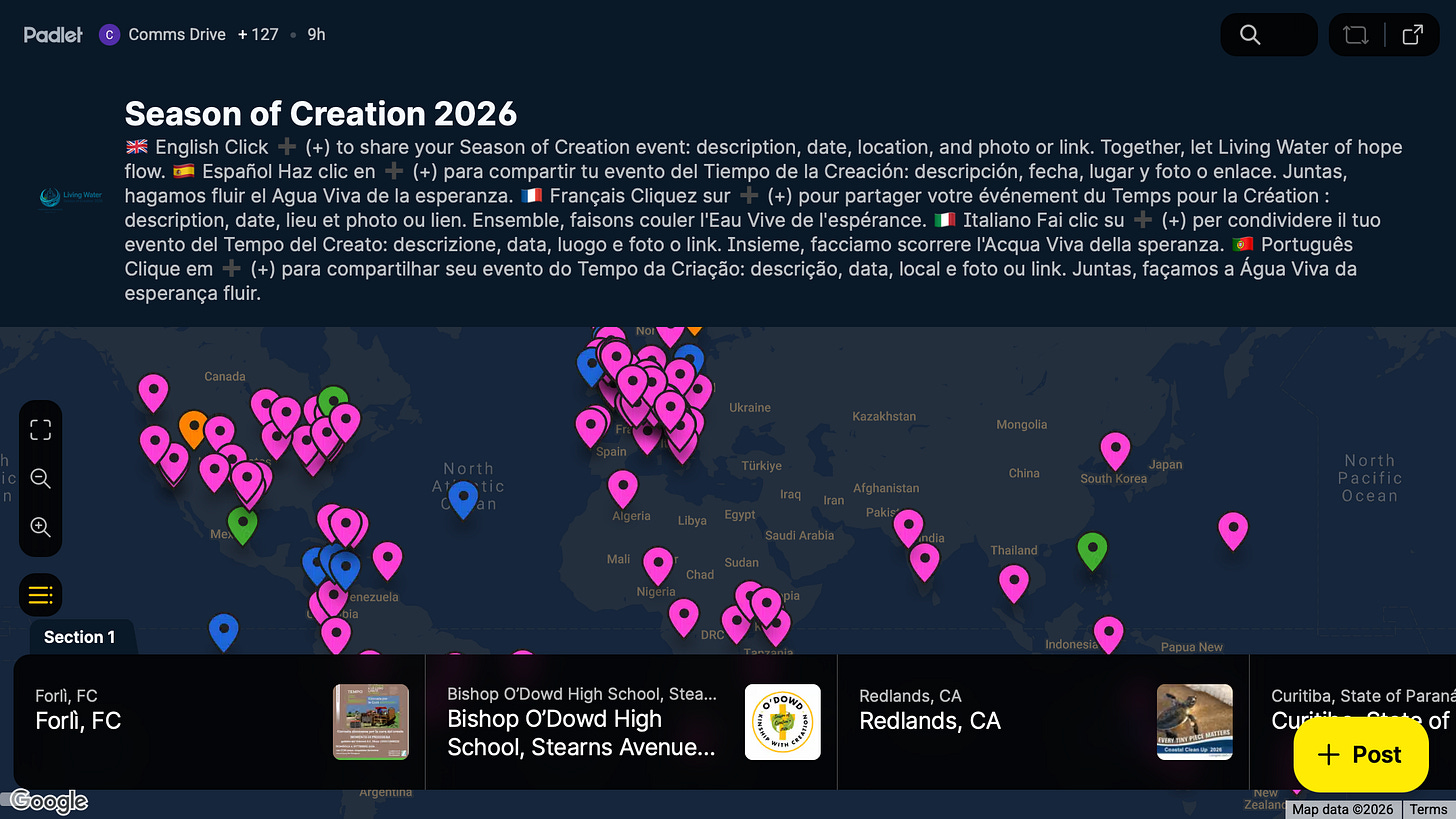
Since the seventh century, September 1 has symbolized the day of the creation of the world in the Byzantine tradition and has been the opening feast of its liturgical year (known as the Feast of the Indiction), in a parallel with the feast of Rosh Hashanah marking the Jewish New Year. This history has now also given rise to a more specific liturgical observance called “Creation in Christ” or the “Feast of Creation,” centered on September 1. It celebrates the ongoing creation of the world in and through Christ, who sustains, unites, and holds all created things. As the ELCA guide to the liturgy emphasizes, “On this day (and through this season) we hear of the triune God who creates all things: sun and moon, shining stars, sea monsters, creeping things and flying birds—and, yes, even human beings. God-in-Christ still takes care of all things and invites us to join in as caretakers of God’s good creation.”
Now something genuinely new has happened in 2026, and it makes my liturgy-wonk sensibilities sing: this ecumenical movement for a Season of Creation has now begun to move inside the formal ecumenical lectionary/calendar machinery. The Consultation on Common Texts has developed an observance called “Creation in Christ” / “Feast of Creation,” with its own proposed lectionary texts. The ELCA, with support from the Lutheran World Federation and WCC, is now encouraging congregations to celebrate it on September 1 or the following Sunday, while explicitly saying congregations may continue keeping the longer Season of Creation through the Francis commemoration around October 4. The ELCA released new Year A worship resources just last month.
The ELCA emphasizes, “This is an exciting time, as the last time there was an addition to the liturgical calendar was Christ the King (Reign of Christ) in the 1920s!” Creation in Christ is the first new feast/festival adopted since the common lectionary was released in 1983.
I will admit I wasn’t fully up to speed on this until somewhat recently, so for 2026 we are simply going to observe the Season of Creation during our Sunday worship services in September, culminating with a special observance (with animals) at the St. Francis Sunday October 4th. But it’s a pretty cool moment, because we are currently witnessing a historically unusual change to the ecumenical liturgical calendar, and being given the opportunity to incorporate it into our worship practices.
And what better focus in 2026 than our care of creation?
As an important aside, if your goal is to regularly hear and read “all” of Scripture, the Sunday lectionary will do a pretty good job of exposing you to around 70% of the gospels over the course of three years. However, only about 3.7% of the Old Testament is read in Sunday lectionary texts (remember the Old Testament is a very big book!), and roughly 25-41% of the remaining New Testament readings (Acts, Revelation, etc.) are heard in the Sunday lectionary.
No posts
Comments
Nothing yet. Say the first thing.
Sign in to join the conversation.