
A couple of weeks ago when the news broke that DHS had been surveilling churches in Minnesota, I mentioned it in my Sunday sermon. Because I was a combination of bemused and exasperated by the news, I think I didn’t talk about it in a faithfully informed manner. So this post serves as a more thorough (and hopefully more pastoral) reflection on how to respond to government surveillance in churches.
For some current context if you’re entirely unfamiliar so far with what has been happening in Minnesota, see this NPR piece.
After I made my off-handed comment during a sermon, I learned within a few days that it had had an out-sized impact at least on some listeners. One person who has been visiting church was honest enough to write and let me know they were concerned they would be perceived as one of the surveillers. This was DEFINITELY not my intent, and I honestly felt bad about this. We had a good conversation about it, and I assured them I wasn’t singling out anyone in particular, just naming the reality that a church as radically progressive as ours is may want to be aware that we now know that DHS has sent undercover agents into church-hosted gatherings as part of its surveillance of activists and organizations.
I do have some direct experience of this: a few years ago I was actually singled out during budgetary meetings of the Arkansas legislature because of my public stance against the trans-phobic legislation of a congress-person. Those talks were retaliatory in nature, directly targeting ministries I conduct in our region as a pastor.
It’s a small state in some ways. So not entirely surprising. And yet alarming to know that the gospel-centered work we conduct as a church can end up as a budget-amending conversation in the legislature aimed at undermining our work.
Returning to the topic of DHS operatives in churches, I’m perhaps less surprised by all this because I lived in Eastern Europe shortly after the fall of Communism. What I remember most clearly from that time is that people remembered governments watching churches and recruited people to spy on one another. That surveillance did things to people. It taught people to watch one another, to doubt one another, even within families and churches. That kind of suspicion is itself one of the effects of surveillance.
Alright, so this all leads me to want to offer some suggestions to readers of this blog, and especially to the members of my own congregation, on a Christian/Lutheran approach to the topic of federal surveillance in churches. Much of this arises from what I’ve learned in conversation with some of our leadership, and a bit of it may be a bit counter-cultural. But here goes:
I don’t recommend “going looking.” There’s no reason worshippers should be profiling visitors or one another in order to figure out whether or not they work for DHS. I think this is somewhat counterproductive, first because it’s unlikely to be effective (I mean, if you suspect someone are you going to do something about it, and if so, what?) but also, as one of my council members wrote: “I’m going to continue to greet everyone as a potential friend and part of the Good Shepherd family. God can worry about spies.”
But be aware. I don’t think any of us can be “wise as serpents and innocent as doves” (Matthew 10:16) if we aren’t at least aware that currently the federal government is spying on churches, is especially targeting Lutheran and other progressive ministries (especially ones focused on loving their immigrant neighbors).
“Be of good courage” (Joshua 1:9). I think if your church is surveilled by DHS in our current political environment, there is some likelihood you are doing the right thing, the good thing, the neighbor-loving thing. Keep it up.
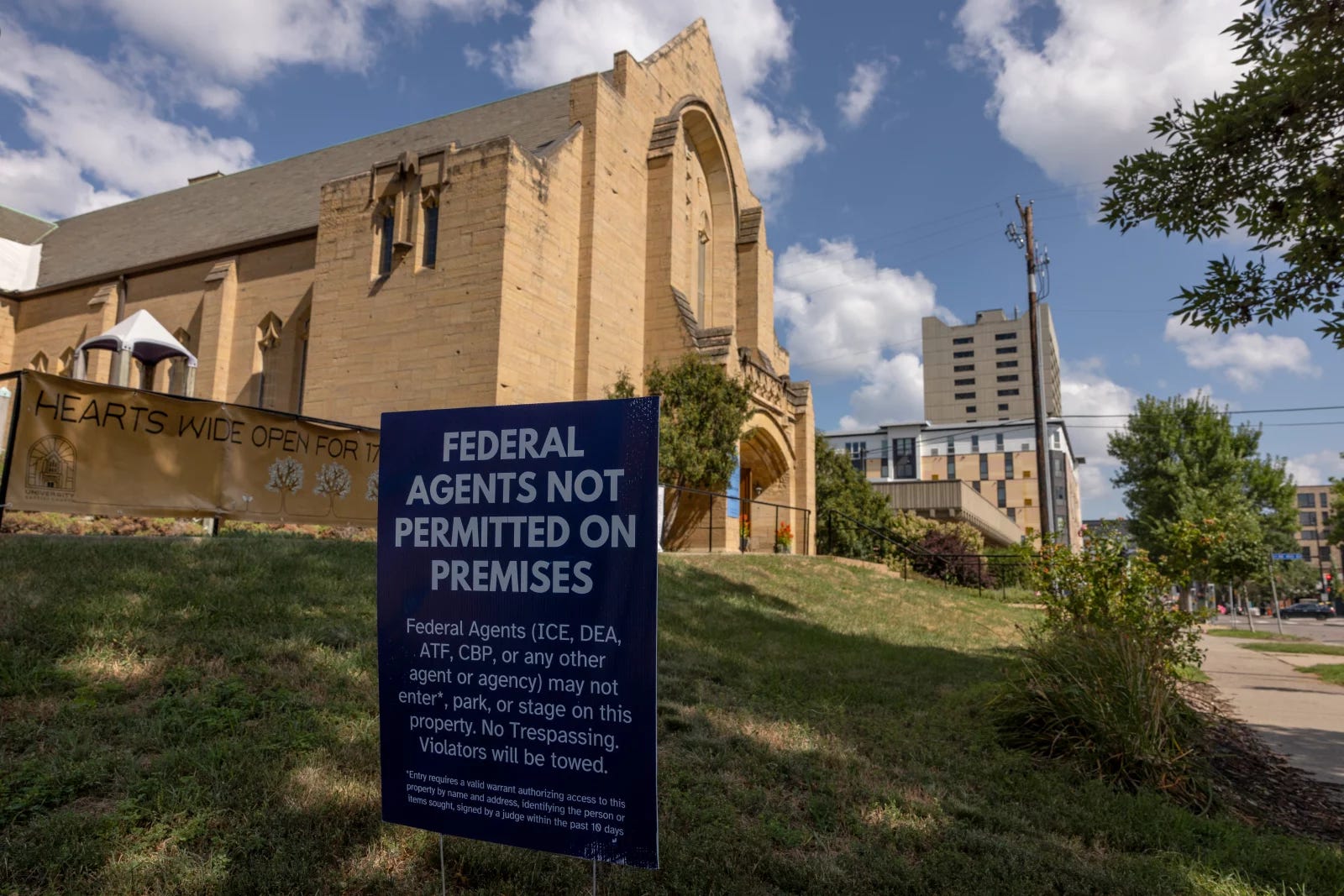
I don’t know that I’d put up that sign some churches are putting up. “Federal agents not permitted on premises.” I find it disjunctive situated directly in front of their other sign, “Hearts wide open.” I mean, federal agents should be able to worship also. What I told my church, and it’s the way I personally live in relationship to the surveillance all around us. “My whole approach is to just be radically public all the time.”
Another council person said, “We need each other so much, and it’s so hard not to let fear creep into that.” Surveillance societies are designed to wedge people apart, keep them silent and suspicious of one another, and to not rely on one another out of fear. The best response to the possibility that we are being watched is to lean into being together so that we can be observed loving one another. Full stop.
No posts
Comments
Nothing yet. Say the first thing.
Sign in to join the conversation.