
The Energy Gang podcast episode recorded at COP28 in Dubai features host Ed Crooks and guests Melissa Lott, Julio Friedmann, and Morgan Bazilian discussing the progress and challenges of the climate talks. Key takeaways include:
The podcast emphasizes the shift in COP28's focus from setting ambitions to implementing solutions for climate change, with discussions on hard-to-abate sectors like steel and aviation fuels. There is a sense of urgency, with the recognition that political changes in upcoming elections could significantly impact climate action.
The guests express optimism about the increasing cooperation among diverse stakeholders and the economic viability of low-carbon technologies. However, there is also concern that climate change is not the primary driver for many participants and that the actual negotiations may not be the most significant part of the COP process.
The conversation touches on the importance of private sector involvement and the need for government action to facilitate investment in climate solutions. The episode reflects on the value of the COP as a platform for dialogue and action, even as some question the environmental impact of such a large gathering.
In summary, the Energy Gang's discussion at COP28 highlights both the progress made in climate negotiations and the challenges that remain, particularly in financing and political commitment. It showcases the evolving nature of the COP meetings and the critical role of private sector engagement in addressing climate change.
by Volts
In the Volts podcast episode from December 8th, 2023, host David Roberts discusses the challenge of gaining local community support for renewable energy projects, particularly in rural areas, with guest Jarra Hicks. Hicks, an expert on community-owned wind farms and the director of the Community Power Agency in Australia, shares insights on the importance of community engagement and benefit-sharing in renewable energy development.
Key takeaways include:
Community resistance to renewable energy infrastructure is a significant barrier to achieving climate targets. This resistance often arises in rural communities that are targeted for new clean energy projects.
Effective community engagement is crucial for the success of renewable energy projects. Developers need to start conversations early, use diverse communication methods, and involve communities in decision-making to ensure both procedural fairness and distributional justice.
Benefit-sharing strategies can help create a positive relationship between renewable energy projects and local communities. These strategies should be flexible, involve early discussions with the community, and aim for long-term, significant impacts. Examples include annual grant funds, revolving loan programs for energy efficiency, and larger strategic projects that address community needs.
There's a growing awareness among renewable energy developers about the importance of social license and community engagement, but practices are still evolving. Industry bodies, policy incentives, and training for developers can help improve engagement strategies.
Regional benefit-sharing could coordinate the benefits from multiple projects to have a larger impact. However, the best models for such coordination are still being developed, and there may be a role for state involvement to ensure equitable distribution of benefits.
Renewable energy transitions should not only be technical but also social. Empowering individuals and communities to participate in renewable energy through policies and support for small to medium-scale projects can foster broader acceptance and enthusiasm for the energy transition.
Overall, the conversation emphasizes that building strong, trust-based relationships with local communities and ensuring tangible benefits are key to overcoming resistance and accelerating the adoption of renewable energy.
The Energy Gang podcast from COP28 in Dubai highlighted the significant focus on nuclear power at the climate talks, emphasizing its potential role in achieving net-zero emissions. The UAE, as the host, showcased its nuclear advancements, with four reactors expected to supply 25% of its electricity demand. A notable development was the declaration by 24 countries, including a mix of expected proponents like France, Japan, and the US, as well as surprising ones like Ghana and Morocco, aiming to triple global nuclear capacity by 2050. This reflects a broader recognition of nuclear energy's importance in providing clean, reliable base load power.
The podcast featured interviews with key figures like Dr. Sama Bilbao y León of the World Nuclear Association, who stressed the overdue attention nuclear is receiving, Henri Payer from the International Atomic Energy Agency, who discussed the realistic yet aspirational goal of tripling nuclear capacity, and Rita Lewis from the US Ex-Im Bank, who underscored the bank's support for the export of U.S. small modular reactor (SMR) technology.
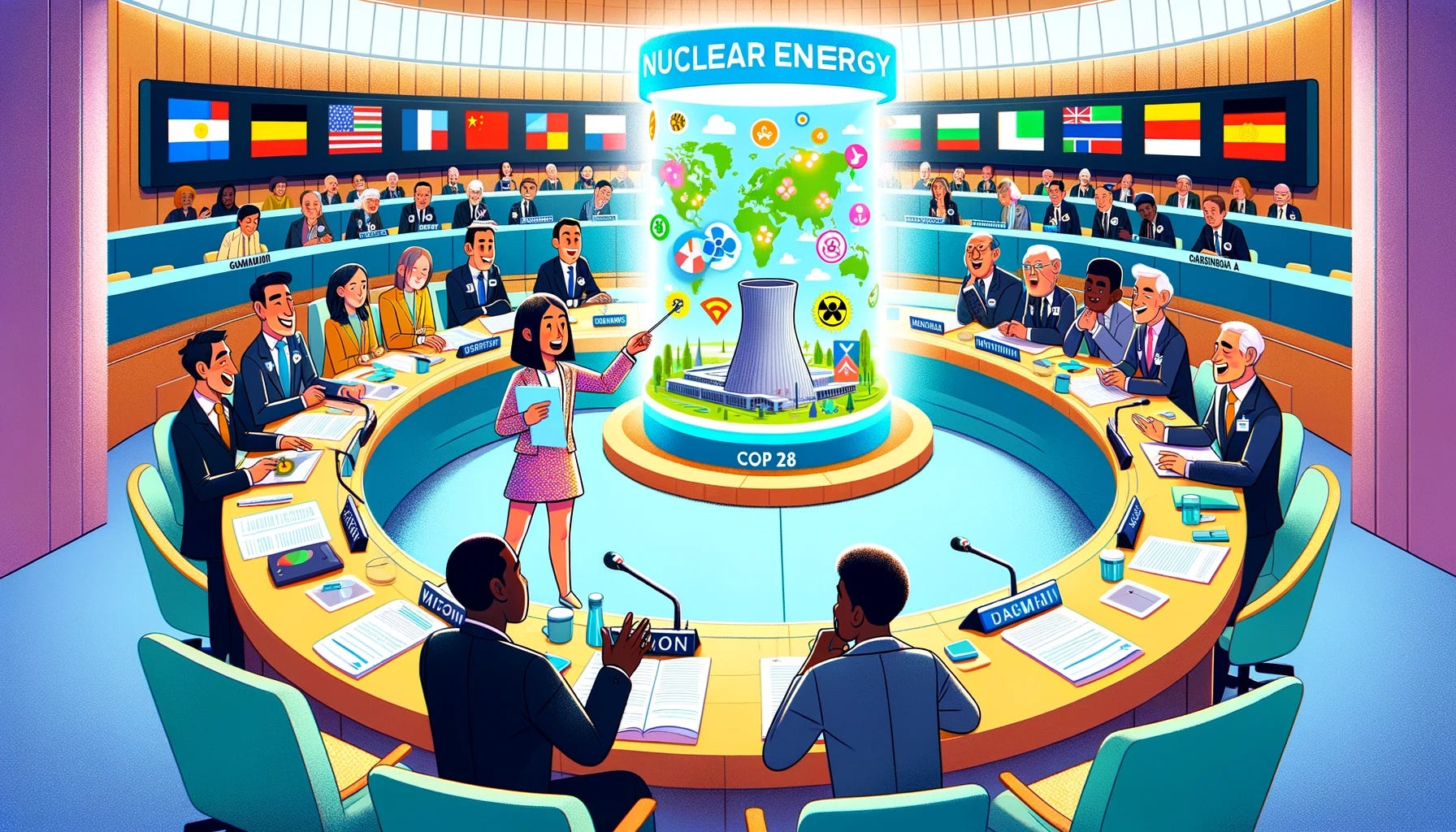
Challenges discussed include aligning investor expectations with the realities of nuclear projects, the need for policies that enable nuclear growth, and transforming market structures to appreciate nuclear energy's value. The industry must also ramp up capabilities to meet expected demand and secure affordable financing. The podcast suggests that despite setbacks, such as the cancellation of a U.S. SMR project, there is still strong interest in nuclear technology, particularly in its potential to decarbonize hard-to-abate sectors like industrial heat. The conversation at COP28 reveals an urgency to address climate change and a recognition that nuclear power, including SMRs, must be part of the solution.
by Volts
In the December 13th, 2023 episode of Volts, host David Roberts speaks with senior wind industry analyst Samantha Woodworth to discuss the challenges facing the U.S. offshore wind industry. The industry recently celebrated the first commercial scale offshore wind farm delivering power to the U.S. grid, but is simultaneously grappling with rising costs, contract renegotiations, and project cancellations. These issues stem from a combination of pre-existing contracts signed in more favorable economic times, and a series of unexpected global events, such as the pandemic and Russia's invasion of Ukraine, which have disrupted supply chains and caused inflation.
Woodworth explains that the U.S. offshore wind industry, being relatively nascent, is particularly vulnerable to these disruptions. However, these challenges are not unique to the U.S., as global renewable energy sectors are similarly affected. The conversation covers the potential solutions and adaptations within the industry, including indexed bids to accommodate inflation in new contracts and the development of a local supply chain to mitigate reliance on European imports.
Despite setbacks, there is optimism for the industry's future. The potential for offshore wind in the U.S. is substantial, with expectations of 15 gigawatts operational by 2030 on the East Coast alone. The conversation also touches on the Jones Act's impact on vessel availability, the notion of an East Coast transmission backbone, and the prospects of floating wind technology, particularly for the West Coast. The episode emphasizes that while the offshore wind sector is experiencing a 'perfect storm' of issues, it is anticipated that these are temporary hurdles, and the industry will adapt and continue to contribute significantly to the U.S. energy transition.
Thank you for reading Climate Pod Digest. This post is public so feel free to share it.
Comments
Nothing yet. Say the first thing.
Sign in to join the conversation.