
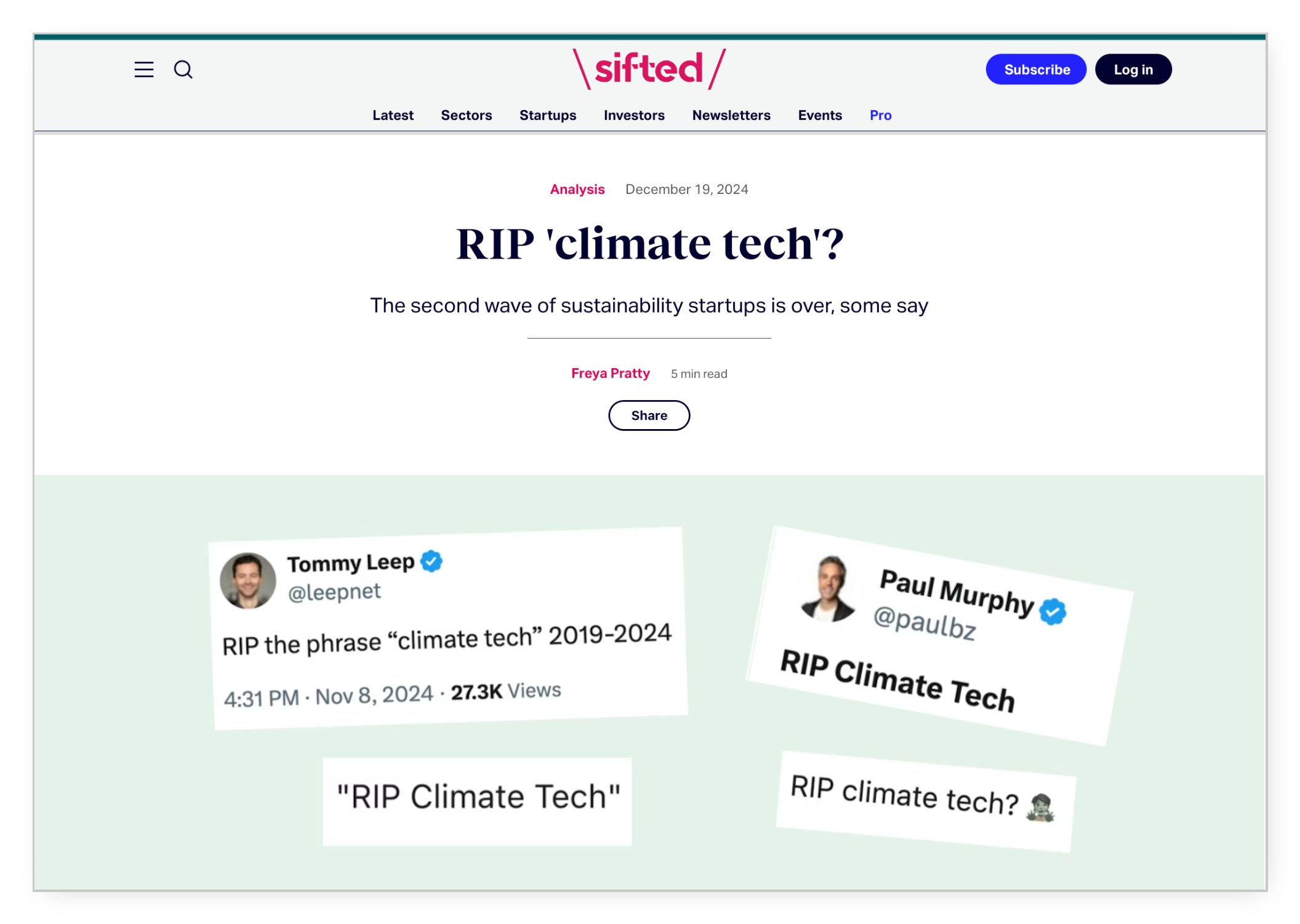
Right after Trump was reelected, my dear friend Tommy Leep shared what became a viral post:
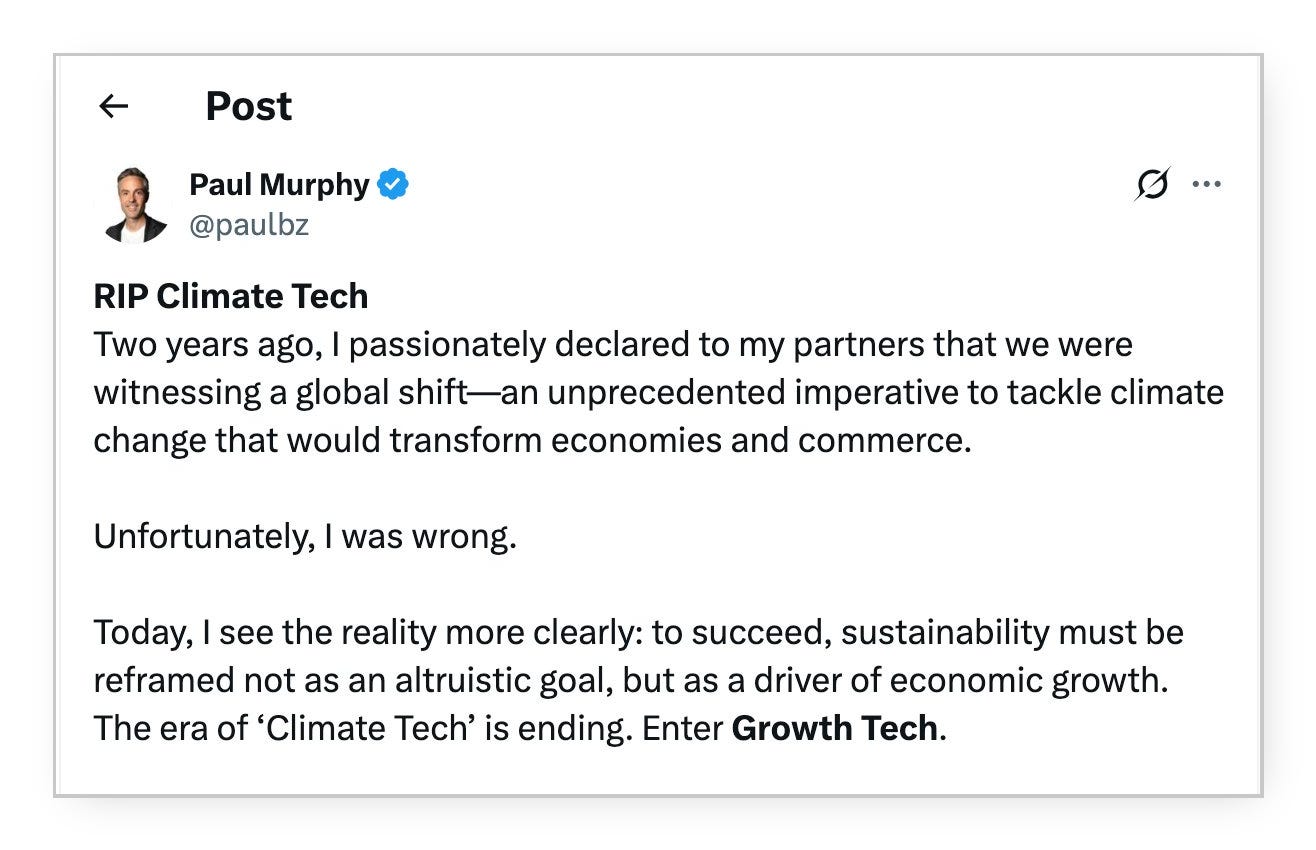
Later Paul Murphy at Lightspeed further elaborated on what he thought the end of climate tech meant:
Today, 16 months later, I’m here to share that $2.3 trillion in climate money says they were wrong — or at least, severely misread.
Tommy and Paul and many others talking about the end of climate tech at the time were referring to a specific investment category label that attempted to gesture towards intention alongside outcomes.
They weren’t saying these technologies are worthless vaporware or these companies are all going to fail, and they were (I believe) ultimately right that bundling the why — our intentions around carbon reduction — and the what — actual technologies — was probably not going to work out like everyone thought.
But their words fed a media machine looking for a good headline, and there’s nothing as eye catching as a tombstone (I guess…??).
If we can agree that what we actually care about are outcomes not labels, and we refresh ourselves on the true major sources of emissions:
And we then look at how solutions within those categories are performing today from a total investment perspective, we see that what was once called “climate tech” is not dead — but alive and well under whatever assumed name it’s politically expedient to call it.
Here at Climate Money, what we focus on isn’t the semantics of a venture category but the massive flow of real capital required to solve an interesting problem that happens to have moral and existential implications. So let’s ignore the obituary and look at the ledger.
BloombergNEF recently released their annual Energy Transition Investment Trends report.
Here’s the headline:
Global investment in the energy transition hit $2.3 trillion in 2025.
It’s up 8% from 2024, and it’s a new record.
2025 was a year of trade disruptions, geopolitical tension, a denier presidential administration… and apparently a lot of climate money. Even US investment increased — albeit at a slower rate of 3.5% — to $378 billion.
These numbers are large enough that it all feels abstract. In the context of infrastructure and societal change, is $2.3 trillion a lot? We constantly hear it’s “not enough” but what does that mean?
Here’s what else costs a few trillion dollars.
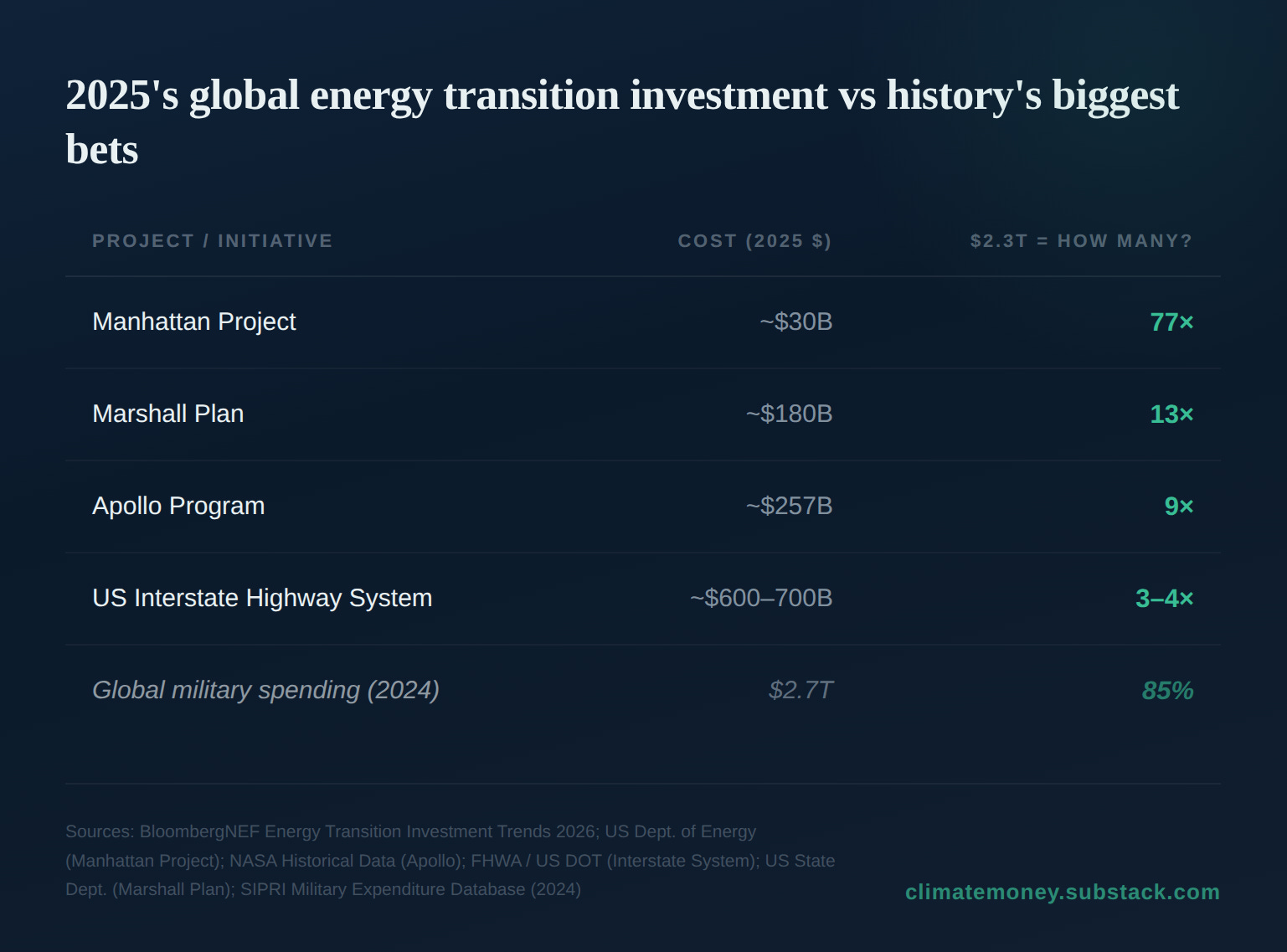
Each of these initiatives reshaped the 20th century world in ways so dramatic that we still feel their impacts in our everyday lives.
The Marshall Plan — which cost $180 billion in today’s dollars spread over four years, rebuilt Europe after WWII, forged alliances that continue to define global geopolitics, and eventually ensured that every European Millennial knew The Simpsons and Friends as well as any American counterpart. In just one year alone, the world invested more than 10X that in the energy transition.
The US interstate highway system — which defined our landscape and created economic mobility alongside cultural migration, could have been rebuilt 4 times over with last year’s climate money.
And even global military spending — which is the highest it has ever been (!), is within spitting distance.
In other words, the climate Manhattan Project that so many people keep calling for — that acceleration of a ‘space race’ for climate that we keep saying we need — is already underway.
This isn’t a one off spike, either. 2025 marks the fourth consecutive record year for energy transition investment.
Even if investment dollars lag policy reality, until there’s evidence otherwise we should assume “trillions” is secular.
I’m always suspicious of big number headlines that claim “investment dollars.” Money changing hands doesn’t always mean societal value generated. So, let’s look at what all’s included.
When BNEF says “$2.3 trillion in energy transition investment,” they are talking about real economy capital expenditure — not about VC deals or the ups and downs of the public markets (trading).
Specifically, this includes:
Capital expenditure on renewable energy projects (like building wind farms or solar installations)
Consumer and fleet purchases of EVs
Buildouts of charging infrastructure
Grid infrastructure buildout
Industrial equipment for decarbonization
The three largest categories were electrified transport ($893 billion, +21%), renewable energy ($690 billion, actually -9.5% due to regulatory changes in China), and grid investment ($483 billion).
Alongside all this deployment spending, BNEF tracks three additional capital flows:
$127 billion in clean energy supply chain investment — spending on the factories and mines that produce equipment, like solar panel factories, battery plants, lithium mines. +6% YoY
$77 billion in climate tech equity finance — venture capital, private equity, IPOs, and secondary offerings in climate focused companies. +53% from 2024’s abnormally low $50.4 billion, less than half of 2021’s $168 billion peak.
$1.2 trillion in energy transition debt issuance — bonds and loans that companies, governments, and projects raise to fund clean energy deployment. +17% YoY 👀
Look at that debt to equity ratio.

The most important number in this entire report is the 15:1 ratio between $1.2 trillion in energy transition debt issuance and $77B in climate tech equity finance.
And to be clear, this isn’t a leverage ratio in the traditional sense. In project finance, a (much lower) 4:1 debt-to-equity ratio on a single solar farm is healthy and expected — it means the equity did its job derisking the asset.
But what we’re looking at here is a pipeline ratio: for every dollar of new equity being raised to fund early stage climate companies, the market issued $15 in debt to finance deployment of proven technologies.
It tells us two things:
1) there’s a lot of debt out there, and
2) the equity pipeline feeding it needs to keep pace.
To put $1.2 trillion in context against the broader capital markets: according to S&P Global Ratings, total new global corporate bond issuance in 2025 was $6.87 trillion. That's the WHOLE bond market — AI, data centers, freeways, buildings, everything, not just green bonds.
So climate tech was over 17% of that??? That is justifiably insane. Maybe we should drop the climate tech naming, and just go back to “clean tech” because clearly clean tech 1.0 was right.
And on that point, all of this debt financing does validate the original equity thesis: that early risk capital serves as a capital access instrument for much larger debt dollars down the road.
VCs and growth investors absorbed technology and market risk so that project finance markets could one day underwrite that work at multiples of the original equity investment.
This is what every VC should be focused on. Not paper markups or markdowns but number of things built and deployed. However, because it takes so long to fully deploy technology, we need an earlier proxy that tells us we’re on the right track.
Debt is that signal.
Debt markets are risk averse by design. Lenders need predictable cash flows, proven technology and scalability, and above all, bankability.
$1.2 trillion in debt tells us that a healthy portion of climate tech is all grown up. Our adorable frontier technologies are now officially deployable, financeable infrastructure companies, and that is pretty incredible. The debt dollars are a signal that a large portion of low emissions technology has crossed the threshold from risky business to underwrite-able enterprise.
As you can guess, most of this is in mature renewable technologies and should give us even more pause when we see another “RIP climate tech” story.
According to the BNEF data, companies tied to mature energy transition sectors — ie, renewables, EVs, storage, grids — raised $989 billion of 2025’s total debt number, or the vast majority. Meanwhile, companies in emerging sectors, like nuclear and hydrogen, raised $77 billion.
In other words, 83% of all energy transition debt went to cleantech 1.0 categories — the technologies that were derisked by equity investors years ago and have since crossed the bankability threshold.
The deals are getting bigger and the lender base is growing, too. Deutsche Bank acted as mandated lead arranger on a €2.9 billion financing for Baltica 2, Poland’s largest planned offshore wind farm. TotalEnergies signed a 15 year PPA with Google for 1.5 TWh of renewable electricity from an Ohio solar farm. These are all now *routine* transactions in what has become a mature, liquid market.
And side note here: There are even early signs of debt dipping its risk averse toes into emerging categories. Recently, the SAF company SkyNRG reached financial close on a 100,000 ton per year SAF plant in the Netherlands — an industry first because it was non recourse project financing, which means that the debt was secured by the project’s revenue and assets, not by the parent company’s assets.
Non recourse project financing means that the risk is shifted onto the lender rather than the borrower, and it’s usually reserved for the most bankable projects and technologies. Typically, the progression from recourse to limited recourse to non recourse is a proxy for how much lenders trust the underlying technology and revenue model.
SAF is a clean molecules category, not even our cleantech 1.0 bread and butter of solar or storage. The fact that it reached non recourse project finance after a 7 year development period is evidence that the maturity curve is starting to branch out from the most obvious sectors.
I’m seeing this on the ground, too. The number of founders I’ve talked to who have ‘lost’ access to public debt programs but have instead closed not one but multiple term sheets with private lenders — at more competitive rates than what government funds could offer — is… not small.
The number of allocators who are suddenly closed to equity but suddenly interested in funding debt vehicles is also not small.
Debt wants climate tech, so why isn’t equity listening?
There is some bad news hidden in this debt to equity ratio though.
We’ve been talking a lot about the $1.2 trillion going towards debt issuance, but the flip side of that is the $77 billion going towards new equity financings. While this is up over 2024’s abnormally low number of just $50.4B, 2025’s $77 billion is still less than half of equity’s peak of $168 billion deployed in 2021’s ZIRP fueled heyday.
In other words, while it’s positive that energy transition companies are proving out their ability to leverage past equity financing into big debt fundings today, it’s negative that the ratio was partially driven by equity’s low absolute number, which itself is a warning sign for the future.
BNEF reports that venture funding for climate startups fell for the third consecutive year. And the composition of what did get funded was narrower than before. The majority went to clean power generation, energy storage, and low carbon transport, and over a third happened in China, concentrated in big, established names like CATL ($5B IPO) and BYD ($5B post-IPO offering).
So what about everything else — there’s ag, carbon management and clean molecules. There’s nuclear and advanced geothermal, which are having a moment with data center demand and hyperscaler PPAs but are still heavily equity dependent and not yet seeing the debt market love. All of these categories are showing meaningful signs of life but aren’t getting fed.
Net Zero Insights data from H1 2025 adds granularity. US climate tech seed deals were down 12.8% YoY, and Series A deals were down 12%. Series B was up 26.8%, but that reflects capital concentrating in later stage, lower risk companies, not really a healthy early stage innovation pipeline.
We need to be asking ourselves — are we bottlenecking the innovation pipeline for the next generation of energy technologies? Are we going to be sorry for today’s overabundance of caution when we have nothing to offer tomorrow’s deal hungry debt markets?
Here is where the two sides of the ratio collide.
Debt markets aren’t just big, they’re growing. And they’re not just growing, they’re accelerating.
Energy transition debt issuance was up 17% YoY in 2025, more than double the overall energy transition investment growth rate of 8%. Corporate and project finance flows were each up 20%. Government labeled debt issuances actually declined as governments scaled back labeled bonds for mature sectors, which means the growth was driven by private credit funds, ESG lenders, and family offices getting into clean energy project finance on their own conviction, not because a government program told them to. This is a much more durable signal than subsidy driven lending.
I’m personally seeing this every day. New private funds are spinning up and established houses are all getting into clean energy project finance with increasing frequency. Climate startups — not just projects — are getting debt term sheets from multiple lenders (including some straight up banks), at better than expected rates, and at earlier stages.
These are the hungry buyers on the debt side of the supply chain, but can the equity pipeline produce enough bankable assets to meet that demand 5 to 10 years down the road? The current trajectory suggests it won’t. If early stage equity funding continues to contract while debt markets continue to expand, we get a mismatch that compounds.
Debt markets need a steady supply of proven, derisked assets. Those assets only materialize after years of equity funded development. A gap like what we’re seeing now in the equity pipeline implies a gap in bankable assets arriving in the early 2030s — or just when debt markets will be at their peak.
That’s a climate problem and a capital markets problem.
There’s a painful irony here. The folks who said climate tech was dead could end up being right, *not* because the first generation of climate technologies failed — as they clearly did not — but because early stage funders forgot the golden rule of investing:
No risk, no reward.
$2.3 trillion in total deployment and $1.2 trillion in debt financing prove that climate technologies work and that capital markets are willing to finance them at scale. As best in class marketplace companies like Uber know well, the real constraint isn’t demand, it’s supply.
So to all my fellow VCs out there, let’s give the market what it wants, shall we? It’s time to build our supply of innovation so that today’s frontier becomes tomorrow’s boring, bankable, energy abundant, zero emissions climate incumbents.
Climate Money is back, and we're all about the double click. This season on the Climate Money podcast, we're tracking all things debt — where the capital is flowing, where the most interesting gaps are, what happens when debt markets start reaching for technologies that aren't fully proven yet, and what founders and lenders on both sides of that bet are seeing on the ground. We'll also be lining up conversations with the people in the capital markets trenches right now. And of course, we'll be staying on top of all of the key headlines in the business of climate.
If you’re new, please hit subscribe so you don’t miss a post or an episode. And if you’ve been around a beat, thank you for sticking with climate and with Climate Money. I’ll see you next time 👋
Comments
Nothing yet. Say the first thing.
Sign in to join the conversation.