
This week’s post is about my visit to the RHS Badminton Flower Show which took place last week. It’s a new site for the show (lying just in the Cotswolds) and will alternate with the Hampton Court location.
I visited on the Friday to give a talk on Climate resilient gardening, which was very apt given the conditions! Being a speaker, meant I could enter the show early and wander around before the public were allowed in which helped a lot as it was so much cooler!
Coping with the heat
It was hot! Very hot, so I really have to congratulate the exhibitors, volunteers, garden teams, RHS staff, contract workers and many others who worked long hours before, during and after the show in high temperatures to keep everything running and looking wonderful. I really felt for the trade stands that were in south facing pitches. Being in the open sun all day was hard, as was keeping sale plants looking pristine.
There were plenty of water points and an abundance of parasols and awnings to keep us cool while we sipping iced drinks or munched a snack. But walking around a busy show ground in temperatures of 30+C was exhausting and I didn’t make it around all the areas of the show, nor did I buy as much as I would have liked because of the temperatures.
But I did take plenty of photos, but as you will know its rather tricky taking photos on a sunny day with a mobile phone! It was virtually impossible to see what you were photographing as screens blacked out and the heat caused the camera functions to switch off. So it was a question of pull out the phone, take the photos, put it back in your bag near a cold can so it could cool down while you walked tot he next garden. Fortunately, most of the photos were OK apart from my shadow crossing quite a few.

My favourite by far was the Julia Rausing Garden designed by Tom Stuart-Smith, which seemed to be coping well with the immense heat. This garden was the centrepiece of the show and was also the largest garden ever created for an RHS event, covering around 2,400 m² to commemorate the life and philanthropic work of Julia Rausing. It was not a typical show garden, but a landscape with winding paths that allowed visitors to walk through and experience the garden. There was woodland-edge planting beneath multi-stemmed trees that cast very welcome shade, drought-tolerant perennial beds, and beyond them, a wildflower grassland with lime trees and a quirky beehive.
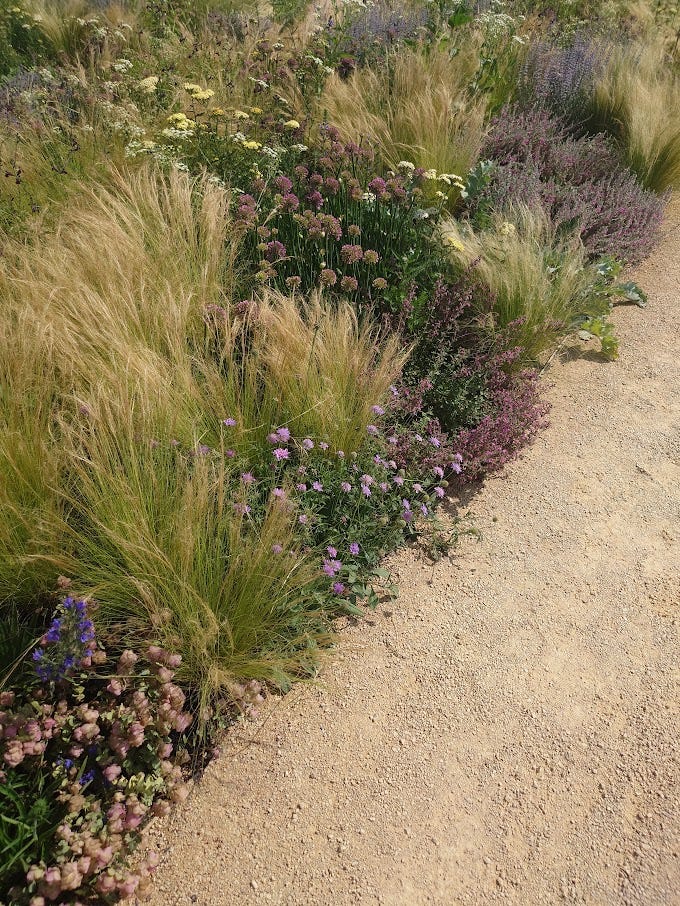
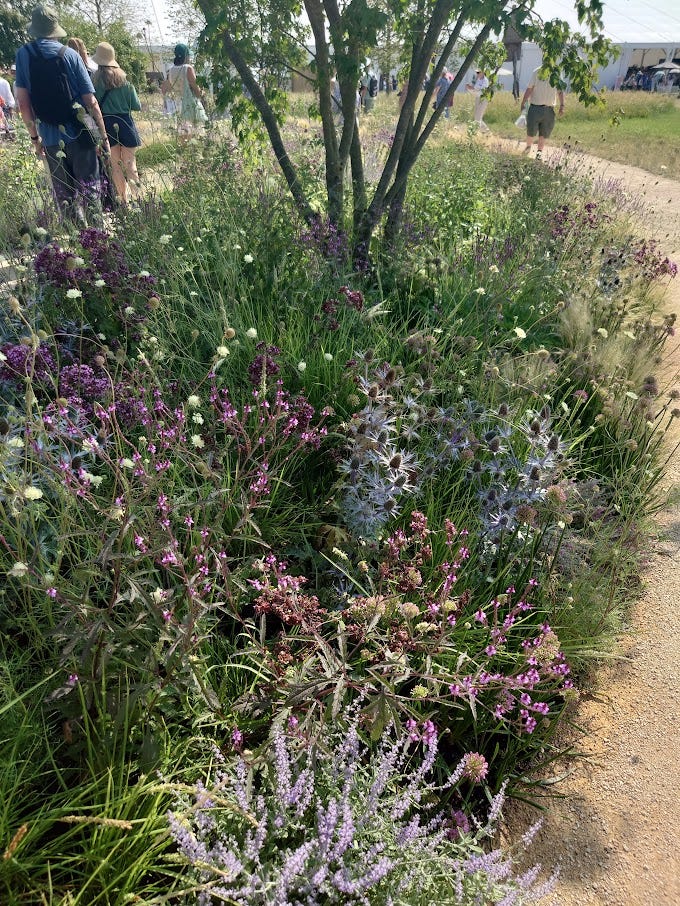
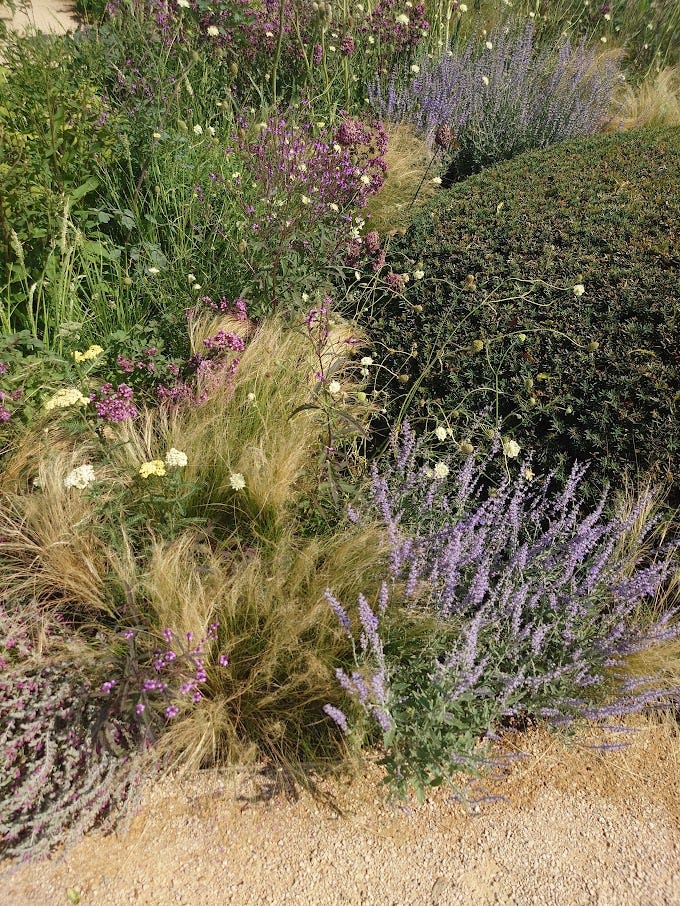
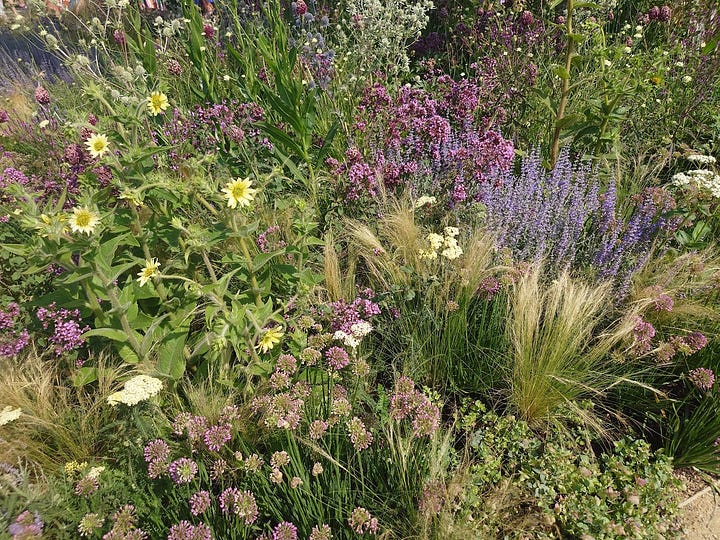
I have listed some of the key plants below as they may be a useful reference for future planting choices.
The key trees were Acer tartaricum subsp ginnala, Catalpa bignonioides, Elaeagnus multiflora, Osmanthus x fortunei and Quercus ilex.
Some the species featured in the perennial planting were: Achillea Credo, Allium Millenium, Artemisia pontica, Aster Twilight, Cynara cardunculus, Crambe maritima, Echium vulgare, Erigeron karvinskianus, Eryngium agavafolium, E. planum, E. Big Blue, Geranium madarensis, Nepeta ‘Dawn to Dusk’, Origanum, Perovskia ‘Prime Time’, Seseli elatum subsp. osseum, Siphium mohrii, Stipa tenuissima, Stipa ‘Ponytails’, Teucrium chamaedrys, Teucrium hircanicum, Teucrium marum, various Thymus, Veronicastrum, and Verbena offinalis ‘Bampton’.
I do have a photo of the planting plan if anybody wants a copy.
I’m liking the germanders more and more. My favourite is the tree germander (Teucrium fruticans), which grows into quite large and sprawling shrub, loving full sun, but preferring a well drained soil that’s alkaline to neutral. Mine flowers for much of the year and its thriving in the current heat.
Three Teucrium species were used in this show garden
Wall germander (Teucrium chamaedrys) , a dwarf evergreen subshrub with dark green leaves that are hairy on the underside which provides drought tolerant. It has spikes of pale rose-purple flowers. Likes a sunny position.
Caucasian germander (Teucrium hircanicum), a bushy perennial reaching to 60 cm in height with aromatic leaves and spikes of red-purple flowers. It copes with full sun to partial shade. This looked great in the show garden, so its another on my list!
Cat thyme (Teucrium marum), a compact, evergreen, bushy subshrub reaching 40 cm, with small aromatic leaves that are downy on the underside and tiny pink flowers in mid to late summer. Enjoys full sun.
The other garden that attracted a lot of attention was Jo Thompson’s The Archers 75th Anniversary Garden, designed to make you feel as if you had stepped into the garden of Bridge Farm, Ambridge. Unfortunately, I don’t listen to the Archers, so many of the details were lost on me, but friends who are fans of the show loved it. It featured a productive kitchen garden with organically grown veg and I loved the way it showcased how land can be managed sustainably. Some of the planting was inspired by the programme’s recent environmental storyline about Bridge Farm’s recovery following a sewage spill.
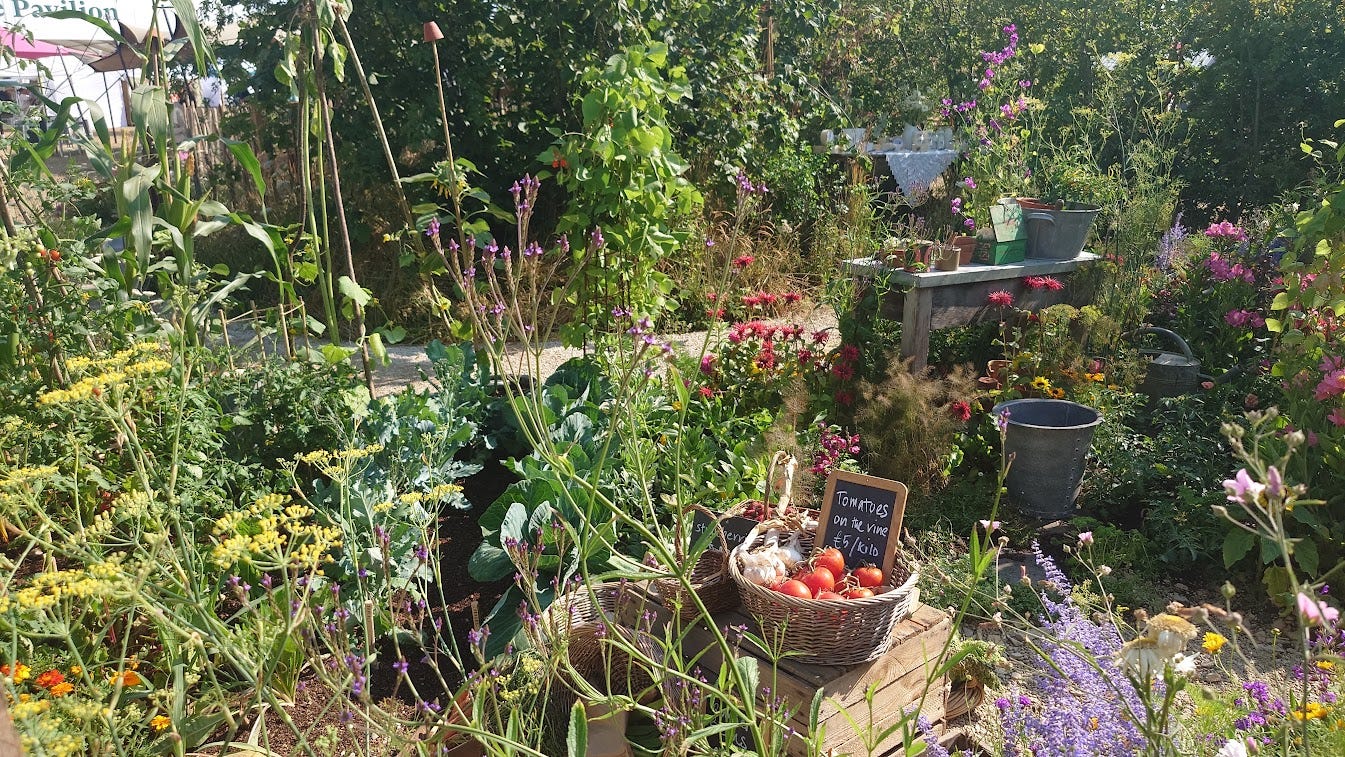
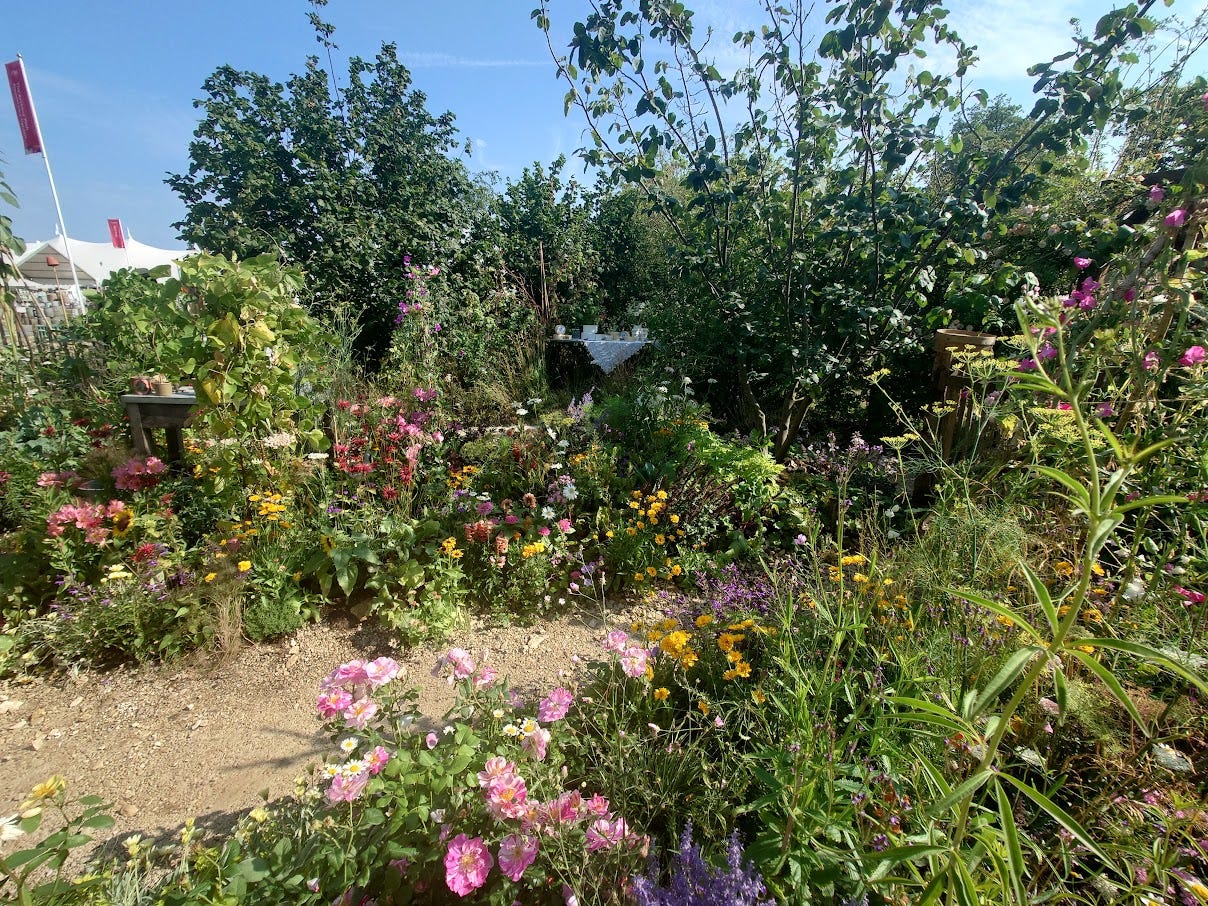
Some of the other gardens that I liked:
The Nascent Shade Garden for Macmillan Cancer support designed by Elle Arnett. Not only was a shade garden very appropriate for such a hot week, but I Ioved the white posts that were made from a mix of stone and lime giving them irregular surface textures.
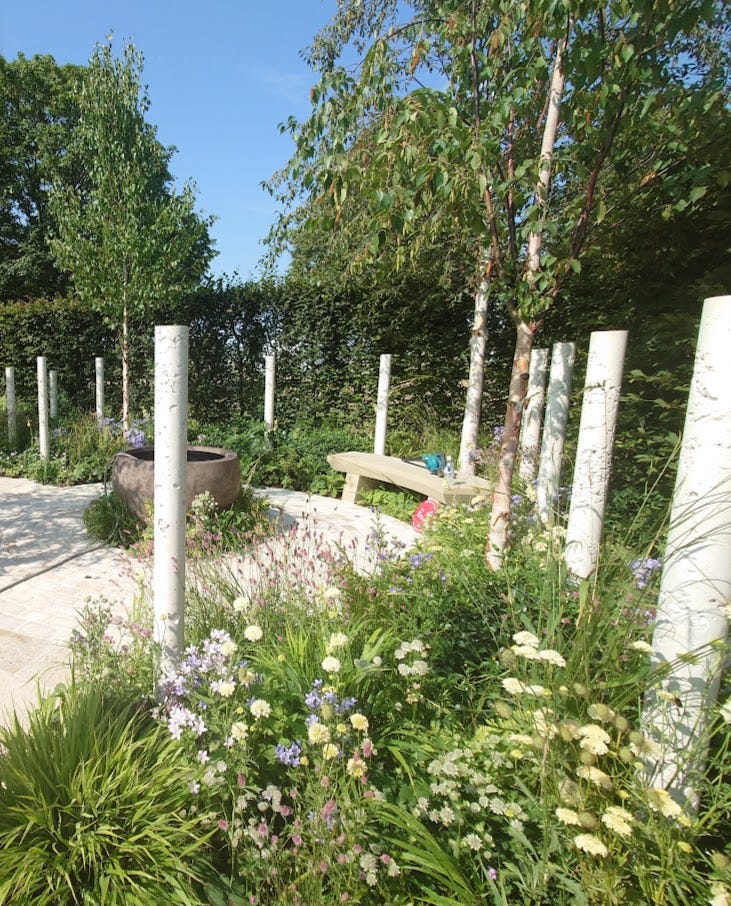
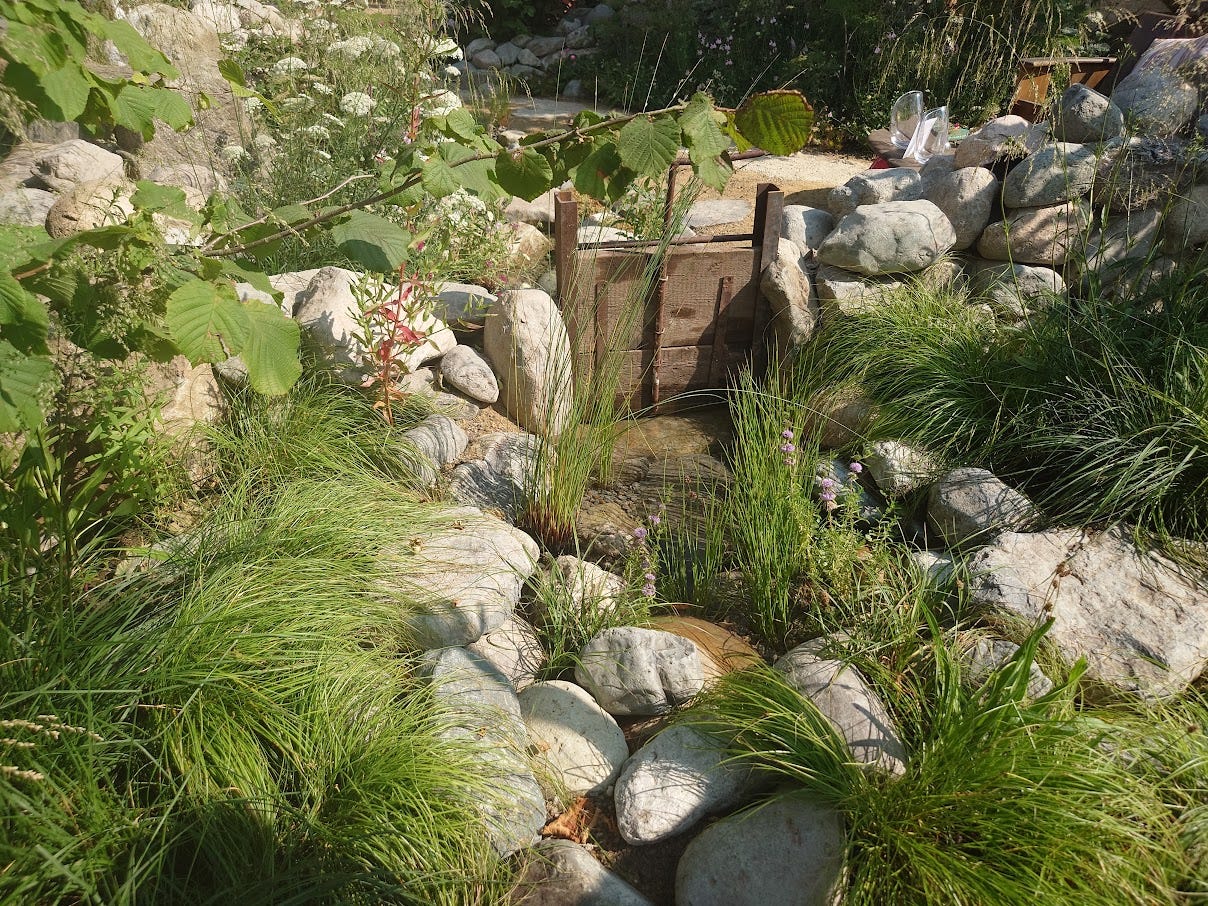
The winning design in the Young Designer Gardens was Sophie Leo’s Where Grief Grows Quite which supported Maggie’s. It reimagined the stone enclosures used by shepherds on the hills to shelter their flocks. The stone wall enclosed the garden and outside the planting was inspired by field boundaries and hedgerows.
I look forward to viewing the Pocket Gardens as there are always a number of take away ideas that tend to be more applicable to a small garden and here are a few that caught my eye:
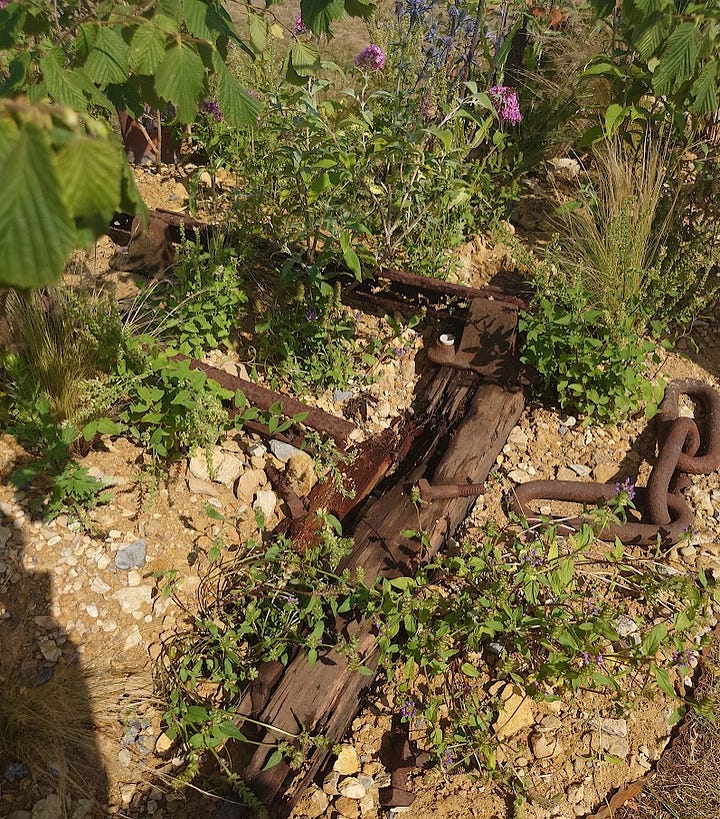
Life in Dereliction by Luke Adams and Esme Jones featured the regenerative processes that occur on brownfield sites. Here the planting medium was crushed aggregates which many of you know is one of my favourite growing substrates. There was plenty of deadwood and rusting objects that you might find on a brownfield site. The drought tolerant planting included Achillea Credo, Echinacea pallida, Cichorium intybus, and Eryngium Big Blue.
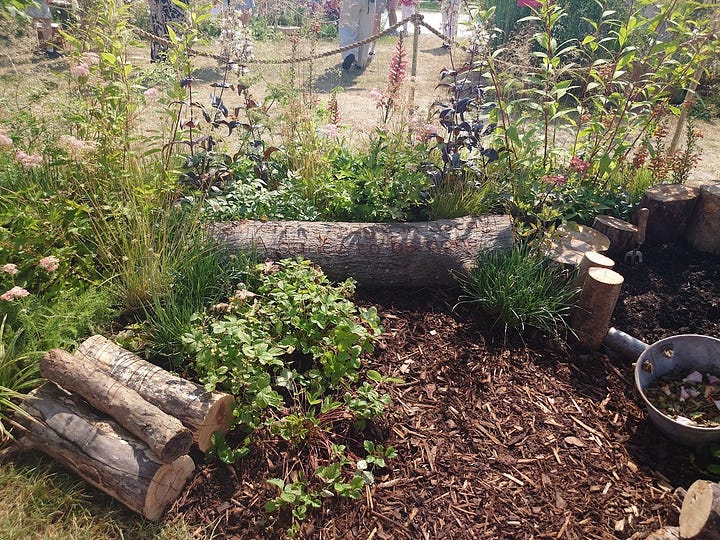
Celebration of Compost and Community was designed by Simon Deeves and it represented a woodland edge garden. The presence of composted green waste and woodchip represented the idea of decay. There was a log carved with the phrase: ‘There is magic in decay. A dance to be done’. This garden is to be located to a primary school to inspire gardening and composting in the next generation in conjunction with the local community composting scheme and Garden Organic’s Master Composter Scheme
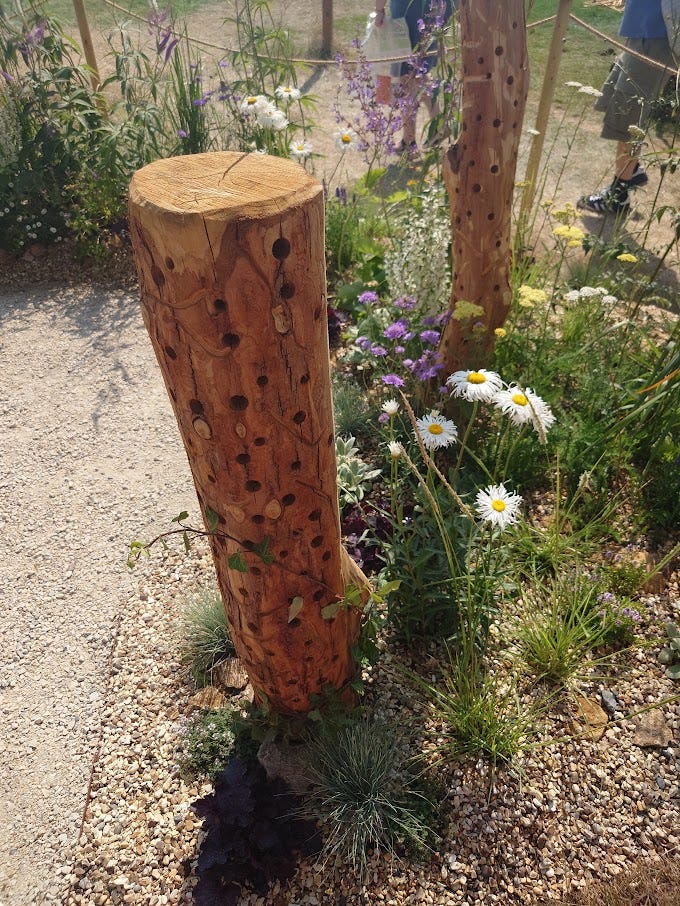
Quite a few gardens had posts for insect life, including University of Sheffield’s Invisible Balance Garden
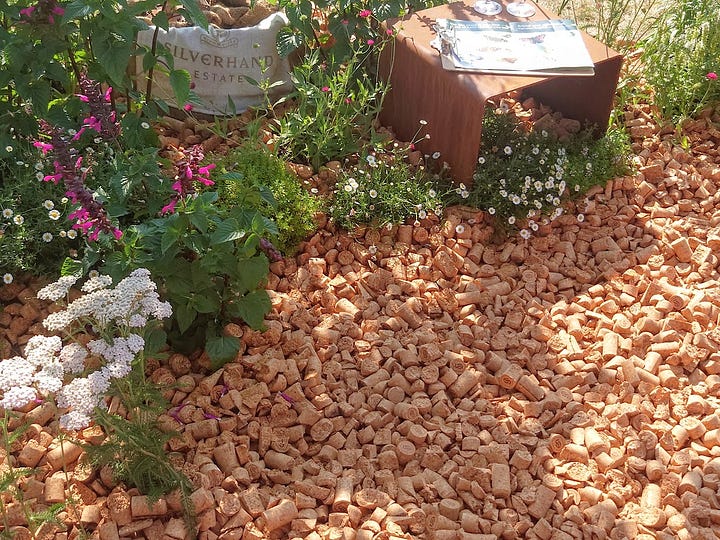
Silverhand Estate: The Butterfly Garden was designed by Emma Atkinson and supported Butterfly Conservation. Here, the use of corks for ground cover caught my attention. As you would expect there were lots of nectar-rich plants to attract butterflies. One of the shrubs was the alder buckthorn (Frangula alnus) which attracts the brimstone butterfly. This garden is to be relocated to the Silverhand Estate in Kent home to the UK’s largest single vineyard that is managed organically, extending to 900 acres.
And this is an appropriate moment to mention that Butterfly Conservation’s Big Butterfly Count is underway and runs until 9 August. The easiest way to take part is to download the Big Butterfly Count app on your phone. To count, pick a place to watch butterflies and moths for 15 minutes and record all that you see. Easy!!
One of my favourite seed producers is Sea Spring Seeds, specialists in veg seeds especially chilli and tomato seeds. Their stand, as always, was filled with wonderful vegetable plants and given the difficult growing conditions over the last few months, I couldn’t believe the quality of Joy’s demo plants.
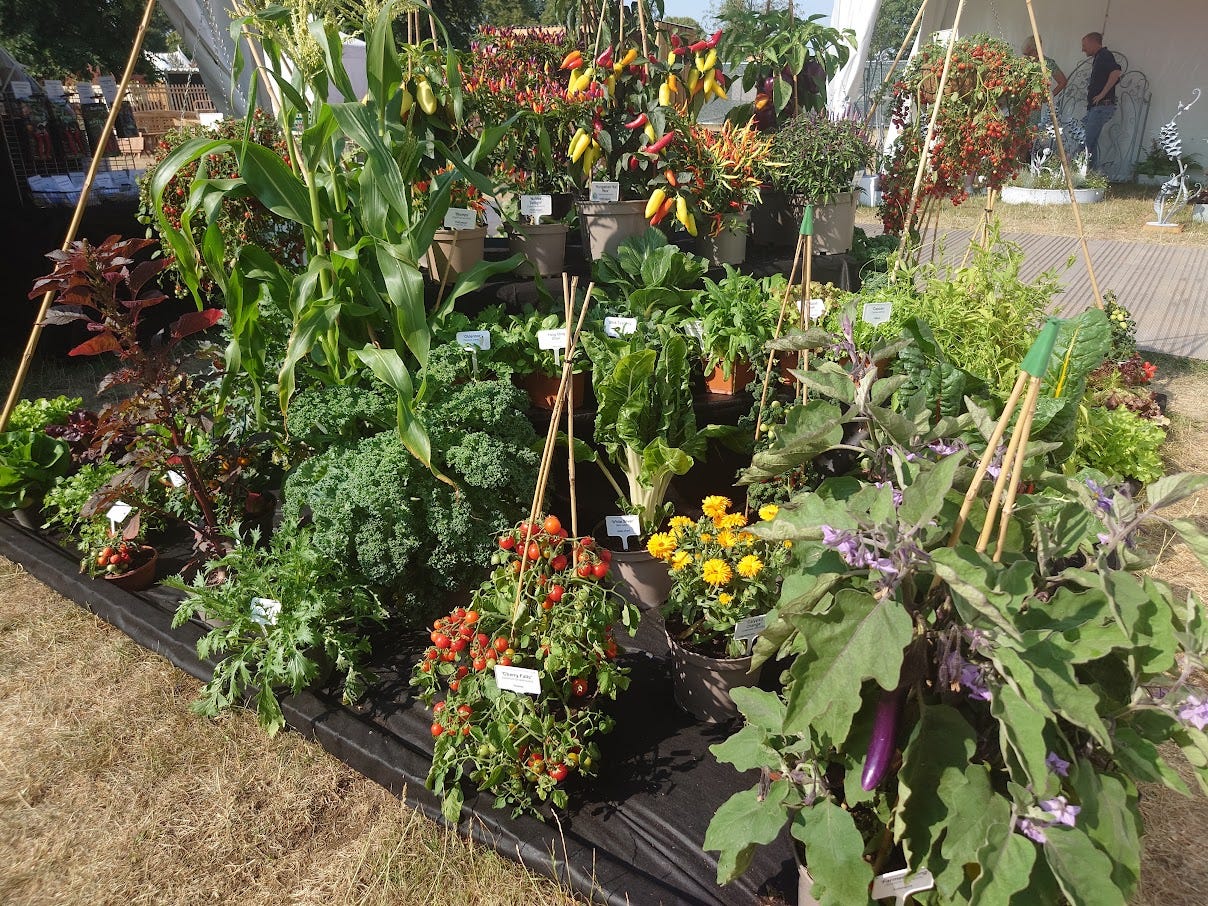
I visited their site in Dorset a couple of years ago and you can read about my visit here.
So I hope you find something of interest in this post
Happy gardening!

PS If you enjoyed reading this post, please click the ‘like’ button at the bottom, it really helps make my posts more visible on the SubStack app. Thank you xxx

The Yeo Valley Organic Garden Festival is back! 17-19 September
I am speaking on Saturday afternoon with a talk titled ‘What’s next for gardening?’ Don’t leave it too long to buy tickets - they sold out quickly last year!
Visit my garden
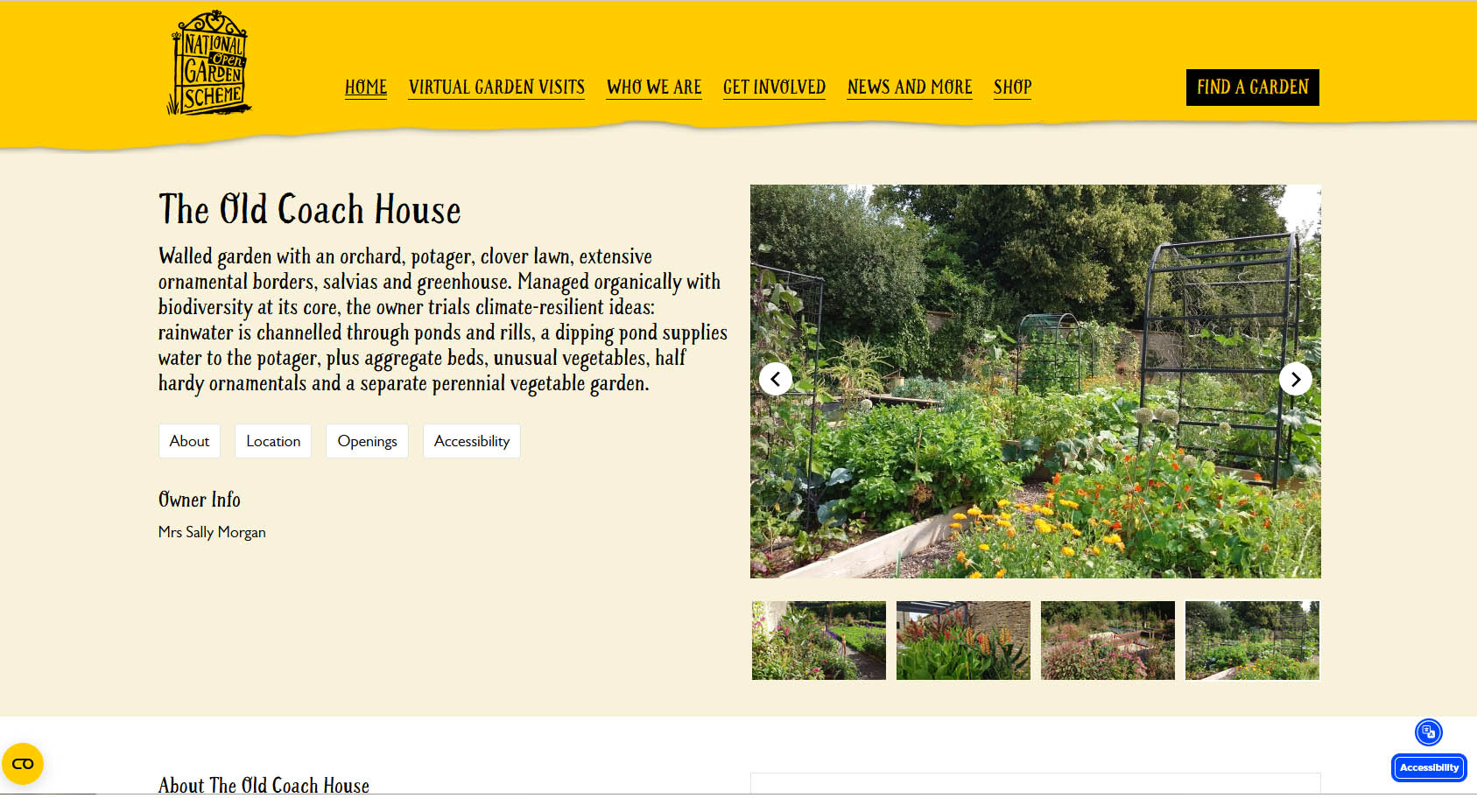
And don’t forget my walled garden is open for NGS on 1 August and 6 September – I’d love to see you !
Comments
Nothing yet. Say the first thing.
Sign in to join the conversation.