
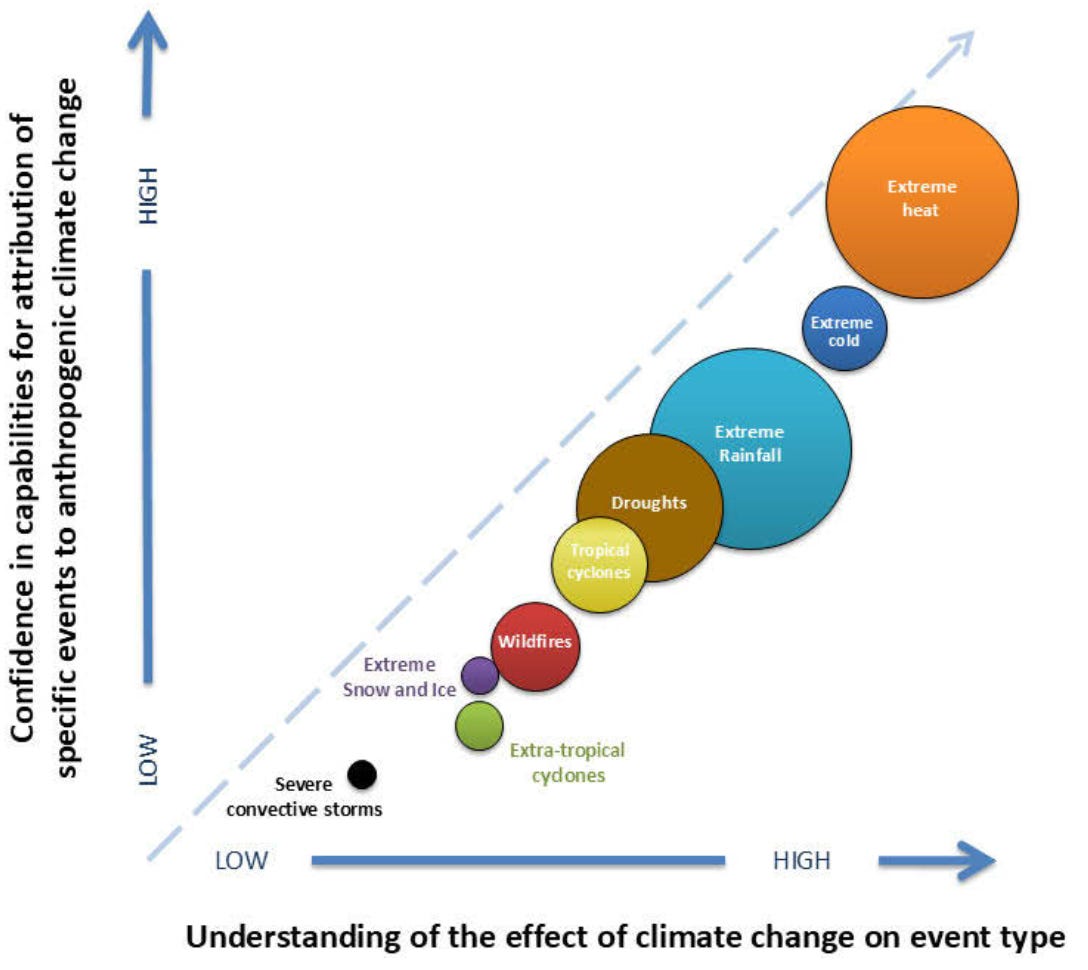
The National Academies of Sciences, Engineering, and Medicine (NASEM) on July 16 released a 236-page report, Attribution of Extreme Weather and Climate Events and Their Impacts. (A press statement provides a summary.) The report by a 15-member committee updates the Academies’ 2016 assessment of attribution science. It describes the improvements in data, methods and modeling over the decade and how these advancements support improved assessments of role of climate change in extreme weather events.
The report also describes the challenges that remain. As illustrated by the figure above, confidence in attributing a climate cause is strongist for events that are essentially thermodynamic, like heat extremes or intense rainfall. But much remains to be learned about small-scale dynamic processes such as convective storms.
The attribution science covered in the report is important not only for planning community resilience and wider private and public risk management. It also is potentially relevant to litigation of claims for compensation for damage resulting from extreme weather events. This economic interest has spurred efforts to discredit the NASEM process, and with it the underlying science. This campaign has included efforts to disrupt and discredit the individual members of the Attribution Committee, and a challenge to Academy processes by some Republican members of the House of Representatives.
No posts
Comments
Nothing yet. Say the first thing.
Sign in to join the conversation.