
Pale of Settlement
Definition and Purpose
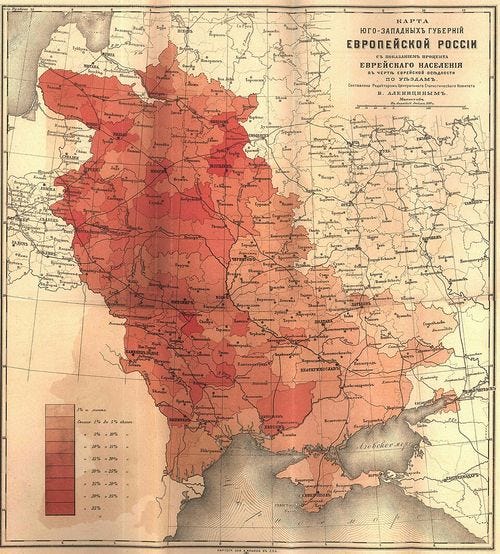
The Pale of Settlement (Russian: Черта́ осе́длости, Cherta osedlosti) was a western region of the Russian Empire where permanent residency by Jews was allowed from 1791 to 1917. Outside this designated area, Jewish residency—whether permanent or temporary—was mostly forbidden. The term “pale” derives from the Latin palus (stake), referring to a boundary or enclosed district.
Established primarily to restrict Jewish movement and economic competition with the general Russian population, the Pale also served to populate newly acquired territories along the Black Sea. At its height, it covered approximately 500,000 square miles (1.2 million square km), comprising about 20% of European Russia.
Geographic Scope
The Pale included large parts or the entirety of modern-day:
Poland
Ukraine
Belarus
Lithuania
Moldova
It also encompassed smaller portions of Latvia and western Russia. The region largely corresponded to the historical lands of the former Polish–Lithuanian Commonwealth. Despite being allowed to live within the Pale, Jews were often excluded from specific major cities (such as Kiev, Moscow, and St. Petersburg) and rural villages at various times.
History and Abolition
The Pale was created under Catherine the Great following the Partitions of Poland (1772, 1793, 1795), which brought a massive Jewish population under Russian rule for the first time. Initial decrees in 1783, 1791, and 1794 restricted Jewish commercial rights to these new annexed territories.
Life within the Pale was marked by economic hardship and legal restrictions. Under Tsar Alexander II (r. 1855–1881), some exceptions were made for educated Jews, merchants, and artisans, allowing them to live outside the boundary. However, following Alexander II’s assassination, Tsar Alexander III enacted the repressive “May Laws” of 1882, which tightened restrictions and spurred waves of pogroms and mass emigration.
The Pale effectively ceased to function during World War I as Jews fled advancing German forces into the Russian interior. It was formally abolished by the Provisional Government in April 1917 following the February Revolution
.
Comments
Nothing yet. Say the first thing.
Sign in to join the conversation.