
Australian cities discourse has had a resurgence over the last month, especially in the Joe-Walker-sphere following his discussion with Greg Kaplan and Michael Brennan about ways to lift Australian productivity. Greg noted the unique elements of Australian geography could unlock productivity, quipping about Sydney and Melbourne’s dominance:
If we could unleash other parts of the country to be engines of productivity growth—more broadly than, say, just mining—there’s a bit of throwing darts, but the potential returns are high.
Michael agreed, and posed the question as to why there was no Phoenix or Austin in Australia, as a challenger city to the larger metropolises of Sydney and Melbourne.
But as AusEcon Twitter was quick to point out, Australia has several cities which are about the same size as Phoenix's 5m people and Austin’s 2.5m people, and the share of its population living in its two largest cities is not unusual (even if the relative size of its two largest cities is).
It would be easy to close the book, say “nothing to see here”, and move onto other more quant heavy topics (like tax reform) where math-focussed economists feel like they’re on safer ground.
But Michael and Greg have a point: Phoenix and Austin are distinct from Brisbane and Adelaide. Having visited both Phoenix and Austin in the last two months, their size wasn’t the thing that stood out; instead, it’s their degree of specialisation. Most people know Austin as a university town with a fast growing consumer tech sector; and Phoenix is well known as a town with cheap housing and strong job prospects, underpinned by its role servicing the desert states.
When you consider the economic and cultural characteristics of Australian cities, the differences seem marginal at best. With that in mind, I want to explore the idea of specialization and differentiation in the Australian economy. Before diving into Australian cities’ lack of specialisation, it’s worth reflecting on why specialisation matters (and how the US has taken advantage of it).
Most people assume that cities’ sizes alone make them so productive. But often these agglomeration benefits cluster at the industry level. This is well documented in the economics of Marshallian externalities; having a central location for industries given them access to:
Cheaper access to inputs and suppliers (cluster effects).
Thicker labour markets more more skilled workers (labour market pooling).
Faster diffusion of ideas (proximity and density of networks).
Indeed, the largest cities in the world were precipitated by specialisation in one industry, which led to comparative advantages in others. New York, Shanghai and London all used their natural harbours to facilitate trade, which created associated industries like insurance and banking. More recently, Hollywood used its climate to spur its cinematic specialisation, with more dry days suited to filming. It was not just their size, but also what comprised it, which led to their prosperity.
I think that specialisation partially explains America’s astounding levels of productivity. For every large American city, a convincing story can be told about its specialisation. For instance, take some of America’s largest cities, and how most people understand them:
New York is the home of finance, dominated by Wall Street and retail banks.
LA is the city of TV and film entertainment, underpinned by Hollywood.
Chicago drives US consumer goods, home to Walgreens, Mondelēz and Sears.
Houston is the home of oil and gas, with oil fields nearby and in the Gulf of Mexico.
Boston is America’s education and biotech home, home to Harvard, MIT and Moderna.
Seattle is the home of established tech, with Microsoft, Amazon and Boeing.
Nashville is the home of the music industry, home to Gibson guitars and music labels.
San Francisco delivers new technologies, thanks to Palo Alto and Silicon Valley.
This plays out in the data. To highlight it, consider some examples from some of the largest US cities1 which have particularly striking location quotients. You can read them as follows: a Bostonian is more than 20 times more likely than the average American to be a biochemist; Seattleites is 17 times more likely to be an avionics technician; Angelenos are nearly ten times as likely to be a film or movie agent; Houstonians are nearly 13 times as likely to be a petroleum engineer (or 11x as likely to be a wellhead pumper).
As an Australian, this seems crazy to me, especially given these are not small cities!
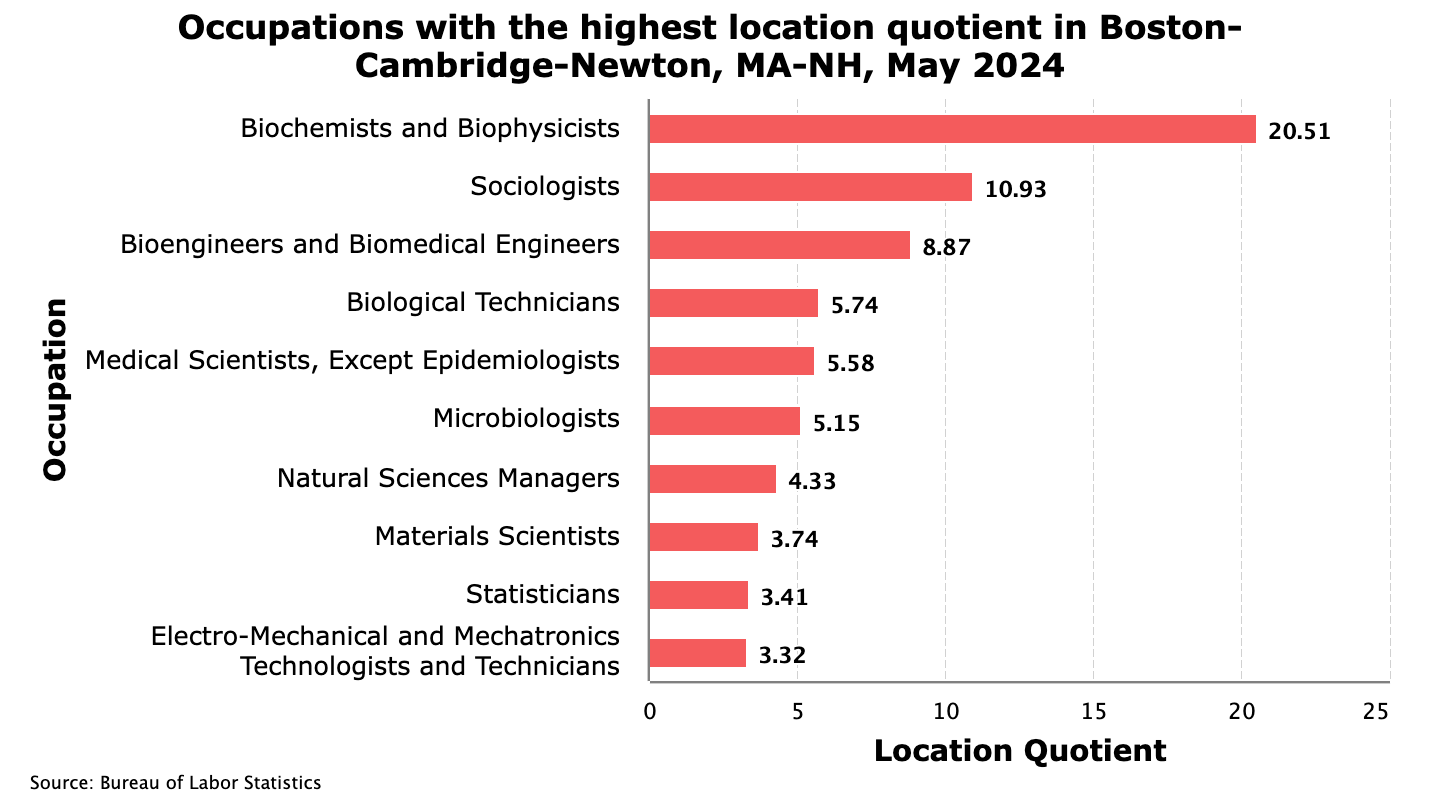
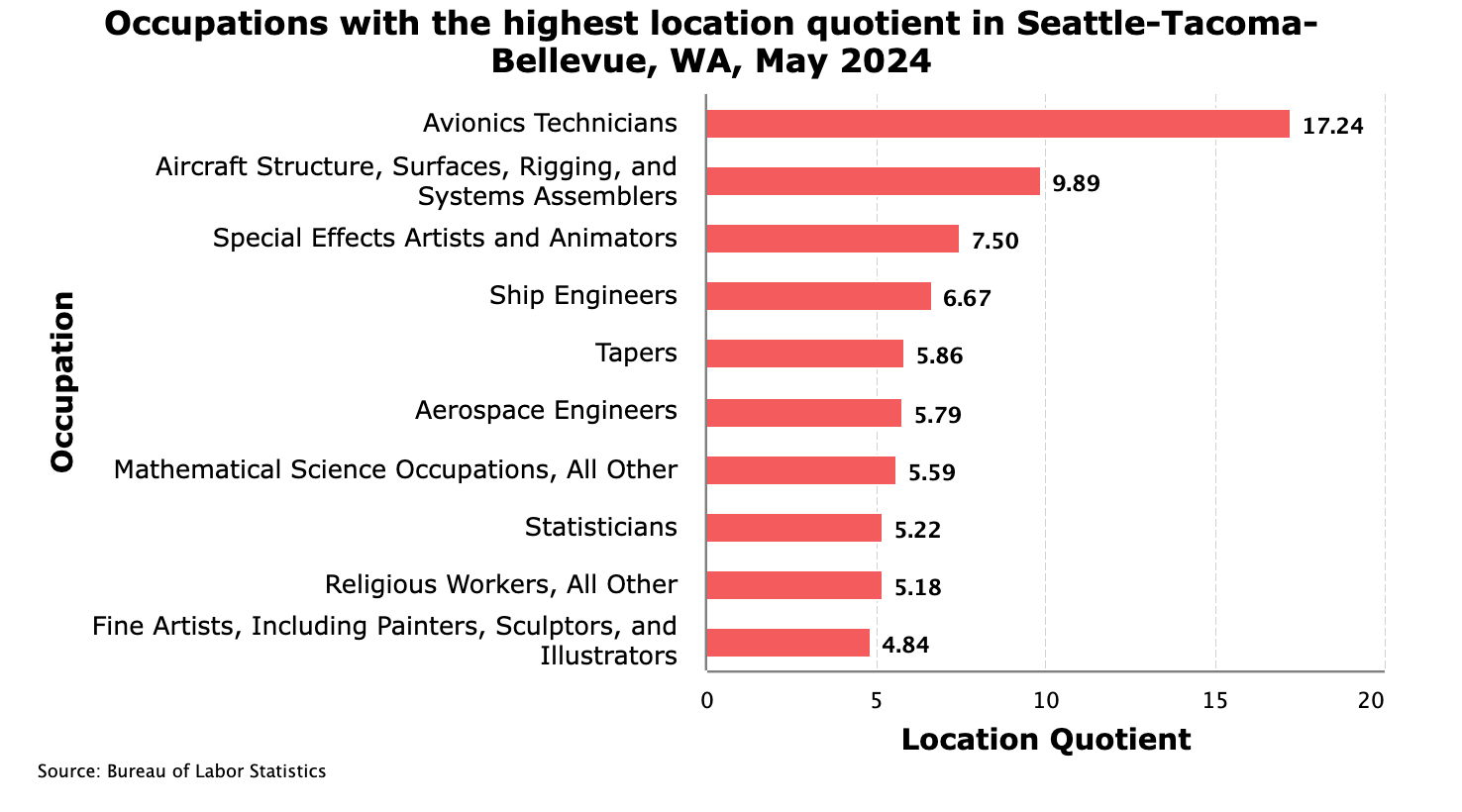
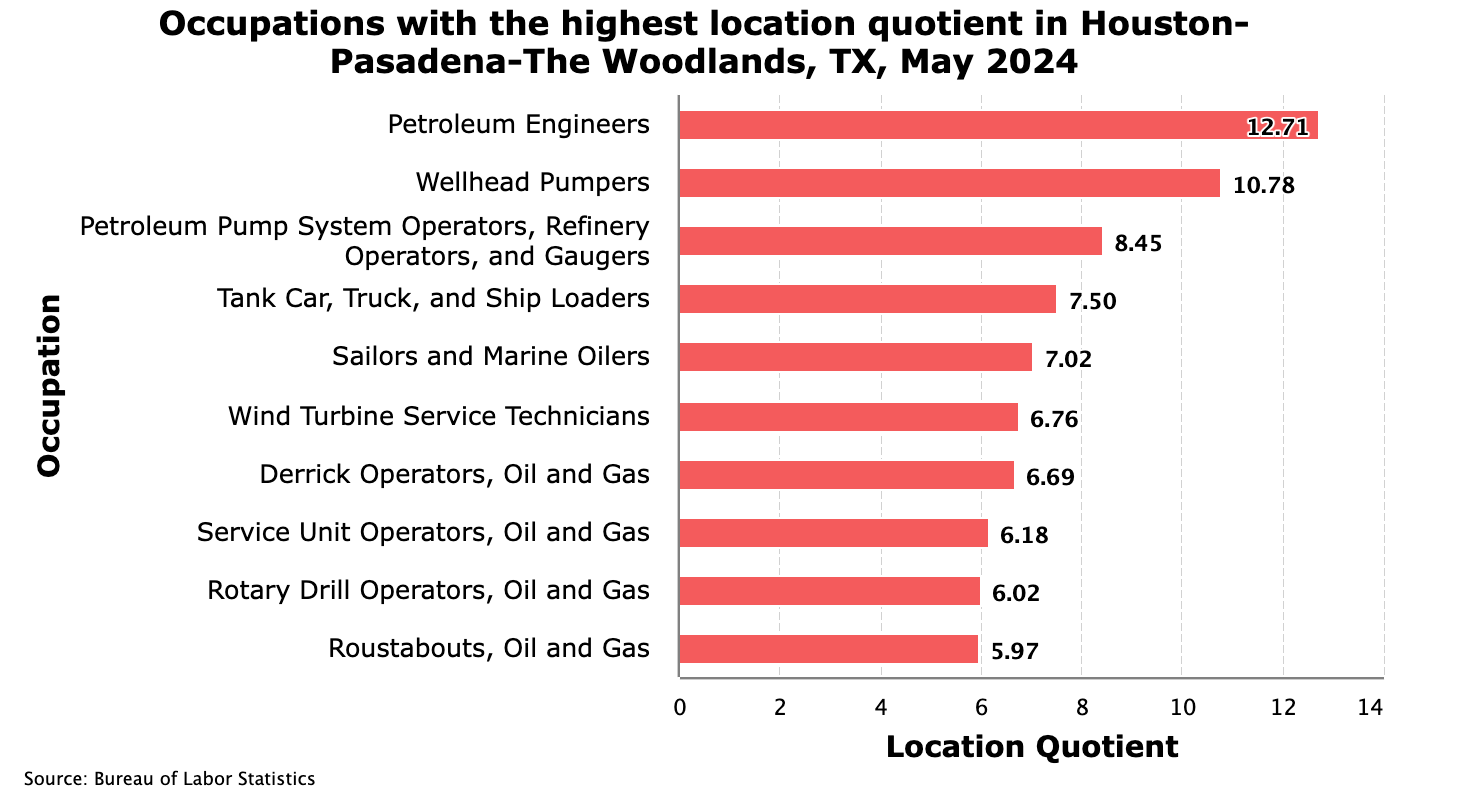
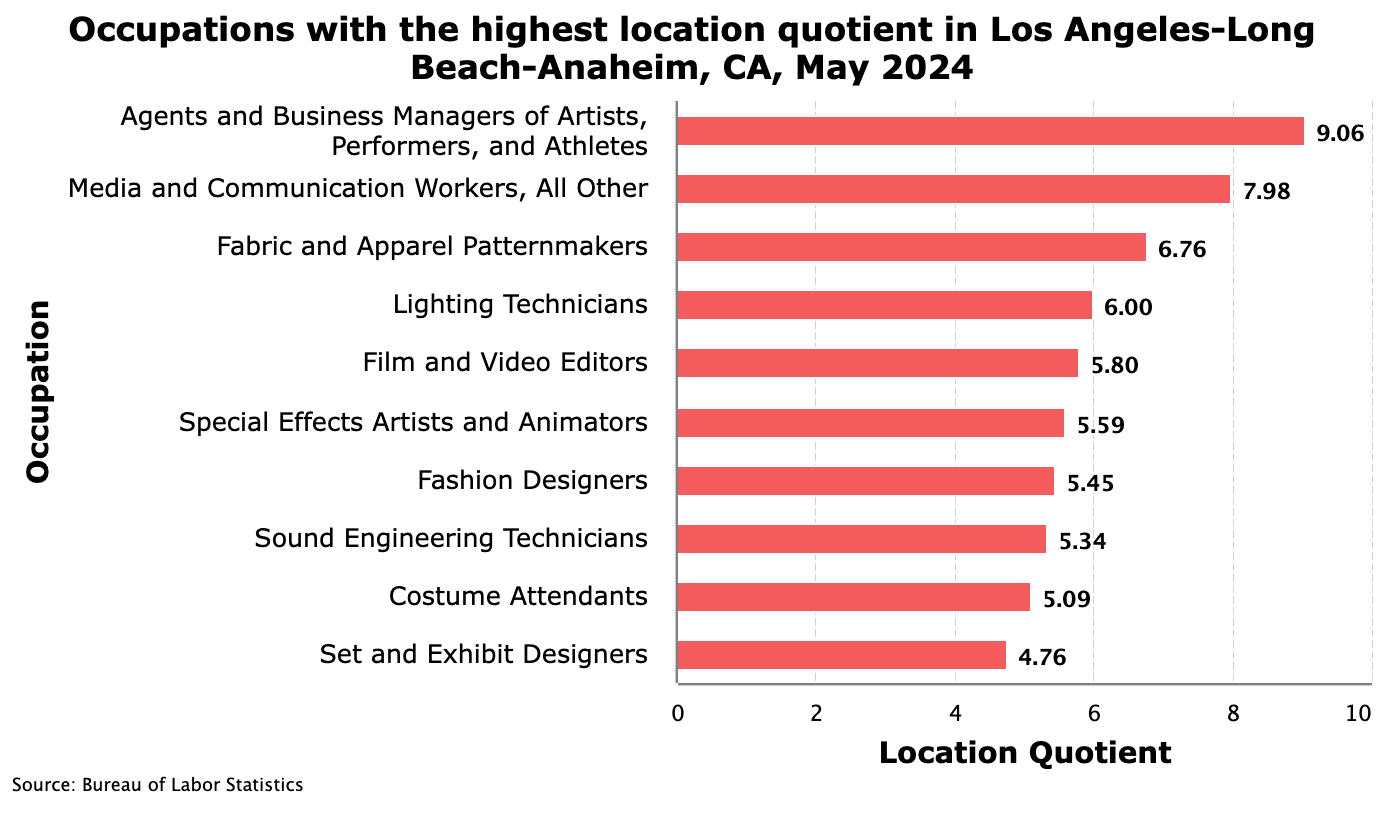
Having visited each of these cities in the past three months, I’ve seen the specialisation on the ground, beyond just these statistics. In Boston, patients for medical trials are recruited through advertisements on the Red Line passing through Kendall Square. Miles of oil processing plants are visible heading into Houston via its Ship Channel. Seattle has large airfields visible when heading into the airport, and two separate museums of flight.
These anecdotes are real-life proof of the ways through which ideas disperse more effectively when cities specialise. And they are a magnet to those with the skills that would be best utilised in the areas demanding their expertise the most highly.
Of course, specialisation is not the only route to urban productivity growth. Jane Jacobs argued that diversity, not concentration, was the real engine of growth. These so-called “Jacobian externalities” suggest that cities benefit when different industries co-locate and cross-pollinate. Silicon Valley may be known for tech, but its strength has long rested on the interplay of hardware, software, venture capital, and even countercultural influences. New York’s vibrancy comes not just from Wall Street but from the proximity of media, fashion, law, and advertising.
The challenge for unspecialised cities, however, is that Jacobian diversity works best when industries are deep enough to interact meaningfully, with genuine rather than superficial innovations being shared. To the extent that these do occur, it’s often the case that deep findings are shared across industries, rather than shallow insights.
Making a similar assessment of Australia’s largest cities would be hard. Perhaps the only distinction that could be made is that Melbourne is the home of AFL, and Sydney the home of rugby league (although even then, Brisbane’s Lang Park would put that claim on ice).
Take, for example, financial services: Australia’s largest banks are split across Sydney (CBA and Westpac) and Melbourne (ANZ and NAB), with Suncorp Bank and Bendigo & Adelaide Bank spread across smaller parts of the country. Coles and Woolworths split themselves between Melbourne and Sydney respectively. Even Qantas splits the operations of its two brands across Melbourne (Jetstar) and Sydney (Qantas), with Virgin based in Brisbane.
In writing this piece, I found that Australia’s location quotient data is scarce. That fact itself makes me doubt whether the few Australian urban economists who exist think seriously about specialization in the Australian cities.
After calculating it using 2021 Census data, I was not surprised by what I found: the three largest Australian cities are, by and large, unspecialised. To the extent they have specialities, these are in low employment jobs that are niche. And, with the exception of Sydney, there are few of these specialties that the average Australian would have any inclination as to why they specialise in these roles (You can play around with this data in a tool I quickly spun-up, if you want to explore more).
Sydney’s greatest specialisation is in Central Banking (something which is, perhaps, unavoidable given our choice to have a single headquarters for our central bank). And when looking at its list of specialties, it appears to only have a slight specialisation in media and finance. The size of its location quotient in each of these roles are well below equivalently sized US cities.
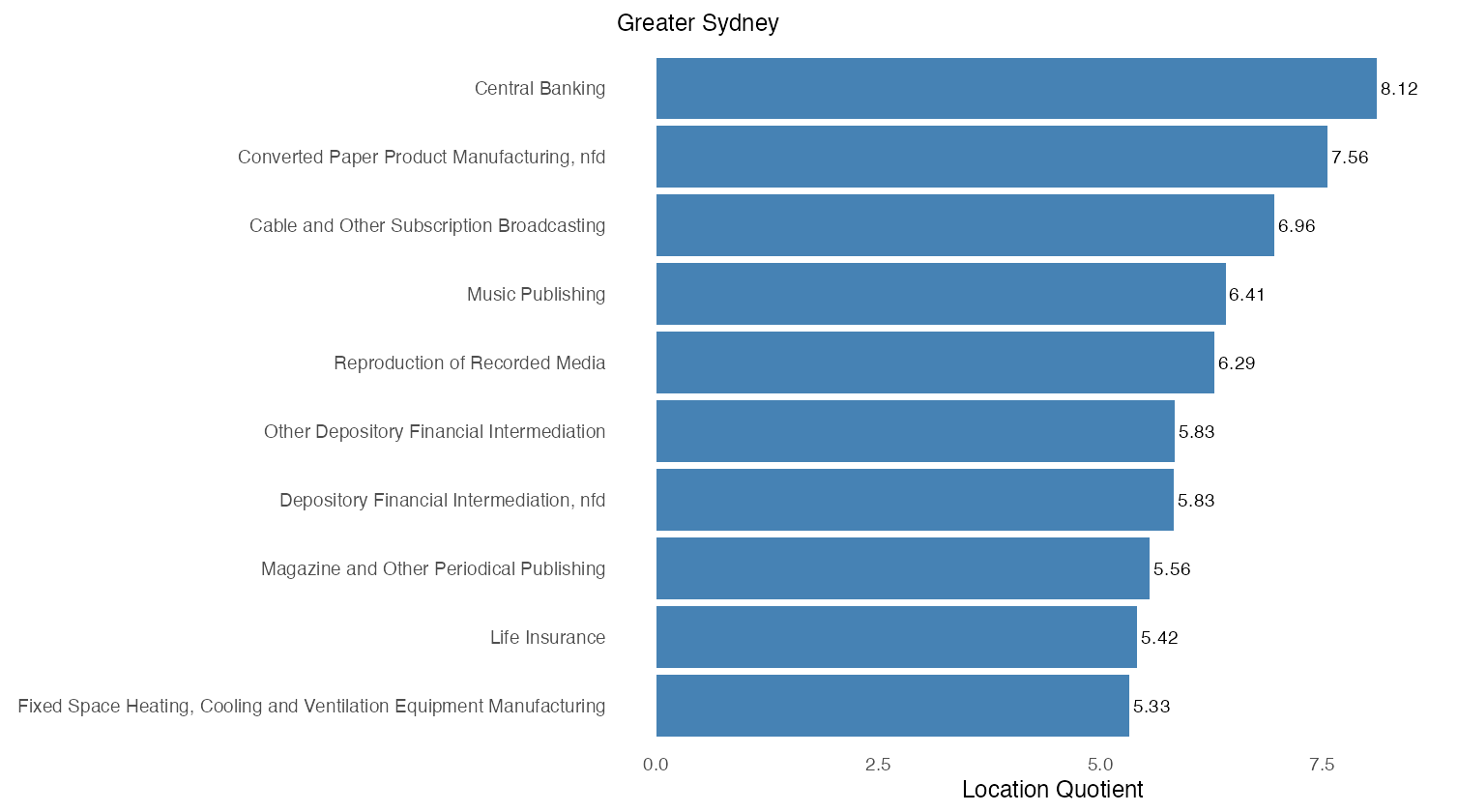
It’s a similar story for Melbourne, whose top location quotient top job is “non-ferrous metal casting” (a job which employs a mere 117 people), then "prefabricated wooden building manufacturing” ( a role which employs only 44 people). Even with such niche roles, the level of specialisation is well below that which you see in large American cities.
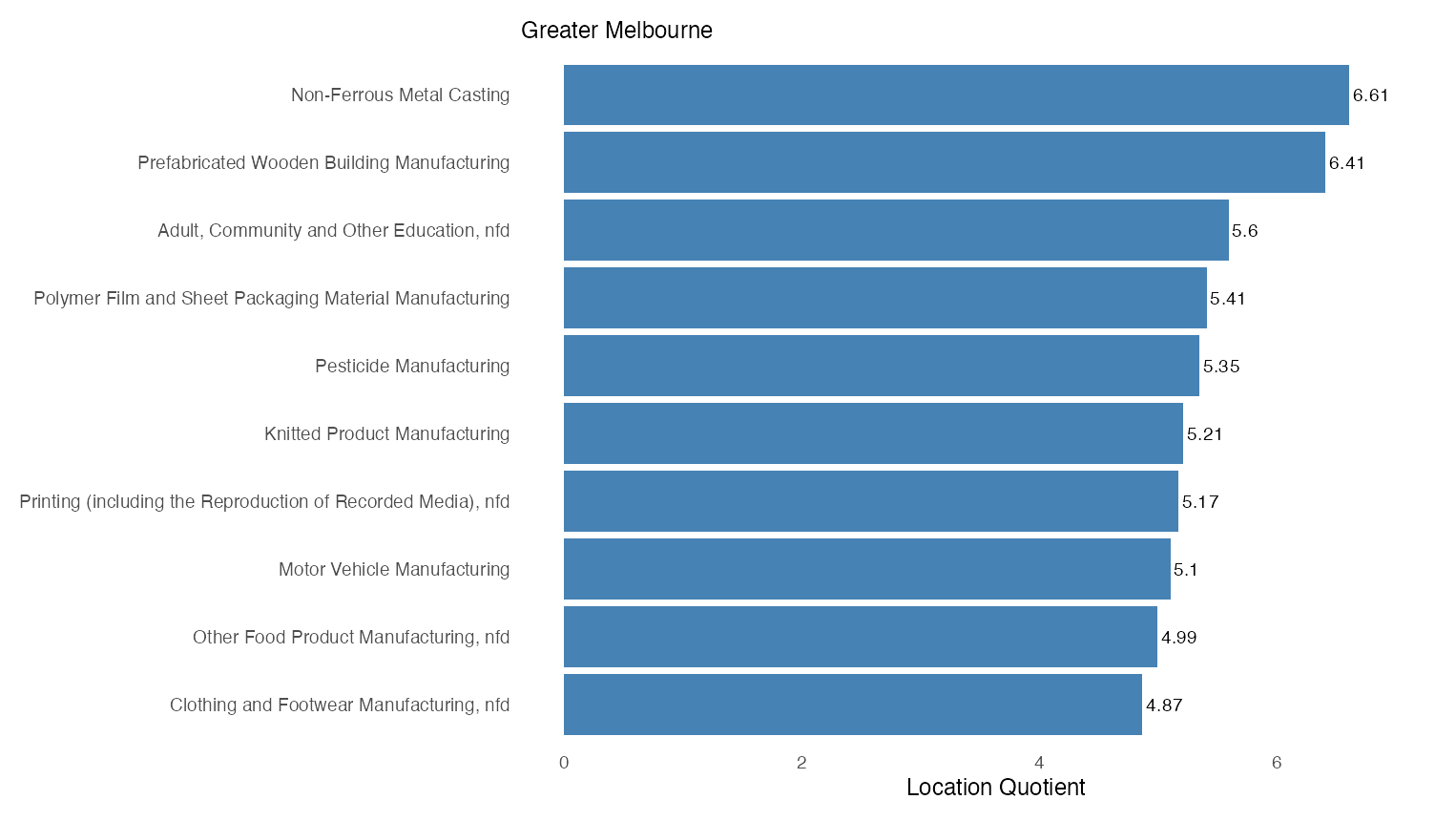
That brings me to the key insight of this post: Sydney and Melbourne aren’t bizarre because they’re the same size; they’re bizarre because they have a no real distinct composition and specialisations.
This isn’t necessarily new. Consider this reflection in a 2015 piece on Australia’s industrial development (one of very few papers that reflect on Australian specialisation). It notes:
…much US, UK and European economic development was spread across many towns and cities, with many trying to capitalise on specific resources or developing skills around a particular industry of advantage, such as Bradford,Leicester and Manchester around textiles, Hamburg and Liverpool around shipping, Coventry and Detroit around motor vehicles… Australian metropolitan cities never developed industrial specialisation to the same degree.
Perth is the clear exception to this rule. Its economy is clearly mining focussed; as such, it’s driven some of the productivity gains that have made Australia the home of some of the most productive mining companies in the world. But even then, it’s not clear to me why both Rio Tinto and BHP have their global head offices in Melbourne?
While there’s more analysis to be done to understand whether Australian cities are optimally specialised, I think it’s worth further discussion and deep reflection among policy makers about:
Whether Australian cities should be more specialised
What has driven this degree of (or lack thereof) specialisation
What we should do about it
Off the top of my head, I think the issue comes down to four possible drivers.
First, I think that buzz-word driven industrial policy by state governments has contributed to this problem. In writing industry strategies, Australian cities have picked chasing new trends over bedding down their technical and comparative advantages. Consider three examples:
Sydney, Melbourne and Brisbane are all, at the same time, channeling funding into building their own biomedical research precincts. This will pull away researchers from the clusters that we know are critical for spurring medical discoveries and commercialising them.
The NSW, QLD and Victorian state governments all have generous grant programs to encourage film and television to be produced in their states. This makes governments beholden to rent seeking production companies, and prevents states from developing the globally competitive industry which is required to eliminate such transfers.
Every state is pouring grants into near-identical hydrogen hubs (Gladstone, Kwinana, Port Bonython, Bell Bay) splitting scarce capex and offtake across too many sites. That fragmentation dilutes cluster effects (no single deep pool of suppliers or skills in a given area), duplicates enabling infrastructure (ports, pipelines, water and power upgrades) and pushes firms to chase subsidies rather than building out a cost-competitive product.
I doubt this is a deliberate choice, but rather suspect that it is a natural consequence of state governments developing policies with exciting announcables rather than genuine substance.
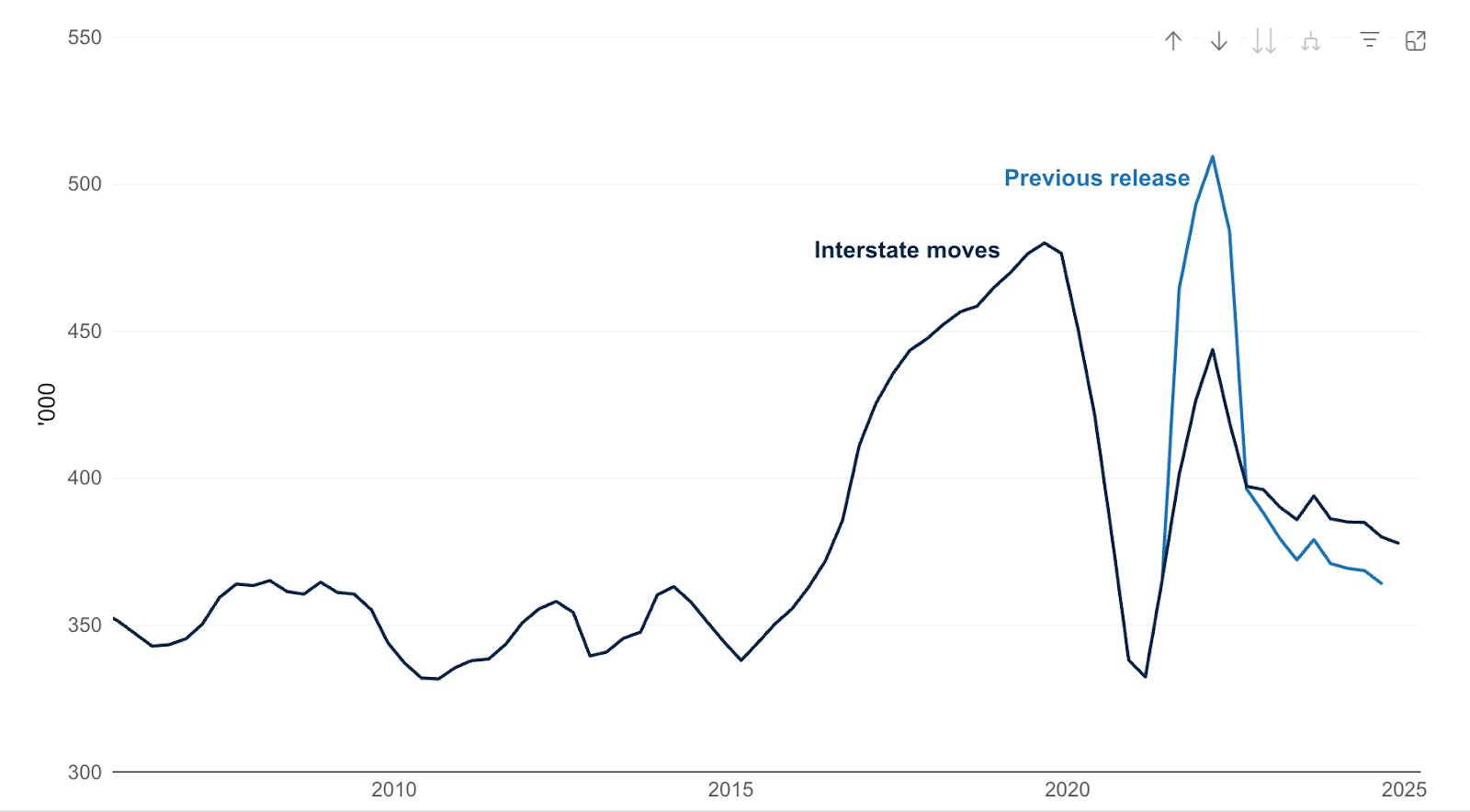
Second, limited labour market mobility may also play a role. Specialisation depends on people moving where their skills are most valuable. Australia and the US have very different rates of interstate mobility: in the US, nearly 2.5% of the population (around 8.2 million people) move to a different state each year; in Australia, the number is nearly half that, at just under 1.4%. In the US, high rates of interstate migration have historically fuelled city clusters. I suspect that the high rates of mobility of college age students has enabled this in America, which is prevented by Australia’s commuter university model. In Australia, there was a steady increase post 2015, but this has since declined post COVID (see graph below). I want to understand more about what has driven this (and what it means for our productivity); I suspect it is much more than just stamp duty.
Third, Australia has been deeply wary of the risks of being too specialised. When the wool boom of the early twentieth century collapsed, it triggered job losses that made “riding on the sheep’s back” less a proud boast than a cautionary tale. When manufacturing declined through the 1970s and 1980s, the loss of protectionist walls left thousands of workers stranded, their skills mismatched to a new services-driven economy. The Productivity Commission, Treasury, and state departments often speak of “resilience” as a guiding principle: don’t let any one industry dominate; spread the risks broadly. That pulls us away from specialisation.
Finally, Australia may simply be too small, at least relative to the U.S. and Europe. With only four and a half major cities, the natural pressure has been to ensure that each offers a “complete package” for residents, rather than allowing one city to lean into specialisation. In larger markets, excess scale creates room for sharper differentiation; in Australia, governments and firms alike hedge against the risk of putting too many eggs in one basket.
What would it take to drive this outcome? I think several concrete steps could be made to help develop more specialised Australian cities.
Use federal government competition payments to adjudicate state industry development plans, and prevent them from being duplicative.
Remove barriers to interstate migration (e.g., removing stamp duty; investing in additional portability of occupational licensing) and actively encourage it among our youth, especially through the university system (e.g., by forgiving HECS for students who move to regions related to their specialisation).
Reform GST payments to provide states some insurance against economic cycles, so they can specialise in more cyclical industries without fear of lost revenue.
Reform the regional migration program so that provisional regional visas only available for migrants with existing skills or capabilities in regions areas of specialisation.
In the spirit of provocation, let me pose a grand vision of what could be the case.
What if Sydney became our New York: a hub for South East Asian and Pacific financing, with a professional services sector that supported both our country and its broader region. Sydney already has many of the foundations in the ASX, two of the big four banks, and a large professional services sector clustered around Martin Place and Barangaroo. But its role today is mostly domestic; it only has a thin pipeline of activity that ties Sydney into the financial centres of Hong Kong, Singapore, and Tokyo. With deeper integration into regional markets (especially given the decline of Hong Kong’s financial sector), I think a big push could turn Sydney into the go-to location for Asia–Pacific financing. And, with some leading VC funds located there, Surry Hills could also be the home of early stage financing too (sorry Cremorne!).
How about if Melbourne became our Boston: the center of biomedical innovation and educational excellence? The bones are already there: Parkville’s biomedical precinct is one of the largest in the southern hemisphere, with the University of Melbourne, the Walter and Eliza Hall Institute, the Peter MacCallum Cancer Centre and CSL all within walking distance of each other. It’s home to Australia’s most prestigious universities and a deep cultural emphasis on learning and research. But Melbourne has never fully converted this intellectual heft into a globally dominant cluster. But it can and should. For example, it should make itself home to Contract Research Organisations, like George Clinical and Novotech (which are both currently based in Sydney). And it should poach talent from USyd to UniMelb.
Adelaide could be a clean energy powerhouse; a green version of Houston (with good wine rather than great Southern BBQ). South Australia already leads the world in renewable energy penetration, with over 70% of its electricity sourced from wind and solar. The state has pioneered grid-scale batteries and has a first-mover advantage in green hydrogen. This would mean anchoring the supply chains in Adelaide by training workers, building engineering consultancies, and clustering firms that export clean energy expertise to the world. In the same way that Houston has become shorthand for oil, Adelaide could become shorthand for renewables.
And Brisbane could transform into our LA: home to tourism and film/TV entertainment. The city already has a natural climate advantage, attracting both international visitors and large-scale events. With the 2032 Olympics on the horizon, Brisbane has a once-in-a-century chance to reimagine its identity. It already plays host to major film productions at Village Roadshow Studios on the Gold Coast, and its weather gives it the same advantage Hollywood had a century ago. Coupled with tourism and lifestyle industries, this could create a globally exportable identity, rather than just being “Sydney’s sunny cousin.”
Time will inevitably prove these visions of mine wrong. But I hope that by the time the world’s eyes are on my home town of Brisbane come 2034, we have a more compelling story to tell about our town’s social and economic future than “just a smaller version of Sydney or Melbourne”. I suspect people across the country might feel the same about their own home towns too.
No posts
Comments
Nothing yet. Say the first thing.
Sign in to join the conversation.