
The recent debacles of First Guardian Master Fund and La Trobe Financial have highlighted the potential mess which occurs when parts of our financial sector grow too quickly with little oversight. In the case of First Guardian Master Fund, more than 12k Australians lost a collective $1.2b to the collapsed fund, much of it from their retirement savings. And in the case of La Trobe, ASIC’s stop order on its private credit product led to their platform being taken down, preventing members from accessing their funds for several days.
These events (and the feeling of unease it generates) prompted a broader question: where could the next financial mess emerge in Australia? The obvious answer, I think, is our superannuation funds and their liquidity management. Specifically, I worry about the risks of super funds facing a liquidity crisis, triggered by a run-like event. With this in mind, I ask: what could we do today to avoid tomorrow’s crisis?
By 2035, Australia’s super funds will have over $8t under management (or 180% of Australian GDP), up from about $3.9t today (or just over 150% of GDP, and over 2x what it was estimated to be in inception) and only $0.6t in 2004. By then, it’s expected to become the second largest pension system in the world (behind only the USA). Indeed, this defined employer contributions system is globally uncommon. Most major countries either have an optional employer contribution scheme (like the US’s 401k program) or, more commonly, a defined benefits scheme (like the UK’s infamously triple locked state pension). That means that it’s hard to look to global benchmarks with how to regulate them and manage their growth.
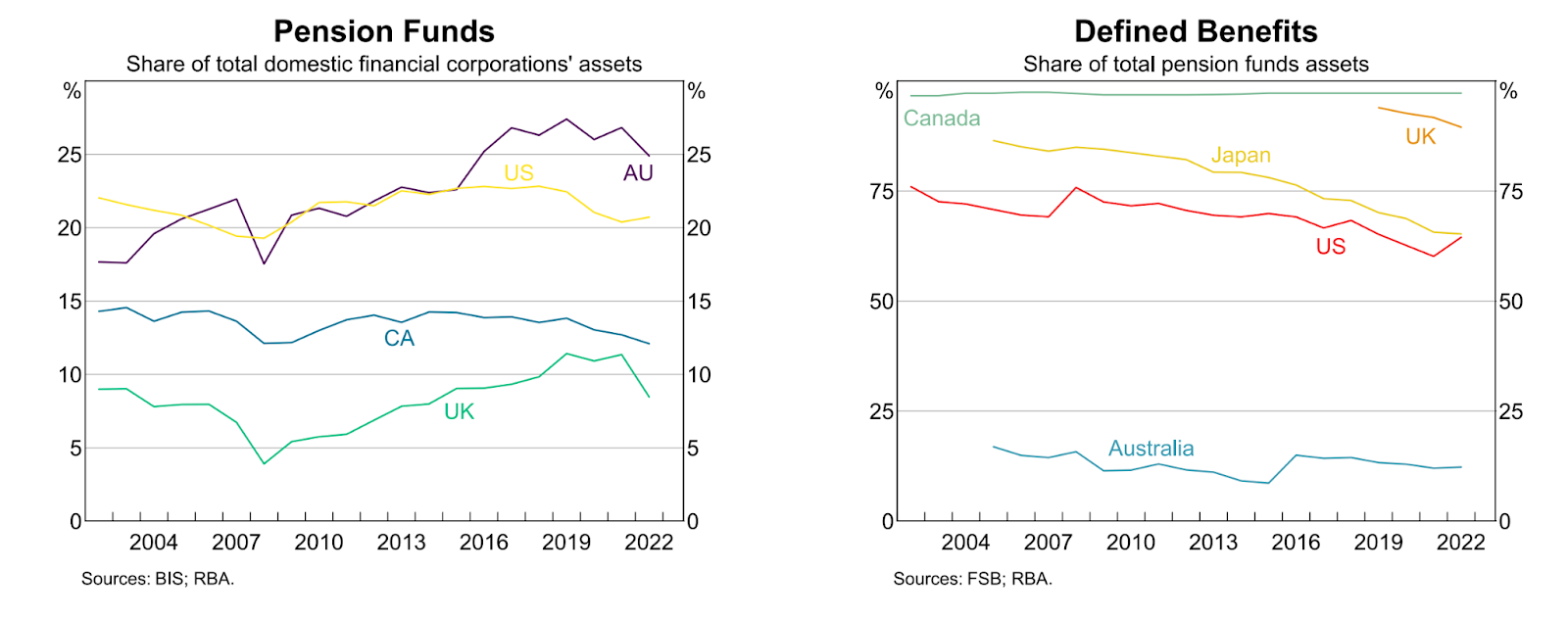
As these factors play out, new questions have inevitably been raised: Should they play more of a role in ‘nation building’ projects? How do we ensure that members get access to high returns across their lifetimes? What can get retirees to manage decumulation as effectively as they can? What’s the right level of mandatory employer contributions to guarantee a stable and safe retirement? What implications does this have for our tax and transfer system, which provides generous concessions for super?
These are all important questions, and much attention has been given to them. But one underappreciated question, I think, is the financial stability risks super funds face. I worry that liquidity risks may be posed by a combination of:
Super funds having more accounts ‘at call’ as their members reach retirement age
A large/growing share of funds being invested in unlisted assets ( away from cash)
Limited oversight of their valuation of unlisted assets
Insufficient ‘bank-like’ capabilities to manage customer withdrawals and liquidity
This could, if not managed well, prompt what would resemble a ‘run’ on super funds.1 In this piece, I highlight how a ‘run’ on super funds could play out, what makes the system increasingly vulnerable to this behaviour and what we might do to stop it from happening. Please review this disclaimer before you read on.
A run on a super fund would be materially different from a run on a bank, despite sharing some similarities. Bank runs are prompted by panic from consumers, who fear their money is at risk (even if, at the time the run starts, it is not). The speed of these crises has been accelerated by social media, which came to bear during the SVC collapse.
When a bank is run, it often becomes insolvent as its short-term liabilities (i.e., at-call deposits, which are fixed) are unable to be met. Without access to emergency liquidity, banks must sell their assets (which have often already declined in value). Because they are leveraged, they can become insolvent by only a partial drop in the value of their assets. And because of the pressures of meeting their deposit liabilities, they often must fire sell their assets (which leads to price drops themselves in illiquid markets).
Super funds, however, do not face the risk of insolvency; that’s because as their asset side fluctuates, so too does the value of the member’s accounts. And today, while all members are able to transfer it to another fund, if there was a mass rush to transfer funds from members who are not in the decumulation phase, I argue that this wouldn’t be that big of an issue. That’s because the funds that received inbound transfers would be in a great space to buy stakes in the underlying assets that the transferee fund is offloading. And many of the unlisted assets of fund positions are already held by other superannuation funds.
What then, would a run on a super fund look like? I see it as a play in five acts. And I’ll describe it in colourful language (because I know how boring financial regulation can be, and this is the only way to get attention to financial risks!).
Act I: Something dodgy happens at a super fund
Consider these situations (which have all already happened) that could prompt concern among members about the reliability and trustworthiness of their super fund:
A major unlisted asset receives a substantial haircut on its valuation
It’s discovered that members have been being overcharged in fees
A governance issue is revealed in the trade-union aligned board of an industry fund
A super fund is named and shamed for their underperformance
Act II: Viral panic
Then, I could imagine an insane conspiracy style video spreading through the bowels of Tik Tok. I imagine this would happen among the SovCit world, but slowly creeps into the MMT freaks and then the Alan-Kohler-obsessed types. The nuanced differences between a bank run and a super run are almost certain to not be appreciated.
Act III: Rapid withdrawal and transfers
Then, people could try to withdraw their super en-masse, with their conviction in their super fund’s incompetence reinforced by how manual the process of withdrawing their money is. This could be complicated by a large wave of non-retirement age consumers also trying to move their super into another fund (which would add even more to the to-do list of the trading desks of the big funds, even if they have a set of buyers for their assets in recipient funds).
Act IV: Fire sale of illiquid assets
Finally, super funds would then have to sell-down their positions in major assets, some of which are unlisted or in relatively illiquid markets. Because of the time pressure to convert these assets to cash, super funds could be forced to sell them at fire sale prices. If this occurred alongside a genuinely downward valuation of an unlisted asset, creditors may be unwilling to extend bridge financing for a super fund due to genuine concern about their portfolio.
Act V: The aftermath
The consequences would, I think, be pretty bad. Large Australian listed companies might face significant swings in value driven by a run-induced liquidation. Super funds are among the largest shareholders in the ASX 200; in many cases, they own double-digit stakes of the country’s flagship firms. If forced to offload these positions quickly the volumes would dwarf what the market typically digests in a single day. Prices would slide, not necessarily because the companies themselves had lost value, but because supply of shares would overwhelm demand. As the IMF put it:
liquidity stress [in superannuation funds] could spill over to financial markets, especially those markets in which pension funds and insurers have a large footprint, such as government bonds, equities, and corporate bonds.
There are four stylised facts that are important when considering the financial risks posed by a super fund. While some more serious thinkers than myself have identified a liquidity crisis as relatively unlikely, I think it’s worth considering these drivers seriously. That’s because financial regulation should be designed to prevent ‘unlikely events’.
a. Super funds will have more funds ‘at call’ as many of their members retire
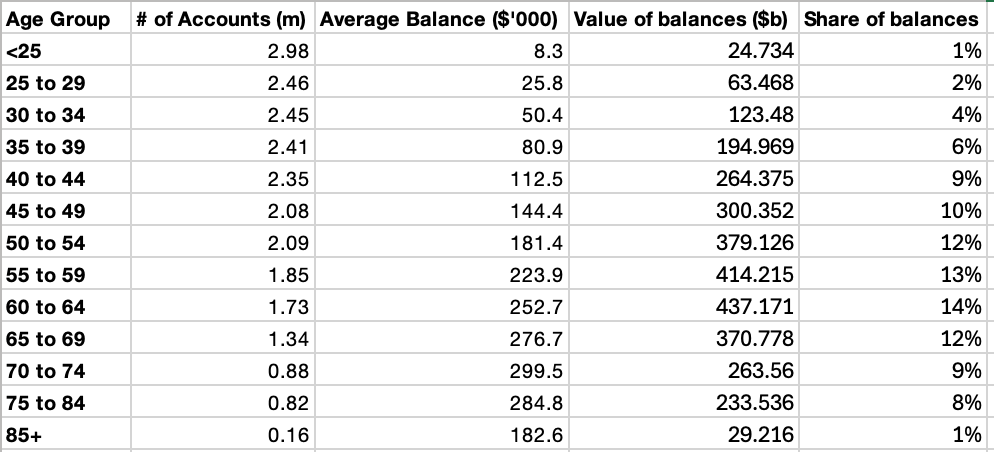
Before members reach defined thresholds (either retired and over 60, or over 65), they are unable to withdraw their super. Because of the aging of our population, growing generational differences in wealth and the age of the system, more consumers will reach this threshold. From 2015 to 2024, the proportion of super funds in ‘pension phase’ increased from 4% to 6%. This means that currently, around 20% of AUM are in the ‘pension phase’. For some retail funds, like Colonial First State and Macquarie, the share of funds in the ‘pension phase’ (or those which are callable) is over 40% of their AUM.
It’s hard to estimate exactly how much of the funds will move to being ‘callable’ in the future (because it requires some involved assumptions about drawdowns and contribution rates) .One can get a solid idea by looking at the distribution of the age of accounts below, with about 30% of balances in the range of 65+.
b. Super funds assets are moving toward unlisted assets (with limited cash holdings)
Super funds have moved into unlisted assets at a rapid pace. Currently, super funds own about $400b worth of unlisted assets, up from less than $200b in 2015. It has such a substantial allocation towards these that the IMF has said of Australian superannuation that our:
…funds hold, on average, illiquid exposures exceeding 20 percent of their total assets. This liquidity mismatch could affect members’ outcomes in a liquidity stress event.
Some of these assets are pretty cool, but underscore the depth of exposure that super funds have to private markets. Take, for example, these investments:
Australian Super owns a 50% stake in Canada Water Estate, a “new, sustainable district in London, blending modern workspaces, retail, and green public spaces”
UniSuper owns a 50% stake in Burra Park, touted to be “the best industrial development site in Australia”, near the Western Sydney Airport.
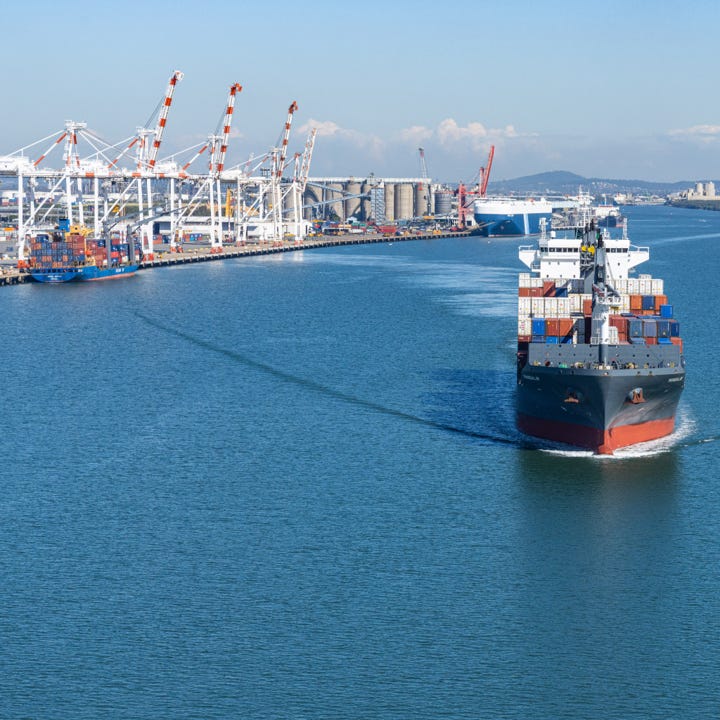
IFM Investors owns (on behalf of its super fund members) the Port of Brisbane, which even includes an international cruise ship terminal!
Australian Super has a 40%, or $774m, stake in the Moorebank Logistics Park, which “will be the largest open access intermodal logistics precinct in Australia”
These types of investments are likely to only grow as private credit expands in Australia, and super funds are encouraged to invest in ‘nation building’ projects. Most of the projects that are touted for them to invest in – like social housing – are in deeply illiquid asset classes, where bespoke financial structures would be required to get their returns over their ‘hurdle’
These assets are hard to navigate at the best of times, let alone when facing liquidity pressures! Take the word of one retail super fund executive, who said:
We are operating in a different environment and therefore investment portfolios need to be different. If you’ve got a third of your assets frozen in unlisted, illiquid things, that’s a very difficult adjustment to make
What this means is that it takes a long time to offload these assets, partly because their business model and underlying cash-flows are complex and partly because there is no available clearinghouse for potential fractional buyers.
At the same time, super funds have limited cash holdings, with about 8% of their assets in cash. This compares to around 20% For some large funds, this is even smaller: only 4% of AustralianSuper’s assets are cash, as they have been driven to by performance standards.
c. There’s insufficient oversight and regulation of their valuation of unlisted assets
As has been well reported, super funds themselves are put in charge of valuing their unlisted assets. A recent APRA review found that serious issues in the governance of unlisted assets:
In relation to unlisted asset valuation governance, the thematic review highlighted particular weaknesses in the areas of board oversight and conflicts of interest management; revaluation frequency; revaluation triggers; valuation control; and fair value reporting.
Based on this read, it’s not clear to me what is functioning well at all among unlisted assets. For a sector which is obsessively tracked for performance, it is almost certainly too much temptation to avoid putting the finger on the scale of an unlisted asset to ensure it meets its benchmark returns. That is: there’s an incentive for super funds to overstate the value of their unlisted assets, so that they don’t get ‘named and shamed’ for underperformance.
What’s particularly challenging about the valuation of unlisted assets is that super funds are invested in similar unlisted assets, due to the herding incentives of the current performance regime. That concentration and correlation means that an unforeseen external shock to these assets could have an impact on many funds at once, creating possible systemic issues.
d. Insufficient investment is being made in the skills needed for the decumulation phase
Most super funds were not designed for the scale and complexity they now carry. They began life as relatively small pension pools, often tied to unions or particular industries, with outsourced call centres handling member queries. Their approach was mainly focused on growing inflows through default options and spending on marketing (including through charming advertisements to the tune of Ben Lee songs). That model is creaking under the rapid growth super funds have experienced.

As more members shift into the decumulation phase, their expectations change. Retirees will want to access their money with the same ease as transferring cash from one bank account to another. Boomers, who have lived through the rise of internet banking, will not tolerate clunky portals or multi-week delays in processing withdrawals.
On the investment side, funds will also need to build even more sophisticated trading floors and liquidity management systems that banks take for granted. Handling large, sudden withdrawals in a portfolio stuffed with illiquid assets is difficult with clunky systems not used to dealing with large variations in outflows. A recent APRA review found that 5.4m Australians have super in funds whose liquidity management processes “require improvement” (albeit these are likely all small funds). To the extent large funds have sophisticated trading desks, they are hamstrung by the RBA’s liquidity tool eligibility rules that prevent them from using some assets to secure borrowing.
These capabilities cost a lot of money to build, and super funds (constrained by fee caps and a performance test that prioritises low costs), cannot generate the revenue to pay for them. Put bluntly: the very rules designed to protect members from high fees may be leaving them exposed to much bigger risks down the line.
We could do a few things to respond to this and prevent challenges. Extending liquidity instruments to super funds (solution number two) seems the most sensible to me, but changes should probably also be made to the performance test too.
First, we could provide some form of insurance for members against fluctuations that are caused by sell-downs. This could take the form of an explicit government guarantee, similar in spirit to the Financial Claims Scheme for bank deposits. The logic is straightforward: if members know they won’t lose money because of fire-sale dynamics, they are less likely to panic and withdraw in the first place. But the downsides are equally obvious. Guarantees have a habit of creating moral hazard, encouraging funds to stretch further into illiquid assets, knowing that the taxpayer is ultimately on the hook. For a system already under scrutiny for generous tax concessions, layering in an implicit government backstop would be politically fraught.
Second, we could extend eligibility for RBA liquidity instruments to super funds. This is, I think, the best solution to this problem. This would bring super funds closer to how banks are treated: with access to central bank liquidity in times of stress. Importantly, this doesn’t mean taxpayers wear the losses. It simply means funds could exchange their illiquid assets for temporary liquidity, much like a bank repo facility. This would likely require broadening the scope of eligible securities for the RBA’s domestic market operations.
Third, we could adjust elements of the performance regime to make super funds more capable of developing into sophisticated financial players. At present, the focus of APRA’s performance test creates an unhealthy incentive: funds are rewarded for beating short-term benchmarks, and punished for underperforming, regardless of whether those benchmarks are well-suited to their portfolios. This bias pushes funds to herd into illiquid assets with more discretion to value them in ways that help them ‘thread the needle’ of performance. A more sophisticated performance might use benchmarks across longer periods, better account for risk-weighted returns by using a Sharpe ratio, or embedding liquidity requirements directly into the test.
Fourth, we could (BASEL style) more closely regulate the asset side of super funds, to drive them to hold more cash and cash-equivalent assets. I think this is a dumb idea. It would reduce the returns that members get, and also not protect them from a run-like event actually occurring.
Finally, we could partially mitigate the risk by transitioning more ‘runnable’ funds to annuity products (which are, by definition, not runnable). This has broader benefits (as expertly suggested by Grattan). This would have interesting implications for both (a) who holds the funds under management and (b) what sorts of investments they make. If and when this proposal gets legs, there will be important questions to ask about the implications it has on financial stability (including how to guarantee the solvency of annuity providing institutions).
Not all of these responses are required right now, and I doubt they ever will all need to be used together. But, as a greater share of our capital is tied up in what were once small retirement programs, we should think about what new financial risks emerge.
Australia’s superannuation system has grown into one of the largest pools of capital in the world. With that scale comes new responsibilities: to members, to financial stability, and to the broader economy. The risks of liquidity shocks in an industry so heavily exposed to unlisted assets, and with such a growing proportion of funds at call, deserve more thought. That’s especially the case if, as their marketing materials assert, we’re all in these funds together (alongside the risks they bring) and our system is, as we proudly boast, globally unique.
My overview of how a ‘run’ on a super fund could turn out is a warning, not a prediction. And it does not mean we should abandon the features that have made the system strong. But it does mean we must recognise that super funds are becoming more like systemically important financial institutions, and should be equipped with tools to address their risks. Reforming the performance test and giving them easier access to emergency liquidity could help avert a future crisis, for comparatively little cost to government.
If managed well, superannuation can remain the envy of the world: delivering secure retirements while financing the next generation of national and global projects. If managed poorly, it risks becoming a point of fragility in our financial system. That risk should be taken seriously by policymakers, before it’s too late.
Nothing in this piece should be read as a suggestion that superannuation balances today are unsafe. Australia’s superannuation system remains one of the strongest retirement savings pools in the world. I do not encourage, and would actively discourage, anyone from withdrawing or moving their superannuation on the basis of these observations. This is not investment advice and should not be interpreted as such; instead, the purpose of this analysis is to highlight systemic issues and policy choices that could help avert these risks.
In addition to writing at Cliffhangar, I also am the editor-at-large of Inflection Points, which publishes more rigorous long-form writing from leading Australian policy thinkers. Visit Inflection Points and subscribe to get quality Australian policy writing direct to your inbox.
Note: I use the term ‘run’ here to provocatively bring the industry preferred term ‘liquidity crisis’ or ‘liquidity mismatch’ to terms that normal people understand. I appreciate (and discuss in a later section) how this liquidity crisis would be materially different from a run on a bank.
No posts
Comments
Nothing yet. Say the first thing.
Sign in to join the conversation.