
I started to suspect I was sick in middle school. I had so much joint pain. I have a lot of compassion for my 14 year old self writing this now. I have so many friends just starting to ache in their thirties, while in my teens I wondered if I was being over dramatic. My hips and shoulders would fall out of place often. I now know these were subluxations, or partial dislocations. My eating disorder set a lot of these symptoms on fire. I was a teenager, everything hurt and I was a fainting risk. This was obviously bad.
But I was a teenager! I think my youth got my symptoms dismissed, and my experience with healthcare was already laden with stress. We were chronically underinsured. Even if my symptoms were taken seriously, we didn’t have the resources to chase anything down. For years when it came to my health, I didn’t have a diagnosis, just several suspicions. I didn’t have treatment, just varying levels of pain.
The available cultural mirrors were less than stellar.
This suspicion of illness on my part took place in the early aughts. The movies I’m ready to talk about are from said time period, when it was notably grim to be queer and ill. It’s still not ideal here in 2025, but let’s move on.
In media, disability is something to overcome or succumb to. Personhood is in opposition to disability. There’s only room for one or the other. And this fundamentally sucks.
I fucking love Little Women. If I were talking to you in person, I would never say I love Little Women. The profanity is necessary. I fucking love Little Women.
(The book is over 150 years old but for the hell of it I’ll say there are spoilers ahead.)
I was three years old when Winona Ryder appeared as Jo March, but the movie’s staying power made the release date irrelevant. My VHS tape was worn to filth. My DVD copy would be equally exhausted.
My love for the movie fueled my love the book and in turn, my love for the author.
I cannot imagine loving Little Women, novel or film, and not relating with Jo. By the time I found the March family, I was already filled with political anger, I was already the eldest sibling. Add in the ways I was sure of my queerness and my desperation to be a writer? I was Jo. I felt it deeply. It doesn’t get more fun than relating to the main character, the hero of the story. And also.
I felt a pull towards Beth. This was less fun. I suspect it was also less universal.
It’s awful to be sick and not know why. I was physically uncomfortable for a decent amount of my adolescence. I wasn’t dying. I knew that. But where else was I going to see a chronically ill teenager?
I struggle to even write this comparison without apologizing for exaggerating my own experiences. I hate taking up space with my symptoms. I was not dying of scarlet fever! I know that! But I knew something was wrong. Beth knew something was wrong. Watching Beth, it seemed like the right way to be sick was to be quiet, noble and pitiful.
Ah, the nineties.
Travel forward to the naughty aughts and you’ll stumble into the release of A Walk To Remember in 2002. I was also obsessed with this movie. There was a five year window of my life where I had every single line memorized, down to the musical cues. (Yikes.)
This movie is a wealth of mess when it comes to the messages it’s sending about gender, health, and morality. The book it’s based on was written in memory of Sparks’ late sister, and I do not want to dismiss the reality of that personal loss. But also, what the fuck.
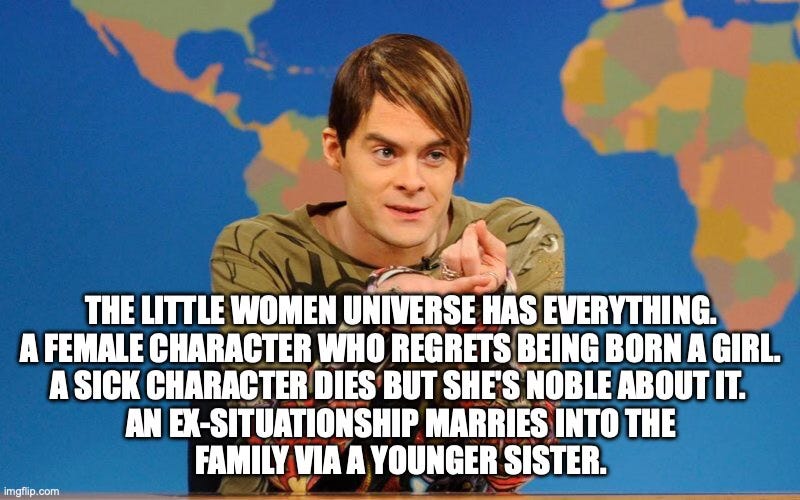
A Walk To Remember makes a ton of choices I’d never defend. But I’ll be honest, (please, forgive me, Louisa May Alcott), the sick character has quite a bit in common with Beth March. Both characters are fictionalized versions of real departed siblings. Both Beth March and Jamie Sullivan teach us that that the best way to be sick is to be immensely kind, selfless and dead. And in both stories, the dying is important. The story doesn’t hold if the sick person survives.
Beth March and Jamie Sullivan don’t fear death. Their deaths are not tragedies for them to succumb to, they’re lessons for the surviving characters. Their own deaths aren’t even about them.
Christianity is the other common factor of these two stories. It is a belief in God and Heaven that keeps the sick characters from mourning their own deaths. This unironically fueled my own desire to believe in a Christian god when I was younger, a way to make illness less terrifying. As a queer millennial it’ll surprise no one that I didn’t stay in the church. As such, I’d like for my illness and suffering to be about me, not a lesson for others that know me. Go figure.
When fiction is written by healthy people, the illness is always the enemy. I can’t pretend to love my symptoms or my illness, but I won’t get anywhere trying to defeat my own body. It’s the one I’ve got. I’m forced to coexist with my illness in a way healthy people never seem to grasp. And while I only talked about the cultural mirrors available during my adolescence, I suspect the options for 14 year olds today aren’t much better.
Speaking of chronic illness, I’m sick as hell right now!
I’ve had this topic queued up for months and entered a really bad lupus flare in early March. I haven’t been able to use my hands consistently, it’s made typing really painful and sometimes impossible. I don’t know how long it’ll take me to be able to type again reliably. I can’t make images the way I usually like to for newsletters either. My brain fog is rough. I’m a bit of a mess.
I’m antsy to write again but even editing this newsletter & adding this post script has worn me down badly. It is what it is. I’m intertwined with my disability!
I’ll be back as soon as I can.
Emrhys
Comments
Nothing yet. Say the first thing.
Sign in to join the conversation.