
This is my fifth reflection from Stanford Continuing Studies Tech 50Z, taught by Sha Sajadieh, who leads Stanford HAI’s AI Index. I am writing from my perspective as a tech executive, Stanford adjunct lecturer, and archery instructor, thinking out loud here on CLEAR to Lead rather than keeping my notes to myself. These reflections are meant to invite discourse, not to offer definitive answers. If this inspires your own reflections, please share them in the comments.
You run a mid-size country: it has decent universities, no chip fabs, and a modest budget. You can meaningfully invest in one layer of the AI stack. Which do you pick, and why? What’s your pitch to the treasury?
When you break down the assignment, there are two important contextual pieces that would change the decision of where to invest. The country we are running is “mid-size,” which is to say not large enough to have enough influence or the resources to invest in the most capital intensive layer, and not so small that we can’t meaningfully invest in and realize returns for that investment. In addition, we have the funds to not just invest but “meaningfully” invest. There is no question that we would still need the full stack, otherwise AI development and functionality would cease to exist, but we don’t have to put the proverbial all eggs into one basket. More important than figuring out which layer of the stack the country should invest in will be the holistic strategy in ensuring that the country continues to harness the powers of AI rather than being harnessed by AI. In reflecting on this assignment, I’ve also concluded that the layer of the AI stack that matters most, and will need the most meaningful investment, isn’t in the stack at all.
In Week 4 I used Liat Ben-Zur‘s six-layer framework to talk about who should own what. It’s worth pulling back out here, since this week’s question is really the investment version of the same map. If you want the fuller breakdown of what belongs in public hands versus private ones, that’s in Possession Is Power: Who Should Have It?
Energy, power, and cooling
Chips, memory, and networking
Compute capacity and AI cloud
Frontier models
Data, developer tools, and model operations
Apps, distribution, and devices
The energy, chip, and compute layers are the infrastructure layers, the ones that can deplete the national budget fastest and depreciate the moment they’re built. The frontier model layer is one most governments have no realistic path to leading because of incentive misalignment and insufficient technical skills. The data and model operations layer tends to be tightly regulated, and building it out well requires the same institutional capacity that governments lack. The applications layer is where countries may counter-intuitively have the most opportunity to solve the biggest societal problems. Having said this, I believe the actual difference maker, education and human capacity, sits outside this stack entirely. It’s the layer underneath all six.
Many companies are starting to realize that if they want to make money and retain control of how they use AI to build their own ecosystems and consumer apps, they need to control the full stack. Companies are motivated to monetize, and the surest way to do that is by controlling pricing and product at every layer they touch. Governments aren’t chasing the same incentive, and they move too slowly to make full ownership anything but a drag on innovation. Vertical integration is a business strategy. It was never meant to be a governing one. So where does this leave our mid-size country?
Given our profile of being a mid-sized country with decent universities, no chip fabs, and modest budget, most of the layers would be out of reach. A national data center would be a solid investment, but we’d still be reliant on imported chips, foreign supply chains, and hardware. A national foundation model is even riskier, since maintaining it and keeping it developed would need ever increasing capital. There’s also an incentive misalignment in those particular investments, since the government should be thinking about the longer term impact on society rather than short term gains.
Given the mandate of government to look after the welfare of its people, it would seem that the applications layer is where the country would be most invested and should invest its capital. We need AI-based applications to solve societal problems where there isn’t money to be made, challenges with our water supply, utilities, public health care systems, housing, and law enforcement. These gaps look like liabilities, but they’re actually opportunities. Private capital is often deployed to start-ups that promise faster and loftier pay offs while harder challenges that take more time to solve often require government intervention and initial grants to research and test potential solutions.
Mid-sized countries may be built on agriculture and need to invest in AI drought prediction and tools for small farmers. Or it could be a multilingual country building language technology for underserved immigrant populations. A country that need a trusted public health or education system may invest more in AI-based preventive care, teacher support, and personalized learning. It’s about finding the problems AI is uniquely positioned to solve, and investing in them first.
There’s a fallacy in thinking sovereignty means owning or government control over every layer of the stack. It doesn’t. Sovereignty means having the authority to choose among providers, the capacity to adapt what we bring in to what our people actually need, and the leverage to renegotiate when the terms of the relationship shift.
If we examine OpenAI for Countries, partner nations get access to frontier models and help standing up domestic compute, and some data and inference stays in country. The core models and the deepest layers of the stack are owned by another entity. And that’s fine, as long as we know what we’re actually negotiating for. As part of this Stargate Project, OpenAI would “raise and deploy a national start-up fund. With local as well as OpenAI capital, together we can seed healthy national AI ecosystems so the new infrastructure is creating new jobs, new companies, new revenue, and new communities for each country while also supporting existing public- and private-sector needs.” This goes well beyond investments in the AI stack itself.
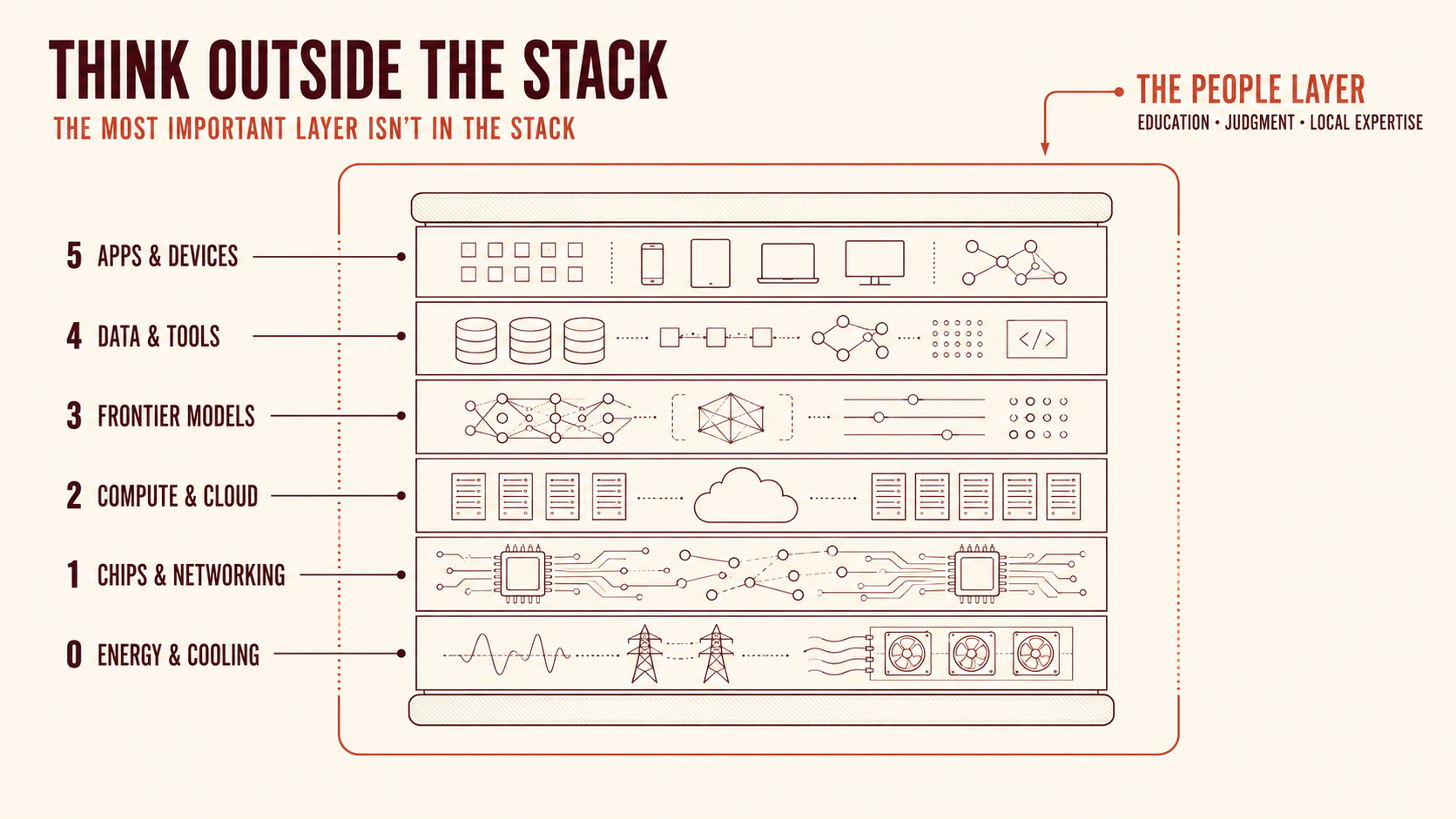
In many ways, the best bet for countries looking to invest in AI is not on the AI stack at all. Investing in its education system and developing skilled domain experts, educators, entrepreneurs, civil servants, procurement leaders, regulators, and community leaders would ensure that the people using AI continue to have the skills to optimize its use. Each citizen will need to decide where AI actually helps and where it doesn’t. I’d start AI literacy early, in K-12, and not just teach kids to use these tools but to question the answers, spot bias and manipulation, protect their privacy, and recognize the moments that still requires their own intuition. Mid-career workers need room to apply AI inside the work they already do. Public officials need the expertise to evaluate vendors, build in safeguards, and keep watching after the system goes live. This “people layer” sits outside the stack entirely, and it’s the one that may determine the future of the country.
For our mid-sized country, we cannot outspend richer countries in an infrastructure race. We can, however, outperform them in solving the problems that require our local knowledge. Well built applications create productivity, companies, public value, and expertise that spreads across the whole economy, not just the tech sector. None of that pays off without the people equipped to build and use it well.
I’d measure the return through:
Novel and accelerated solutions to our biggest societal challenges
Improved public services and higher workforce productivity
AI literacy rates increasing across K-12 and adult education programs
Number of public officials and civil servants trained to evaluate, procure, and oversee AI third party providers
Talent retention and growth of a domestically trained, AI-literate workforce rather than brain drain
I’d also request co-investment from industry and partnerships with universities and neighboring countries, so public money is able to establish a national fund to ensure access to AI capabilities for everyone.
In summary, my pitch to the treasury comes down to one principle:
Our edge was never going to come from building the most powerful AI in the world. It comes from the people equipped to apply it wisely to what matters most to our own citizens. Investment in education and human capacity is what makes any bet on the stack pay off at all. For a country with a modest budget, that investment, paired with a meaningful stake in the applications layer, offers the clearest path from technological dependence to national agency.
Which layer IN the stack would you want your country to invest in and where OUTSIDE the stack would you prioritize for investment?

No posts
Comments
Nothing yet. Say the first thing.
Sign in to join the conversation.