
“What is Your Love Song?”
Would you use AI or traditional search to find the answer?
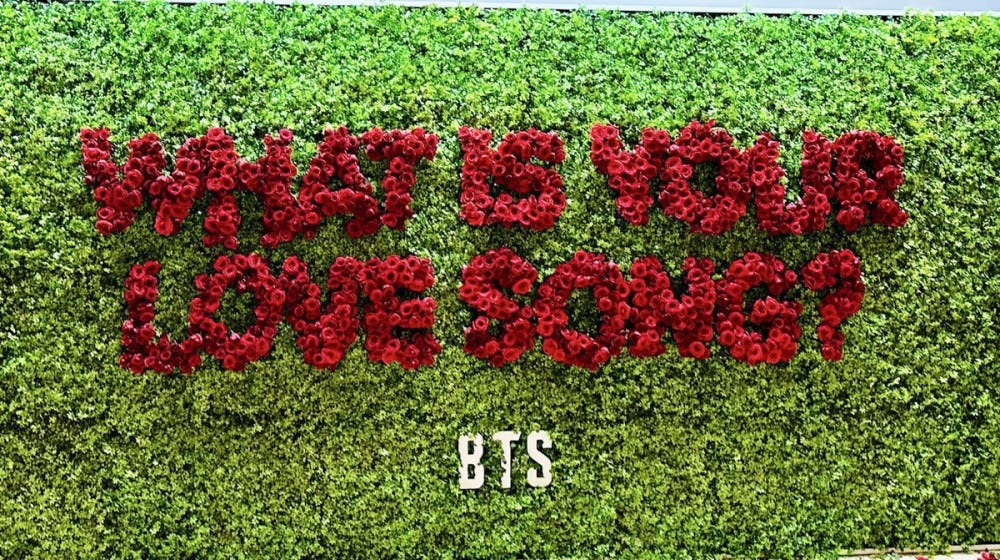
This question was emblazoned throughout the Stanford campus as I arrived this morning to teach my weekly ACCEL Leadership Program. Parking lots were taped off. I had to badge into the only remaining garage. Merchandise tents were already drawing lines at 8am for a BTS concert that wouldn’t start for nearly twelve hours. The phrase was part of the group’s global comeback campaign after two years of mandatory military service, tied to their new album ARIRANG. 150,000+ fans were expected across three sold-out nights at Stanford Stadium. As comebacks go, it was a big one.
But “What is Your Love Song?” is also a pretty good test case for this article. If you want to know what the phrase means in the context of the BTS campaign then SEARCH it. Specific, factual, already published. Search will get you there in seconds. If you want to sit with the question personally and ponder what song holds the deepest meaning in your own life, and why, then that is a different kind of inquiry entirely. One worth having with AI, or with yourself. The answer to which tool to use depends entirely on which question you are actually asking.
Not everything requires AI. Nor should it.
Over dinner at Jenny He’s home, she mentioned something she had recently told her team at Ergeon, the home renovation company she founded and runs as CEO. Jenny is a former McKinsey associate partner, Princeton graduate, and licensed contractor and not someone who shies away from technology. But her team was burning through tokens too quickly, routing every question through AI regardless of whether the job called for it. A zip code lookup. A material price. A competitor’s address. All of it going through a reasoning engine when a search index would have done the job in seconds at a fraction of the cost.
“Don’t use AI to look up everything,” she told them.
I hear versions of this everywhere now — in startups, in the Fortune 500, in my own workflow. We have trained ourselves to treat AI as the default for any question that crosses our minds. But a lot of what passes for “AI work” is really just expensive search wearing a smarter outfit.
The economics are more lopsided than most people realize — and they are getting more so, not less, as models grow more powerful.
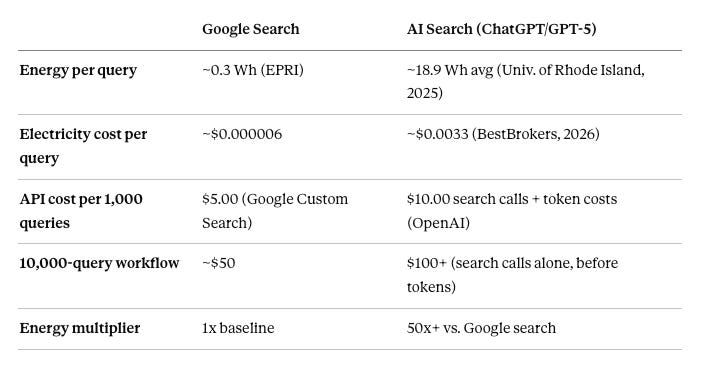
Google’s Custom Search JSON API offers 100 free queries per day, with additional queries at $5 per 1,000. A traditional Google search is computationally lightweight: it matches keywords against a pre-built index and returns results. The Electric Power Research Institute puts a typical Google search at around 0.3 watt-hours of energy per query.
A ChatGPT query is a different order of magnitude entirely. Researchers at the University of Rhode Island’s AI lab found that GPT-5, which launched in August 2025, averages around 18.9 watt-hours per medium-length prompt which is over fifty times the energy of a Google search. BestBrokers calculated in March 2026 that at current U.S. commercial electricity rates, each ChatGPT query costs approximately $0.0033 to process in electricity alone — before any API markup.
At the API level, where the real business costs land, the gap widens further. OpenAI’s web search tool runs $10 per 1,000 calls, before adding the model tokens required to read, reason, and respond. Run 10,000 lookups through a search API, and you might spend $50. Route the same 10,000 queries through AI with web search, and you start at $100 for the search calls alone — then layer token costs on top for every response the model generates.
For a startup watching its burn rate, that gap adds up fast.
And cost is not the only thing you are spending.
A January 2025 study by Michael Gerlich, published in the peer-reviewed journal Societies, surveyed over 600 participants and found a significant negative correlation between frequent AI tool usage and critical thinking abilities. The mechanism he identified is “cognitive offloading” which is delegating mental tasks to an external tool until the internal capacity for those tasks starts to atrophy. His conclusion: “overuse may lead to unintended cognitive consequences.”
Around the same time, researchers at Microsoft and Carnegie Mellon University found that the more workers leaned on AI to complete tasks, the less critical thinking they engaged in and the harder it became to call on those skills independently. The study looked at 319 knowledge workers and found that high confidence in AI’s ability to do a task reliably correlated with reduced cognitive engagement from the human doing the asking.
Think about what this means in practice. When a team member types “What is the zoning code for this address?” into ChatGPT instead of a search engine, the AI does not simply retrieve the answer. It reads, interprets, synthesizes, and presents. The user gets a clean, packaged response and never has to scan sources, evaluate credibility, or form a judgment. Over time, that skipped process is not just a shortcut. It is a skill that quietly erodes.
Jenny’s instinct to protect her team from this is not about frugality. It is about keeping a workforce that still knows how to think.
The most clarifying research on this question comes from the Nielsen Norman Group, the gold standard in user behavior research. Their 2026 study observed how people chose between AI chatbots and traditional search for real tasks and the pattern was strikingly consistent.
People reached for AI when they started with a vague idea, when they needed to juggle multiple requirements simultaneously, or when they were trying to synthesize information from many sources. One participant described it this way: “It’s one of the most helpful places to start. It can really help direct me into a more narrow type of search.”
But when accuracy mattered and when they were evaluating a major purchase, researching health information, or verifying a specific fact, they went back to traditional search and trusted sources. The researchers summed it up plainly: users choose AI to explore and synthesize; they rely on traditional search when accuracy and trust are on the line.
In practice, most people are already doing this intuitively, even if they haven’t named it. The question is whether they’re doing it deliberately or just stumbling into the right tool by accident.
The distinction is simpler than it sounds once you see it. Here are three practical tests I now use myself and that I have started helping others who are asking which tools to use and when.
1. The Retrieval Test: Am I looking for something that already exists?
If the answer to your question lives in a database, on a website, in a document, or on a map then you are RETRIEVING, not thinking. Dates, prices, definitions, addresses, company facts, article links, stock tickers, regulatory codes. These are lookup tasks. Search was built for them. It is faster, cheaper, and often more accurate because the source is right there in the results for you to verify.
The moment you ask AI for a fact, you are asking a reasoning engine to do a filing clerk’s job but paying a seasoned consultant’s rates.
2. The Synthesis Test: Do I need to combine, compare, or make sense of multiple inputs?
This is where AI earns its keep. When you are weighing tradeoffs across five vendors, drafting a first pass at a strategy document, reframing a problem you are stuck on, pressure-testing an argument from multiple angles, or trying to see a pattern across disparate data points then you are not retrieving. You are SYNTHESIZING. That is cognitive work, and AI is a genuine thought partner for it.
The Nielsen Norman Group research found that AI’s greatest advantage was reducing working-memory load: when users had to compare details across multiple options and sources, AI could hold and organize that complexity in ways that traditional search could not.
3. The Stakes Test: What happens if the answer is wrong?
If a wrong answer means a wasted click, use whichever tool is convenient. If a wrong answer means a bad investment, a regulatory violation, a misdiagnosis, or a broken client relationship, verify through primary sources. AI can help you generate hypotheses and explore possibilities, but high-stakes decisions require the kind of source-level scrutiny that only traditional search can provide by clicking through to the original document, the actual regulation, the real data set.
One practical middle path: tools like Google’s NotebookLM let you upload your own trusted sources — contracts, research papers, internal reports — and ask questions only within that bounded set of documents. You get the conversational fluency of AI without the risk of the model wandering into hallucinated territory. When the stakes are high and you have known, reliable sources to work from, you may want to use a tool like NotebookLM before you open a general-purpose chatbot.
Jenny He’s dinner-table observation points to something larger than token budgets. It points to a new kind of literacy that leaders will need to cultivate in their organizations. Not AI literacy in the sense of knowing how to write a better prompt, but TOOL-SELECTION LITERACY. The discernment to ask, before every query: What kind of thinking does this task actually require?
Search is for finding.
AI is for thinking with you.
The future is not “AI first” for every task. It is task first, then tool. And the organizations that internalize that distinction will not only save money. They will build teams that remain capable of the judgment, the scrutiny, and the independent critical thinking that no language model can replace.
That may be the next essential productivity skill: knowing when not to use AI.
What is the most expensive question your team asked AI this week — and could a search have answered it just as well?
If you had to audit your last ten AI queries, how many were really just search in disguise?
No posts
Comments
Nothing yet. Say the first thing.
Sign in to join the conversation.