
It has been an alarming Northern Hemisphere summer of record heatwaves, devastating wildfires and concern about the approach of an El Niño event next year that could make the climate headaches even worse.
As if that wasn’t enough, the interruption to energy supplies from the Gulf continues, with sporadic hostilities between the US and Iran. Energy efficiency investor Jonathan Maxwell told Cleaning Up that he believes Europe is close to “breaking point” on gas supplies (see Show Snippets below).
The Cleaning Up team, led by Michael Liebreich, has been arguing that the answer to both climate and energy security headaches is to accelerate electrification – but also to avoid setting “unachievable” targets for electricity as a percentage of final energy. Electrification will be a major theme at Cleaning Up events in the next few months.
Meanwhile, scepticism grows about the economic benefit of the artificial intelligence data centre build-out, expressed forcibly by Senator David Pocock in the 3 August episode of Cleaning Up’s Australia Deep Dive (see that section further down the newsletter).
Michael posted a Substack article on 10 August, challenging the argument Jean-Baptiste Fressoz makes in ‘More and More and More’ – that sources of energy are only ever additive, and therefore there is no real energy transition taking place. “What is happening…. is that clean energy is growing faster than energy demand, and is likely to continue to do so. As long as this goes on for a decade or two more, then fossil fuels will, by simple arithmetic, be forced into retreat,” Michael wrote. An illustration of this dynamic is the chart below on sales of cars and light trucks.
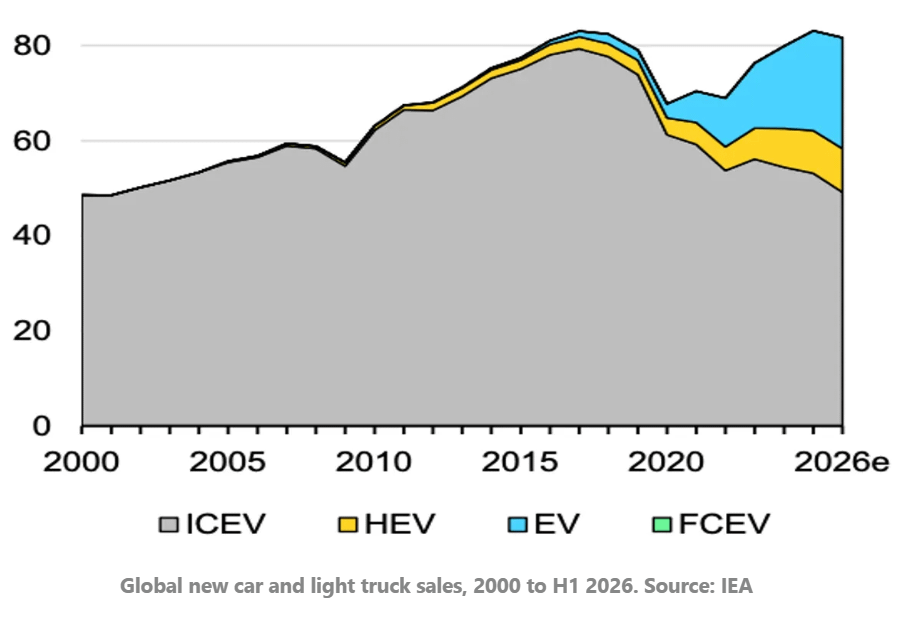
He addressed the question of whether using less energy is the only way to cut emissions: “No. Over the past 15 years, the global economy has grown by 50%, and emissions have only increased 9% – a stunning decoupling. We are a lot nearer to peak emissions than people think and moving in the right direction, albeit far too slowly.”
Cleaning Up will be in New York for Climate Week, and hosting a Leadership Circle Breakfast in New York on 21 September. We’ll bring together our Leadership Circle members, their guests, and other key stakeholders in the Cleaning Up network. If you’re planning to head to New York for Climate Week, please let us know by replying to this email, or by contacting team@cleaningup.live.
The issues of energy and security will be the focus in mid-September of the first of a new season of dinners for the Cleaning Up Leadership Circle. These are closed-door, smaller events that we’re excited to add to our programme line-up.
Bryony Worthington talked to David Kirchman for the 5 August episode of Cleaning Up. Professor Emeritus at the University of Delaware, one of the world’s leading microbial ecologists and author of ‘Microbes: the Unseen Agents of Climate Change’, Kirchman told Bryony: “In some places in the oceans, iron is the limiting nutrient. It’s not nitrogen or phosphorus, it’s iron…..If you add iron, everyone’s really happy. Phytoplankton grow like mad, and they potentially take down more CO2 from the atmosphere, and that helps drive down the effect of climate change.
“There are places that are not close to continents that are iron-limited. In the South Pacific and the Southern Ocean are the two big ones. So these are far from the Sahara, they’re far from continents, they’re far from sources of iron. So there’s been some calculations indicating, yeah, if you flew enough 747s or whatever big plane you have and dump iron, maybe you can get enough carbon dioxide uptake by the phytoplankton to make a difference. But that’s where the discussion starts.”
If you want to learn more about microbes and climate change, check out “Processes in Microbial Ecology”, by David Kirchman and Ashely Shade, just published by Oxford University Press, available here.
Michael’s guest on the 29 July episode was Jonathan Maxwell, founder and chief executive of SDCL, a specialist investor in energy efficiency and founding member of Cleaning Up’s Leadership Circle. Maxwell noted that the UK and Europe were facing the Hormuz crisis with very low gas reserves:
“I do think that we’ve now got to the breaking point in Europe. Now, that’s not going to resonate very much with people in the US, where there’s relative abundance of oil and gas, for example. But here in Europe, for certainly whether it’s down to security, either geographic security, energy security, or indeed just managing our energy resources or prices, affordability and cost of living for people, this is a forcing function.”
“If you’ve got any sense of energy security, America does, Europe’s trying to, it’s not a destination. It’s a position that you need to defend. So, what do you do to defend that? And the only way to defend it is just getting better, being able to use your resources more efficiently, more effectively, driving competitiveness, driving productivity,” he added.
Paul Simshauser, chief executive of Iberdrola Australia and professor of economics at Griffith University, was Michael’s guest for the 10 August episode of the Deep Dive. He explained how the costs of building new wind projects Down Under has risen in the last seven years:
“If you go back to 2019 here in Australia, most power purchase agreements….for wind projects were being done between AU$45 and AU$50 a megawatt hour. It was very cheap. In fact, cheaper than our marginal coal- and gas-fired generators…..If you were trying to do a wind power purchase agreement right now, I think your median price would be AU$110. It’s such a huge increase.”
Simshauser added: “Interest rates have probably contributed AU$24 a megawatt hour increase, and we went from almost zero interest rates in 2019, back to I guess what you’d call a historic neutral at 4.5% or so. The original equipment manufacturers, their supply and install of turbines has probably gone up by AU$18 to AU$20 a megawatt hour over that period. And they probably weren’t making a lot of money back in 2019. And presumably they’re at least washing their face now.” He said Australia had to look at how to get wind costs back down, particularly with the coal fleet approaching the end of its life. He cited two options – focussing on sites inland with higher wind speeds, and shopping around for cheaper turbine suppliers.
David Pocock, senator for the Australian Capital Territory and former international rugby player, told Michael in the 3 August episode of the Deep Dive that he is concerned and sceptical about the advent of artificial intelligence data centres.
“You just have to look at what’s happened in the States where data centres come online, they’re sucking up energy, whether that’s from the grid, electrons or burning gas, and they make it more expensive for everyone else. We cannot go down that path as Australians.”
Pocock went on to say: “I’m just so sceptical of these AI companies. I mean, what is this race? It’s to replace human labour, ultimately. And so what does that do for a country like Australia? We are so reliant on personal income tax, in terms of our overall budget and tax take. So what we’re racing to then [is to] replace human labour, it’s not like data centres are huge employers. And so what is the end game here? Why are we rushing to do this and potentially compromising our climate goals, creating a whole bunch of emissions? Obviously, the easiest emissions to avoid are the ones you haven’t created yet.”
Actis said on 23 July that International Finance Corporation and Société De Promotion et de Participation Pour la Coopération Economique, known as Proparco, would become minority investors in Uluğ Enerji, a private electricity distribution and retail group in Türkiye. Uluğ, which is majority-owned by the Actis Long Life Infrastructure Fund, aims to invest the new capital in “network expansion, grid modernisation, digitalisation and climate resilience”.
On 3 August, KKR announced that it had agreed on behalf of an insurance account it manages to buy a 50% stake in a 1.2GW TotalEnergies onshore wind and solar portfolio, “largely developed” in Germany, Spain, France and Poland. KKR said the investment “reflects our conviction in the long-term fundamentals supporting Europe’s renewable energy sector”.
EDP said on 29 July that it had commissioned a ‘triple hybrid’ renewable energy project, consisting of solar, wind and battery assets. The site at Las Lomillas, Cuena, Spain has 122MW of combined capacity, The company said its energy management system “determines whether it is more efficient to inject wind and solar power directly into the grid, store it in batteries, or even charge the batteries from the grid for later discharge when required”.
Schneider Electric said in a statement on 30 July that it had reduced its Scopes 1 and 2 CO2 emissions by 81% in the first half of 2026 compared to the baseline of 2017. Scope 1 emissions are those from a company’s own operations; Scope 2 are those from purchased electricity, heating and cooling. It added that Scope 3 emissions, those that occur in the company’s upstream and downstream value chain, fell by 12% compared to a 2021 baseline.
Zeke Hausfather, climate scientist and guest on episode 242 of Cleaning Up in January 2026, wrote on 3 August: “I’m not sure folks have realised just how crazy the second half of 2026 and 2027 will be for global temperatures – on the back of a record-smashing El Niño event.” His projection showed temperatures in 2027 reaching between 1.6 and 1.8 degrees Celsius above the 1850-1900 baseline.
Fatih Birol, executive director of the International Energy Agency and guest on episodes 133 and 253 of Cleaning Up, in July 2023 and April 2026, said on 15 July that the global economy faces a renewed challenge if the Strait of Hormuz is not opened up within a matter of weeks. He said that Pakistan, Bangladesh and India were particularly vulnerable to a shut-off in the supply of energy and fertilisers.
Lily D’Ambrosio, minister for climate action for the state of Victoria and guest on Cleaning Up’s Australia Deep Dive, quit her government role on 30 July, saying: “With our first offshore wind auction set to launch in August and Victoria now well placed to manage any further disruption to global fuel markets, I have decided that it is time to step back.”
The next edition of the Cleaning Up newsletter will be on Monday 24 August. We would love your feedback and ideas for the Cleaning Up newsletter or for the show. Please send them to team@cleaningup.live.
Comments
Nothing yet. Say the first thing.
Sign in to join the conversation.