
An action-packed few days saw a change of UK Prime Minister and energy secretary and the publication of a European Union Electrification Action Plan, against the backdrop of on-off hostilities threatening oil trade from the Middle East.
Andy Burnham took over on 20 July as the new UK PM, and immediately replaced most of the cabinet ministers appointed by his predecessor Sir Keir Starmer. The moves included John Healey as the new Chancellor and the shifting of Ed Miliband from energy secretary to foreign secretary.
Miliband’s successor in the energy brief, Miatta Fahnbulleh, is expected to maintain policies on renewable energy, climate targets and electrification. Indeed the new government’s first move was to cut VAT on electricity from 5% to zero at a cost of GBP 850 million – giving not just a saving for consumers but also a modest boost for the relative economics of heat pumps.
The most contentious area, however, is the rumoured relaxation of restrictions on UK North Sea oil and gas drilling. On Cleaning Up last week, Anders Opedal, chief executive of Equinor (described by Michael Liebreich as the “world’s most progressive fossil fuel company”) said that he thought there was potential for the UK to find plenty of additional “small traps” around existing oil fields, if the political support was there (see Show Snippets below).
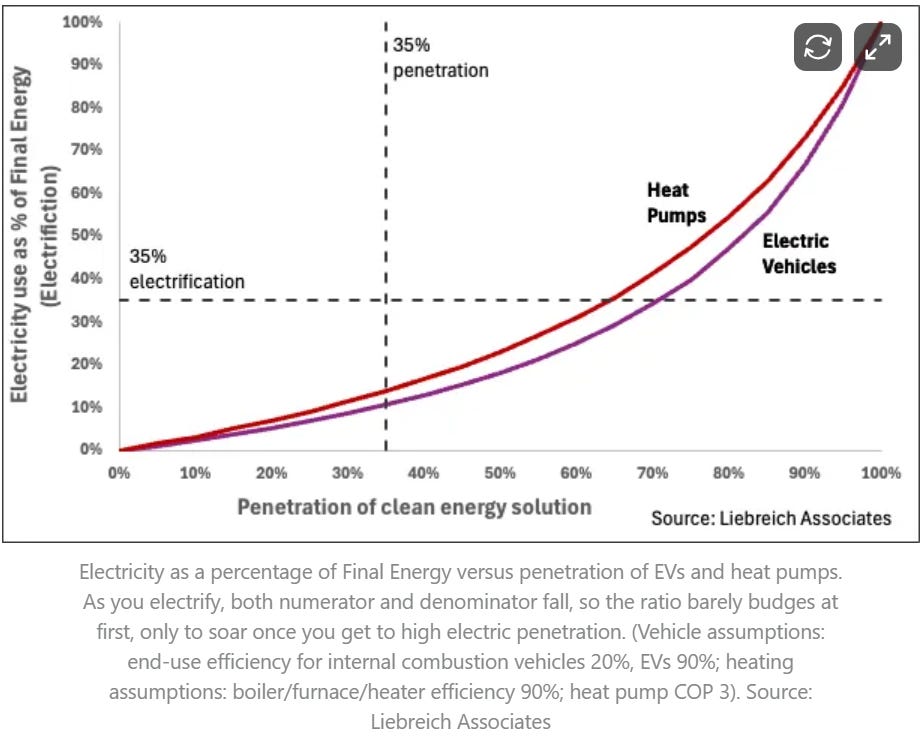
Michael posted a Substack article on 19 July, entitled ‘EU Proposes Unachievable Electrification Target’. He argued that the European Union’s target of increasing electricity’s share of final energy from 24% to 46% by 2040 was “entirely unachievable”. The reason is what has become known as the ‘final energy fallacy’.
“Because ICE cars and fossil-fuelled heating are so inefficient, they use much more final energy than their clean equivalents. And that means getting to 46% electricity/final energy by 2040 would require over 75% of all vehicles and heating to be electric. Not sales, ALL vehicles on the road, and ALL buildings. 2040 is just 14 years away,” he said. See chart below.
The Canadian Climate Institute published a report on 22 July, co-authored by Michael along with three of the institute’s senior team, on how to build out that country’s grid for the new era of electrification and demand growth without driving up electricity bills. Their proposed Powering Canada Forward Fund would come from the federal government and be repayable over time, allowing “utilities to charge ratepayers for the growing system once it has scaled rather than before they have seen the advantages”.
James Cameron, chair of Cleaning Up’s editorial council, was the guest on the 16 July Second Nature podcast with Rich Stockdale, founder of Oxygen Conservation. A wide-ranging conversation included how James helped establish modern climate law and how land restoration is the biggest opportunity ahead.
Amid the blizzard of Cleaning Up activities last month was a dinner on 22 June, hosted by Kristina Miskowiak Beckvard, Danish ambassador to the UK, and Pedro Serrano, the European Union’s ambassador to the UK. The topic discussed was “the future of energy systems”, including bringing down costs, resilience and the balance between next steps and reaching the last percent in decarbonising. Michael took part, along with Dan Jørgensen, the European Commissioner for energy and housing, Dhara Vyas, chief executive of Energy UK, and a clutch of leading academics and policy-makers.
Anders Opedal, chief executive of Equinor, the Norway-based oil and gas giant, sat down with Michael for the 22 July episode of Cleaning Up. He explained how his company had squeezed significant extra oil and gas production out of North Sea fields, defying outside forecasts that Equinor production would fall: “What the analysts have not incorporated is innovation of our people, the geologists, the geophysicists, the technology development, the new ideas about where we can find oil and around existing fields.” He added: “Can this also happen in the UK? Definite yes, it’s the same geology. It’s the same big discoveries. It’s the same kind of potential around the existing fields. So we think, but it’s up to the UK government at the time to say if you want to explore it or not.”
However, Opedal was emphatic that times were changing in energy:
“We have a view as a company that the energy transition will happen. We stand for a balanced view on it. We know that over time, oil and gas will be less in demand. The biggest trend we see now in the world in terms of energy is the electrification trend, and kind of hoping that all these trends will go away, that’s not the right approach.”
He went on to discuss his company’s progress on offshore wind, where it has 6GW under development including the vast Dogger Bank site in the North Sea, and in carbon capture and storage.
The 15 July episode of Cleaning Up saw Bryony Worthington in conversation with Alex Shoer, managing director of GridVest, a company focussed on bringing batteries into energy markets in the US. He said:
“I think there’s still like these old narratives that people are just clinging to around renewable energy…. it puts stress on the grid and all these things, and there’s a cap at how much you can have. And it’s like look, all of that kinda goes away in the light of cheap and safe batteries.”
Bryony asked where the US might seek a competitive advantage in the years ahead, having seen leadership in current-generation batteries go overwhelmingly to China. Shoer replied: “Solid state is a really good example where the U.S. actually does have a real meaningful head start technologically. It’s a completely different manufacturing process [compared to lithium iron phosphate batteries], so it’s one that I don’t think the Chinese companies are naturally well suited for, and there’s just this huge opportunity for the U.S. to say hey, we’re gonna invest in this segment and we want to become the best at this technology.”
The fifth episode, released today (Monday), finds Michael in conversation with Professor Ross Garnaut, economist, authority on the economics of climate change and former advisor to Australian prime ministers Bob Hawke and Kevin Rudd. Garnaut argued that Australia should have a key international role in the world’s decarbonisation, as the location with the “lowest cost in terms of the quality of resources for very large quantities of renewable energy”.
Australia also has “enormous capacity to produce, at low cost, biocarbon, which is the other essential ingredient…. for the low-carbon industries of the future”, he said. He gave the example of ammonia, a key input for fertilisers: “Historically, they’ve been made from coal or gas with huge carbon emissions. In the zero-carbon world, urea will be made from green ammonia, made from renewable energy, plus biocarbon.”
Lily D’Ambrosio, energy and resources minister for the state of Victoria, spoke to Michael for the fourth episode of the Australia Deep Dive, released on 20 July. She touted a big change in her state over recent years:
“When we were first elected about 10 years ago, we had a reliance on coal generation that was around in the high 80s percent [of electricity generation]……. We are now down to 53% reliance on coal generation. And we started from a base of having less than 11% of our electricity coming from renewable sources in Victoria. In just 10 years, we’re up to 44.5%.”
D’Ambrosio, who is the longest-serving energy and climate minister in her country, talked of the key role batteries were playing in Victoria’s electricity system: “The Australian Energy Market Operator’s their last report on price trends has shown that because big batteries have outbid gas peaking generation to set the price, it’s meant that our overall cost of electricity in the last quarter has been significantly lower than what it otherwise would have been.”
Actis said on 14 July that the MTerra Solar project, in which it is an investor, had inaugurated its first phase in Luzon, the Philippines. The overall project is slated to become the world’s largest integrated solar and battery site, with phase one boasting nearly 1.4GW of PV along with 825MW of four-hour storage.
Arup announced on 7 July that it had provided the environmental and social advice for the EUR 500 million financing of the expansion of the SuedLink interconnector in Germany. The money for the EnBW project comes from a consortium of commercial banks, guaranteed by Danish export credit agency EIFO.
On 15 July, Mitsubishi Heavy Industries said that it had agreed to work with Entergy, an electricity generator and distributor in southern US states, on advancing the use of combined-cycle gas turbines with carbon capture and storage. The aim of the collaboration will be to achieve a “50% reduction in overall costs”.
Octopus Energy issued a statement on 17 July, arguing that the UK’s new prime minister could cut GBP 190 off household energy bills through a combination of electricity market reform and the shifting of levies from billpayers to general taxation. Octopus said: “Britain’s electricity market is wasting billions. The one-size-fits-all design means expensive gas often sets the price even when cheap renewable power is available. Because the market lacks local price signals, it rewards the wrong behaviour – and consumers pay for it.”
Katie White, guest on episode 240 of Cleaning Up in January 2026, was promoted to minister of state in the UK Department for Energy Security and Net Zero on 21 July, from her previous role as minister for climate in the same department. The move was part of a wide-ranging reshuffle of the UK government by new Prime Minister Andy Burnham upon taking office.
On 17 July, Teresa Ribera, executive vice-president of the European Commission and guest on episode 37 of Cleaning Up in March 2021, presented the EU’s review of its Emission Trading System, and its new Electrification Target (see Michael’s response in the News section above).
Australia-based tungsten producer EQ Resources said on 20 July that a company controlled by Andrew Forrest, guest on episode 210 of Cleaning Up in May 2025, had bought a 16.8% share of its equity. Forrest is chair of Fortescue Metals Group, the mining company.
Daniel Yergin, vice-chairman of S&P Global and guest on episode 111 in January 2023, remarked on 16 July: “The profound growth of US liquified natural gas is exceeding all expectations.” An S&P Global study found that US feedgas demand for LNG exports will double to 36 billion cubic feet per day in the next five years, 25% higher than previous base-case projections.”
The next edition of the Cleaning Up newsletter will be on Monday 10 August. We would love your feedback and ideas for the Cleaning Up newsletter or for the show. Please send them to team@cleaningup.live.
Comments
Nothing yet. Say the first thing.
Sign in to join the conversation.