
I was able to see famed Beat poet Allen Ginsberg twice before he passed away in 1997, both at the tail end of his life, and quite within quick succession of one another.
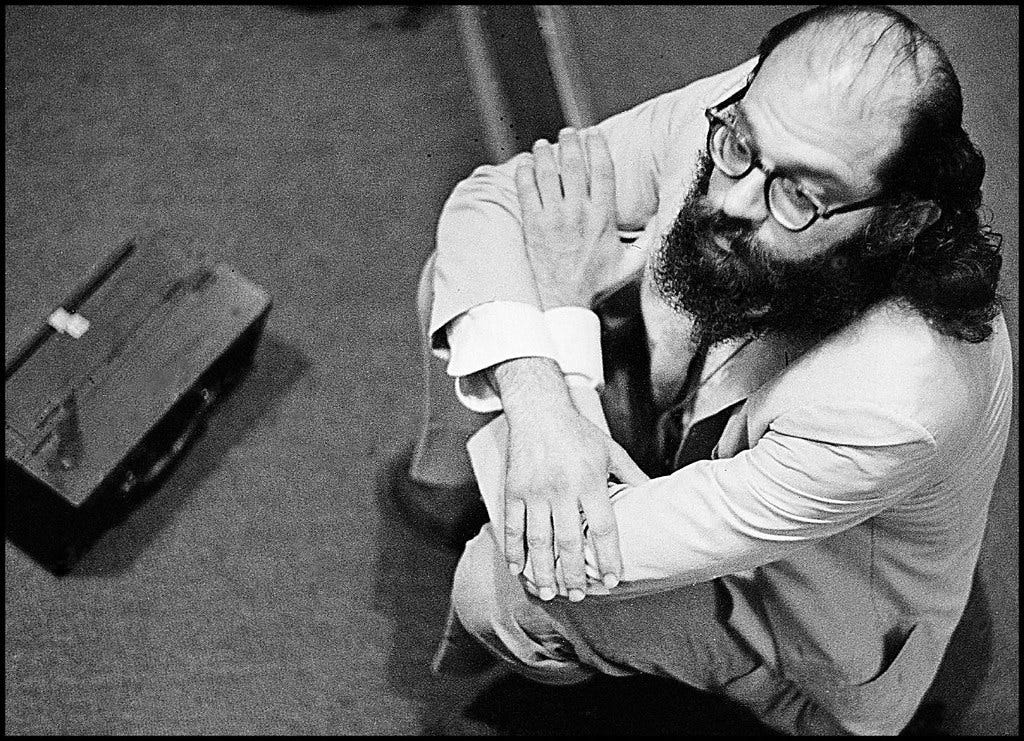
This had to be around September of 1996. I was eighteen. I had just started my freshman year at college here in New York. Word got around about Ginsberg doing a reading at a church in Harlem, so a group of eager writing students all hopped on the train and headed out. I had no idea where we were going, only that we were. What choice was there? We were on our pilgrimage to see Ginsberg, holy Beat poet.
In high school, my heroes were the Beats. I had a circle of friends who grew up fantasizing about which writer we were most like. Marc was always Kerouac. Hutch was Ginsberg. I had such a hankering for William S. Burroughs, it wasn’t even funny. We pretended to emulate these writers as only high schoolers knew how, much like others might idolize musicians or movie stars. These were our rock stars.
But I’d never seen any of these writers. I’d only read them. So — having a chance to attend a live event with any one of our idols was a nonstarter. I had to go. I was still new to New York, the city and its subways didn’t make sense to me, but the pilgrimage to Ginsberg felt like an appropriate beginning to my own burgeoning Beat fantasies.
Funny to think how eighteen feels so young now. I was so open to inspiration, ready to receive what the world had to offer… and tonight, it was Allen Ginsberg.
The place was absolutely packed. Every pew. Hundreds of people. We were nowhere near the front, but simply to be in the same room as Ginsberg felt electric. Felt real.
There are but few moments in my life where I can attribute a particular event — a reading, a performance, a book, a movie, a song — to something holy.
I will say that this moment, seeing Ginsberg, was one of these moments. Seeing him, here and now, even in his frail state, as he plowed through a set-list of poetry was… fun. There was a giddy electricity to it all. He was channeling energy that readers half his age would be blessed to tap into. He was enjoying himself… and so were we. Being amongst all these reverential readers, hearing him talk… it was so cool! At one point either Lawrence Ferlinghetti or Gregory Corso heckled Ginsberg from the upper balcony… How crazy is that?! Look at us! Kids in the city! Seeing the Beats!
If that was all there was to experience, it would’ve made for a cool night. An evening to remember, for sure, maybe. But that wasn’t the end of it. This was all prelude.
Ginsberg closed out the evening with a reading of William Blake’s “Nurse’s Song (Innocence).” There are two Nurse’s Songs found within Blake’s Songs of Innocence and Experience. Ginsberg frequently read — or performed — poems of Blake’s. On this night, I remember him giddily reading “The Tiger.” But it’s something about “The Nurse’s Song” and its refrain “and all the hills echoed,” read this night that touched me in ways that very little literature ever has. It was, in effect, a holy moment for me.
When has a poem ever done that to you? When has a reading, an invocation, changed you? Whose words were they?
Before he began, he instructed us to sing along to the final refrain — ‘and all the hills echoed.’ The audience was happy to oblige. The poem itself is short. Here it is:
When the voices of children are heard on the green,
And laughing is heard on the hill,
My heart is at rest within my breast,
And everything else is still.
‘Then come home, my children, the sun is gone down,
And the dews of night arise;
Come, come, leave off play, and let us away
Till the morning appears in the skies.’
‘No, no, let us play, for it is yet day,
And we cannot go to sleep;
Besides, in the sky the little birds fly,
And the hills are all cover’d with sheep.’
‘Well, well, go and play till the light fades away,
And then go home to bed.’
The little ones leapèd and shoutèd and laugh’d
And all the hills echoèd.
Ginsberg had a particular instrument with him. A harmonium, I believe? It was more wooden box than accordion, a clunky contraption with a set of bellows that flexed when squeezed between his knees. Ginsberg was certainly looking scrappy, much leaner than the black and white photos I had taped to my dorm room wall, taken fifty years ago. Still — there was something so spritely, so wily, about him. He bopped and danced, never remaining still, even as he sat in his chair on stage, legs fanning open and shut to produce a steady hum throughout his rendition of “The Nurse’s Song.”
Ginsberg didn’t have a sheet of paper with the poem printed out in front of him. He recited Blake’s poem from memory. By heart. By the time he reached the end — ‘and all the hills echoed’ — the audience all joined him. Not once, not twice, but several times. Countless times. It started, and Ginsberg wouldn’t stop, so we didn’t stop, repeating this one line over and over and over again. Just when you thought he wouldn’t repeat the line again, he did. And again. This went on for nearly ten minutes.
I wish I could go back to this moment in my life. I wish I could convey to you, reading this now, what this moment was like nearly thirty years ago. Members of Ginsberg’s poetic entourage began to yodle in these swooning loops. Members of the balcony harmonized with those of us in the pews below. The entire church, the very air itself, was alive with William Blake’s poem, channeled through Allen Ginsberg’s wiry, failing body, his harmonium seething between his knees, and it just wouldn’t stop. The moment felt eternal. It felt alive, transcendent. Five words. And all the hills echoed.
I wept.
I know that sounds silly. Believe me, I hadn’t expected it. Why did this moment have such a profound effect on me? I’m not a religious person. I’m not a musical person. I’m not even the biggest Allen Ginsberg fan (that was Hutch, that was Jack). But being there, in this transformed space, moved by the music and words of William Blake, I felt a sense of divine inspiration that I’ve only felt a handful of times. It changed me in ways that I can’t quite express beyond that notion of having experienced something holy. It transcended Blake, it transcended Ginsberg. It truly felt alive, and eternal.
I left that church believing in the power of poetry, the alchemy of art. I felt inspired in every sense of the word, and I have never forgotten it.
Allen Ginsberg died the following year, only a few months after that night.
Here is a recording of Ginsberg performing “The Nurse’s Song (Innocence)” in 1968.
What is your holy moment? What are the words that changed your life?
Who wrote them?
No posts
Comments
Nothing yet. Say the first thing.
Sign in to join the conversation.