
Hi, I’m Claudia, a curator of human connections and thought-provoking ideas about hurry-culture. My message: Stop rushing through life - Get busy living.
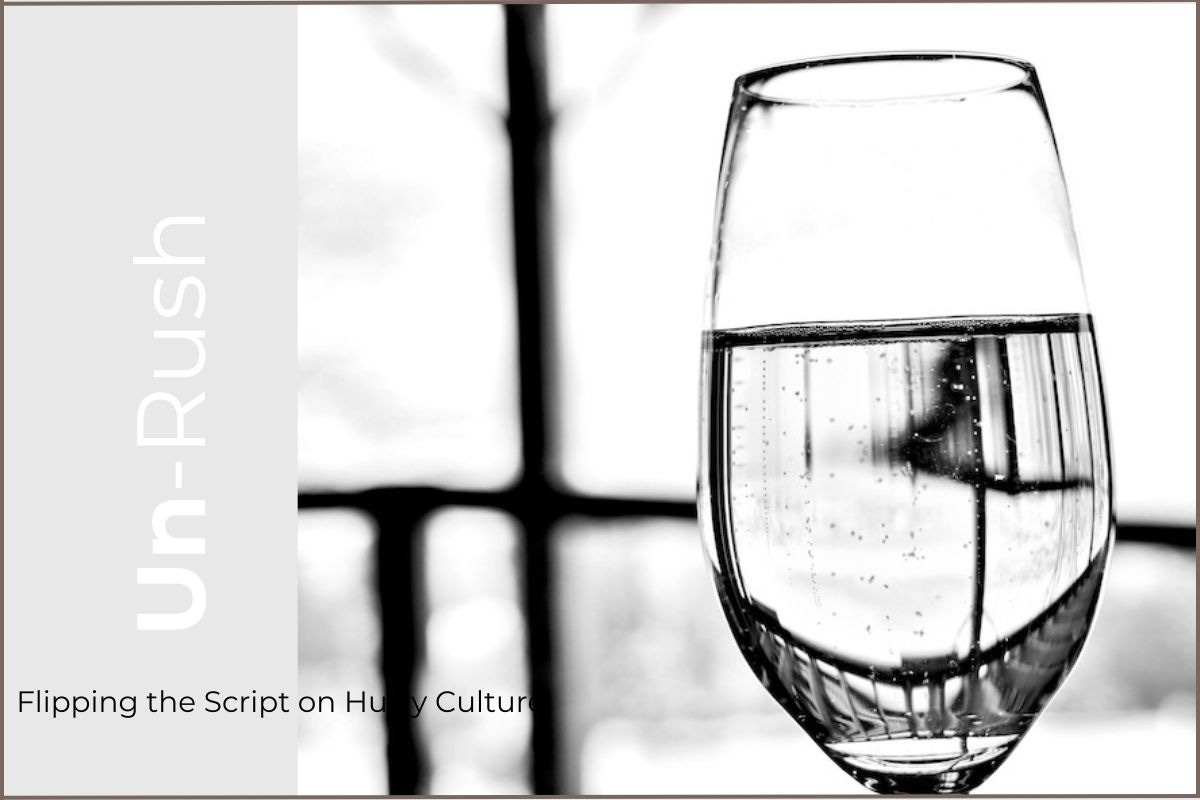
I read a line in a wine magazine and had to pause.
A 23-year-old writer was describing her dream date: a bottle of wine, nothing more expensive than that, shared slowly over a few hours in a restaurant. Then she caught herself. “But honestly,” she said, “that might be too intimate. It could scare a guy away.”
Too intimate. A bottle of wine. I didn’t get it. So, I kept reading.
She called her younger brother, who had been with his girlfriend for three years, and asked if they’d ever ordered a bottle for the table. He paused, genuinely confused. “What are you talking about?”
That pause is what this article is about. Not the wine. Not even the romance angle the piece was actually about. The pause is a 20-something brother searching his own memory for something that used to be the most ordinary form of company two people could keep. So I thought. But this young man had no idea. I don’t think that the uncomfortable feeling of sharing a bottle of wine is about Gen Z, and I don’t think it’s about romance. I think it’s about all of us, and I think the wine is just a very sharp image we are looking at.
In a world spinning faster, we didn’t get less romantic. But something quietly removed our tolerance for unstructured time with another person. And Gen Z is just showing us what the hell happened.
Here’s the part worth sitting with: this isn’t a story about a generation that wants less intimacy. It’s a story about a generation raised without ever needing to sit inside an empty gap with nothing to say or to do. Every pause in being with another person used to belong to nobody. You’d sit. You’d wait. Someone would speak eventually, or not, and either was fine. Then the gap got a job assigned to it. A phone’s job. And it’s had one for so long now that an entire generation has grown up never once experiencing an unfilled pause as anything other than a malfunction to correct.
So, let’s take the phone away. And take away the agenda too. No reservation to keep, no next stop, no plan with a shape. What’s left isn’t peace. It’s exposure. Not romantic exposure, something closer to structural exposure. Nobody is managing the moment. You are simply in it, for as long as it takes, with nothing external deciding when it ends.
That’s the actual thing the 23-year-old writer was naming, whether she had language for it or not. Not “vulnerability.” Unmanaged time. And this is worth being precise about, because it would be easy, and simply lazy, to blame this feeling and behavior on efficiency, on a generation optimizing every hour for output. That’s the obvious argument, and it isn’t the real one. The real one is stranger and more specific: an entire cohort of people has never practiced sitting across from another person with a gap in the conversation and nothing standing between them and it. Not a task. Not a screen. Not even a plan for what comes next. Just two people and duration.
Wine, of all things, used to be the tool for exactly this. Not because it’s romantic, but because it has no natural stopping point. You can’t drink a bottle efficiently. Nobody has ever “gotten through” a shared bottle of wine the way you get through a to-do list. It was woven into the fabric of ordinary social life for exactly that reason: shared at tables, poured at length, never rushed, because rushing it defeated the entire point of having it there. It is, arguably, one of the oldest low-stakes tools humans ever built for practicing unstructured presence and get-together. If people can no longer do this – which is, in my opinion, the most culturally normal, natural, zero-agenda, nothing-to-accomplish activity there is….? Then, what’s gone isn’t romantic confidence. It’s the underlying capacity itself. Just being present.
And the stakes here aren’t generational, and they aren’t really about dating at all. They’re universal, and they implicate everyone. Every time any of us, any age, any decade, reaches for a phone the instant a conversation goes quiet, or fills a lull with a suggestion of something to do next, or can’t sit in a room with another person without narrating what happens in it, we’re training the exact same reflex. It becomes a habit. Gen Z didn’t invent this kind of “gap reflex”. They were simply raised inside it from the beginning, with nothing before it to compare it to. The rest of us just have a memory of the alternative. That’s the only difference. And I find this a scary difference. What is going to happen more generations down the line?
What’s actually eroding is the capacity to be present with someone when nothing is being performed, produced, or filled. To let a conversation find its own shape because you’ve stopped managing the clock, to notice the small shift in someone’s face three sentences after they’ve said the thing that was actually on their mind, the kind of nuance you only catch because you let the time run long enough for it to surface. You cannot schedule your way into that moment. You can only be sitting there, unhurried, when it happens.
The bottle of wine isn’t the problem. The lack of a schedule attached to it is.
When’s the last time you were with someone, no plan, no phone, nowhere else to be, and you didn’t reach for a gap filler?
Thanks for reading,
With stillness, serenity, and a smile,


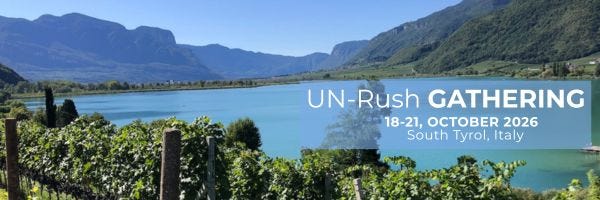
If you’re looking for genuine, face-to-face encounters (including some incredible South Tyrolean wine) where you can discuss with other un-rushing souls different ways in which we can further develop and improve the path we are already on to un-rush our way of living….. Join the Un-Rush Gathering in South Tyrol in October 2026 — Here you can find out all about it:
You got me hooked! I want to learn more!
Claudia Brose is an event creator, writer, and founder of Un-Rush, the essence and meaning of her life’s journey. As a curious explorer of other cultures and life concepts, she moved from Germany to Tokyo and from San Francisco to the Italian Alps. Each move was choosing her own rhythm over the world’s hurry-expectations. Previously, equipped with an MBA and a journalism degree, she cruised through marketing, management, and the non-profit Asian cultural sector. Through her work, she loves to enable connection, presence, friendship, and growth.
Comments
Nothing yet. Say the first thing.
Sign in to join the conversation.