
As many readers here and elsewhere will know, the use of the oceans by non-state actors and non-governmental organizations has been one of my topics of academic interest and publications for nearly two decades. This includes the various flotillas to Gaza beginning in 2010. A day before that event, I submitted an article to Small Wars Journal titled “The Ship is the Visual, Even in the Shadow Zones.” (Here, though the full article doesn’t seem to be available any longer.) The reason I used that title was because of a Skype interview I conducted at that time with Dr. Rebecca Gomperts who had founded Women on Waves which conducted maritime campaigns to provide abortions to women offshore from countries that restricted the procedure. A list of those campaigns is here though WoW now seems to have shifted from ships to robots like its rAborta.
During the interview I asked her why she was using ships instead of simply going to national borders. Here was part of her response:
The ship is a visual; it makes the problem visual. Women travelling to other countries, it’s often under the radar, they do it secretly, they suffer tremendously but it’s not public. With the ship we are making the problem that exists visible.
That was the insight I thought most intriguing that applied to other organizations I was then studying. The ship was indeed the visual. Sometimes it didn’t matter if the services or goods (in whatever case) were provided, it was the ship that brought visibility to the issue whatever organization was focused. She was right. Whether it was Women on Waves, Sea Shepherd or other organizations, media were attracted to the ships leaving port, conducting operations, or returning. That was the value.
Similarly, we see another example the past few days with the latest iteration of those stating their intent to provide aid to people of Gaza. Most of the time the ship or ships used could not carry enough supplies for any significant relief even if they had reached shore; instead, they were used to generate media interest.
The current Gaza Flotilla, named the Global Sumud Flotilla, sought to break the Israeli blockade of Gaza and deliver urgent humanitarian aid as famine and catastrophic hunger threaten the region. Yesterday, dozens of ships carrying food, water, and medicine departed from Barcelona, forming what organizers describe as the largest civilian maritime mission to Gaza since the blockade began. Delegations from at least 44 countries participated, and notable figures aboard included activists such as Greta Thunberg, actor Liam Cunningham, and former Barcelona mayor Ada Colau.
But just hours after these ships departed…actually hold that thought. Since apparently a number of ships were sailing vessels and, assuming from my old Pearson sloop’s capabilities all those years ago that their best speed under sail or motor would be about seven or eight knots, in the four or five hours they were underway they could have only gone just over the horizon when there was a change of plans.
Back to the development:
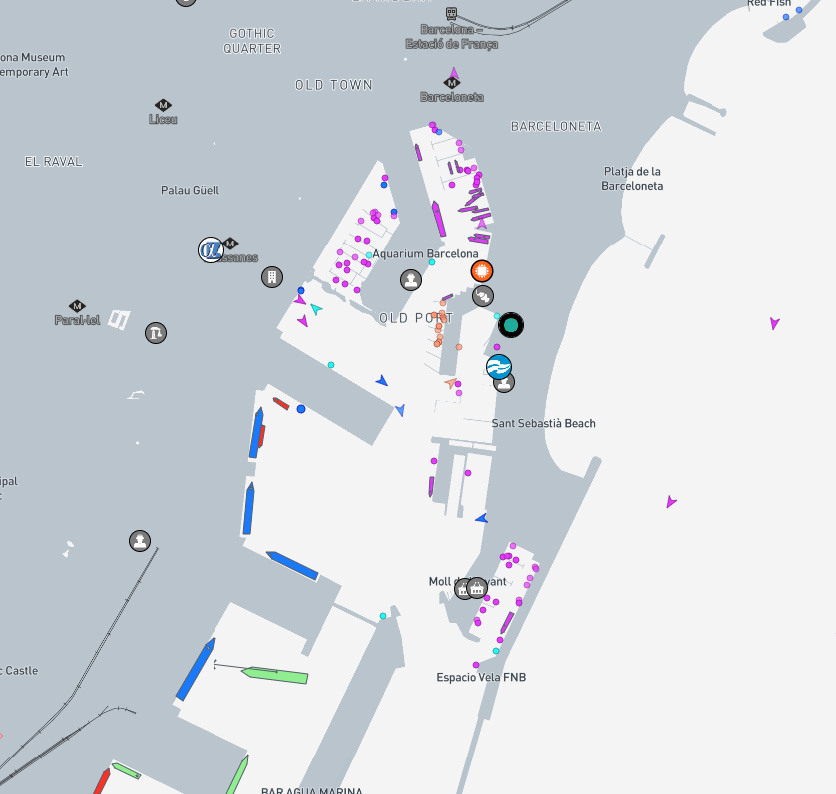
The Global Sumud Flotilla carrying aid to the Israeli-blockaded Gaza Strip has been forced to turn back due to poor weather, according to a statement by the group and sources travelling with the mission. The flotilla said on X that strong winds on Sunday of more than 30 knots (55.6 kilometres per hour, or 34.5 miles per hour) on the Mediterranean Sea could have posed a problem for smaller boats in the convoy. “The decision was made by the [flotilla] steering commission … to turn back towards Barcelona’s La Vela port, where they arrived after 22:00 (10pm, or 20:00 GMT),” Al Jazeera’s Mauricio Morales said while reporting from the Familia, part of the flotilla.
I haven’t found the Familia in Port Vela:
The episode does again show that any operation at sea can be altered by the reality of the elements - namely weather. In the course I taught at the Academy on US naval history, I always started with a couple of days on ancient naval history, including slides like this:
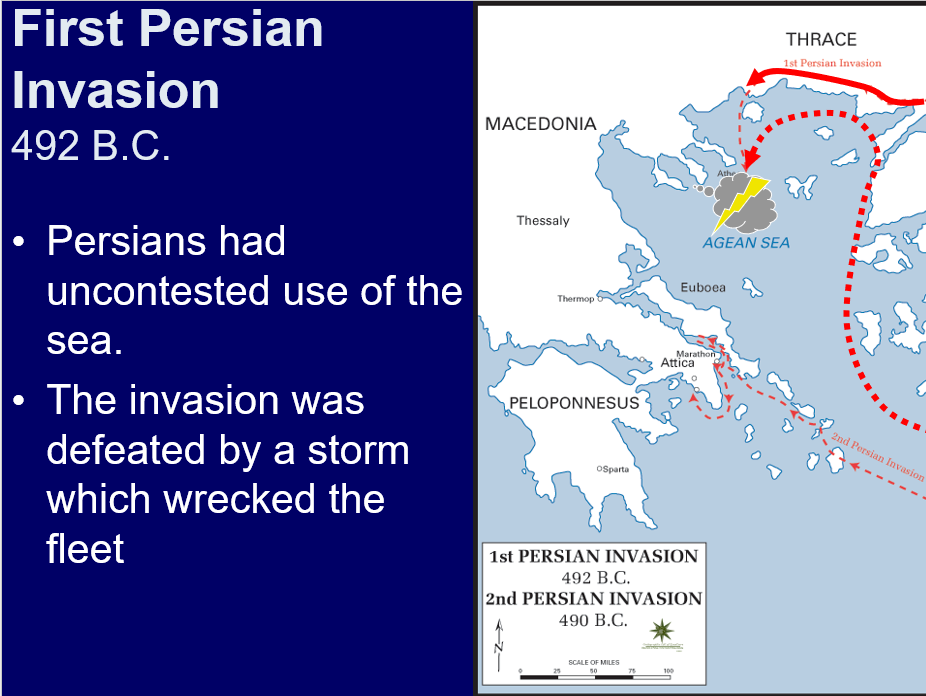
Naval history is littered with expeditions that weather turned back before they ever reached their intended targets. The pattern is consistent across millennia and civilizations.
In 492 BCE, Persian King Darius I dispatched a fleet under Mardonius to punish Athens and Eretria for their support of the Ionian revolt. The expedition never reached Greece. A storm off Mount Athos destroyed 300 ships and killed over 20,000 men. The survivors abandoned the campaign entirely.
Eight years later, Xerxes' invasion force suffered similar weather losses near Euboea. While the Persian fleet pressed on to the eventual defeat at Salamis, storms had already significantly degraded their naval strength before any battle was fought.
The medieval period offers perhaps the most famous example when Kublai Khan attempted to invade Japan. The first invasion in 1274 saw 500-900 ships and tens of thousands of troops forced back by storms that the Japanese later mythologized as the kamikaze or "divine wind." When the Mongols tried again in 1281 with over 4,000 ships, an even more devastating typhoon near Kyushu ended their ambitions in Japan permanently.
Early modern Europe provides equally instructive cases. The Spanish Armada of 1588, after being repelled by English forces, attempted to return home via Scotland and Ireland. Severe Atlantic storms wrecked dozens of ships, forcing survivors back to Spain with losses exceeding half the fleet.
During the French Revolutionary Wars, General Hoche's 1796 expedition carrying 15,000 troops to aid an Irish rising against Britain exemplifies weather's decisive role. Storms in the Bay of Biscay and off Bantry Bay scattered the fleet completely. Not a single French soldier landed on Irish soil.
Even Napoleon's invasion plans for Britain between 1803-1805, though never launched, were repeatedly frustrated by Channel gales that prevented the French fleet from concentrating. These weather delays contributed to the strategic failure that culminated at Trafalgar.
Like their historical predecessors, the flotilla organizers faced the fundamental challenge of coordinating multiple vessels across significant maritime distances while remaining vulnerable to meteorological conditions beyond their control assuming they could achieve their goal simply by getting underway and crossing the Mediterranean.
The flotilla's composition - described as ranging "from rundown old luxury yachts to tiny wooden sailboats and industrial-looking vessels," including the century-old ship Sirus - made weather sensitivity inevitable. Mixed fleets of varying sizes and capabilities have always been particularly vulnerable to rough conditions, as the fastest common speed becomes the limiting factor for the entire operation.
***
Earlier I mentioned Dr. Gombert. Below is the transcript of our core interview in 2010 in case you’re interested:
29 JANUARY 2010 0830-0900 EST
Via SKYPE Rebecca Gomperts
CB:
RG: I first thought of using the sea to provide services when I was a physician on a Greenpeace ship.
CB: What was the advantage of providing services on the sea rather than going to the border of a country to provide those services?
RG: Because it’s the Dutch law that applies in international waters, you can help women legally and safely.
CB: Was it also cheaper to do it, logistics wise to provide the ship rather than another country
RG: Women do that all the time. Women travel. That’s why it’s one of the main social injustices because women who do not have the money cannot travel to other countries. The ship is a visual; it makes the problem visual. Women travelling to other countries, it’s often under the radar, they do it secretly, they suffer tremendously but it’s not public. With the ship we are making the problem that exists visible.
CB: Have you found that the countries visited, do they prevent you from going into the harbor or do they prevent women coming out to you.
RG: We have done four campaigns with the ships so far. It was only Portugal that sent warships to prevent our ship from entering. That was the only time a government tried to stop the ship from coming in.
CB: How did that happen? Did they contact you on bridge to bridge?
RG: The Minister of Defence contacted the captain of the ship through a fax. They said Women on Waves was a threat to national security and health and they were preventing the ship from entering national waters. We filed a court case against the Portuguese government because they did this and we won this through the European Court for Human Rights. (see Women on Waves v. Portugal)
CB: How did you decide to use the types of ships you used for your campaigns? Is your decision on what types of ships centered around the A-Portable or are there other things in the decision-making process?
RG: We used the Mobile Treatment Room three times and the ships had to be proper to carry that – it’s basically a container and so the ships had to be outfitted for the Mobile Treatment Room. That was the size of the ship that was determined by the Mobile Treatment Room; however there have been a lot of developments recently especially concerning medical abortions – abortion with pills – it has been proven very safe to take outside the surgical theater. The last campaign we did which was in Spain we actually had a yacht and we worked with the local organization because the miscarriage happens back on shore so follow-up care was provided by us. So we used a yacht without the mobile treatment room. For us, that is a much better solution.
CB: Is that because it’s cheaper?
RG: It’s much easier for us because you don’t need big harbors so you’re more flexible.
CB: You lease the boats on a short-term basis?
RG: Yes.
CB: How did you identify the crew? Were they volunteers? Were they paid? Did you have to vet them for qualifications for seamanship, for example?
RG: It depended what ship we used. Two times we had a ship registered under the Dutch shipping certificate and all the crew had to have their certificates in order. Most of the crew volunteered. Some were reimbursed. The captain was reimbursed. They had to do extra training sometimes to update their certifications. On the other side, the yacht for example, there were just two crew and they had sailing experience – they had been sailing for thirty years. But that’s different than having a ship under a Dutch shipping inspection.
CB: Did you decide to use the Dutch flag because of the flexibility that offered?
RG: I’m Dutch so we knew the situation here. I think there might have been other countries where we could have registered the ship but it was much more complicated. (audio difficult – the menstrual regulation?)
CB: When you’re ready to go into a country’s waters do you know ahead of time what you will do in the case of their navy or coast guard approaching you?
RG: It was a European ship so we have European protection, but we have lawyers always that work very closely with us but we never expected to have what happened in Portugal. That’s why we have a group of lawyers standing by in case of such a situation.
CB: You’ve done four voyages in the past ten years, do you have any plans for the future?
RG: Yes. (laughter) It’s a complicated thing to prepare. We only go to countries where we are invited by local women’s organizations and it’s like a year-long preparation with mobilizing on the ground because they’re the ones who know we’re there to support them in the legalization of abortion in their country.
CB: So your organization is more grassroots and you will wait to be invited.
RG: Sometimes we will meet to decide when the ship will come.
CB: What have you found to be the greatest logistical challenges to these voyages – that might be fuel, or food or water.
RG: Portugal was the most difficult but they can’t do that anymore because they lost the court case. The government fell and abortion was legalized. It was also the most effective campaign.
CB: Why was it the most effective, because it was the response of the Portuguese government that generated the most interest?
RG: Of course, that is absolutely the case. It was worldwide front page news. It was widely discussed in the European Parliament and basically it was considered a big scandal.
CB: You saw a lot of political changes immediately?
RG: Yes. It was one of the main issues in the campaign. So it brought a lot of interest especially because of the Minister of Defence.
CB: If the Portuguese government and the Minister of Defence had not done that, do you think it would have been as successful?
RG: No. But we were there to help women and a lot of women in distress who were calling.
No posts
Comments
Nothing yet. Say the first thing.
Sign in to join the conversation.