
Jonathan Swift, in his famously satirical 1729 essay “A Modest Proposal,” suggested the unthinkable to solve the intractable: Why not, with a straight face, let the outrageous provoke serious solutions?
Public radio faces its own intractable challenges - aging audiences, funding woes, and accusations of partisan drift. So, in the spirit of Swift and with tongue only partially in cheek, I propose a remedy: hand the programming reins of NPR to the creators of South Park - Trey Parker and Matt Stone.
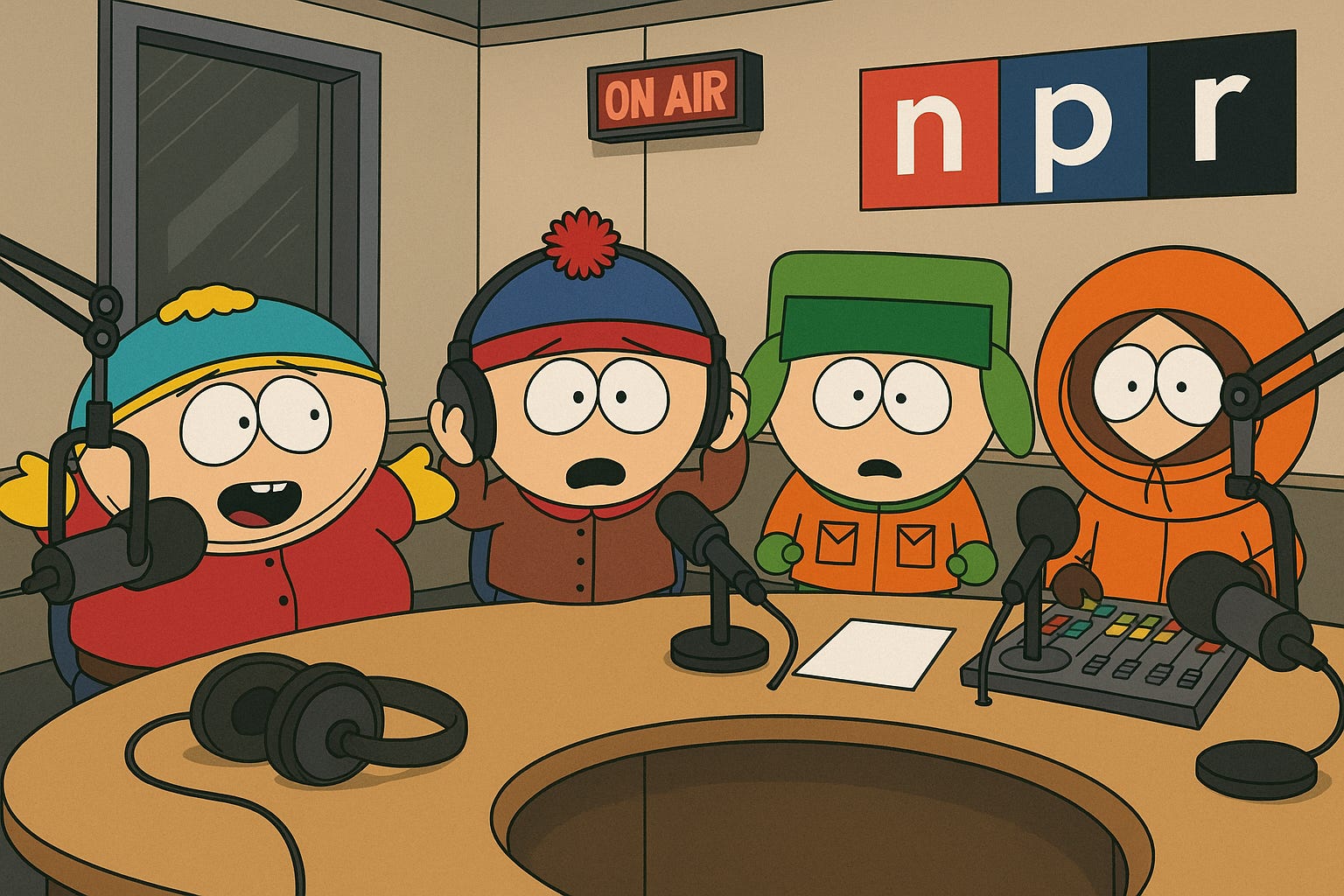
NPR’s institutional founding vision, as expressed in President Lyndon B. Johnson’s remarks signing the Public Broadcasting Act of 1967, was aspirational: “not just a broadcast system, but one that employs every means...so that the individual can rise.” Three years later, NPR’s Articles of Incorporation included this, in part, as its mission:
Article III
The purposes for which the Corporation is organized are:
1. To propose, plan and develop, to acquire, purchase and lease, to prepare, produce and record, and to distribute; license and otherwise make available radio programs to be broadcast over noncommercial educational radio broadcast stations, networks and systems;
2. To engage in research study activities with respect to noncommercial educational radio programming and broadcasting;
3. To lease, purchase, acquire and own, to order, have, use and contract for, and to otherwise obtain, arrange for and provide technical equipment and facilities for the production, recording and distribution of radio programs for broadcast over noncommercial educational radio stations, networks and systems.
4. To establish and maintain one or more service or services for the production, duplication, promotion and circulation of radio programs on tape, cassettes, records or any other means or mechanism suitable for noncommercial educational transmission and broadcast thereof.
During my first job after college in the late 1980s, NPR’s All Things Considered was on during my nightly drive in the heavy traffic of Route 128 outside Boston and over the years continued to listen to it off and on. And I have donated in the past to WAMU, mostly because of my support specifically for two weekend programs, Rob Bamberger’s “Hot Jazz Saturday Night,” and Murray Horwitz’s “The Big Broadcast” who took the helm after long-time host, the late, great legendary Ed Walker.
But the decades have changed as NPR has become more a news outlet with a more focused audience than the general public (although one might make a service available to everyone, it doesn’t mean that everyone will choose to use that service.) According to recent demographic studies, more than two-thirds of NPR’s radio audience is over 45, with only the 65+ audience segment growing. Its core listeners are well-educated, affluent, and overwhelmingly liberal (over 56% self-identify as left-leaning). In addition, media has expanded in a way that would have been unbelievable in 1970 – satellite radio, streaming services, Youtube, podcasts, etc, - have expanded the availability of news and information sources to the general public which, some have argued, means NPR could simply shift from a public organization to a private one, or a revenue generator for the government. And, of course, NPR has become a lightning rod as public radio for, and by, people already comfortably inside the urban, more liberal bubble, a stereotype recently lampooned by South Park’s Cartman, although I still give SNL the edge for a funnier treatment of a NPR program.
South Park, now in its 27th season, remains the last, best hope for truly impartial, razor-sharp social commentary. It has consistently surpassed SNL in its biting commentary and ability to attack all sides. Parker and Stone’s brilliance lies in skewering all sides of every contemporary debate without fear - or mercy. No topic is sacred: Mormons (especially their hit Broadway musical “The Book of Mormon”), Muslims (including a censored Muhammed episode and the movie “Team America”), Catholics, Scientologists; gender, race, transgender bathrooms, Hollywood, global geopolitics (see the “Band in China” episode), and environmental activism (including a take on the Animal Planet’s series “Whale Wars”) all have fallen under their savage directness, always cutting to the core issue. Some time after the airing of the spoof of Sea Shepherd on the Whale Wars episode, Peter Hammarstedt (someone I admire for his intelligence, courage, and sense of humor, albeit dubious preference in hockey teams) told me when he spoke at the museum what it was like to be caricatured and made into a cartoon.
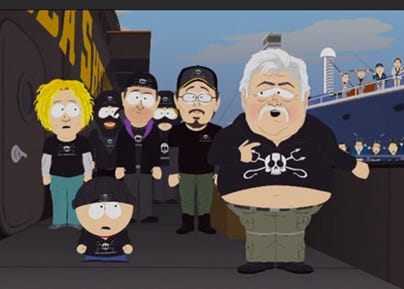
Parker and Stone’s method is equal-opportunity offense, wrapped in astonishing intelligence and shocking (and sometimes dark) humor.
In the recent season opener, the show savaged President Trump, which has earned a response from the President’s supporters and the White House. But they may not have realized that in the same episode NPR itself wasn’t spared. One of the kids, Eric Cartman, bemoans to his mother the fact that his favorite radio show, NPR, has been cancelled:
NPR. National Public Radio. Where all the liberals bitch and whine about stuff. It was the funniest show ever. You got white people who want to feel bad about themselves while listening to jazz between tote bag drives.
Parker and Stone target everyone. That’s what South Park still delivers, every week.
Why put “South Park” in charge of NPR? Three reasons:
1. It will generate income.
South Park isn’t just a ratings juggernaut; it’s a streaming goldmine. Paramount+ paid $1.5 billion. South Park merchandise and spin-offs, from video games to live events, are cash cows. As NPR faces declining member donations and stagnant government support, imagine the fundraising drive: “Donate now and get a limited-edition Eric Cartman NPR mug!” Tote bags would never be so cool.
2. It will attract younger audiences - and keep aging ones.
The heart of NPR’s challenge - as it is with other legacy media - is demographic decline. The 18-34 crowd is largely missing. South Park is geared toward the 18-49 demographic. South Park is already an intergenerational phenomenon, celebrated by Millennials and Gen Z for being as likely to mock the left as the right, TikTokers as much as suburban dads, and has maintained a lot of us Gen Xers. Who else has managed to keep their “show” fresh for nearly three decades while continually drawing in twentysomethings?
3. It will guarantee impartiality through universal offense.
Paralysis by self-consciousness plagues much of public radio today; topics are tiptoed around or presented in a one-sided manner, lest someone be offended. Arguably, the same is true of any cable news program which targets programming toward whatever political demographic it is cultivating for ratings and ad revenue. South Park “offends” everyone, and in so doing, restores the independence intended as NPR’s core. Rather than pushing listeners to choose a pre-approved “side,” South Park-style programming would ridicule hypocrisy and self-deception across the spectrum. If there is hope for revitalizing the true spirit of public broadcasting, it may lie in embracing intelligent satire, courageous commentary, and uncompromising honesty - qualities that can offer a unique and refreshing perspective alongside traditional news programming.
Americans of all stripes have shown a willingness, if not a craving, for cultural commentary that doesn’t pick a “side,” but instead laughs at the absurdity of every side. The challenge for NPR is not to be more serious, more sober, or more doctrinaire - it’s to risk being more fearless, more original, more surprising.
At the close of his Public Broadcasting Act remarks, President Johnson imagined “new ways to build a great network for knowledge - not just a broadcast system, but one that employs every means...” In 2025, that means meeting Americans where they are and giving them something no podcast algorithm or cable channel can provide: the shock and delight of true, impartial satire. It also wouldn’t be the first time that South Park and NPR interacted.
It's a modest proposal, to be sure. But then again, isn’t every real solution a little bit preposterous at first?
No posts
Comments
Nothing yet. Say the first thing.
Sign in to join the conversation.