
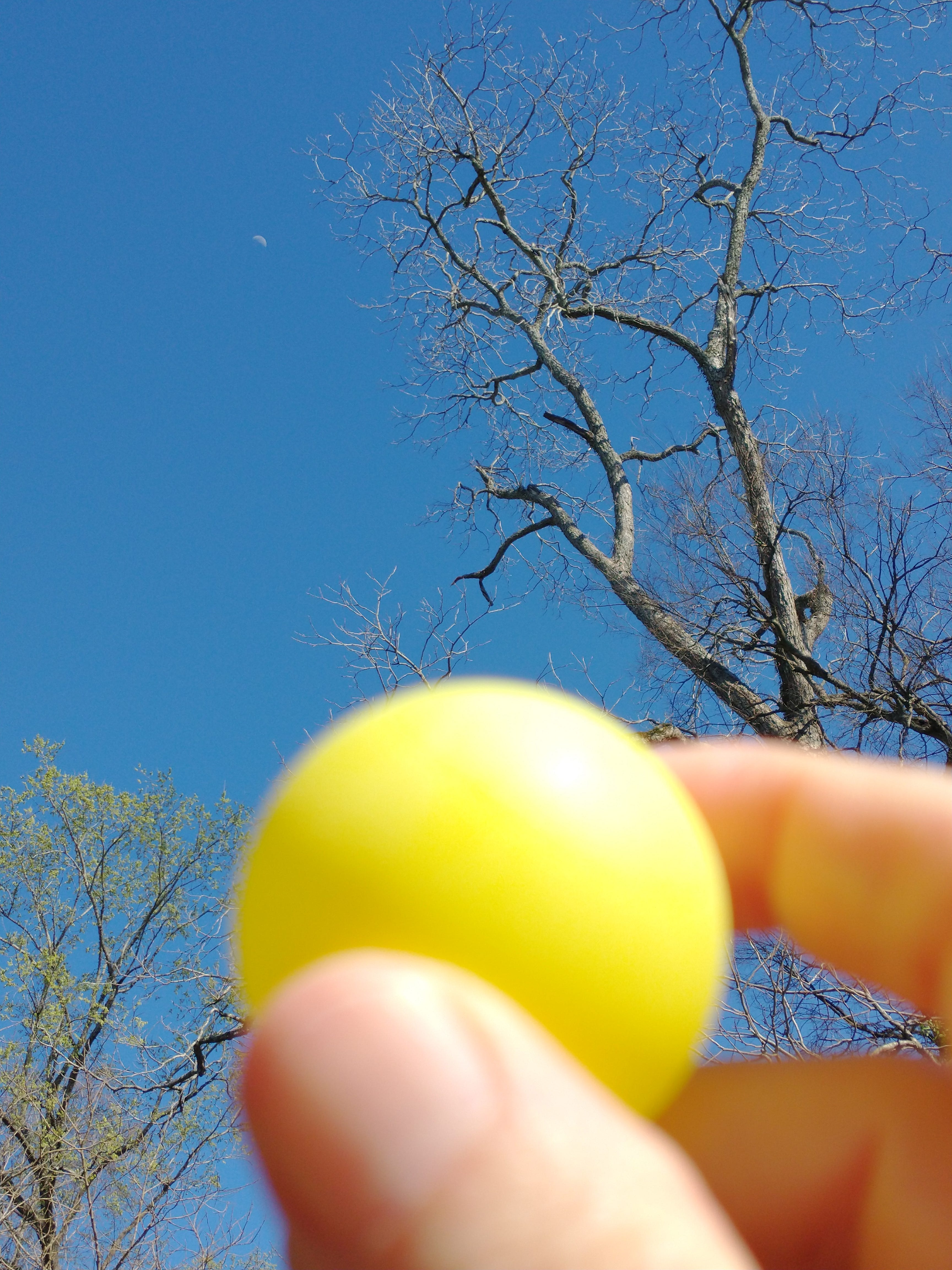
Cover Photo - Moon Misconception Exposed!
Welcome to Issue #54 of The Classroom Astronomer!
- Past and Future of TCA Issues
- Ping Pong Balls and the Moon for KnowledgeSky Lessons - Busting a Moon Misconception
Fourth Post of Exploration of the Universe with Big Data (Part A )
This issue is a bit skimpy (and the Exploration of the Universe with Big Data delayed) due to yours truly getting rather ill, too much to sit at the laptop. Mostly but not quite fully recovered. I will spare you the details.
More positively, this being April, the next month begins Conference Season. May through July are four large astronomical society meetings in which much educational material is presented. I participate virtually to all, but one will occur when I am on a week long trip. The American Astronomical Society does very little online these days but those I can get to while I am traveling, live or via YouTube, I will look at, though education is pretty rare among those. The others, the EAS, CAP and British NAM meetings are entirely hybrid. Therefore, expect some increase in TCA postings after April.
Additionally, I am supposed to be on a trip next week to Atlanta and the following week to Augusta and Savannah, Georgia, in mid-month. I am assuming I will make the trips but if I do, I won’t be able to write during most of the next two weeks. If I don’t go, it will be this reluctant-to-leave-me illness stopping me. I am expecting to get out TWO issues today and tomorrow on the Exploration of the Universe material.
One last note in a more positive vibe. Out of virtually nowhere, an astronomical book project dropped into my lap, on a short deadline, but easy to do because I already have most of the material! I will make an announcement on or about the May 1 issue with a discounted pre-order promotion. All I will say right now is that it will be of interest both to those who like astronomical traveling and those who like observing the night sky all night.
Enjoy!
Dr. Lawrence Krumenaker, Publisher
Email: newsletter@classroomastronomer.com
Website: Classroomastronomer.com
The Moon’s Dark Half is Due to Earth’s Shadow, Right?
Young students are often surprised to find the Moon up in the daytime sky; it is too often pictured as a bright disk in a dark night sky. But having it visible in school hours is the best way to get rid of at least one misconception about the Moon’s phases, about what causes them.
Common ideas are that the dark part of the Moon’s shape being caused by the shadow of the Earth on the not-visible part of the Moon, or by clouds blocking the light (either from the Sun or as a kind of filter in the Earth’s atmosphere). A good way to test the latter is to set up a Sun-Earth-Moon model in a classroom, put the ball representing the Moon off to one side of the student so that a half-moon shape is seen and have some kind of cloud (such as dry ice in water creating a fog) between student and ‘moon’ and seeing that the fog doesn’t do anything about the shape of the Moon they see.
But using the real Moon in the sky is more interesting for the first misconception. Take the same Moon-ball outside on a clear day (no clouds helps) and hold it up towards the Moon (see Cover Photo). It should be very evident that they have the same shape because the Sun is shining on both spheres from the same place, in the photo, from the right. Further more, there should be shadows on the ground to the student’s left. That further supports the idea that the dark part of the Moon shape is the Moon’s own shadow, or rather, that part of the Moon is in its own shadow, the not-yet-lit by the Sun area.
If you do this during a phase that does NOT have a straight edge, such as a fat crescent shape or a fat gibbous Moon, that further supports the idea that, like the Moon in the student’s hand, the Moon itself is a sphere by having the same curvature of a day-night or sunlit/not-sunlit border.
This little exercise is a stronger way to teach a topic when the topic has misconceptions abounding. Show with a model and experience rather than with simple teacher authority.
Personal Note: An article on ‘busting misconceptions’ discussing seasonal climate and weather causes, and the locations of Sun, rain and rainbows, is in editorial hands for a future issue of The Physics Teacher, from the American Association of Physics Teachers.
In Post #3 we looked at the online service Aladin and located all the information available, including a huge number of alternative designations and names for the star Regulus. In this Post, we begin the search for that same information but for the stars on our List of Ten stars we want to check. Then we will look at those stars we are interested that have no name, just a coordinate published.
Let’s quickly recap the ten objects we are going to be searching for their information:
40 (Omicron-2) Eridani - Winter Star, Home of the Vulcans in Star Trek
Aldebaran - Home of a colony in Star Trek
Wolf 359 - Scene of a major battle in Star Trek
Polaris - The Pole Star
Thuban - Star in Draco the Dragon that used to be the Pole Star
Dubhe - Top Front Pointer star in Ursa Major (Big Dipper)
BS Tauri - Irregular variable star with an unexpected periodicity
BD+21d 255 = K3 - An unusually high galactic latitude S-star
K8 - A carbon star
KU-11 - Another carbon star
All of the list down to the bottom two use classical names or designations from historic surveys and catalogs of the sky. Flamsteed (40) numbers. Bayer (Omicron) designations with Greek letters. Specialized catalogs’ designations, such as a high proper motion (movement across the sky) list by Max Wolf, over 100 years ago. The Bonner Durchmusterung (BD), a whole sky catalog made in the 1800s by astronomers at the German Bonn Observatory.
The bottom 2 (or 3) are objects observed by this article’s author using his K numbers (except one later was found to have a BD number. That will be in Post #5.
40 Eridani (= Omicron-2 Eri) Home to the Vulcans in Star Trek.
Not to be confused with nearby Omicron-1 Eri. It is the slightly reddish star in the center of the Digitized Sky Survey photo below…..
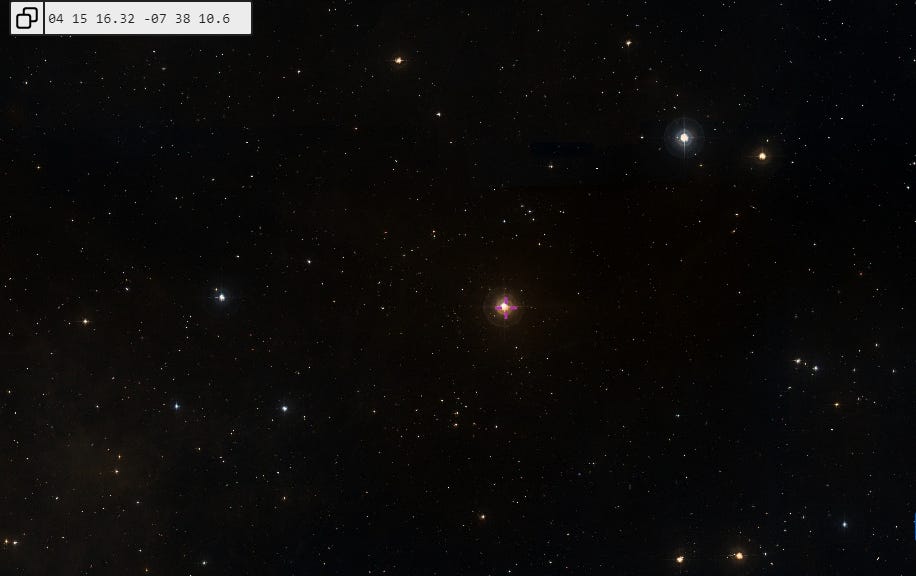
…for good reason. In this first block of data, it is a K0 dwarf star, redder than the Sun. It is also a high proper motion star, noted for its high speed across our field of view, and it is nearby, about 16 lightyears (ly) away.
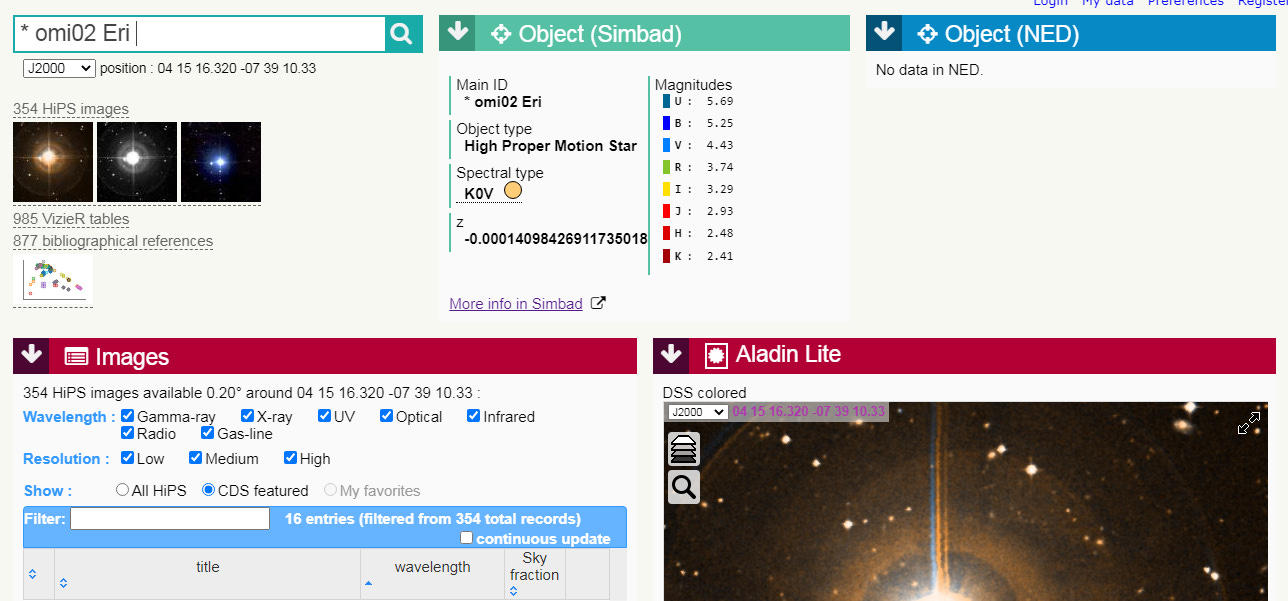
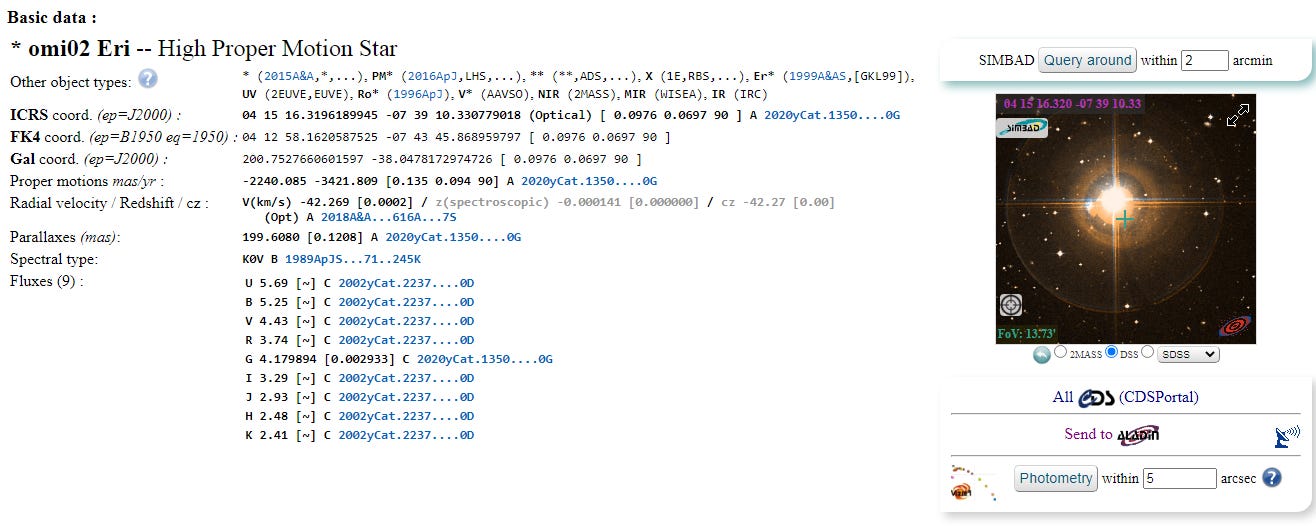
Find that by dividing 3262 by the milli-arcseconds (mas), here 199.6. Best way to get that information is to click on the More Info in Simbad link in the Object column.
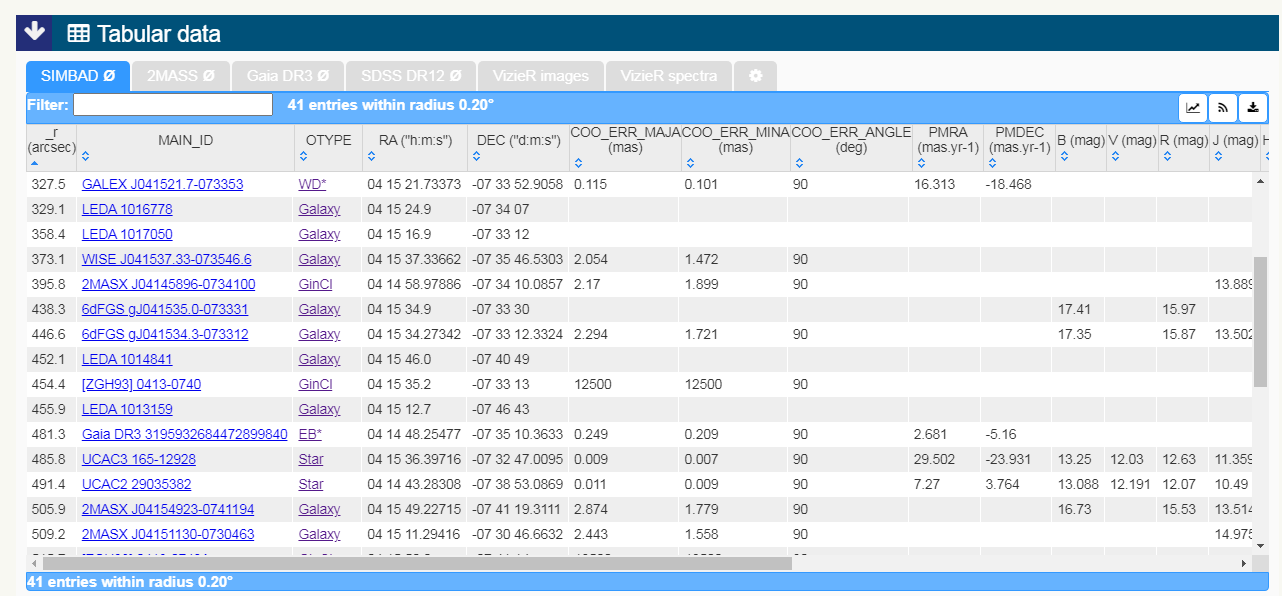
Back to Aladin, we drop past some data to a Tabular data block. It goes further down and also to the right than this screen shot shows. You see on the left a whole bunch of alternative names, i.e what the star is called in various catalogs of star data from satellites and observatory surveys…..41 one of them.
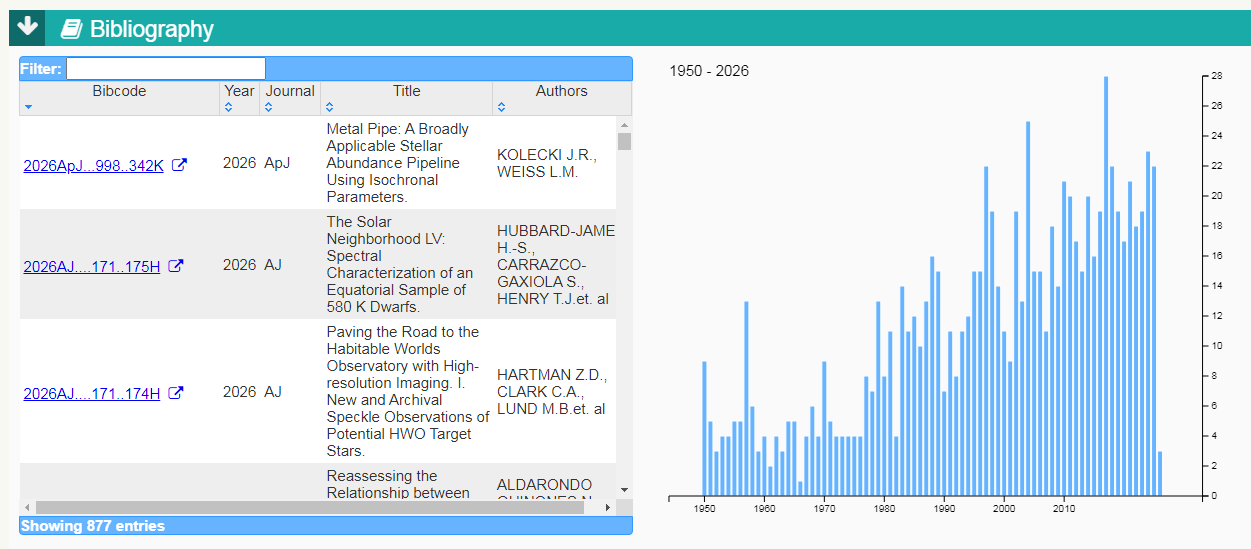
Read all about the research? Go down another screen. You’ll see the first of (in this case) 877 articles that refer to this star in some way, and a graph of the amount of publications over the years, here obviously increasing.
Finally, let’s get all the alternative names, some 56 or so, in one space where we can explore if there are exoplanets, or other interesting information. This we get back in Simbad, below the first screen we showed above.
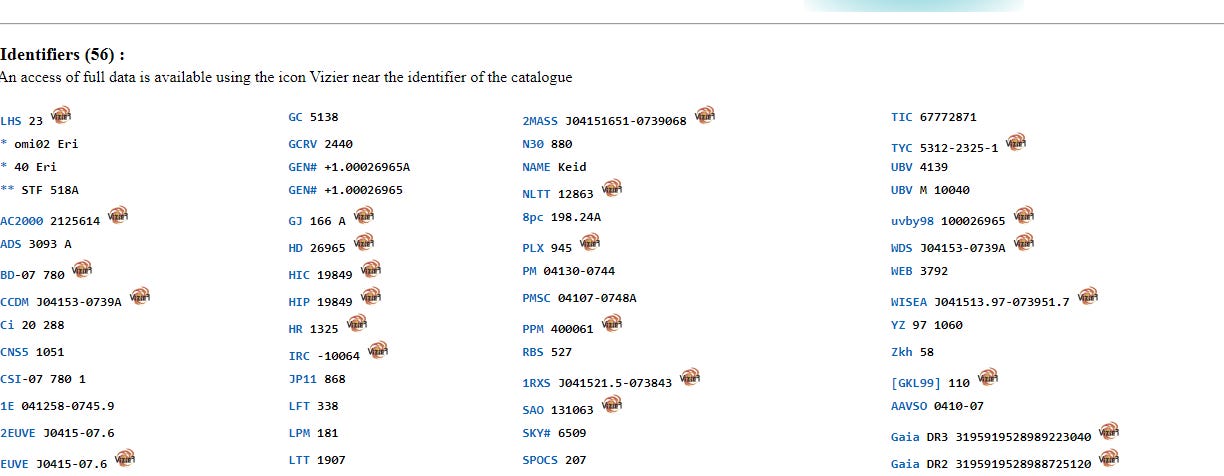
Clicking on the whirlpool symbol, with Vizier in it, gets you directly into those particular data realms. Sorry, no portal yet exists into the Vulcan Academy Library…..
Comments
Nothing yet. Say the first thing.
Sign in to join the conversation.