
“The great Mississippi River seemed forever flowing, flowing through his speech, through the shadowless white sands of thought. His voice seemed to say like the river, ‘Why hurry? Eternity is long; the ocean can wait.’”
Many societies are in the habit of elevating important cultural figures to the status of near-mythical heroes, and the United States is certainly no exception. So deep is the reverence for our great politicians, athletes, and artists that it can be easy to forget that they were human beings, complete with just as many complexities and nuances as anybody else. Understanding them as people often requires a considerable amount of investigation.
Such is very much the case for Mark Twain, who was already being lauded as one of the nation’s greatest writers and satirists during his lifetime and has only become more so since his death (find one of his short stories, “The Celebrated Jumping Frog of Calaveras County,” read aloud here). Perhaps it was in an effort to escape this towering image that he built Stormfield, the remote Connecticut mansion where he lived for the last two years of his life, which he initially called “Autobiography House.” As if in recognition of the fact that his public image had become something apart from who he was, he decorated one of the rooms with caricatures of himself.
One of the most insightful looks at the man behind the mythology comes from a similarly valorized figure in American culture: Helen Keller. Ironically, “Our Mark Twain,” an account of their friendship that she wrote for The American Magazine, deals not with the popular image of Twain but with “Mr. Clemens” as he appeared to those with whom he shared his final home. The result is more than a little melancholy, which may come as a surprise to those who are only familiar with Twain as the great humorist, but therein lies much of its value.
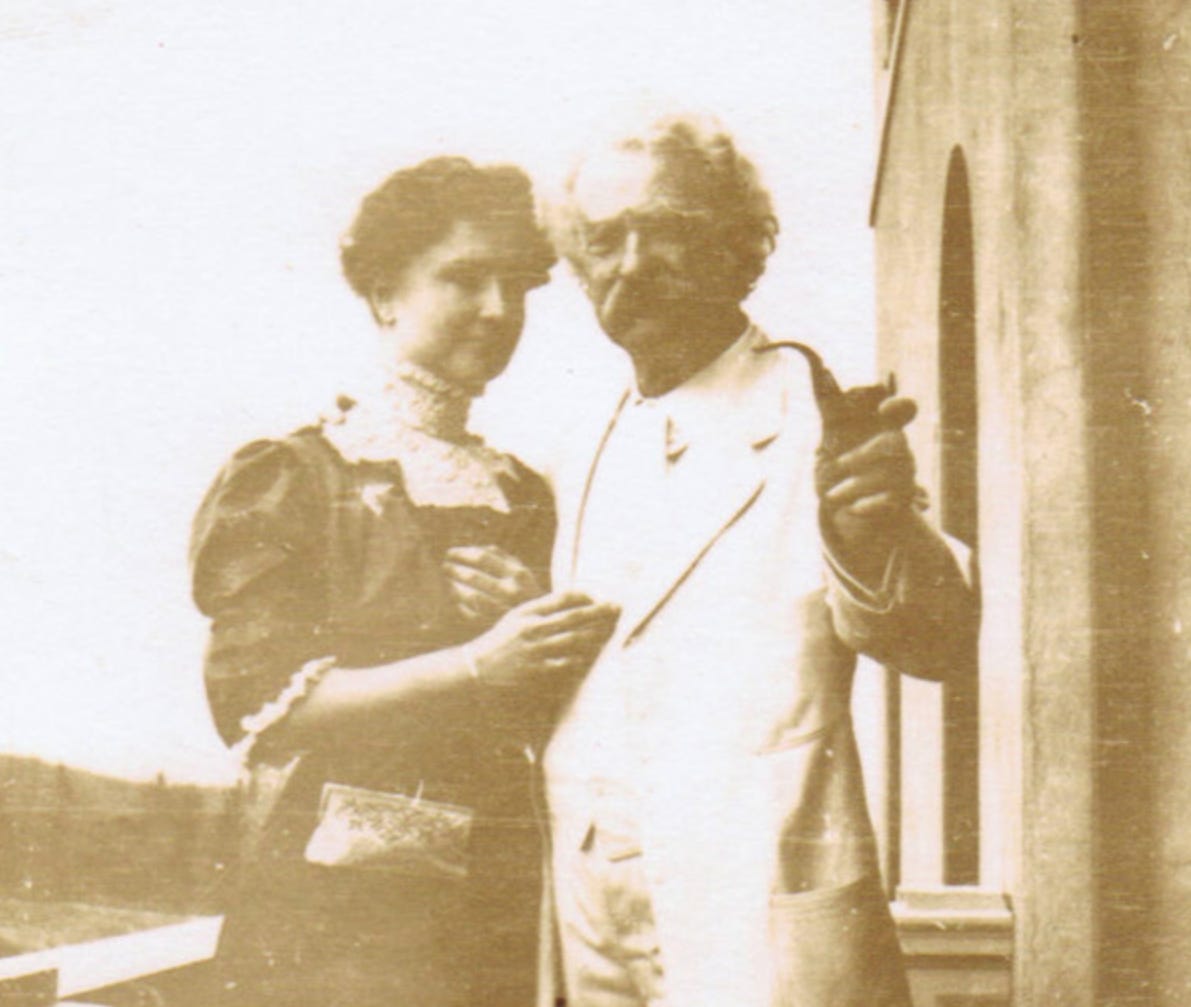
Stormfield burned to the ground some time after Twain’s death, leaving only a single stone wall behind, but Keller’s vivid writing preserves not only the estate itself but, more importantly, the human being who lived there.
Please enjoy…
Headline Image: Connecticut Landscape by John Henry Twachtman, c. 1890

An excerpt from My Ántonia by Willa Cather, 1918
“After the Race” by James Joyce, 1904
Comments
Nothing yet. Say the first thing.
Sign in to join the conversation.