
Guys, during the week, I lost my cat. For days, I couldn't even laugh at a joke at work.
And it really got me thinking... How on earth did Mark Twain do it? How?!
How do you keep writing some of the funniest books ever written, spend your life making people laugh, travel the world giving humorous lectures... while your own life keeps breaking your heart?
Is that even humanly possible?
Have you ever really read about Mark Twain's personal life? I mean, really read it? If you have, you'll understand exactly what I'm talking about.
You know that old saying about comedians being the saddest people on earth? That's not even my problem. My problem is... how do they keep going?
How do they keep showing up? How do they keep making everybody else laugh when they can barely hold themselves together?
This is about Mark Twain, guys…
Mr. Twain has, inarguably, spent decades making millions of strangers laugh. But this same man also buried three of his four children, watched his publishing empire collapse under crushing debt, lost a fortune on one of the worst technological investments of the nineteenth century, saw his younger brother die in a steamboat explosion, lost his father before he was even a teenager, and spent years working himself almost to exhaustion just so he could eat.
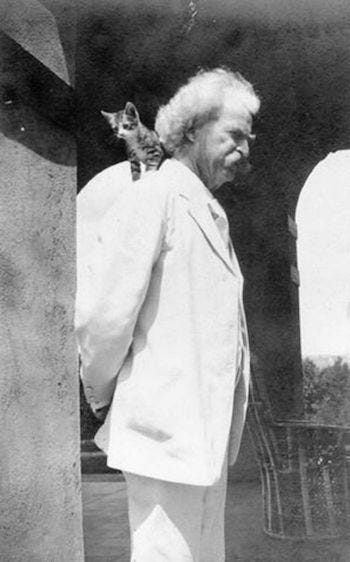
I know that is not the life most of us picture when we hear the name Mark Twain or come across his books or his picture on the internet. Most of us just picture the white suit and the cigar. Me too.
We just picture the man who could fill a lecture hall with laughter before anyone had even settled into their seats. That is true, but not the whole truth.
And after reading everything I could find about him, I understood that pain comes in levels. There are levels to these things, really. Looking at the list of everything he went through... I think the bankruptcy, the public failure, the humiliation, and all the financial mistakes had nothing on what eventually happened to him. Yes, they did a number on him, but what finally broke him was the death of his daughter, Susy.
And that is not an exaggeration. By the time Susy died, life had already thrown almost everything it possibly could at Mark Twain.
Twain's publishing company collapsed under debts of ninety-four thousand dollars, an extraordinary amount in the 1890s. Part of the disaster was tied to his business partner, Charles L. Webster, his nephew by marriage, whose growing dependence on drugs made an already struggling business even harder to manage.
Then came one of the most famous bad investments in history: the typesetting machine episode. Twain poured forty thousand dollars into James Paige's astonishingly complicated typesetting machine.
The thing had nearly eighteen thousand moving parts. It was brilliant, it was revolutionary, and it also barely worked.
While newer, simpler technology quietly took over the printing industry, Twain kept financing Paige's invention, convinced that success was only one more improvement away. It never came.
By the time he accepted defeat, he had lost what would be roughly one and a half million dollars today.
And yet, even then, Mr. Twain refused bankruptcy.
Instead, he embarked on exhausting lecture tours across the world, travelling from city to city and country to country, standing on stages and making strangers laugh, writing cheques from his earnings to people he owed money to because his sense of honour would not let him do anything else.
But through all of this, his family kept him going and kept him functional. And within his family, one person in particular kept him more grounded than anyone else.
Her name was Susy.
Susy Clemens was born on March 19, 1872, the second child and eldest daughter of Samuel Clemens, also known as Mark Twain.
From the very beginning, she was something apart from ordinary. She was sharp, emotionally alive, and intense in ways that simultaneously exhausted and delighted everyone around her.
When Susy was thirteen years old, she did something beautiful and thoughtful. She wrote a biography of her father.
It was not for school and not because anyone asked her to. She wrote it because she was frustrated, specifically because the world only ever seemed to see Mark Twain as a humorist, and she found that reductive and slightly insulting to the man she actually knew.
In her own words, with her original spelling left exactly as she wrote it at thirteen, it says;
"It enoyed me greatly, because it troubles me to have so few people know papa, I mean realy know him, they think of Mark Twain as a humorist joking at everything."
And then, in the same biography, describing him directly:
"He is a very good man and a very funny one. He has got a temper, but we all of us have in this family. He is the loveliest man I ever saw or hope to see and oh so absent-minded! He does tell perfectly delightful stories."
She was thirteen.
She wrote that without anyone prompting her, purely because she loved him and because she thought the world was not paying close enough attention to who he really was.
Mark Twain kept that biography for the rest of his life. He later wrote that he had received compliments before, but none had touched him like that one; none could approach it in value in his eyes.
He called her a prodigy.
He wrote that she was a magazine of feelings and that, in all things, Susy was intense; that in her this characteristic was not a mere glow dispensing warmth but a consuming fire.
At one point, he based his portrayal of Joan of Arc on her. Twain literally modeled his ideal of a saint on his own daughter. That is the specific and unmistakable measure of how he saw her.
Susy herself was complicated in exactly the way brilliant people tend to be.
She grew frustrated with her father's fame as a mere humorist, in the same way she had been frustrated as a child writing that biography.
She wanted the world to see him as a serious writer, as the full human being she had always known him to be. She was ambitious, fiercely loyal, and deeply sensitive to the gap between public image and private reality.
Susy wanted to be an opera singer.
She trained in Europe with real dedication, but her voice teacher eventually told her she did not have the physical strength that grand opera demanded.
By her early twenties, she was anemic, sleep-deprived, and losing weight in ways that alarmed everyone around her. She was literally fading.
In August 1896, while visiting the family's old home in Hartford, Connecticut, Susy developed a fever. The fever turned into spinal meningitis. She was twenty-four years old.
The family's Irish maid, Katy Leary, took care of her through it, sleeping on a sofa in the room and never once leaving her side.
Susy spent her final days moving in and out of delirium, between moments of strange clarity and complete confusion. At one point, she clutched an article of her mother's clothing and wept because she was convinced her mother had died. At another, she looked out the window at the street below and sang quietly to herself:
"Up go the trolley cars for Mark Twain's daughter. Down go the trolley cars for Mark Twain's daughter."
She later lost her sight and lapsed into a coma. On August 18, 1896, Susy Clemens died.
Her mother, Livy, and her sister Clara were on a ship in the middle of the Atlantic, racing home to reach her. They arrived three days too late.
Mark was in England when the news found him. He was completely alone.
He wrote to his closest friend, the Reverend Joe Twichell, a letter that I believe is one of the most devastating things a grieving father has ever committed to paper.
I am going to give it to you in full because it deserves to be read in full and not summarised:
"I did know that Susy was part of us; I did not know that she could go away; I did not know that she could go away, and take our lives with her, yet leave our dull bodies behind. And I did not know what she was. To me she was but treasure in the bank; the amount known, the need to look at it daily, handle it, weigh it, count it, realize it, not necessary; and now that I would do it, it is too late; they tell me it is not there, has vanished away in a night, the bank is broken, my fortune is gone, I am a pauper."
Mark Twain never set foot in the Hartford house again.
He worked constantly after that because he believed it was the only thing that helped. He once wrote that he worked all day, and that trouble vanished away whenever he used that magic.
Writing was the container he poured everything into when there was nowhere else for it to go.
But Livy, his wife, had no such container. In Mark's own words, she sat solitary all the day and all the days, wondering how it all happened and why.
You see, Susy had been her constant companion, her closest comrade, and without her, Livy had nothing left to anchor herself to.
The grief eventually consumed her health entirely, and she died in 1904, eight years after Susy, never having fully recovered from losing her.
Ten years after Susy's death, Mark published the biography she had written of him in the North American Review. You can look it up.
He published it completely unedited, with her original thirteen-year-old spellings and all, because he wanted the world to see her exactly as she was.
Susy is buried in Woodlawn Cemetery in Elmira, New York. Her headstone bears a poem that Twain adapted from Robert Richardson's Annette:
“Warm summer sunshine kindly here,
Warm southern wind blow softly here,
Green sod above, lie light, lie light,
Good night, dear heart, good night, good night."
Mark outlived two other children as well. His infant son, Langdon, died at the age of two from diphtheria. His daughter Jean died on Christmas Eve, 1909, drowning in the bathtub during a seizure.
We will have a whole piece on his other losses because they deserve their own space and their own time. But Susy was the one who broke him.
Thankfully, he found a way of channeling his grief through writing. Maybe that is what kept him standing. Who knows what would have become of him otherwise?
It is heartbreaking that the man who wrote our favourite books, who made the entire world laugh, was hurting the whole time. It is heartbreaking even writing this.
I no longer think Mark Twain’s greatest achievement was making the world laugh, I think it was finding a way to keep laughing himself.


No posts
Comments
Nothing yet. Say the first thing.
Sign in to join the conversation.