
There are writers, and then there was this man who was crazy enough to describe his own method of writing as “a willful blurring of literary boundaries.”
As a German who grew up in the shadow of the Second World War, he wrote about the Holocaust without ever directly mentioning it, and yet readers understood exactly what he meant.
He literally wrote sentences that went on for nine pages. He casually rejected the term novel because he hated plot and dialogue.
This man turned history, memoir, biography, travel writing, and fiction into a single, seamless flow, and you could not tell where one ended and the other began.
Unfortunately, he died in a car crash at fifty-seven, just as many believed a Nobel Prize was only a matter of time.
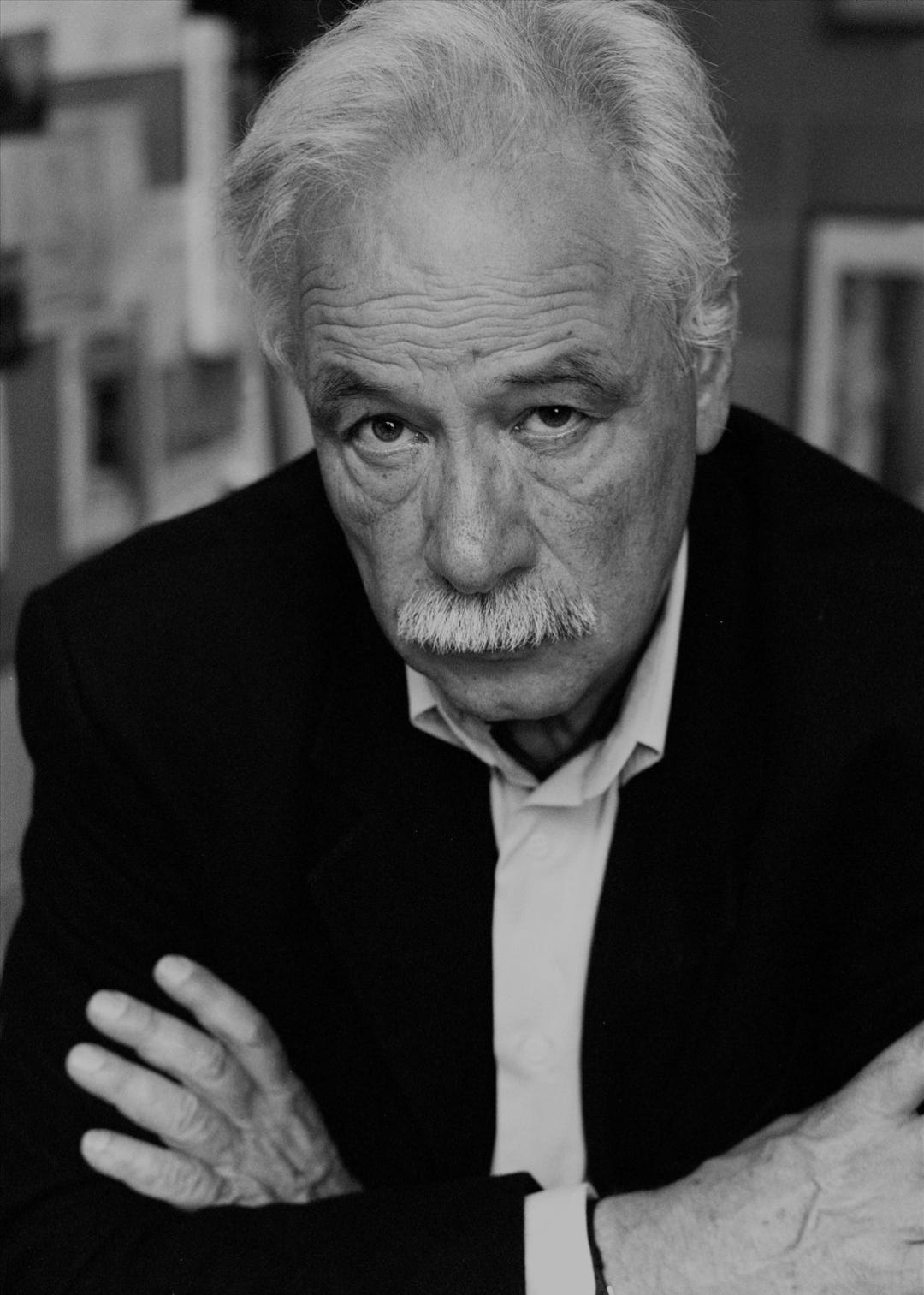
That is not your normal kind of writer or author... That was W. G. Sebald.
And this is my favourite thing about him…
Earlier, when I said there are writers, and then there is Sebald, I meant every word, and other scholars and critics have confirmed it.
This man wrote sentences that went on for pages. One sentence in Austerlitz famously stretches for nine pages without a single paragraph break.
Nine pages, no paragraph break, just a slow, relentless, hypnotic flow of words that pulls you under like a current.
One scholar, Amir Eshel, described the effect as “the elasticity of the syntax, the avoidance of clear paragraph structure, the slowness it practices and imposes on the reader.” He wanted to slow you down. His prose was not designed to be consumed quickly. His prose was designed to be endured.
And that endurance, he believed, was a form of moral resistance. You could not read Sebald while scrolling on your phone. You had to sit with him. One critic described his style as “a slow lava flow of narrative, a vast black river of type.” It was never intended to be fast. It was never intended to be easy. It was beautiful and devastating and impossible to forget.
Like I mentioned earlier, W. G. Sebald is famous for writing clearly about the Holocaust without ever directly describing it.
You see, he was born in Germany in 1944, just before the war ended. His father was a soldier in Hitler's army. He grew up in the post-war silence, where no one talked about what had happened. He learned about the concentration camps at school when he was seventeen, and the trauma of that knowledge hit him hard.
He believed that you could not write directly about the Holocaust without falling into “sensationalism” or “sentimentality.” So he developed his own way of writing about it, an entirely different approach.
He wrote about people who were affected by the Holocaust, people who were haunted by it, and people who were searching for fragments of memory that had been erased. Sebald wrote about characters who were “lost souls, breaking beneath the burden of their own anguish.”
For instance, in his poem about the town of Türkenfeld, he describes a small German town, possibly seen from a passing train. It is a “fine little idyllic lyric.”
If you know what lies behind Türkenfeld, this will make a whole lot of difference.
You see, Türkenfeld was the location of one of ninety-four subcamps linked to Dachau and a station on the railway called the Blutbahn, the “blood track” that transported thousands to their deaths.
Sebald leaves all of this out of the poem. Like I mentioned earlier, he does not mention the Holocaust directly. But its shadow is everywhere.
One scholar, Carol Jacobs, described his approach as an “ethics of melancholy outrage.”
He was outraged, but he expressed that outrage indirectly. He expressed it through suggestion and allusion. He once said, “I suppose it is submerged realities that give to dreams their curious air of hyper-reality.” His entire writing project was about bringing those submerged realities to the surface.
Sebald broke so many rules. He rejected the very idea of the novel. In an interview, his biographer, Carole Angier, said, “He rejected the term ‘novel’ because he disliked the creaking apparatus (as he'd say) of plot and dialogue, of getting people in and out of rooms.”
Not one of his books follows a normal narrative arc. There are no clear beginnings, no dramatic climaxes, and no neat resolutions. Instead, they take the form of musing and remembering, with long passages of digression, all expressed in striking and very beautiful prose. And, like we have mentioned earlier, he described his method as “a willful blurring of literary boundaries.” He did not care about genre. He cared about a kind of truth that was not bound by facts.
W. G. Sebald loved using images. He once wrote that, “The more images he gathered from the past, the more unlikely it seemed to him that the past had actually happened in this or that way, for nothing about it could be called normal: most of it was absurd, and if not absurd, then appalling.”
To Sebald, history was not a neat story. To him, history was chaotic, fragmented, and often incomprehensible. So his books reflected that chaos.
The academic Richard Gray called his narrator a “ghostwriter” in the profound sense that his stories “fictionally re-enact the histories of obscure, but once-living individuals whose lives they revitalize.”
Sebald was the poet of the disregarded, the people who had been sidelined by history, whose memories had been erased, whose voices had been silenced.
Sebald once said, “Physicists now say there is no such thing as time: everything co-exists.” He further stated, “Chronology is entirely artificial and essentially determined by emotion. Contiguity suggests layers of things, the past and present somehow coalescing or co-existing.”
I am sure you will agree with me that Sebald's writing reflects this belief. His sentences drift between past and present, memory and speculation, fact and invention. You cannot tell where one layer ends and another begins.
I love how his biographer describes his sentences. It says his sentences “maintain a constant oscillation between different temporal forms, between ‘I remember’ and ‘we stopped,’ ‘I went out’ and ‘that had touched.’” This creates an “unstable temporality” that shifts between different layers of the past and different aspects of the present.
It is disorienting by design. He wanted you to feel the weight of time bearing down on you.
Frank Kermode wrote about the clock's “tick-tock” as a model of plot; he said the “tock” is the end that gives meaning to the whole. But Sebald “extends the gap between ‘tick’ and ‘tock’ ad infinitum.” There is no resolution, no neat ending, just the endless, heavy passage of time.
He once wrote, “I feel more and more as if time did not exist at all.” He further stated that, “The only thing is that there are various spaces interlocking according to the rules of a higher form of stereometry, between which the living and the dead can move back and forth as they like.”
Now back to the photographs. The photographs in his books are no less deceptive. He filled his books with blurry, melancholic black-and-white images of people, places, and objects. At first glance, they look like evidence, like proof that everything he is telling you actually happened. But they are not evidence. They are part of the illusion.
You see, some of the photographs are real. But some are actually fake. Some are taken from archives, Sebald himself took some, some were altered, and others were completely fabricated.
His biographer, Carole Angier, said, “It's the insertion of photographs and documents that makes his characters feel so real. We don't just imagine them as we read, we see them, we look into their eyes.”
The only problem is that those eyes are actually lying to you. Sebald openly admitted that the photographs served the purpose of “readerly disorientation.”
You see, Sebald wanted you to feel unsettled. He wanted you to question what was real and what was invented. He turned it into a style that critics now call “Sebaldian,” and many younger writers have since adopted aspects of it.
Sadly, W. G. Sebald died in a car crash on December 14, 2001. He was fifty-seven years old. He was driving with his daughter Anna when he suffered a heart attack behind the wheel. The car swerved into oncoming traffic and collided head-on with a truck.
At the time of his death, he was at the peak of his career. He was still writing and still had more to say.
He had been working on a major project about Corsica alongside several other unfinished works that remain part of his literary estate.
Many writers believed his greatest work might still have been ahead of him.
J. M. Coetzee admired him deeply. When Susan Sontag famously asked, “Is literary greatness still possible?” her answer was simple: “One of the few answers available to English-language readers is the work of W. G. Sebald.”
Members of the Swedish Academy later acknowledged that he would have been a worthy Nobel laureate. Sadly, he never lived long enough for that possibility to become reality.
And before you ask… No! W. G. Sebald never won the Nobel Prize. But perhaps awards were never going to be the measure of his legacy anyway.
His works, Vertigo, The Emigrants, The Rings of Saturn, and Austerlitz… those books are now widely regarded as masterpieces, and together they helped create an entirely new literary vocabulary.
His influence stretches across contemporary literature. Writers continue borrowing his blend of fiction and nonfiction, history and memory, photographs and prose.
I personally loved the fact that his approach has become so distinctive that it now has its own adjective: “Sebaldian.”
I believe one critic captured his achievement better than anyone else. He said, “What earns Sebald the gratitude and affection of readers is the great darkness, the shimmering light. He was able to pin both down, time and again, with impeccable technique, onto the printed page.”
Guys, after reading some of his works, essays, biographies, and some other works, I am no longer convinced that great literature is supposed to give us answers.
Take Primo Levi, for example. He spent the rest of his life writing about the Holocaust, yet he never claimed to explain it. He simply bore witness to it.
So, maybe that is literature's greatest achievement: not answering history's hardest questions, but teaching us how to live with the ones history never completely resolves. Mystery.
Or take Elie Wiesel, for example. He spent decades writing about the Holocaust, not because he thought it could ever be fully explained, but because it could never be allowed to fade into silence.
Outside the Holocaust, another example of the mystery of literature is Franz Kafka. It has been over a century now, and people are still arguing about what his stories really mean.
And guys, I am addicted. Because these are the kind of books I now love to read… books that I don't necessarily want to give me answers anymore. Books that leave something unresolved, books that make me keep turning things over in my head long after I have closed the book. Books that send me down the rabbit hole, researching, reading, questioning, and then somehow finding five more books I now have to read
.
No posts
Comments
Nothing yet. Say the first thing.
Sign in to join the conversation.