

The moment I entered the room, I sensed something was wrong. In many respects, everything appeared as it should, yet somehow, I could sense a quiet desperation in my friend: her usually radiant smile was diminished; the light in her eyes dimmed. In a futile grasp for normalcy, I asked my friend how she was, but intuitively, I knew the answer. Suddenly, the truth bursts forth: “He wants a divorce.”
That morning, I listened, with tears continually welling in my eyes, as my friend heartrendingly related her sorrow and confusion: without warning - without seeming reason - her husband had decided he wanted to leave her and their child. Citing his need to be free and his lack of “self-knowledge,” he, like countless other men and women before him, appeared ready to sacrifice his family upon the altar of self-actualization and personal discovery, heedless of the catastrophic damage left in his wake. I felt stunned. Divorce might seem rather commonplace or acceptable in our modern culture, and collectively, we tend to minimize its impact, but as I sat listening to my friend, watching her tears, hearing her anguish as she felt her world crumble, the devastation became all too palpable and agonizingly real.
For quite some time now, our culture has promoted an ego-centric worldview. As children, we were all told to follow our dreams - regardless of the cost; to pursue aspirations over relationships; to consider personal feelings as paramount. Ancient fairytales, which championed the triumph of goodness over evil, and taught children to courageously pursue virtue and eschew selfishness - despite the often heavy cost - slowly gave way to stories that emphasized the importance of self-fulfillment over duty. No longer was the sacrificial love between a man and woman (for the good of each other and their children) something to which we should aspire. Suddenly, denial of self was a veritable anathema, elevation of self the ideal.
Unsurprisingly, the glorification of autonomy has naturally manifested itself into a rejection of the family as an obstacle to personal happiness (no wonder divorce seems like such a justifiable choice). Men and women alike began to view marriage less as a covenantal promise to love each other for the good of the other, and more as a means to achieve personal satisfaction. The increasingly popularized view of children - the natural fruit of a loving marriage - as an impediment to adult gratification - emphasizes the doctrine that each individual should live for himself. How many married couples adamantly declare their disinclination to have children? Is it possible to have a robust marriage culture when the normal demands of children, which undoubtedly limit adult pursuits, are so vocally disdained? If we, as a culture, are unwilling to prioritize children, whose natural vulnerability and dependency frequently requires adults both to curtail personal desires and to cultivate patience, understanding, and selflessness, is it surprising when grown adults fail to exhibit self-denial in serving their spouses?
Self-denial, however, goes against a human’s grain. I was reminded of this when, last night, I got into an argument with my seventeen-year-old daughter. She, anxious about looming homework, college visits, and the like, was frustrated by my, perhaps overly harsh, criticism that she had not begun an assignment with a swiftly approaching deadline. As I lectured about the importance of getting the project started, she countered that, unlike nearly all of her peers, she rarely enjoys “downtime.” To be clear, my eldest daughter most definitely has a full schedule: between her lofty academic aspirations, participation with a pre-professional ballet company, and part-time employment, she has little “free” time. And, to top it all off, her cuckoo parents decided to welcome twelve children into their lives - thereby forcibly consigning their progeny to a rather shocking number of siblings, complete with all the sacrifices inherent. These challenges, however, are all the more acutely felt in light of cultural norms that frown upon the creation of additional responsibilities (in the form of additional family members) for older siblings and parents alike. As my daughter keenly perceived, while our “over-sized” family necessitates the involvement of all the children, but particularly the oldest, to allow for the normal functioning of our household (well, as “normal” as our household could possibly be), most families can get by without each person helping fully. Many of Natalie’s friends simply do not have to serve their family (beyond the bare minimum), and subsequently, they happily hand over all familial responsibilities to their parents. In my daughter’s lament, I clearly saw the cycle of selfishness that has been normalized over the years: each member of the family - from husband and wife to daughter and son - has been conditioned to live for themselves.
Two weeks ago, I (along with Natalie and my baby son) visited my sister and brother-in-law, who themselves have five children. Ironically, as we were traversing airports on our journey to the East Coast, my sister’s family came down with a violent stomach virus, a situation that was further intensified by my sister severely breaking her arm (she fell hard, after slipping on her wood floor) - and this misfortune happened only days after my brother-in-law broke his own hand in a basketball accident (I know, truth is stranger than fiction). Despite the unexpected difficulties, we still managed to visit the Pope Saint John Paul II Museum and Shrine near the National Basilica of the Immaculate Conception in Washington, D.C Meandering through the exhibits of this modern-day Saint, I was particularly struck by his work on behalf of the family and human dignity - the significance of which modern Western society fails to perceive. While the world seems to increasingly emphasize and promote the narrowing of self - labeling autonomy and self-interest as the height of human success - Saint John Paul II advocated for the expansion of self through love. Rather than turning ever-inward, JPII unequivocally stated that we each have a duty - a Divine commission - to stretch ourselves beyond our cramped scope of self-interest in a continual effort to serve others in joy and love. While modern experts counsel living for oneself, even within the context of marriage and family, this Sainted Pontiff offered a diametrically opposed stance: “Each member of the family has to become, in a special way, the servant of the others and share their burdens.”
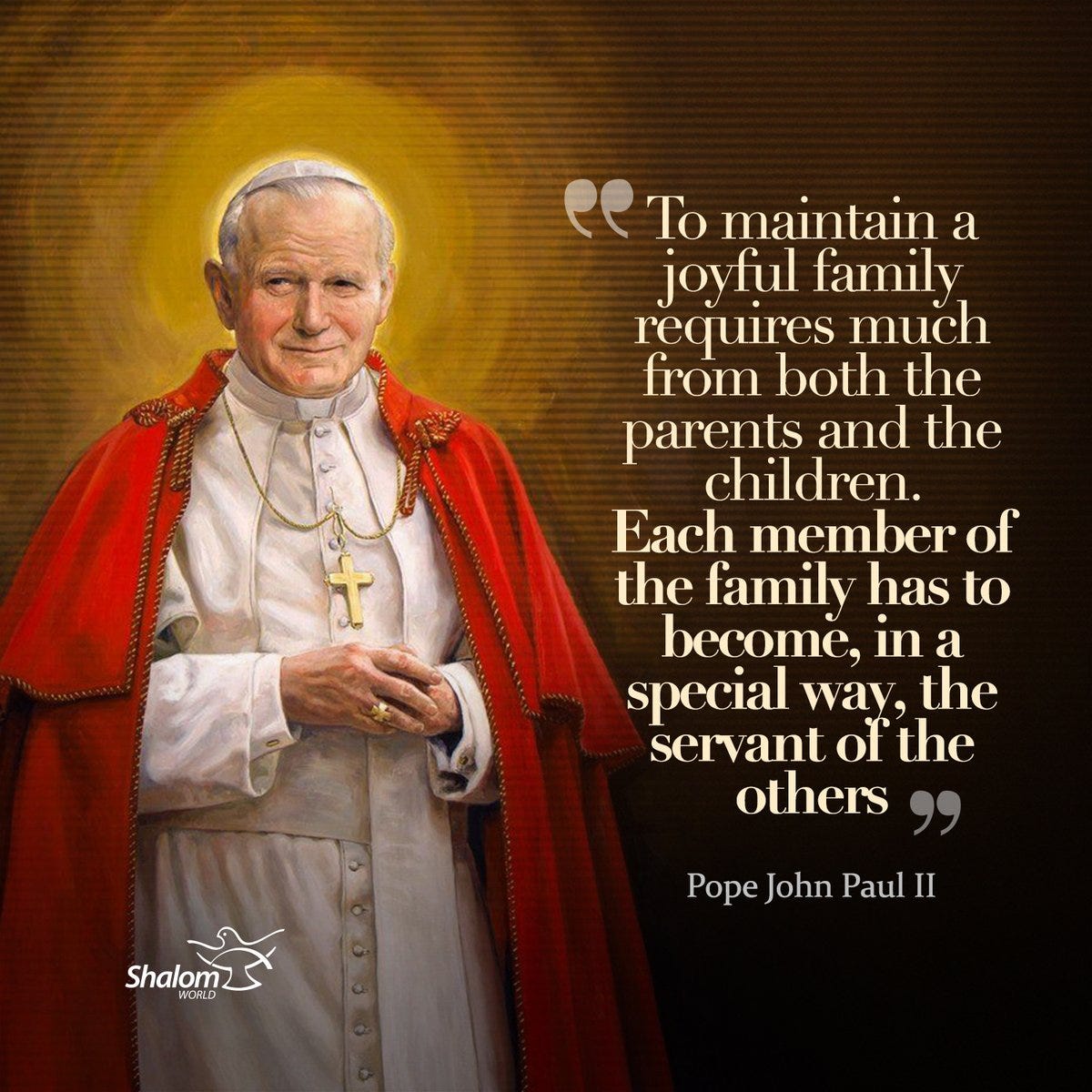
This imperative clearly rankles the modern soul, but if we really examine the issue, we see that the call to love - and to love without measure or self-interest - simply agitates the human heart. Our modern society, with all its conveniences, indulgences, and entertainment, may suffer from an increased proclivity toward self-centeredness, but in reality, the bristling against service is characteristic of human nature itself. Men and women hate to bend our wills to another; we lament interruptions of our carefully formulated plans; we scoff at the notion that our desires might not be best; we reject the intrusion of others’ needs upon our time and energy. Encouraged by a societal push to promote our egocentric tendencies, we end up destroying the relationships that make us strong: husbands and wives grow to disdain each other, parents long to liberate themselves from the burdens of children, and entitled children learn to spurn responsibility or duty. And all of this perpetuates a cycle of selfishness that destroys individuals, couples, families, and ultimately, societies.
Anyone who has lived in a family (essentially, every one of us), has seen how selfishness erodes happiness. In my own family, I know that things become the most chaotic, the most challenging, and the most frustrating when the burdens of family life fall primarily on the shoulders of one or two of its members, rather than the entire unit. In a large family, the ramifications of self-centeredness seem to proliferate more rapidly than they might in a smaller family. A married couple without children might be able to camouflage selfishness, since adults are not so readily dependent upon the help of others and can “soldier on” when the other spouse might not be willing to extend his or herself. Similarly, in families with fewer children, mothers and fathers often feel equipped to shoulder most, if not all, household responsibilities and burdens, so children are sheltered from sacrifices that would, in all likelihood, expand their young hearts. One of the built-in blessings of large families is that their survival necessitates the involvement of all: husbands, wives, and children. So, while self-giving love is necessary for all families to truly thrive, in a large family it is essential to stave off veritable implosion. But actually, when I consider how frequently divorce rears its destructive head, it seems all families - regardless of size - so desperately need the sacrificial spirit of service to stave off ruin.
Of course, this isn’t to say self-denial is easy. It isn’t. It requires commitment and resolve. It is achieved only through trials and tears. It demands continual detachment from things that are fleeting, be they material acquisitions, pleasurable pursuits, or personal accomplishments. All sacrifice is hard, because it means giving something up - something we desire. And giving up something of value is challenging because it requires self-mastery. It means prioritizing our affections and recognizing that what we want, what we hope for, is not always what should be most valued. It means that some things are inherently better than others, and we should seek the best things at the expense of the “lesser” things - even when those “lesser” things might be good in their own right. When we are willing to forsake truly lovely things - pleasure, tranquility, personal aspirations, comfort, and more - to serve others, we give testimony to the sublime goodness of people.
As children and young people growing up in the second half of the twentieth century, we were all instructed to let our hearts dictate our choices. We were counseled to prioritize self-achievement and personal liberty over duty, responsibility, and relationship. But if my friend’s situation (and the situation of countless others grappling with the devastation of divorce) is any indication, that counsel of pursuing self-fulfillment at the expense of others seems the least likely to produce genuine happiness in our souls. If we want to recapture the beauty of the family - the indissolubility of marriage, the irreplaceability of children - we need to emphasize the virtues that promote unity and love over the virtues that cater to self. If we want to increase our capacity for love, perhaps we need to stop limiting our opportunities to love. And while that begins with asking ourselves to do things we might find initially distasteful or undesirable, it also demands that we refuse to shelter others - particularly the children we are raising - from heartache, struggle, or difficulty. We need to reorient our aspirations to esteem responsibility over gratification and love over self-indulgence. Perhaps we should say yes to more relationships that stretch us, that ask us to give when we are tired, to try when we’d rather not, to dig for patience and tenderness when we feel incapable of giving either. Like any athlete, if we never push ourselves beyond our seeming limits, our muscles atrophy, our abilities diminish, and we fail to grow. Likewise, if we choose to live exclusively - or even chiefly - for self, how will we become truly great in love? When we refuse to test ourselves, will we be surprised at our inability to give fully? A most wise Man once said: “He who secures his own life will lose it; it is the man who loses his life for My sake that will secure it” (Matthew 10:39, Knox Version). For the sake of our families, our souls, and our collective happiness, we would do well to heed His advice.
No posts
Comments
Nothing yet. Say the first thing.
Sign in to join the conversation.