
I’ve long had a soft spot for the late famed country singer Kenny Rogers. Perhaps it’s because my parents fell in love with his album “Christmas,” and my siblings and I vividly recall waiting - with impatience - to descend our staircase on Christmas morning, and the album’s opening song was our signal to race down the steps to see the hoped-for treasures brought by Santa Claus. As his voice rang out, we children joyously gasped at the gifts encircling our tree, which was covered in all its luminescent glory and ornament-clad splendor. His songs instantly transport me to my childhood. And perhaps even more importantly, Rogers’s beautiful Christmas songs point to Christmas’s foundational truth of the Incarnation and how this event forever changed our world.
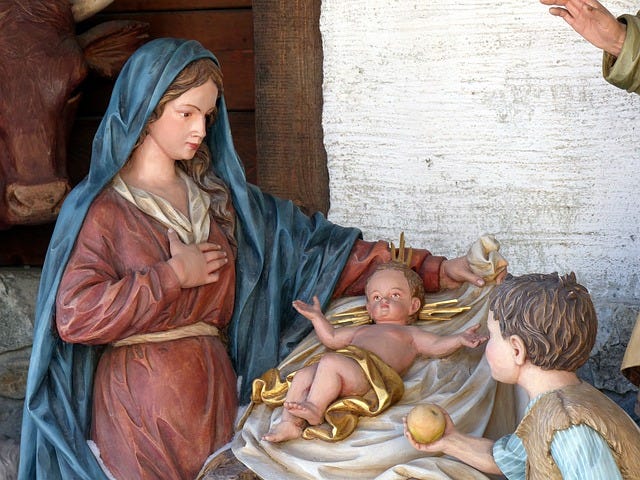
But there is one Christmas song of Kenny’s that is not so universally embraced as his others - one that has particularly upset many Catholics over the years: “Mary, Did You Know?” In 1996, Rogers and Wynonna Judd sang this contemporary Christmas carol and brought the song to the national stage (while it had been previously recorded by lesser known Christian and country artists, the duo of Rogers and Judd increased its audience).Though countless Americans appreciated their version and the various stylings to come, it seems that, with every new iteration of the song, critical posts or articles (primarily from my fellow Catholics) resurface, lamenting the song as a detraction from Mary and her singular role in Salvation history. Before I continue my personal thoughts on this “Christmas controversy,’ I would like to repost the lyrics for reference:
“Mary, did you know that your Baby Boy would one day walk on water?
Mary, did you know that your Baby Boy would save our sons and daughters?
Did you know that your Baby Boy has come to make you new?
This Child that you delivered will soon deliver you.
Mary, did you know that your Baby Boy will give sight to a blind man?
Mary, did you know that your Baby Boy will calm the storm with His hand?
Did you know that your Baby Boy has walked where angels trod?
When you kiss your little Baby, you kissed the face of God?
Mary, did you know?
The blind will see. The deaf will hear. The dead will live again. The lame will leap. The dumb will speak The praises of The Lamb.
Mary, did you know that your Baby Boy is Lord of all creation?
Mary, did you know that your Baby Boy would one day rule the nations?
Did you know that your Baby Boy is heaven’s perfect Lamb?
The sleeping Child you’re holding is the Great I Am.”
The greatest concern stems chiefly from the opening stanza, which ends with the lines: “Did you know that your Baby Boy has come to make you new? This Child that you delivered will soon deliver you”. To many faithful Catholics, that line is an affront to the Dogma of the Immaculate Conception: the ancient belief, formally declared, pronounced, and defined by Pope Pius IX on December 8th, 1854, stating “that the most Blessed Virgin Mary, in the first instance of her conception, by a singular grace and privilege granted by Almighty God, in view of the merits of Jesus Christ, the Savior of the human race, was preserved free from all stain of original sin” (Apostolic Constitution, Ineffabilis Deus). Faithful Catholics firmly believe that the Blessed Virgin was conceived Immaculately - kept free from the stain of Original Sin - in order that she, as the new Ark of the Covenant, would not only serve as a most worthy home for her Divine Son, but also be a perfectly sublime source for His very Flesh. Given our belief in this Doctrine, it is quite understandable that the song lyrics might give a conscientious Catholic pause.
In truth, these particular lyrics are not doctrinally correct, as Mary had truly already been delivered - outside of time - by her Son’s Sacrifice. Yet, while most Protestants wrongfully assert that Catholics place Mary on equal footing with God, in actuality, we profess the undeniable truth that Mary was delivered from sin (she, too, needed a Savior, as she is not God, but only human). The difference between Mary and the rest of humanity, however, rests not on whether she was delivered, but on the timing of her deliverance: Mary experienced the Salvific work of her Son prior to its happening, while the rest of us fully experienced the saving effects of His Sacrifice after it had occurred. Mary, like all of us, was miraculously and gratuitously saved - but, unlike all of us, saved by her own Child - a perplexing and mystifying phenomenon (hence the series of awe-struck rhetorical questions in “Mary, Did You Know?” attempting to comprehend these astounding happenings surrounding the Incarnation). And when you think about it, “Mary, Did You Know?” is much less an interrogation of Mary than a very weak, very imperfect, very human coming-to-terms with mysteries that defy our comprehension: an invitation to reflect upon and ponder events that surpass human understanding and perception. These are mysteries of such unfathomable depth and magnitude that we, like children, clumsily string our inquiries and musings together with countless inaccuracies and imperfect understanding. We try to apply our human comprehension to things that simply cannot be comprehended, and the expressions of our meditations show the messiness of our understanding.
But that doesn’t mean that the truth cannot be derived from the messiness. It may not be the most perfect Christmas anthem, but in my humble estimation, when we listen to this work - perhaps more so than any other popular Christmas song - we contemplate Mary, and she - as she always does - points us to her Son and invites us to marvel at the Goodness and Wonder of God (“My Soul doth magnify the Lord. And my spirit rejoices in God my Saviour. Because He hath regarded the humility of His handmaid; for behold from henceforth all generations shall call me blessed. Because He that is mighty, hath done great things to me; and holy is His Name.” Luke 1:46-49) When we meditate on the lyrics of “Mary, Did You Know?” - even with the imperfections - we more deeply contemplate the role of Mary in the Incarnation and the life of the Savior (and by natural extension, the lives of all human beings), and that contemplation can be a teaching moment - particularly in a world that so little understands Mary. It can cause us to ponder how a human being can really and truly and inexplicably be the Mother of God. And as God ordained a woman to be His Mother, how would she necessarily be different from everyone else? Blessed, but not for her own honor and glory; rather, blessed in a specific way, at a specific time, for the glory of her Child, Who is the Savior of the World, the Savior of His Mother.
**These are my thoughts. Agree or disagree, I am eager to hear yours in the comments.
No posts
Comments
Nothing yet. Say the first thing.
Sign in to join the conversation.